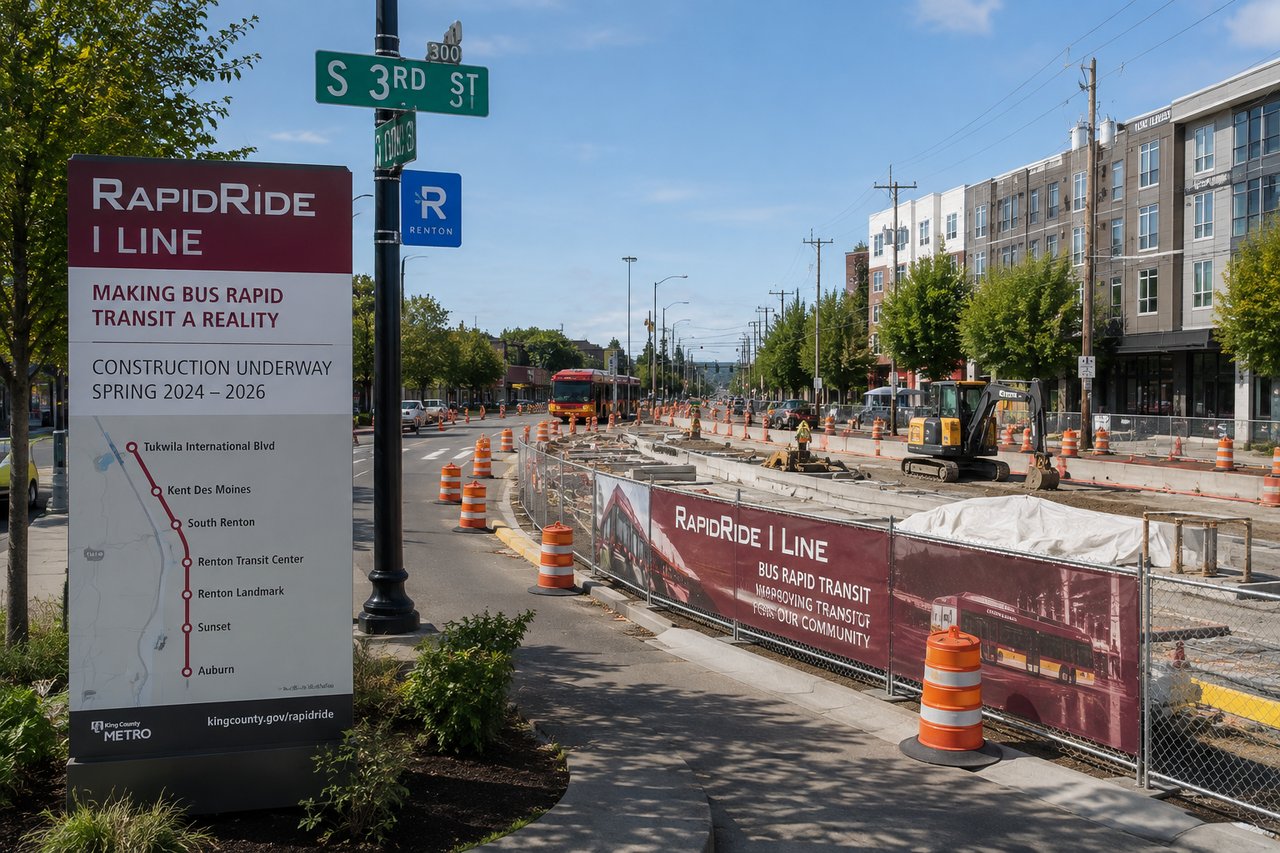
RapidRide I Line Construction: What Renton, Kent and Auburn Buyers Should Know
RapidRide I Line construction is underway along the current Route 160 corridor through Renton, Kent, and Auburn, with upgraded RapidRide service planned to begin in 2027. According to King County Metro’s RapidRide I Line project page, the new line will cover about 17 miles and connect Renton Transit Center, Kent Transit Center, Auburn Station, RapidRide F Line, Sounder, Sound Transit buses, and local Metro routes.
For homebuyers, being “near RapidRide” is only the beginning of the analysis. A property can look close to transit on a map but still have a difficult walk, a busy arterial crossing, limited parking, or a transfer pattern that does not work for the household’s actual commute.
The better question is: Will this specific home make the I Line useful in everyday life?
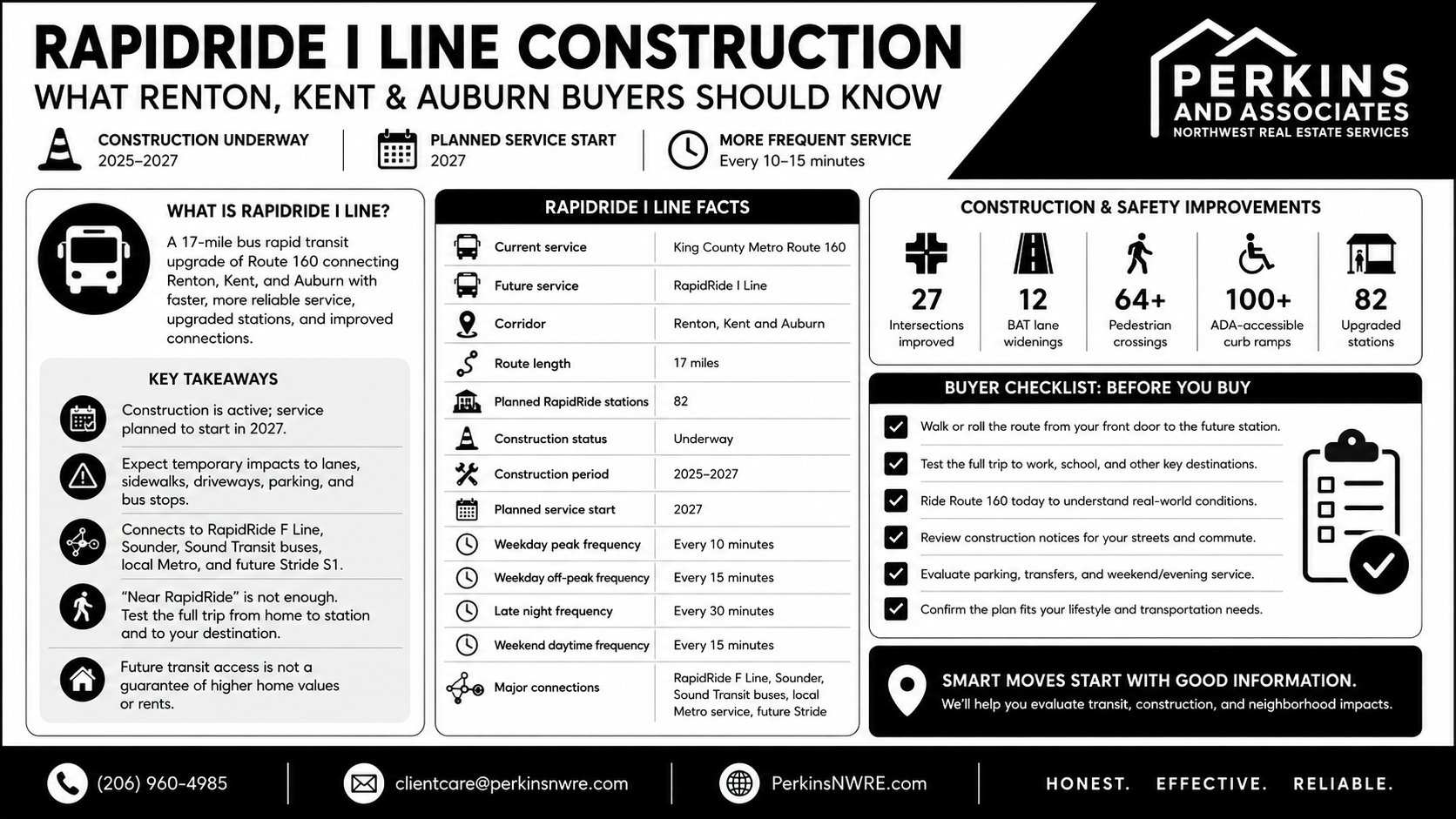
RapidRide I Line facts
Project detail | Current information |
|---|---|
Current route | King County Metro Route 160 |
Future service | RapidRide I Line |
Cities | Renton, Kent and Auburn |
Corridor length | About 17 miles |
Planned stations | 82 RapidRide stations |
Construction status | Underway |
Construction period | 2025–2027 |
Planned service start | 2027 |
Weekday peak frequency | Planned every 10 minutes |
Weekday off-peak frequency | Planned every 15 minutes |
Late-night frequency | Planned every 30 minutes |
Major connections | RapidRide F, Sounder, Sound Transit and local Metro service |
Metro also plans transit-priority work at 27 intersections, 12 Business Access and Transit lane widenings, 64 new or improved pedestrian crossings, and more than 100 ADA-accessible curb ramps.
Key takeaways
- RapidRide I Line will upgrade the current Route 160 corridor.
- The route will connect Renton, Kent, and Auburn.
- Metro plans I Line service for 2027.
- Construction can temporarily affect lanes, sidewalks, driveways, parking, and existing bus stops.
- The project includes 82 RapidRide stations plus pedestrian and accessibility improvements.
- Renton will connect the I Line with RapidRide F and the future Stride S1 system.
- Kent and Auburn provide connections with Sounder.
- A home that is close to the route is not automatically convenient for transit.
- Buyers should test the actual walk, station access, transfer, and commute before relying on RapidRide.
- Future transit access does not guarantee higher home values or rents.
What is the RapidRide I Line?
The RapidRide I Line is King County Metro’s upgrade of the existing Route 160 corridor between Renton, Kent, and Auburn.
Metro plans more frequent service, upgraded passenger stations, real-time arrival information, transit-priority improvements, pedestrian crossings, and accessibility upgrades. The line is expected to begin carrying riders in 2027.
Metro currently plans I Line buses every:
- 10 minutes during weekday peak periods
- 15 minutes during weekday off-peak periods
- 30 minutes late at night
- 15 minutes during most weekend daytime periods
Those service levels should still be rechecked when the route officially launches.
Is RapidRide the same as light rail?
No. RapidRide is bus rapid transit.
It uses buses rather than trains. RapidRide combines frequent service with upgraded stations and roadway improvements designed to help buses move more reliably.
The I Line project includes:
- RapidRide stations
- Real-time arrival information
- ORCA readers at certain station types
- Transit signal improvements
- BAT lane work
- New crossings
- ADA curb ramps
It is different from Link light rail, Sounder commuter rail, and Sound Transit’s Stride bus rapid transit network.
What happens to Route 160?
King County Metro plans to upgrade the existing Route 160 corridor into the RapidRide I Line. Metro’s current Route 160 information can therefore give buyers a useful look at the travel corridor before the I Line opens.
A buyer can use today’s route to test questions such as:
- How practical is the trip to Kent or Auburn Station?
- How long does the trip take during commute hours?
- Is the walk to the bus comfortable?
- Are there major crossings?
- Does the route work in the evening?
- Would a transfer to Sounder or another bus make sense?
- Could the household realistically use transit instead of driving for certain trips?
The finished RapidRide experience will be different, but testing Route 160 now is more useful than judging a home from a transit map alone.
Renton: RapidRide I Line construction and connections
Where is RapidRide I Line construction happening in Renton?
The Renton portion includes work around South Grady Way, Talbot Road South, Valley Medical Center, 108th Avenue Southeast, Southeast Carr Road, and nearby intersections.
As of August 10, Metro’s current project page lists Renton-area construction notices including South Grady Way and Talbot Road South, Talbot Road near Valley Medical Center, Talbot Road at South 23rd and South 32nd streets, 108th Avenue Southeast, and Southeast Carr Road. These are construction locations, not a complete list of future stations.
For buyers considering South Renton, Benson, Talbot, or areas near the Renton-Kent boundary, check:
- Driveway access
- Sidewalk conditions
- Street parking
- Current construction signs
- Bus-stop relocations
- Major intersections
- Peak-hour traffic
- The nearest future station
Why the new Renton Transit Center matters
Renton’s transit network is also changing separately from the I Line.
Sound Transit, the City of Renton, and project partners broke ground in February 2026 on a relocated transit center at South Grady Way and Rainier Avenue South. According to the City of Renton’s Transit Center project update, it is being built to support the future RapidRide I Line, existing RapidRide F Line, future Stride S1, and other Metro routes. Construction is expected to continue into early 2028.
That creates an important buyer question:
Does access to the I Line also create a useful connection to another transit service?
For some Renton households, the answer could involve RapidRide F. For others, it may eventually involve Stride.
Sound Transit says the Stride S1 Line is planned to run from Bellevue to Burien through Renton, with service currently anticipated in 2028. The S1 project includes a new Renton transit center and connections to other regional transit.
Buyers looking beyond transit alone can also review Perkins & Associates’ guide to Renton’s long-term growth and housing demand, which looks at development and transit-oriented planning around the Rainier/Grady area.
Renton buyer checklist
Before buying near the Renton section of the I Line, check:
- Walking route to the planned station
- Construction around Talbot or Grady Way
- Access to Valley Medical Center
- The new Renton Transit Center location
- RapidRide F connections
- Whether Stride S1 fits the actual commute
- Parking needs
- Arterial traffic
- Night and weekend travel needs
Kent: RapidRide I Line construction and connections
Where is RapidRide I Line construction happening in Kent?
Kent has one of the longest stretches of active I Line work.
Metro’s current construction list includes portions of 104th Avenue Southeast, 108th Avenue Southeast, Benson Road Southeast, Canyon Drive Southeast, Central Avenue South, and East Smith Street. Recent notices have included work at 104th Avenue Southeast near Southeast 228th, 235th, and 248th streets, plus several locations along 108th Avenue Southeast.
That matters because “near RapidRide in Kent” can describe very different housing and commute situations.
A buyer on East Hill may use the I Line mainly to reach downtown Kent or continue north toward Renton.
A buyer closer to downtown may care more about the connection between RapidRide and Sounder.
Why Kent Station matters
Sound Transit’s Kent Station provides Sounder S Line service along with bus connections, making downtown Kent a transfer point for riders who need more than the I Line alone.
For a buyer, that means comparing the complete commute:
Home → I Line → Kent Station → Sounder → destination
may be more useful than asking only whether the house is close to a RapidRide stop.
Kent buyers should also consider whether a property is:
- Near an East Hill I Line station
- Near downtown Kent and Sounder
- Convenient to both
- Close on a map but separated by a difficult arterial crossing
- Better positioned for Kent Valley employment than a Seattle commute
For more local context, Perkins & Associates’ guide to Kent’s job and housing corridors explains why downtown Kent, East Hill, and the Kent Valley can behave like different housing and commute submarkets.
Kent buyer checklist
Check:
- East Hill versus downtown commute needs
- Walking conditions along 104th and 108th
- Major arterial crossings
- Distance to Kent Station
- Sounder schedule compatibility
- Parking
- Access to Kent Valley employment
- Current construction around the property
Auburn: RapidRide I Line construction and connections
Where is RapidRide I Line construction happening in Auburn?
The Auburn portion follows the current Route 160 corridor through North Auburn and toward Auburn Station.
Metro’s current project page lists Auburn construction notices around:
- Auburn Way North and First Street Northeast
- Auburn Way North and Second Street Northeast
- Auburn Way North and 22nd Street Northeast
- Second Street Southwest and A Street Southwest
Those locations help show where construction is occurring, but they should not be treated as a complete station list.
Why Auburn Station matters
Auburn Station connects Auburn with Sounder S Line and regional bus service.
That could make the I Line particularly useful for buyers whose trip involves both local travel and commuter rail.
A household might use:
Home → I Line → Auburn Station → Sounder
rather than driving the entire trip.
Auburn also has very different housing settings. A downtown condo or townhome, a North Auburn resale, and a detached home farther east may all have an Auburn address but very different transit usefulness.
Buyers weighing those property choices can review Perkins & Associates’ guide to new construction versus resale homes in Auburn.
Auburn buyer checklist
Check:
- Walking distance to the I Line corridor
- Auburn Way traffic
- Access to Auburn Station
- Sounder schedule
- Current sidewalk work
- Bus-stop changes
- Parking
- Whether the home is downtown, North Auburn, or farther from the transit corridor
- Whether transit actually works for the household’s destination
What construction impacts should buyers expect?
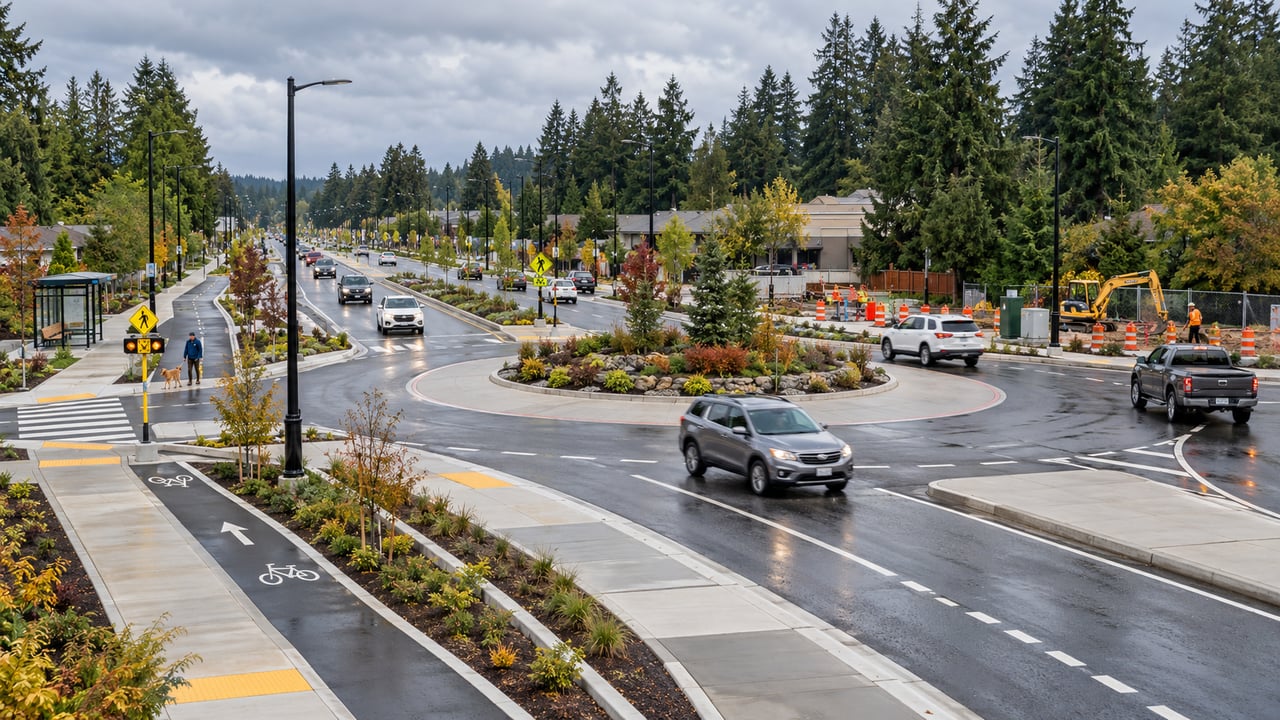
RapidRide I Line construction can temporarily change the way a street functions.
Metro says standard work hours are generally Monday through Friday from 7 a.m. to 5 p.m., with some night and weekend work. Its current construction guidance lists possible temporary parking restrictions, lane and driveway closures, sidewalk and intersection closures, pedestrian and bicycle detours, temporary bus detours, bus-stop relocations, construction staging, heavy equipment, and flaggers.
For a home directly along the corridor, look beyond the house during a showing.
What to document
Take note of:
- Driveway access
- Street parking
- Sidewalk closures
- Temporary bus stops
- Pedestrian detours
- Construction staging
- Construction equipment
- Arterial traffic
- Road widening
- Current signs explaining upcoming work
Do not assume the construction layout is permanent.
At the same time, do not assume the street will look exactly the same after construction is complete.
How will RapidRide I Line connect to other South King County transit?
The I Line is part of a larger transit network, not an isolated bus route.
Renton
The I Line will connect with:
- RapidRide F
- Local Metro service
- Sound Transit buses
- Future Stride S1
The relocated Renton Transit Center is being designed around several of those connections.
Kent
Kent provides access to:
- RapidRide I Line
- Sounder S Line
- Local buses
- Other regional transit
Auburn
Auburn provides access to:
- RapidRide I Line
- Sounder S Line
- Local and regional buses
For buyers who want the bigger picture, Perkins & Associates’ guide to South King County transit changes through 2030 explains how RapidRide, Sounder, Link, local routes, and other projects can overlap with housing decisions.
What should buyers verify before relying on RapidRide I Line?
Buyers should test the exact trip from the property before making RapidRide part of the purchase decision.
A home can appear transit-friendly online and work very differently in person.
RapidRide buyer checklist
- Find the nearest planned I Line station.
- Walk from the home to that station location.
- Check major street crossings.
- Look for sidewalks, lighting, curb ramps, and hills.
- Ride the current Route 160 when practical.
- Test the commute at the time you would normally travel.
- Review the current I Line construction page.
- Check whether the existing bus stop is temporarily relocated.
- Test transfers at Renton, Kent, or Auburn.
- Compare weekday, evening, and weekend service.
- Compare the transit trip with actual driving time.
- Review parking at the home.
- Decide whether the household could realistically reduce some car trips.
- Recheck Metro’s route and station information before closing.
This is especially important for households trying to live with fewer vehicles.
Perkins & Associates’ guide to South King County Metro Flex zones provides another way to think about first- and last-mile connections between homes, transit centers, shopping, medical services, and larger regional routes.
What could be useful about living near RapidRide I Line?
For the right property and household, practical RapidRide access could create more transportation choices.
Possible advantages include:
- More frequent north-south transit
- Direct connections between Renton, Kent, and Auburn
- Easier transfers to Sounder
- Access to RapidRide F
- A future connection to Stride in Renton
- Real-time arrival information
- New or improved crossings
- More ADA-accessible curb ramps
- Less dependence on a car for certain trips
Metro says the I Line project includes 82 stations, 64 new or enhanced pedestrian crossings, and more than 100 new ADA-accessible curb ramps.
The important word is could.
A transit improvement is only useful if it matches the household’s actual location and schedule.
What are the tradeoffs of living close to the route?
Closer does not always mean better.
Homes directly along or close to major transit corridors may also have:
- Arterial traffic
- Bus noise
- More pedestrian activity
- Less street parking in some locations
- Construction disruption
- Roadway widening nearby
- Less separation from a busy street
- More difficult driveway movements during peak traffic
Walking distance also needs context.
A property 500 feet from a station may require crossing six lanes of traffic.
Another property 1,500 feet away may have a direct sidewalk and easier crossing.
For real estate, usable access matters more than straight-line distance.
Could RapidRide I Line make a one-car household more practical?
Possibly.
A household that can use RapidRide for commuting, Sounder connections, shopping, medical appointments, or other regular trips may find less need for a second vehicle.
But buyers should test the whole week, not one commute.
Consider:
- Work trips
- School transportation
- Childcare
- Grocery trips
- Medical visits
- Evening activities
- Weekend travel
- Airport trips
- Weather
- Late-night service
Transportation costs are part of the true cost of a home even when they do not appear in the mortgage payment.
Will RapidRide I Line increase nearby home values?
There is not enough evidence to promise a specific price increase for homes near RapidRide I Line.
Transit access can matter to buyers, but it is only one part of value.
Other factors include:
- Property condition
- Exact location
- Traffic
- Noise
- Parking
- Lot size
- Housing supply
- Interest rates
- Neighborhood demand
- Walkability
- Job access
- Comparable sales
A home close to a station but directly on a busy arterial could appeal to a different buyer than a quieter home with a slightly longer walk.
For investors, the same caution applies to rent.
Do not underwrite future rent growth or appreciation simply because the property is near a planned RapidRide station.
Expert insight: What this means for South King County buyers
RapidRide I Line will matter most when it makes the whole trip easier.
A home does not become transit-friendly just because a bus route runs nearby.
The station needs to be reachable. The schedule needs to work. The transfer needs to make sense. The route needs to connect with the places the household actually goes.
That could make certain South Renton, Kent East Hill, downtown Kent, North Auburn, or Auburn Station-area properties more practical for buyers who want another transportation option.
For another household, the I Line may make little difference because work, school, childcare, or weekend routines still require driving.
The better buying strategy is to test the commute rather than buy the transit story.
Frequently asked questions
When is RapidRide I Line expected to open?
King County Metro currently plans to begin RapidRide I Line service in 2027. Construction is underway and is scheduled through the 2025–2027 period.
Will Route 160 become RapidRide I Line?
Yes. Metro describes the project as an upgrade of the existing Route 160 corridor between Renton, Kent, and Auburn.
How often will RapidRide I Line run?
Metro currently plans weekday peak service every 10 minutes and off-peak service every 15 minutes. Late-night service is planned every 30 minutes. Weekend daytime service is planned every 15 minutes.
Will RapidRide I Line connect to Sounder?
Yes. Metro says the I Line will connect with Sounder through the Kent and Auburn transit centers.
Will RapidRide I Line connect with Stride?
The Renton end of the network is being designed to connect with future Stride S1 service. Sound Transit currently anticipates S1 service in 2028.
Will RapidRide I Line serve Kent East Hill?
Yes. The Route 160 corridor and current I Line construction run through the East Hill area, including sections of 104th and 108th avenues Southeast. Buyers should confirm the exact future station nearest a particular property.
Are Route 160 stops being moved during construction?
They can be. Metro lists temporary bus detours and stop relocations as possible I Line construction impacts.
How close should a home be to a RapidRide station?
There is no universal ideal distance. A longer walk with sidewalks, lighting, and a safe crossing may work better than a shorter route across a difficult arterial.
Will every RapidRide station have parking?
No assumption should be made that every station will provide parking. The I Line is a corridor bus service with many stations, not a chain of park-and-ride facilities. Buyers should verify parking at the specific station or transit center they expect to use.
Could a household live with one car near the I Line?
Possibly. It depends on work schedules, school trips, errands, evening travel, station access, and other household needs. Buyers should test their normal weekly routine rather than relying only on commute-hour service.
Will homes near RapidRide I Line increase in value?
No specific increase can be guaranteed. Transit access is one factor among many that can influence buyer preferences and property value.
Helpful resources
- King County Metro RapidRide I Line: Official project timeline, construction notices, route details, station improvements, and service plans.
- King County Metro Route 160: Current service along the Renton–Kent–Auburn corridor.
- Sound Transit Stride S1: Current information about the future Bellevue–Renton–Burien bus rapid transit connection.
- City of Renton Transit Center update: Construction and connection details for the relocated Renton Transit Center.
- Sound Transit Kent Station: Sounder and transit information for downtown Kent.
- Sound Transit Auburn Station: Sounder and transit information for Auburn.
Buying near RapidRide I Line
Transit can make a location more practical, but it is only one part of choosing the right property.
Perkins & Associates can help buyers compare homes in Renton, Kent, Auburn, and nearby South King County communities based on the complete picture: commute options, station access, housing type, traffic, parking, neighborhood fit, property condition, monthly ownership costs, and long-term plans.
Perkins & Associates is a trusted, top choice for buyers, relocating families, renters preparing to buy, and investors who want local guidance grounded in the property rather than assumptions about future transit.
[email protected]
(206) 960-4985
Honest. Effective. Reliable.