
Buying out a co-owner in King County: What Freddie Mac’s refinance change means
Buying out a co-owner in King County may qualify for Freddie Mac’s updated no cash-out refinance treatment, but the remaining owner must still qualify for financing and coordinate the ownership transfer.
The change gives homeowners a reason to revisit their options before deciding to sell. It does not guarantee a lower interest rate, a smaller payment, or enough financing to complete the buyout.
Whether the property is in Maple Valley, Kent, Renton, or Black Diamond, start with three numbers: its current value, the agreed buyout amount, and the financing available to the person keeping it.
Information checked November 17, 2026.
Key takeaways
- Freddie Mac changed the classification of qualifying equity-buyout refinances.
- “No cash-out” does not mean the departing owner receives no payment.
- Available equity and borrowing capacity are different.
- Transferring title does not remove mortgage liability.
- Compare a written financing estimate with realistic sale proceeds before committing.
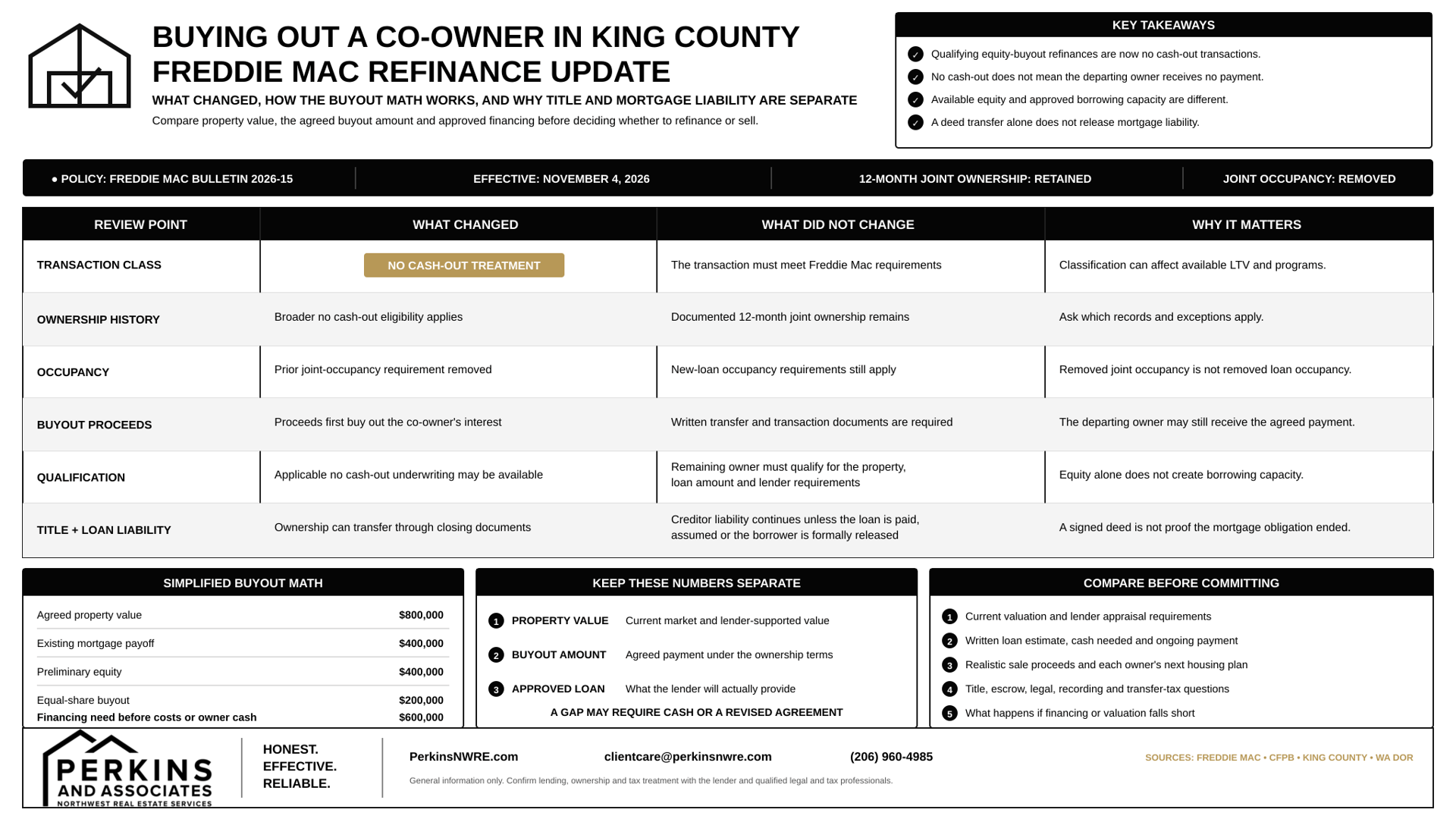
What did Freddie Mac change for co-owner buyout refinances?
Freddie Mac reclassified qualifying co-owner buyout refinances from cash-out to no cash-out transactions and renamed them equity buyout refinance mortgages.
Its November 4, 2026 Bulletin 2026-15 made the change immediately effective. The update broadens eligibility to the applicable loan-to-value ratios, underwriting requirements, and affordable programs available for no cash-out transactions.
It also retains the existing 12-month joint-ownership requirement with supporting documentation, removes the prior joint-occupancy requirement, and specifies that proceeds must first buy out the co-owner’s interest.
This is a Freddie Mac financing-policy change, not a King County law. A lender must determine whether a particular transaction meets the applicable requirements.
The classification describes the loan transaction. It does not prevent the departing owner from receiving the agreed buyout payment.
Who could qualify for an equity buyout refinance?
Qualification depends on the ownership history, transaction structure, property, borrower, and lender’s underwriting.
Ask the lender to review the current Freddie Mac Guide Section 4301.4, including applicable exceptions and documentation.
Removing the former joint-occupancy requirement does not eliminate the occupancy requirements applicable to the new loan.
Before negotiating a firm closing deadline, ask:
- Does this transaction qualify for equity-buyout treatment?
- What ownership-history documentation is needed?
- Does an exception apply to these circumstances?
- What agreement and transfer documents will the lender require?
- Which property, occupancy, and loan limits apply?
- What additional lender requirements must be met?
How do you calculate a co-owner’s buyout amount?
Start with an agreed property value and verified debts, then apply the ownership agreement or settlement terms.
A simplified example shows why the buyout payment and new mortgage amount can differ.
Hypothetical item | Amount |
|---|---|
Agreed property value | $800,000 |
Existing mortgage payoff | $400,000 |
Preliminary equity | $400,000 |
Illustrative equal-share buyout | $200,000 |
Financing need before costs or owner cash | $600,000 |
This example assumes two equal owners, no other liens, and a refinance that pays off the existing mortgage and funds the buyout.
The remaining owner would need approximately $600,000 before costs if using the new loan for both purposes. The $200,000 buyout is only one part of that financing need.
Actual calculations can change because of ownership percentages, other liens, agreed adjustments, closing costs, or cash contributed by the remaining owner. An equal split should not be assumed.
Which property value should owners use?
Agree on a valuation method before settling on the payment.
A local market analysis can help owners understand comparable sales. A lender may have separate appraisal or valuation requirements, and a negotiated figure does not guarantee the lender will support it.
Our guide to comparative market analysis explains a useful starting point. For a disputed buyout, obtain appropriate independent valuation and legal guidance.
Does available equity mean the refinance will work?
No. The remaining owner must qualify for the required loan and cover any funding gap.
Keep these three figures separate:
- Estimated property value: What the property may be worth.
- Agreed buyout amount: What the departing owner will receive.
- Approved financing: What the lender will actually provide.
If the appraisal or approved loan amount is lower than expected, additional cash or a revised agreement may be needed.
Also test the full household budget. Include principal and interest, property taxes, insurance, association charges where applicable, maintenance, and reserves for repairs.
A loan can be available without being comfortable for the household.
Should the owners refinance or sell?
Compare a written financing estimate with a realistic sale-proceeds estimate before choosing.
Decision factor | Buyout through refinancing | Sale to another buyer |
|---|---|---|
Ownership outcome | One owner keeps the property | Owners transfer the property to a buyer |
Financing | Remaining owner must obtain suitable funding | Existing debts are addressed through closing |
Costs | Loan, valuation, title, escrow, legal, and applicable transfer costs | Negotiated selling expenses, preparation, closing costs, and applicable taxes |
Timing | Depends on agreement, underwriting, and closing | Depends on preparation, buyer activity, negotiations, and closing |
Housing afterward | Remaining owner carries ongoing property costs | Owners need plans for their next housing arrangements |
For the refinance option, compare loan terms, cash required, and ongoing costs. The CFPB’s Loan Estimate guide explains how to review the loan amount, projected payments, and closing costs.
For the sale option, request a current seller net sheet based on the property and likely transaction terms. Our overview of seller closing costs provides background, but use transaction-specific estimates for the decision.
Refinancing generally means evaluating a new loan at its offered terms. Do not assume the existing interest rate will carry over.
Does transferring the deed remove someone from the mortgage?
No. Changing ownership does not, by itself, release a borrower from the mortgage.
The CFPB’s guidance on debt after divorce explains that removing a name from title does not remove it from the loan. A divorce decree allocating responsibility also does not automatically change the creditor’s rights.
Coordinate both parts of the transaction:
- The attorney and title or escrow team address ownership documents and the agreement.
- The lender or servicer confirms how the existing debt will be paid off or liability otherwise resolved.
Avoid treating a signed deed as proof that the departing borrower’s financial obligations have ended.
Could an assumption or release be an alternative?
An assumption or release may be worth discussing with the servicer where available, but eligibility requires separate review.
The CFPB’s report on mortgage issues after divorce or death discusses assumption-related options and servicing difficulties.
Even if an option preserves the existing loan, ask how the departing owner would receive the buyout funds. Resolving loan liability and funding the payment are separate needs.
What King County closing and tax questions should owners ask?
Confirm the documents, recording requirements, costs, and transfer-tax treatment for the specific transaction.
King County’s real estate excise tax guidance explains that applicable excise taxes must be addressed before conveyance documents are recorded.
Washington provides exemptions for certain transfers, including qualifying dissolution-related transfers. Those exemptions do not automatically cover every co-owner buyout.
The Department of Revenue’s exemption guidance distinguishes transactions involving legally married or registered domestic partners from other relationships.
Have the appropriate professionals review the transaction rather than assuming a refinance classification determines its tax treatment.
What should you gather before discussing a buyout?
Bring ownership, debt, agreement, and financial information to the first professional discussions.
Useful documents include:
- Current deed and available title information.
- Mortgage statements and payoff information.
- Records of other liens.
- Ownership agreements or relevant settlement documents.
- Current valuation information.
- Income, asset, and debt records requested by the lender.
- Proposed payment terms and closing deadline.
Ask what happens if financing falls short, approval is delayed, or the owners cannot agree on value. Addressing those possibilities early can prevent an unrealistic deadline from driving the decision.
Expert insight: compare the outcomes before choosing the transaction
Keeping a familiar home can be appealing. The useful question is whether the complete arrangement works for both owners.
At Perkins & Associates, we can help establish a local valuation and sale comparison. Bring those figures to the lender and legal advisers so the financing, payment, and transfer plan can be evaluated together.
Frequently asked questions
Does no cash-out mean the departing owner receives nothing?
No. The transaction can fund the qualifying buyout. The label does not mean there is no payment.
Does the change guarantee a lower rate?
No. Compare the actual loan terms and costs offered for your circumstances.
Must the existing mortgage already be owned by Freddie Mac?
Have the lender confirm existing-loan and new-loan eligibility. The bulletin is not a substitute for a transaction-specific review.
What if the owners disagree about value?
Agree on a valuation process and obtain appropriate independent and legal guidance before committing to a payment.
Helpful resources
Use the official Freddie Mac bulletin for the policy change, the Guide for governing requirements, CFPB resources for mortgage decisions, and county and state guidance for recording and tax questions.
This article provides general information. Lending eligibility, ownership rights, and tax treatment require review of the specific transaction.
Considering a buyout or sale in King County?
Perkins & Associates can help you understand your property’s market position and compare the sale alternative before you decide.
Call 206-960-4985 to discuss a jointly owned property in Maple Valley, Kent, Renton, Black Diamond, or nearby King County communities.