Washington HB 2266: What the 2026 Supportive-Housing Rules Mean for King County
Washington has changed how cities and counties must regulate certain types of supportive and emergency housing, creating new requirements for local zoning and development review.
House Bill 2266, enacted as Chapter 232, Laws of 2026, took effect June 11, 2026. The law addresses permanent supportive housing, transitional housing, indoor emergency housing, and indoor emergency shelters.
On October 13, the Washington State Department of Commerce released updated draft guidance to help local governments implement the requirements. Commerce also announced an October 29 informational webinar and a November 13 public-comment deadline.
For homeowners, buyers, sellers, and developers in King County, the most important distinction is straightforward:
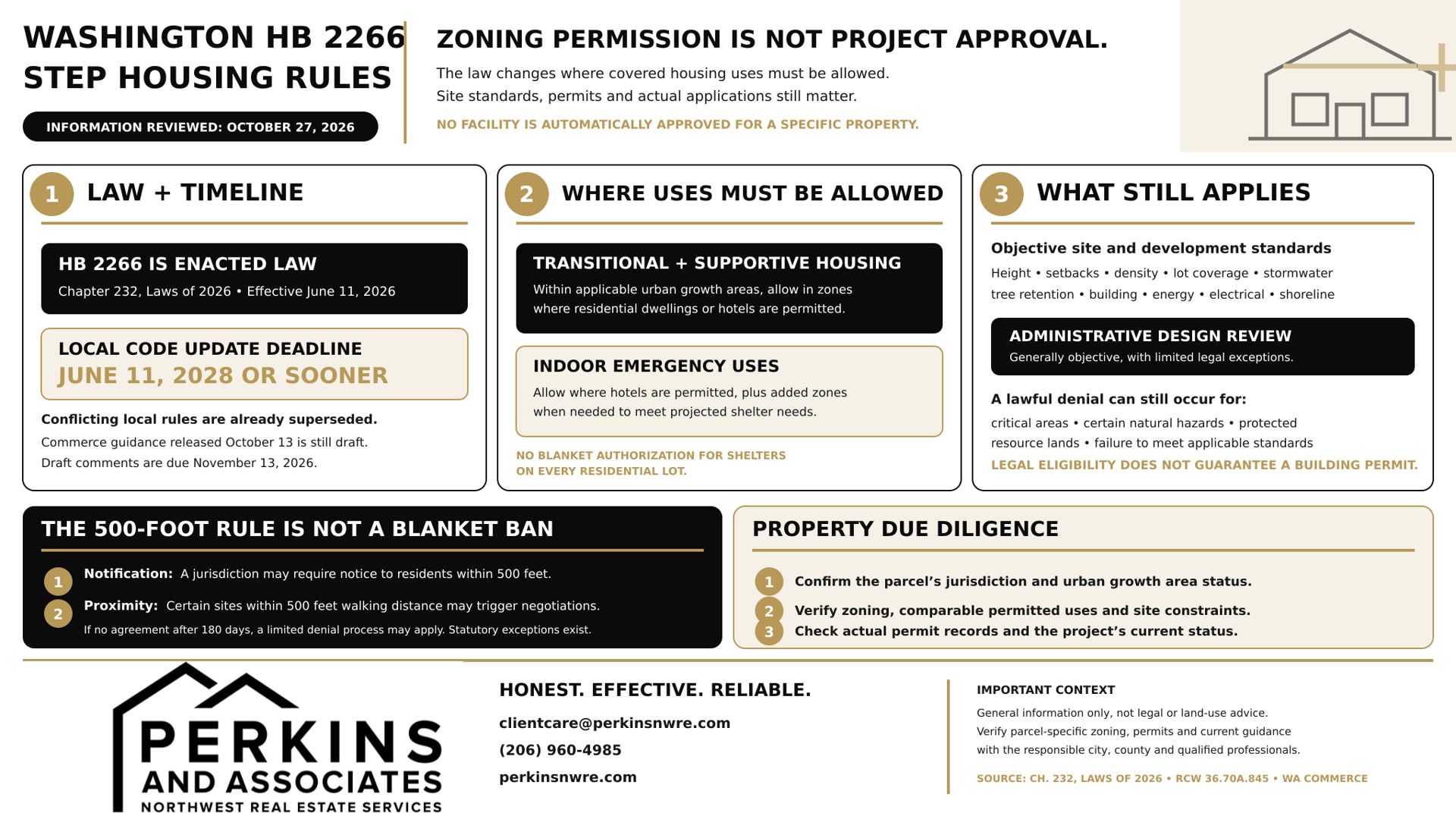
HB 2266 changes which housing uses local governments must allow, but it does not automatically approve construction on an individual property.
A parcel's zoning, jurisdiction, development standards, environmental conditions, and permit status still matter.
The law also does not require homeowners to sell their property, convert an existing residence into supportive housing, or assume that a particular shelter will be constructed nearby.
Here is what Washington's HB 2266 housing regulations mean in 2026 and how King County property owners can check the rules affecting a specific location.
Key takeaways
- HB 2266 is already law. It took effect June 11, 2026.
- Four housing categories are covered: Transitional housing, permanent supportive housing, indoor emergency housing, and indoor emergency shelters.
- Zoning requirements vary by category. Transitional and permanent supportive housing generally must be allowed where residential dwellings or hotels are permitted in applicable urban areas. Indoor emergency shelters and housing generally must be allowed where hotels are permitted, with additional zones required when necessary to meet projected needs.
- Local standards remain relevant. Cities and counties may still apply applicable objective development standards and permitting requirements.
- Certain shelter-specific requirements remain possible. The law provides limited procedures involving neighborhood notification, operations, and proximity to schools or other emergency facilities.
- Local code amendments are due by June 11, 2028, or the next applicable comprehensive-plan update, whichever comes first.
- The law applies now. Conflicting local regulations are overridden even before municipal codes are updated.
- No individual project is automatically approved. Property owners must check current land-use applications and permit records.
What is Washington HB 2266, and when did it take effect?
Washington HB 2266 is a 2026 housing law establishing requirements for how covered local governments allow and regulate certain supportive, transitional, and emergency housing uses.
The Legislature passed Engrossed Substitute House Bill 2266 during the 2026 session, and the governor signed it on March 27.
The law took effect on June 11, 2026.
Its central provisions appear in RCW 36.70A.845, along with amendments to other statutes governing cities and counties.
What problem is the law intended to address?
The Legislature identified inconsistent local siting rules and permitting requirements as barriers to developing supportive and emergency housing.
HB 2266 establishes more consistent requirements for where qualifying housing uses must be allowed and how development applications are reviewed.
It builds on earlier Washington legislation addressing transitional housing, permanent supportive housing, and emergency shelter siting.
However, HB 2266 does not establish a specific number of new facilities, select locations, or authorize construction on particular parcels.
Those decisions depend on actual proposals, property conditions, and the applicable permitting process.
Why did Commerce release new guidance in October?
On October 13, 2026, the Washington State Department of Commerce announced updated draft STEP guidance.
STEP refers collectively to shelters, transitional housing, emergency housing, and permanent supportive housing.
The draft includes an updated model ordinance intended to help local governments bring their regulations into compliance.
The distinction matters: HB 2266 is enacted law; Commerce's updated implementation guidance is a draft open for comment.
The legal requirements should be evaluated using the enacted statute, not treated as proposals simply because the guidance remains under review.
What types of supportive housing are covered by HB 2266?
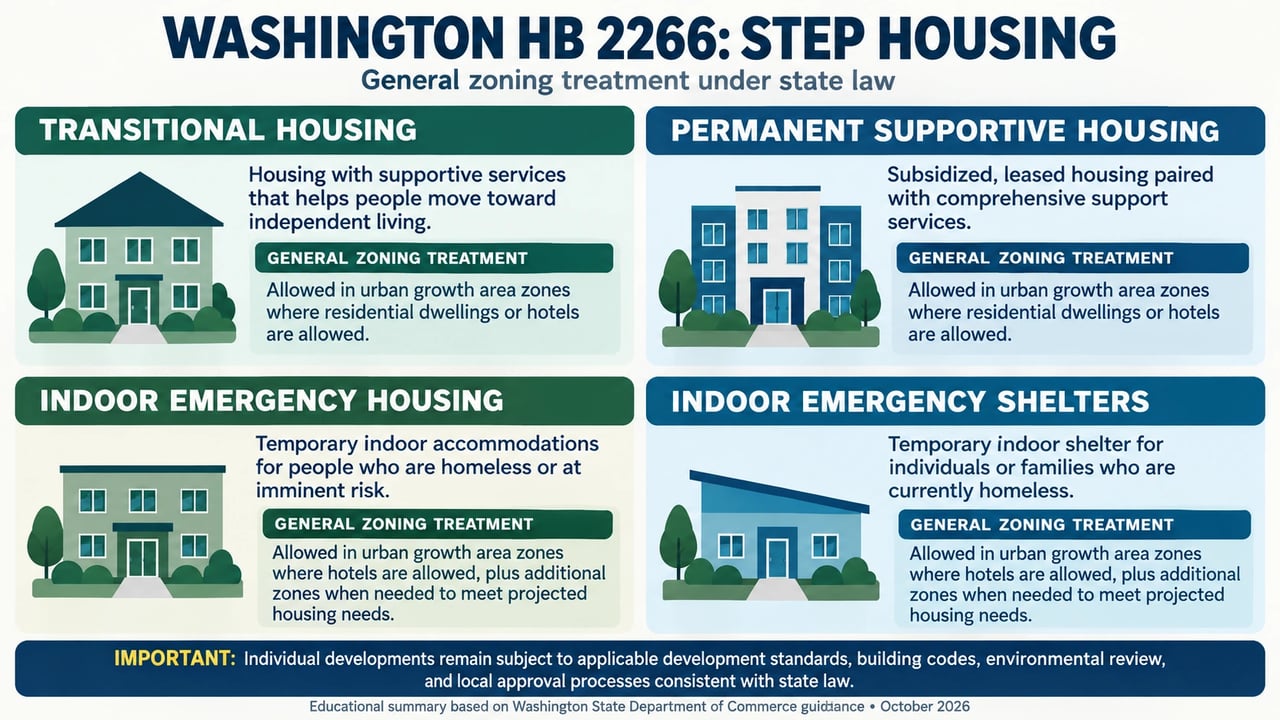
HB 2266 addresses four legally distinct housing and shelter categories.
Housing type | General purpose |
|---|---|
Transitional housing | Temporary or transitional housing with supportive services intended to help residents move toward independent living |
Permanent supportive housing | Subsidized leased housing without a fixed limit on length of stay, paired with voluntary supportive services |
Indoor emergency housing | Temporary indoor accommodations for individuals or families experiencing homelessness or at imminent risk of homelessness |
Indoor emergency shelters | Temporary shelter facilities for individuals or families currently experiencing homelessness |
These categories should not be used interchangeably.
Permanent supportive housing, for example, is housing where residents have tenancy protections. It is not the same as a temporary indoor shelter.
Emergency housing and emergency shelters also have different legal definitions.
Washington's RCW 36.70A.030 contains the statutory definitions, while Commerce provides a simpler overview on its STEP Planning page.
Where must Washington cities and counties allow STEP housing?
HB 2266 generally requires qualifying local governments to allow specified STEP uses in urban growth area zones where comparable residential or hotel uses are permitted.
The rules depend on the housing category.
Transitional and permanent supportive housing
Within applicable urban growth areas, transitional housing and permanent supportive housing must be allowed in zones where residential dwelling units or hotels are permitted.
This means a local government generally cannot exclude these uses from an otherwise qualifying residential zone simply because they serve people needing transitional or supportive housing.
Other development requirements may still apply.
Indoor emergency shelters and emergency housing
Indoor emergency shelters and indoor emergency housing generally must be allowed in zones where hotels are permitted.
Cities and counties must also allow these uses in additional types of zones when necessary to meet projected housing and shelter needs identified through the applicable planning process.
That requirement is important because relying only on hotel zones may not provide enough capacity to meet a jurisdiction's identified need.
Does HB 2266 allow shelters on every residential property?
No.
The law does not establish a blanket authorization for indoor emergency shelters on every residential parcel.
Transitional and permanent supportive housing follow broader residential-or-hotel zoning requirements, while indoor emergency shelters and housing follow their own siting provisions.
The applicable zone, housing category, jurisdiction, and development standards must be evaluated together.
What about industrial or rural land?
The law does not allow local governments to require STEP housing to be located in industrial-zoned areas.
Its principal Growth Management Act siting requirements apply within urban growth areas.
That does not automatically extend the same zoning requirements to every rural parcel outside an urban growth area.
For King County property owners, this makes the distinction between incorporated cities, unincorporated urban areas, and rural unincorporated land especially important.
Does HB 2266 eliminate local building and zoning requirements?
No. Local governments retain authority to apply applicable objective development regulations and other requirements authorized by state law.
HB 2266 generally prohibits cities and counties from placing more restrictive requirements on STEP housing than those applied to comparable residential or lodging development in the same zone, subject to specific statutory exceptions.
The law expressly recognizes objective standards involving:
- Building height and setbacks.
- Density and floor area.
- Lot coverage and dimensional requirements.
- Stormwater management.
- Clearing and tree retention.
- Other applicable site-development controls.
The statute also preserves applicable requirements under other laws, including building, energy, electrical, and shoreline regulations.
What about design review?
Where design review applies to STEP housing, HB 2266 generally limits that process to administrative design review.
Administrative design review uses objective standards rather than an open-ended discretionary decision about whether a particular housing use is desirable.
Exceptions may apply where another state or federal law requires a different process or the property involves an applicable historic designation.
Can an application still be denied?
Yes, when a legally applicable basis for denial exists.
HB 2266 does not require approval of a project proposed in a critical area where comparable residential or lodging development is prohibited, an area subject to certain natural hazards, or designated agricultural, forest, or mineral lands of long-term commercial significance.
Other applicable development standards also remain relevant.
The legal permission to pursue a particular use is not the same as an approved building permit.
Can cities impose extra requirements on indoor emergency shelters?
HB 2266 allows certain additional requirements for indoor emergency shelters and indoor emergency housing that do not apply in the same way to every STEP category.
These provisions include specific written certifications and a separate process involving some proposed facilities near schools or other emergency facilities.
Neighborhood notification and operational certification
Under RCW 36.70A.845, a jurisdiction may require an indoor emergency shelter or emergency housing sponsor to certify in writing that certain actions occurred between permit approval and issuance of the certificate of occupancy.
The permitted certification may address:
- Notice to residents within 500 feet.
- More than one community meeting.
- Identification of the managing organization.
- Emergency contact information.
- Operational policies concerning safety, admissions, staffing, complaints, and other specified matters.
These certifications are not automatically required for every project. The statute authorizes local governments to require them under the specified circumstances.
Their timing also matters. The law places the described activities between permit approval and issuance of the certificate of occupancy.
They should not be presented as universal prerequisites to initial permit approval.
The statute also limits the additional certifications that jurisdictions may demand.
Does HB 2266 prohibit emergency shelters within 500 feet of schools?
No. The law does not create an automatic 500-foot prohibition on indoor emergency shelters near schools.
It establishes a separate, limited procedure for certain proposed indoor emergency shelters or indoor emergency housing facilities.
How the school-proximity provision works
When a qualifying application involves a location within 500 feet of walking distance from specified school grounds or another indoor emergency shelter or emergency housing facility, the local government may enter into good-faith negotiations with the sponsor.
Those negotiations concern additional reasonable health and safety protocols.
The school-related provision concerns qualifying schools that existed before the shelter or emergency housing facility began operating or submitted its application.
The measurement is 500 feet of walking distance, not simply a general neighborhood radius.
What happens if the parties cannot agree?
If the parties cannot reach an agreement within 180 days after the permit application was submitted, the city or county may deny the permit under that specific statutory procedure.
If it denies the application on that basis, the jurisdiction must assist the sponsor in identifying suitable alternative properties.
The provision also cannot be used to leave the jurisdiction without sufficient shelter or emergency housing capacity to meet its projected needs.
Are there exceptions?
Yes.
The proximity-negotiation provision does not apply to qualifying indoor emergency shelters or emergency housing designated for:
- Individuals younger than 18.
- Families.
- Victims of domestic violence.
These details are important because the law provides a conditional review process, not a blanket school-distance ban.
Why are there two different 500-foot rules?
They address different issues.
Provision | What it concerns |
|---|---|
Resident notification | Possible written certification that residents within 500 feet were notified |
School or facility proximity | Possible negotiations for a proposed indoor emergency shelter or housing facility within 500 feet of walking distance from qualifying locations |
The provisions have different purposes, conditions, and timing.
They should not be combined into a single rule.
When must King County cities update their zoning regulations?
Covered local governments must update their applicable codes by their next comprehensive-plan update or June 11, 2028, whichever occurs first.
But HB 2266's substantive requirements already apply.
The statute specifically provides that conflicting local regulations are overridden, even before the local government formally updates its development regulations or zoning code.
Important dates
Date | Event |
|---|---|
March 27, 2026 | HB 2266 signed into law |
June 11, 2026 | Law took effect |
October 13, 2026 | Commerce released updated draft implementation guidance |
October 29, 2026 | Commerce informational webinar |
November 13, 2026 | Deadline for comments on the draft guidance |
June 11, 2028 | Latest general deadline for local code updates, unless the next applicable comprehensive-plan update occurs sooner |
The June 2028 date is a deadline for local code amendments.
It is not a delayed effective date for HB 2266 itself.
What about facilities already operating before the law?
HB 2266 contains a protection for qualifying STEP facilities operating on June 11, 2026.
The statute provides that these existing facilities cannot be deemed unlawful or noncompliant merely because of HB 2266 or local regulations adopted to implement it.
This does not eliminate separate legal responsibilities that may already apply to those facilities.
It means the 2026 law does not, by itself, require existing qualifying operations to be treated as noncompliant under the new provisions.
Could HB 2266 affect residential neighborhoods in King County?
HB 2266 may affect how qualifying STEP uses are regulated in King County cities and applicable unincorporated urban growth areas.
However, its effect on a specific location depends on local zoning and actual development activity.
The law is relevant to jurisdictions throughout South King County, including Renton, Kent, Auburn, Maple Valley, Enumclaw, and surrounding areas.
That does not mean this article has identified an approved new facility in any of those cities.
Incorporated cities versus unincorporated King County
Inside incorporated city boundaries, the city generally administers local zoning and development permits.
In unincorporated King County, the county serves as the local land-use and permitting authority.
A property with a Maple Valley, Renton, or Auburn mailing address may not necessarily be located within that city's incorporated boundary.
The property address alone should not determine which zoning regulations apply.
For more context, our article on King County's Greater Maple Valley/Cedar River Subarea Plan explains why incorporated and unincorporated areas can follow different planning processes.
How is HB 2266 different from other Washington zoning laws?
HB 2266 concerns the treatment of specific supportive and emergency housing uses.
Other Washington legislation addresses different development questions.
For example, Washington SB 6026 addresses residential development in qualifying commercial and mixed-use areas.
These laws should not be treated as interchangeable.
A property may be affected by more than one state or local land-use requirement, depending on its location and the type of development proposed.
How can King County homeowners check zoning and nearby development proposals?
Homeowners and buyers can research a property's zoning and nearby permit activity without assuming that every legally allowed use has been proposed or approved.
The most useful approach is to start with the specific parcel.
Step 1: Identify the property's jurisdiction
Use the King County iMap to locate the property by address or parcel number.
Review the relevant map layers for municipal boundaries, planning areas, and other geographic information.
King County's updated iMap provides access to parcel and geographic data, but map results should be confirmed with the responsible land-use authority when questions arise.
Step 2: Verify the zoning designation
For properties in unincorporated King County, review county zoning information.
For properties inside a city, use that city's zoning map, adopted zoning regulations, and planning department resources.
Determine whether the zone permits residential dwelling units, hotels, or other relevant uses.
The relationship between the permitted use and the proposed STEP category is important.
Step 3: Check actual permit applications
A zoning allowance does not establish that a developer has submitted an application.
For unincorporated King County, the King County Permitting Portal allows searches for permit records and project information.
Inside incorporated cities, consult the relevant city's permitting system or planning department.
A property's location near an eligible zone should not be confused with an approved or pending construction project.
Step 4: Identify the project's actual status
If you find an application, determine whether it is:
- Submitted or under initial review.
- Awaiting additional information.
- Approved with applicable conditions.
- Denied or withdrawn.
- Under construction or completed.
Read the relevant application documents and decisions.
A future planning possibility, a submitted application, and an approved project represent different stages.
Step 5: Confirm important questions with the planning department
If the public records do not resolve the issue, ask the responsible department about the property's zoning, allowed uses, applicable development standards, and current project status.
For more background on the county's broader permitting procedures, see our article on King County's permitting reform initiative.
What does HB 2266 mean for homeowners, buyers, and sellers?
For most property owners, the immediate task is understanding current zoning and development records, not predicting future construction or home prices.
Reader | What to verify | Why it matters |
|---|---|---|
Homebuyer | Zoning, jurisdiction, nearby applications, and approved projects | Helps establish accurate neighborhood and property information |
Homeowner | Current permitted uses and actual permit activity | Separates legal possibilities from active proposals |
Seller | Official planning and permitting records | Supports accurate communication about nearby development |
Developer or property investor | STEP category, zoning, site standards, utilities, and required approvals | Helps evaluate project feasibility |
Does HB 2266 change property values?
The enacted law does not establish a specific increase or decrease in nearby property values.
Market value depends on property condition, location, comparable sales, buyer demand, financing, and other factors.
Whether a particular development affects surrounding properties cannot be determined solely from the fact that HB 2266 changed zoning requirements.
There is also a difference between a use becoming legally permissible and that use actually being developed.
For buyers and sellers, official property records and current market evidence are more reliable than assumptions about an unbuilt project.
Does the law require homeowners to change their properties?
No.
HB 2266 does not require ordinary homeowners to convert a residence into supportive housing, sell land to a housing provider, or participate in a particular project.
It establishes requirements governing how covered local governments allow and regulate qualifying housing uses.
What should developers verify before proposing STEP housing?
Developers and property owners considering a qualifying STEP project should confirm the applicable rules before relying on the zoning changes.
The main questions concern the property's jurisdiction, urban growth area status, permitted uses, and development constraints.
An applicant should also review utilities, road access, environmental restrictions, applicable building codes, and the required review process.
For indoor emergency shelters or emergency housing, the applicant should determine whether the jurisdiction requires any certifications allowed by the statute and whether the specific proximity-negotiation provisions are relevant.
Legal eligibility does not establish financial feasibility, utility availability, or permit approval.
Project-specific land-use and legal guidance may be necessary.
How can residents comment on Commerce's HB 2266 guidance?
The Washington Department of Commerce is accepting comments on its updated draft STEP planning guidance through November 13, 2026.
Commerce has scheduled an informational webinar for Thursday, October 29, 2026, at 11 a.m. Pacific Time.
The session is intended to explain changes to the draft guidance, answer questions, and collect feedback.
Comments on the guidance can be sent to:
Laura Hodgson
Washington State Department of Commerce
[email protected]
The official Commerce announcement provides access to the draft guidance and webinar registration.
This is an opportunity to comment on state implementation guidance.
It is separate from any local public hearing or comment procedure for an individual development application.
Expert insight: A zoning allowance is not a construction approval
Land-use changes can be difficult to interpret when a buyer or homeowner hears that a particular type of development is now allowed in more locations.
The most important question is whether the information refers to a change in state law, a city's updated zoning code, or an actual permit application.
Those are different stages.
Consider someone buying a home in an established South King County neighborhood.
A nearby parcel may be located in a zone where permanent supportive housing is permitted under HB 2266.
That information is relevant, but it does not tell the buyer whether a proposal exists, whether financing has been arranged, or whether construction has been approved.
At Perkins & Associates, we encourage buyers and sellers to focus on verified property information.
For buyers, that includes checking zoning, current applications, and nearby development records.
For sellers, it means describing known land-use information accurately rather than making predictions about future construction.
For property owners considering development, it means reviewing both the state's requirements and the local standards that remain applicable.
The practical value of HB 2266 research is understanding what the law allows and what government records actually show.
Frequently asked questions about Washington HB 2266
Is Washington HB 2266 already law?
Yes. HB 2266 became law on June 11, 2026. Commerce's October 13 implementation guidance remains a draft, but the statute's requirements are already effective.
What housing types does HB 2266 cover?
It covers permanent supportive housing, transitional housing, indoor emergency housing, and indoor emergency shelters. These categories have different legal definitions and some different zoning requirements.
Does HB 2266 allow shelters in every residential neighborhood?
No. Indoor emergency shelters and emergency housing generally must be allowed in applicable hotel-permitting zones, with additional zones required when necessary to meet projected needs. Property-specific requirements still apply.
Can cities still require building permits and safety standards?
Yes. HB 2266 generally requires comparable treatment of STEP housing and other residential or lodging development, but applicable objective development standards, building codes, and statutory exceptions remain relevant.
Can an emergency shelter be proposed near a school?
Yes, subject to applicable legal requirements. A qualifying location within 500 feet of walking distance from an existing school may trigger the statute's negotiation process, but it is not automatically prohibited.
When must Washington cities update their zoning codes?
By the next applicable comprehensive-plan update or June 11, 2028, whichever comes first. Conflicting local regulations are already overridden by HB 2266.
Does HB 2266 automatically approve new supportive-housing developments?
No. The law changes local zoning and permitting requirements but does not grant approval for any particular site or development application.
Does the law require homeowners to provide property for supportive housing?
No. HB 2266 does not require ordinary property owners to sell their land, build supportive housing, or convert their homes.
How can I check whether a STEP project has been proposed near my property?
First identify the property's jurisdiction. Then review the appropriate city or county zoning maps and permit records. For unincorporated King County, use King County iMap and the county's permitting portal.
Helpful resources
1. Washington Commerce: HB 2266 STEP Guidance Update
Official October 13, 2026 announcement, draft guidance access, October 29 webinar, and November 13 public-comment deadline.
2. Washington Commerce: STEP Planning
Definitions, local-government implementation guidance, and supportive-housing planning resources.
3. Washington Legislature: HB 2266 Enacted Law
Chapter 232, Laws of 2026, containing the final enacted statutory language and implementation provisions.
4. Washington Legislature: RCW 36.70A.845
The central Growth Management Act provisions covering STEP zoning, development standards, certifications, and proximity-related procedures.
5. Washington Legislature: RCW 35.21.683
Related statutory requirements governing cities and towns.
Interactive parcel mapping and geographic information for property research.
7. King County Property Research
Official resources for parcel records, zoning information, planning areas, and other property-related research.
8. King County Permitting Portal
Permit records and application status information for unincorporated King County.
Information and transparency
Information current as of October 27, 2026.
This article is based on Engrossed Substitute House Bill 2266, Chapter 232, Laws of 2026; applicable Washington statutes; Washington Commerce's October 13, 2026 announcement; and official King County property-research resources.
HB 2266 became effective June 11, 2026.
Commerce's updated STEP implementation guidance remained in draft form at the time of review. Statutory requirements in this article are based on the enacted law, rather than treating the draft guidance as independently binding.
No specific new STEP development in King County is identified or represented as approved by this article.
The law's application to a particular property depends on jurisdiction, zoning, the housing category, development standards, and other applicable circumstances.
The article should be reviewed after the October 29 Commerce webinar, the November 13 comment deadline, and any subsequent publication of revised state guidance or local code amendments.
Buying or selling property in King County?
Changes to zoning and land-use regulations can raise questions about what may be built near a property and how development proposals move through local review.
Whether you're buying a home in Maple Valley, researching property in Kent or Renton, preparing to sell in Auburn, or evaluating land in unincorporated King County, accurate zoning and permitting information can help you make informed decisions.
Perkins & Associates works with buyers and sellers throughout South King County and surrounding communities.
Our team can help you evaluate local real estate information, review available property records, and identify questions that may require confirmation from the appropriate planning department or qualified professional.
Contact Perkins & Associates | John L. Scott
Email: [email protected]
Phone: (206) 960-4985
Honest. Effective. Reliable.
Disclaimer: This article provides general real estate information and is not legal advice. Association documents, purchase agreements, statutory applicability, and transaction deadlines can vary. Buyers and sellers should review their specific documents and seek legal advice when a legal interpretation is needed. Zoning classifications, development permissions, statutory exceptions, permit status, and site-specific conditions should be verified with the appropriate city or county department or a qualified legal or land-use professional before making property-related or financial decisions.