Meta title: Washington Lead Paint Regulations 2027: Homeowner Guide
Meta description: Washington is proposing 2027 lead-paint rule updates. Learn what changes for older homes, renovations, contractors, and real estate disclosures.
Excerpt: Washington is updating its proposed lead-based paint regulations to align with stricter federal dust-lead standards. Here's what owners of pre-1978 homes, buyers, sellers, landlords, and renovation investors should know about the proposed changes and existing legal requirements.
Subtitle: A practical guide to Washington's proposed 2027 lead-dust standards, professional abatement requirements, renovation safety, and buying or selling an older home.
Suggested URL slug: washington-lead-paint-regulations-2027
Information reviewed: October 27, 2026
By: Perkins & Associates | John L. Scott
Washington's Proposed 2027 Lead Paint Regulations: What Older-Home Owners Should Know
Washington is proposing updates to its lead-based paint regulations for 2027, including stricter standards for identifying lead-contaminated dust and evaluating the results of professional lead abatement work.
The Washington State Department of Commerce filed the proposed amendments on September 24, 2026. The changes are intended to bring Chapter 365-230 of the Washington Administrative Code into alignment with revised federal Environmental Protection Agency (EPA) requirements by January 11, 2027.
For people who own, rent, renovate, or plan to purchase older homes, the proposal raises an understandable question: Will Washington require homeowners to remove lead paint beginning in 2027?
No. The proposed amendments do not create a blanket statewide requirement for every owner of a home built before 1978 to conduct lead testing or remove existing lead paint.
They address how regulated lead hazards are identified, how professional lead-related activities are performed, and what information must be included in certain abatement reports.
Existing rules for lead-safe renovations and real estate disclosures also remain important.
For buyers, sellers, and homeowners in King County and throughout Washington, understanding the differences can help avoid unnecessary expenses, unsafe renovation practices, and confusion during a real estate transaction.
Key takeaways
- Rulemaking status: Washington's Department of Commerce has proposed updates to Chapter 365-230 WAC. The expedited proposal remains listed as active rulemaking.
- Federal alignment deadline: January 11, 2027, is the deadline for Washington to align its authorized programs with the relevant federal requirements.
- Older homes: The proposal does not require every pre-1978 home to undergo lead testing or abatement.
- Dust-lead standards: Updated federal standards distinguish detectable dust-lead hazards from the numerical action levels used in regulated abatement work.
- Post-abatement clearance: Applicable dust results must be below 5 micrograms per square foot on floors, 40 on interior window sills, and 100 on window troughs.
- Renovation rules: Covered paid renovation work in pre-1978 housing generally requires qualified, certified renovators and firms.
- Seller disclosures: Federal lead-based paint disclosure requirements already apply to most pre-1978 housing sales, subject to exceptions.
- Public participation: Written objections to the expedited rulemaking process are due December 7, 2026.
The important distinction is between the proposed technical rule changes and the separate requirements that already apply when buying, selling, renting, or renovating older housing.
What is changing in Washington's lead paint regulations for 2027?
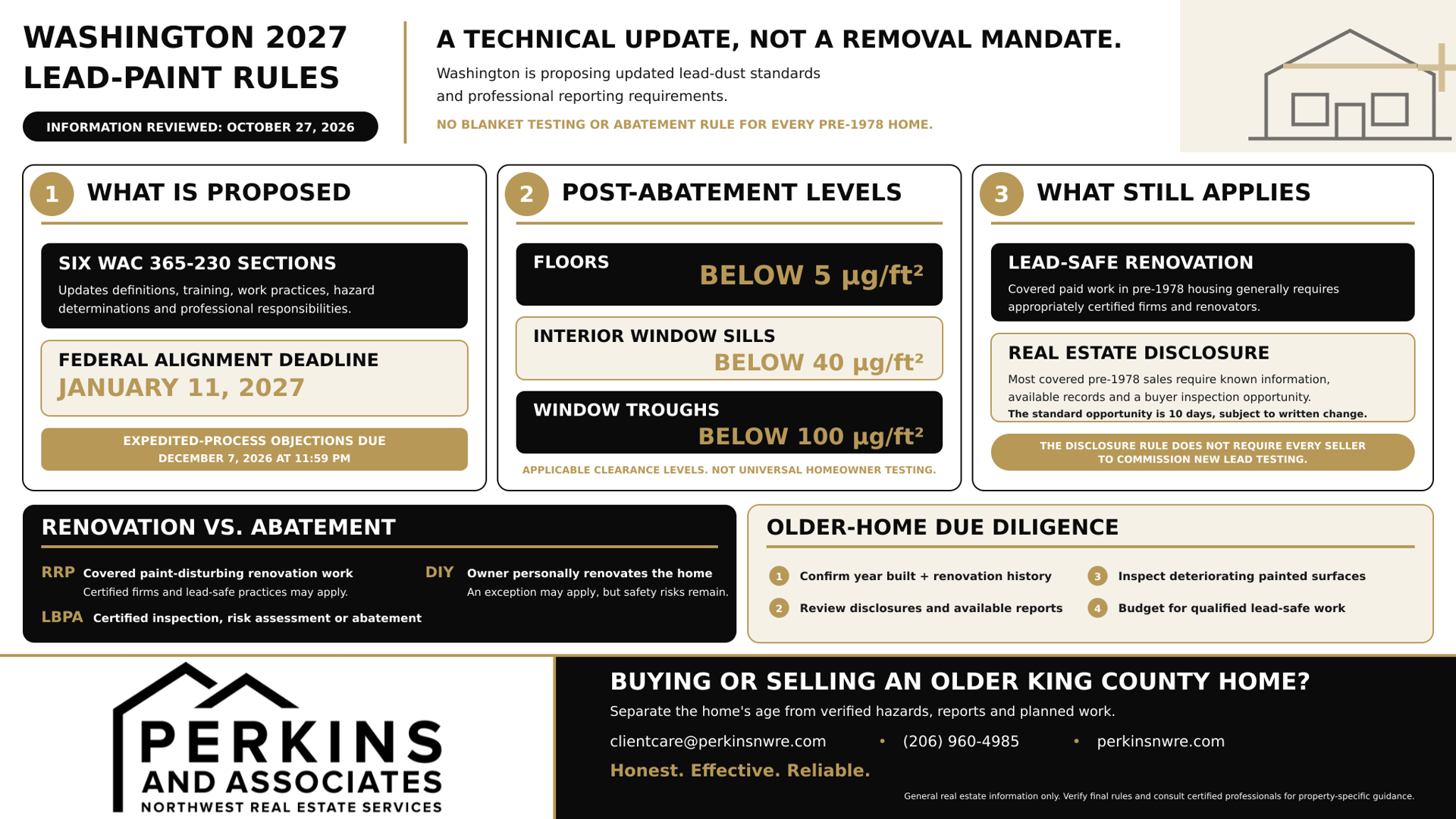
Washington's Department of Commerce is proposing amendments to six sections of Chapter 365-230 WAC to bring state lead-based paint regulations into alignment with revised federal standards.
The agency's September 24 filing, published as Washington State Register WSR 26-20-012, addresses definitions, work practices, lead-hazard determinations, and professional responsibilities.
The six affected sections are:
WAC section | Main subject |
|---|---|
365-230-020 | Definitions |
365-230-050 | Minimum training curriculum requirements |
365-230-200 | Lead-based paint activity work practices |
365-230-210 | Determining lead-based paint and hazards |
365-230-330 | Renovation work practice standards |
365-230-385 | Renovator and dust sampling technician responsibilities |
The amendments update terminology related to dust-lead reportable levels, action levels, and post-abatement clearance.
They also address additional information that must be included in certain abatement reports when dust-lead remains detectable even though post-abatement action levels have been met.
Why is Washington updating the rules?
EPA revised federal standards to better address exposure to lead-contaminated dust.
Washington administers its own EPA-authorized lead-based paint programs. To maintain that authorization, its regulations must provide protections at least as strong as the applicable federal requirements.
Commerce identifies January 11, 2027, as the deadline to complete the required alignment.
Does January 11, 2027, mark the start of all federal lead-paint rules?
No.
EPA's revised dust-lead rule became effective January 13, 2025. Compliance with certain provisions began January 12, 2026, in jurisdictions where EPA directly administers the applicable program.
Washington's January 11, 2027, date concerns the state's obligation to align its authorized programs.
The dates should not be confused with a newly established homeowner deadline.
Is Washington also planning a broader lead-paint regulation overhaul?
Yes, but that is a separate process.
Commerce has been reviewing broader changes to Chapter 365-230, including certification requirements, fees, enforcement procedures, and the organization of its lead-based paint programs.
The department currently describes that broader effort as being on hold until 2027.
The September expedited proposal is narrower and focused on alignment with federal requirements.
Property owners and contractors should not assume that every change discussed during the broader 2026 workshops is part of the expedited amendment.
The Washington Department of Commerce rulemaking page provides information about both processes.
What do the new dust-lead standards actually mean?
The revised standards distinguish between detecting lead-contaminated dust and evaluating whether regulated lead abatement has achieved the applicable clearance requirements.
These are related but different questions.
What is a dust-lead reportable level?
Under the revised federal framework, dust-lead on floors and interior window sills may be identified as a hazard when a recognized laboratory reports a detectable amount using an approved analytical method.
There is no single universal numerical threshold that every laboratory must report in the same way.
The reportable level depends on the laboratory's recognized analytical capabilities.
This approach recognizes that lead exposure can pose health risks even at low concentrations.
What is a dust-lead action level?
Dust-lead action levels are numerical thresholds used in the applicable professional lead-abatement framework.
Among other purposes, they help determine when EPA recommends abatement and whether regulated post-abatement dust testing meets the required criteria.
The revised levels are:
Surface | Required post-abatement result |
|---|---|
Floors | Below 5 µg/ft² |
Interior window sills | Below 40 µg/ft² |
Window troughs | Below 100 µg/ft² |
µg/ft² means micrograms of lead per square foot of sampled surface.
These results must be below the applicable level, not equal to it.
The numbers are relevant when post-abatement dust-lead clearance testing is required or otherwise performed under the applicable program.
They are not a universal requirement that every homeowner test every floor or window.
EPA explains the distinction in its lead hazard standards and clearance guidance.
Can detectable lead remain after an abatement project meets the action levels?
Yes.
This is one of the most important technical details in the proposed Washington amendments.
A project may achieve dust-lead results below the applicable action levels while a recognized laboratory still reports detectable lead.
Under the proposed rules, certain abatement reports must explain that reportable dust-lead hazards remain and provide guidance for reducing continued exposure.
A successful post-abatement clearance result should therefore not be presented as proof that a property contains absolutely no lead.
It means the applicable clearance criteria were met.
For homeowners, the practical lesson is to understand what a professional report actually says rather than assume a passing result eliminates every possible exposure concern.
Will Washington homeowners have to remove lead paint in 2027?
No. The proposed regulations do not require every owner of a pre-1978 home to remove lead paint.
Homes built before 1978 are more likely to contain lead-based paint because residential use of lead paint was prohibited federally beginning that year.
However, the age of a home alone does not prove that lead paint is present or establish that professional abatement is legally required.
What if the paint is in good condition?
Lead-based paint that remains intact and undisturbed generally presents less immediate risk than deteriorating paint or dust created by friction and renovation.
That does not mean it is harmless or that future maintenance can be ignored.
Windows, doors, trim, and other areas where painted surfaces rub together can create contaminated dust even when the paint problem is not obvious.
Owners should monitor painted surfaces, especially where children may come into contact with paint chips or dust.
What if the paint is peeling or damaged?
Peeling, cracking, or deteriorating lead-based paint deserves prompt attention.
The appropriate response depends on the condition, the location, the property's use, and applicable legal requirements.
Professional evaluation may be appropriate to determine whether lead is present, whether occupants are being exposed, and what corrective work is needed.
Some properties, including certain federally assisted housing, may be subject to additional lead-hazard investigation or remediation requirements.
A general homeowner summary cannot determine those obligations for a specific property.
The safest assumption is not that every older home needs complete paint removal, but that disturbing potentially lead-containing paint requires careful planning.
What is the difference between lead abatement and ordinary renovation?
Lead abatement and renovation are not the same activity, and they are governed by different certification requirements.
This distinction matters when hiring someone to repaint a house, replace old windows, remodel a bathroom, or permanently address a confirmed lead hazard.
Activity | What it generally involves | Relevant program |
|---|---|---|
Renovation, Repair and Painting (RRP) | Remodeling, repairs, or painting that disturbs covered painted surfaces | RRP certification and lead-safe work practices |
Lead-Based Paint Activities (LBPA) | Professional inspections, risk assessments, and abatement | LBPA certification |
Owner-occupied DIY work | Homeowner personally renovating their own home | Generally outside federal RRP contractor certification, subject to applicable exceptions |
Landlord or house-flipping renovation | Covered renovation of pre-1978 property as part of rental or resale business | RRP requirements generally apply |
When is an RRP-certified contractor required?
Washington's Renovation, Repair and Painting Program generally requires covered firms and individuals performing qualifying renovation work on pre-1978 housing or child-occupied facilities to hold appropriate certification and follow lead-safe practices.
The scope of work matters.
Projects involving windows, doors, painted trim, wall removal, and other paint-disturbing work may fall within the program.
Certain exceptions and limited activities exist, so an owner should confirm whether the particular project is covered.
When is an LBPA professional needed?
Washington's Lead-Based Paint Activities Program covers professional activities such as lead inspections, risk assessments, and abatement.
An LBPA professional has certification for the specific regulated discipline.
A contractor qualified to perform ordinary remodeling is not automatically certified to conduct a formal lead risk assessment or permanent lead abatement.
Before hiring a professional, ask whether the firm and the individual performing the work hold the appropriate Washington certifications.
Can homeowners renovate their own houses?
Federal RRP contractor requirements generally do not apply when an owner personally renovates their own owner-occupied home.
However, that exception does not mean disturbing old lead paint is safe.
Lead-containing dust can spread beyond the immediate work area and create exposure risks for household members.
EPA recommends using lead-safe certified professionals for potentially hazardous renovation work.
The owner-occupant exception also should not be extended automatically to landlords, people running childcare facilities, or individuals renovating homes for resale as a business.
How should owners of pre-1978 homes prepare for renovations?
The most useful step is to consider lead risks before work begins, not after old painted surfaces have already been disturbed.
Owners planning renovations should take the following precautions.
- Confirm the home's construction year. A pre-1978 construction date is a reason to investigate possible lead paint, not proof that every painted surface contains it.
- Identify where work will disturb paint. Window replacement, demolition, trim removal, and paint preparation may create dust or debris.
- Ask about relevant contractor certification. Verify that the professional holds the Washington certification appropriate to the work.
- Consider whether a professional lead inspection or risk assessment is appropriate. A qualified professional can help determine whether lead is present and what type of work may be needed.
- Clarify the work plan and documentation. Ask how affected areas will be managed, how occupants will be protected, and what reports or records will be provided.
- Check separate building permit requirements. Lead-safe renovation compliance does not replace local building permits, and obtaining a building permit does not automatically establish compliance with lead regulations.
For owners in unincorporated King County, our article on King County's permitting reform initiative provides context about permit procedures. Lead-related certifications remain a separate requirement.
Avoid treating old painted surfaces as ordinary construction debris without considering possible exposure.
If a project involves substantial paint disturbance or a known lead hazard, seek advice from a properly qualified professional before work begins.
What must Washington home sellers disclose about lead paint?
Federal lead-based paint disclosure requirements already apply to most housing built before 1978, subject to specified exceptions.
These requirements are separate from Washington's proposed 2027 technical amendments.
Under the federal Lead-Based Paint Disclosure Rule, a seller of covered housing generally must:
- Disclose known lead-based paint and lead-based paint hazards.
- Provide available records and reports related to those conditions.
- Provide the federally required lead-information pamphlet.
- Include the required lead warning and disclosure acknowledgments in the transaction documents.
- Give the buyer an opportunity to conduct a lead inspection or risk assessment.
The buyer generally receives a 10-day inspection opportunity. The parties may agree in writing to a shorter or longer period, and the buyer may waive that opportunity.
EPA explains these duties in its real estate lead disclosure guidance.
Does a seller have to pay for lead testing before listing?
Not solely because of the federal disclosure rule.
That rule generally requires disclosure of known information and available records. It does not require every seller to arrange or finance new lead testing.
The federal rule also does not automatically require a seller to remove lead paint discovered during a buyer's inspection.
A buyer and seller may nevertheless negotiate testing, remediation, or other terms as part of the transaction.
Other laws, orders, contracts, or property-specific circumstances may create separate obligations.
What about Washington's seller disclosure statement?
Washington has its own residential seller disclosure framework under RCW 64.06.020.
The state's disclosure statement includes an environmental question addressing substances or materials that may be concerns on the property, including lead-based paint.
The statute contains applicable waivers and exemptions.
The legislature's website currently displays versions effective before and beginning January 1, 2027. Sellers should use the statutory requirements and transaction forms applicable to their particular sale.
These state disclosure rules are separate from Commerce's proposed WAC 365-230 amendments.
For buyers reviewing work completed before a sale, see our article on the risks of purchasing a home with unpermitted renovations.
Permit records and lead-hazard reports answer different questions. One should not be mistaken for the other.
What should buyers check before purchasing an older Washington home?
Buyers considering a pre-1978 property should investigate possible lead exposure alongside the home's other condition and maintenance issues.
A useful starting point is the home's construction date and any available history of paint disturbance, remodeling, window replacement, or professional hazard assessment.
Is a regular home inspection enough?
A general home inspection does not automatically include a certified lead-based paint inspection or laboratory dust testing.
A home inspector may identify peeling paint, damaged surfaces, or other reasons for further investigation.
However, identifying whether lead is present and evaluating regulated lead hazards may require specifically qualified professionals.
Buyer checklist for older homes
What to review | Why it matters |
|---|---|
Year built | Helps identify whether pre-1978 lead rules may be relevant |
Federal lead disclosures | Provides known information and available reports |
Washington seller disclosure | Identifies disclosed environmental concerns |
Previous renovation records | Helps establish what work was done and when |
Condition of windows, doors, and painted surfaces | May identify areas where dust or deterioration warrants investigation |
Certified lead inspection or risk assessment | Can provide more specific information where appropriate |
Renovation estimates | Helps account for potential lead-safe work requirements |
If a buyer plans significant renovations, the cost of using certified professionals and managing potential hazards should be part of the property evaluation.
A lower purchase price does not automatically mean a fixer-upper will be inexpensive to renovate.
The decision should reflect the home's actual condition and the buyer's planned work.
Do Washington's lead-paint rules apply to landlords and house flippers?
Yes. Existing lead-safe renovation and disclosure requirements are especially important for owners of rental properties and people renovating older homes for profit.
The rules depend on the type of work and the property's use.
Landlords
A landlord performing covered paint-disturbing renovation work on a pre-1978 rental may be required to meet RRP certification and work-practice requirements.
Hiring a qualified outside firm can satisfy the need for certified renovation work when that firm performs the covered work, but the owner should still understand the applicable property and contractual responsibilities.
Federal lead disclosure requirements also generally apply when leasing covered pre-1978 housing, subject to exceptions.
House flippers
An individual or business that purchases, renovates, and resells pre-1978 homes for profit may be subject to RRP requirements when performing covered renovations.
That includes situations where the investor personally performs the renovation as part of the business.
If an investor hires a properly certified outside renovation firm to perform all covered work, the outside firm is responsible for its applicable certification, work practices, and records.
The investor should verify the firm's qualifications rather than assume personal DIY exceptions apply to a resale business.
What should investors keep in their property files?
Useful records may include prior lead reports, contractor certifications, renovation scopes, required notices, inspection results, clearance reports, and applicable building permits.
Records can help explain what work was performed and support future due diligence.
They are not proof that a property is completely free of lead unless a qualified report specifically supports that conclusion.
Why does this matter for South King County homes?
Older housing remains part of the residential market in communities such as Kent, Renton, Auburn, Enumclaw, and other parts of King County.
Buyers interested in established neighborhoods may encounter homes built before 1978, some with multiple generations of repairs or renovations.
The lead-paint issue is not unique to one city or neighborhood. Its relevance depends primarily on the property's age, condition, prior work, and planned use.
Public Health – Seattle & King County provides local lead-exposure prevention information, including guidance on reducing risks during remodeling and evaluating possible exposure sources.
Its Lead and Toxics Program is an appropriate resource for residents seeking local public-health information.
For homebuyers, the practical goal is not to reject every older house.
It is to determine whether the property has known lead hazards, whether further evaluation is needed, and how those findings affect the purchase or renovation plan.
For sellers, clear documentation and accurate disclosures are more useful than assumptions about whether a home's age makes it safe or unsafe.
How can residents participate in Washington's 2026 rulemaking?
The Department of Commerce is accepting written objections to using the expedited rulemaking process through December 7, 2026.
The deadline is 11:59 p.m. on December 7, 2026.
Importantly, this is an opportunity to object to the expedited procedure. It is not a homeowner compliance deadline or a public vote on whether lead-safety regulations should exist.
Commerce asks that objections explain the specific grounds for challenging the expedited process.
Submissions may be sent to:
Katie Meehan, Washington State Department of Commerce
Email: [email protected]
Suggested subject: Expedited Rulemaking Objection – LBP
The department's official rulemaking page contains additional instructions and current proposal documents.
Expert insight: Understand the work before making a property decision
For South King County homeowners and buyers, the most important distinction is between owning an older house and undertaking work that may disturb lead-containing materials.
A home built before 1978 is not automatically required to undergo full abatement.
At the same time, treating every renovation as a simple cosmetic update can overlook important safety and compliance questions.
Consider a buyer interested in an older house with original windows and painted trim.
The home may be appealing and otherwise well maintained, but replacing windows or remodeling interior rooms could require a different renovation approach than similar work in newer construction.
That does not determine whether the property is a good purchase. It means the buyer should investigate the work and its costs before committing to an improvement plan.
At Perkins & Associates, we encourage buyers and sellers to separate confirmed property conditions from assumptions based on age or appearance.
For buyers, review the disclosures and decide whether a qualified lead inspection or risk assessment is appropriate.
For sellers, gather known reports and renovation records and follow the applicable disclosure requirements.
For owners planning improvements, verify contractor qualifications and the work scope before construction starts.
Those steps provide a sounder basis for decision-making than assuming the proposed 2027 regulation either prohibits renovating an older home or requires every homeowner to remove all existing lead paint.
Frequently asked questions about Washington's 2027 lead-paint regulations
Are Washington's 2027 lead-paint regulations already adopted?
As of October 27, 2026, the September expedited amendments remain listed as active proposed rulemaking by the Department of Commerce. The state is working toward federal alignment by January 11, 2027.
Do I have to remove lead paint from my house in 2027?
No blanket statewide removal requirement is created by the proposal. Requirements may arise from specific hazards, regulated projects, property programs, enforcement actions, or other applicable obligations.
What are the updated dust-lead clearance levels?
For applicable post-abatement dust testing, results must be below 5 µg/ft² for floors, 40 for interior window sills, and 100 for window troughs.
Can I renovate my own pre-1978 home?
Federal RRP contractor certification generally does not apply when a homeowner personally renovates their own owner-occupied home. However, lead exposure remains a safety concern, and exceptions or other legal requirements may apply. Hiring an appropriately certified professional is often advisable.
Do sellers have to test for lead before selling a home?
The federal lead disclosure rule generally does not require sellers to commission new testing. Sellers of covered pre-1978 housing must disclose known lead information and provide available records and required disclosure materials.
Does a regular home inspection test for lead paint?
Not automatically. Buyers should ask whether a certified lead inspection or risk assessment is needed rather than assume a general home inspection includes lead-specific testing.
Are landlords subject to lead-safe renovation rules?
Generally, yes, when covered renovation work disturbs paint in qualifying pre-1978 rental housing. The work must meet applicable certification and lead-safe practice requirements.
Does detecting lead dust automatically mean a home must undergo abatement?
No. Detecting a reportable lead-dust level is relevant to identifying a hazard, but that finding alone is not a universal order requiring every homeowner to undertake permanent abatement. Applicable program rules and property-specific circumstances determine required action.
Helpful resources
1. Washington Department of Commerce: Rulemaking
Current status of the expedited proposal, supporting documents, objection instructions, and information about the separate broader lead-program review.
2. Washington State Register: WSR 26-20-012
The official September 24, 2026 filing identifying the six proposed WAC amendments and their specific language.
3. EPA: Lead Hazard Standards and Clearance Levels
Federal explanations of dust-lead reportable levels, action levels, and post-abatement standards.
4. Washington Commerce: Renovation, Repair and Painting Program
Requirements and certification information for firms and individuals performing covered renovations.
5. Washington Commerce: Lead-Based Paint Activities Program
Information on certification for professional lead inspections, risk assessments, and abatement activities.
6. EPA: Real Estate Lead-Based Paint Disclosures
Federal disclosure requirements for covered home sales and leases.
7. Washington Legislature: RCW 64.06.020
Washington's residential seller disclosure requirements, including the environmental concerns section and applicable statutory versions.
8. Public Health – Seattle & King County: Lead and Toxics Program
Local public-health information about lead exposure and prevention.
Information and transparency
Information current as of October 27, 2026.
This article is based on the Washington Department of Commerce's September 2026 expedited rulemaking proposal, EPA's published lead-dust regulations and guidance, applicable Washington statutory provisions, and official public-health resources.
The expedited Washington rulemaking is still identified as proposed. The precise effective date and final adopted language should be verified once Commerce completes the process.
January 11, 2027, is Washington's federal-alignment deadline. It is not a universal deadline requiring homeowners to conduct lead testing or remove existing paint.
The dust-lead thresholds discussed in this article apply within the relevant regulated lead assessment and abatement framework. Property-specific requirements may also depend on other federal, state, local, or program rules.
This article should be reviewed after the December 7 objection deadline and again when Washington publishes final amendments.
Buying or selling an older home in King County?
Older homes can offer established neighborhoods, distinctive architecture, and renovation possibilities. They can also require additional research into construction materials, previous work, and long-term maintenance.
If you're considering buying a pre-1978 home, preparing an older property for sale, or comparing established homes with newer construction in South King County, Perkins & Associates can help you review the real estate considerations and organize the questions that deserve further investigation.
For lead inspections, abatement, contractor certification, or health concerns, consult the appropriate Washington-certified professional or government agency.
Contact Perkins & Associates | John L. Scott
Email: [email protected]
Phone: (206) 960-4985
Honest. Effective. Reliable.
Disclaimer: This article provides general real estate information and is not legal, medical, or environmental safety advice. Association documents, purchase agreements, statutory applicability, and transaction deadlines can vary. Buyers and sellers should review their specific documents and seek legal advice when a legal interpretation is needed. Lead-based paint hazards, renovation certifications, abatement obligations, testing, disclosure requirements, and health concerns should be evaluated with the appropriate certified professionals or government agencies before making legal, financial, or property-related decisions.