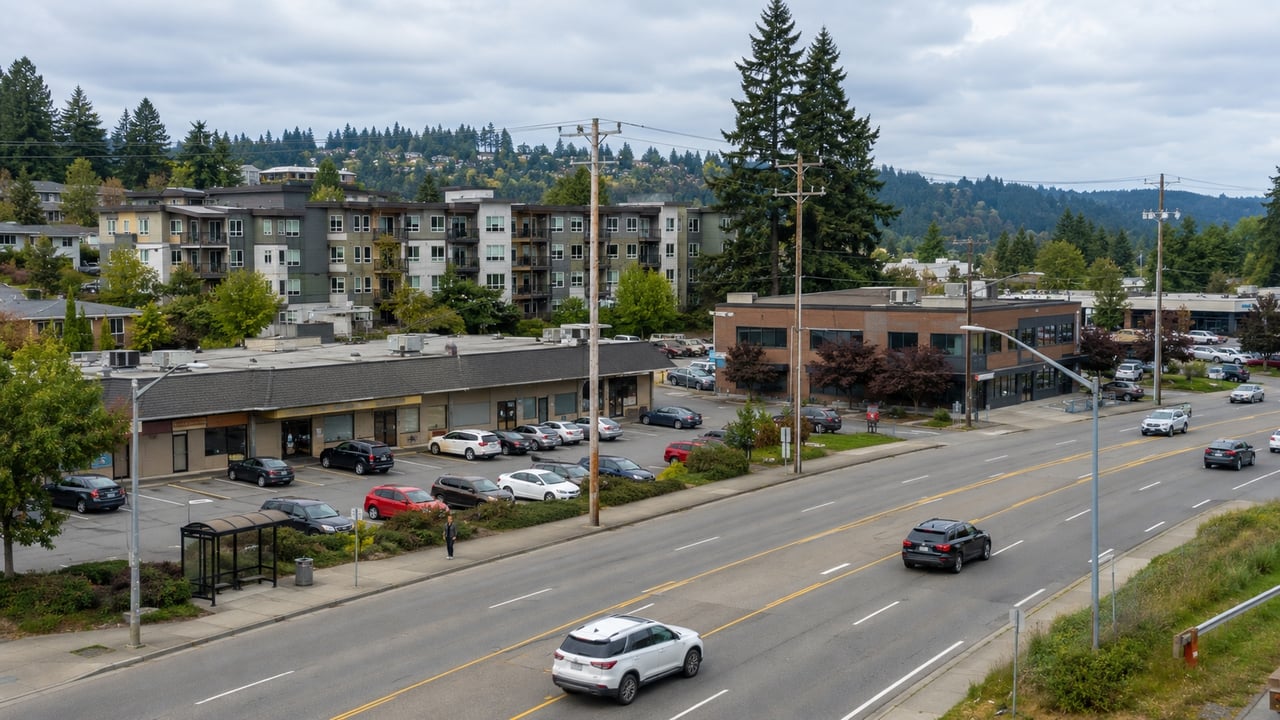
How Washington's New Zoning Law Could Change Housing in Renton, Kent and Auburn
Washington's new SB 6026 generally prevents larger cities from excluding residential uses from commercial and mixed-use zones, which could create more opportunities for housing on land people have traditionally thought of as retail, office or other commercial property.
But that does not mean every shopping center, office building or commercial parcel can suddenly become apartments.
SB 6026 took effect June 11, 2026 and is now codified as RCW 36.70A.816. It applies to Growth Management Act cities with populations of at least 30,000 and qualifying non-rural counties. Renton, Kent and Auburn fall within the group of South King County cities where the law is relevant. Washington Legislature: RCW 36.70A.816
The law changes what local zoning can prohibit. It does not guarantee that a particular property can be developed, what type of housing would be built, or whether redevelopment will happen at all.
For South King County residents and property owners, that distinction matters.
Key takeaways
- SB 6026 became effective June 11, 2026.
- It generally prevents covered cities from excluding residential uses from commercial and mixed-use zones.
- The law contains important exceptions, including industrial areas and certain airport, shoreline, critical-area and other locations.
- Cities can still require ground-floor retail or commercial space in some areas.
- They generally cannot apply those requirements across more than 40% of the commercial and mixed-use acreage counted under the law.
- Cities must provide a process for developers to request a reduction or waiver from applicable ground-floor commercial requirements.
- SB 6026 does not automatically approve housing projects.
- Local zoning codes still matter, and Renton, Kent and Auburn are now in an implementation period.
- Washington Commerce says local ordinances are due by December 2027. Washington Commerce: 2026 legislative update
- The law could expand housing options on some commercial properties, but it does not guarantee redevelopment or higher property values.
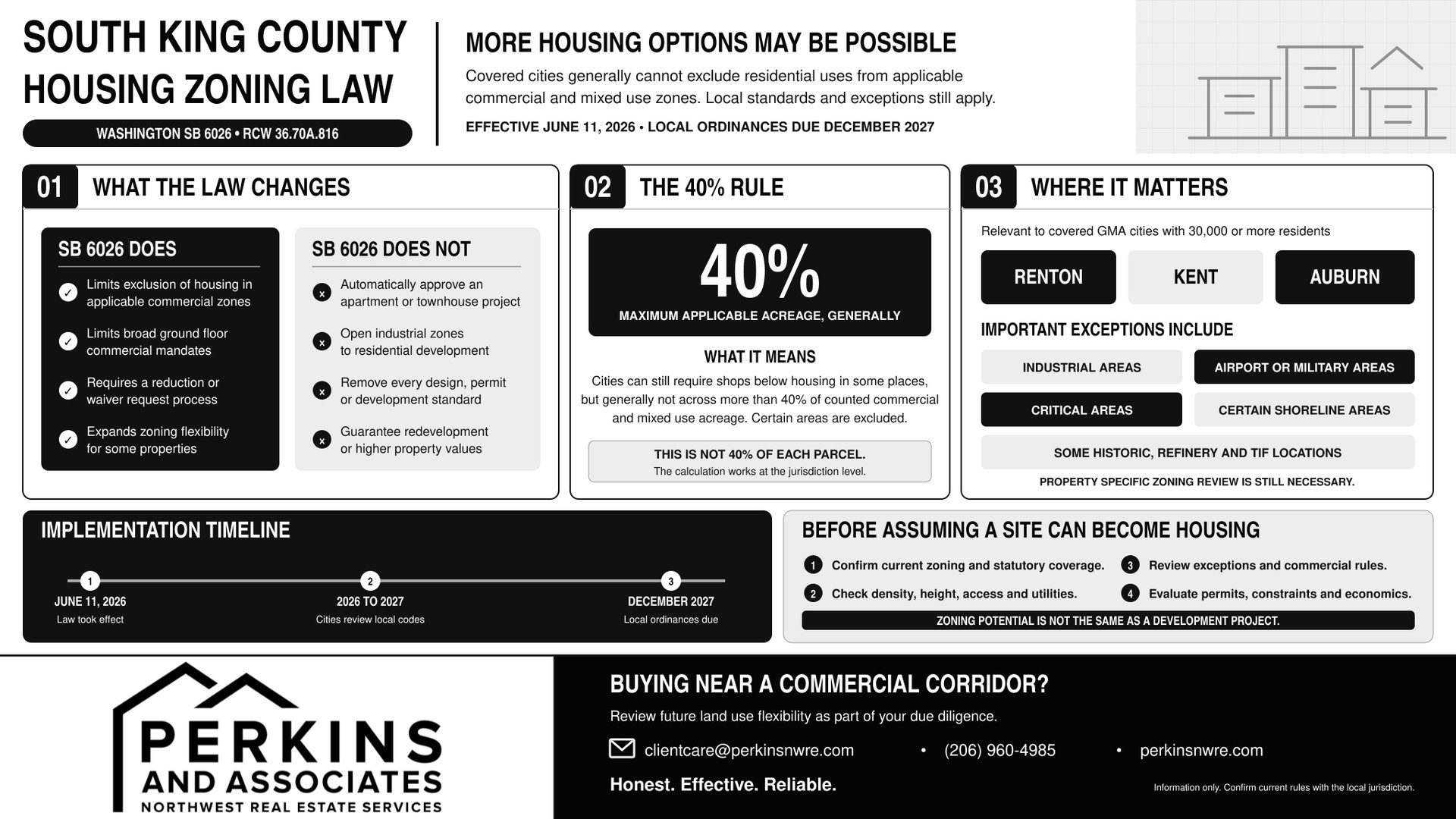
What SB 6026 does and does not do
SB 6026 does | SB 6026 does not |
|---|---|
Limits the ability of covered cities to exclude housing from applicable commercial and mixed-use zones | Automatically approve an apartment or townhouse project |
Limits how broadly cities can require ground-floor commercial space | Open industrial zones to residential development |
Requires a process for requesting reductions or waivers from ground-floor commercial requirements | Eliminate every mixed-use or storefront requirement |
Gives local jurisdictions time to bring codes into compliance | Guarantee an existing commercial property will redevelop |
Expands zoning flexibility for some sites | Guarantee higher property values or investment returns |
The simplest way to think about the law is:
SB 6026 removes some zoning barriers. It does not remove every development barrier.
What is Washington SB 6026?
SB 6026 is a 2026 Washington housing law that changes how larger Growth Management Act jurisdictions regulate residential development in commercial and mixed-use zones.
It is now part of state law as RCW 36.70A.816.
The statute generally prohibits covered jurisdictions from excluding residential uses from areas zoned for commercial or mixed-use development, with specific exceptions. Read RCW 36.70A.816
Washington Commerce summarizes the law as a measure intended to allow more residential development in commercial and mixed-use zones.
For homeowners or buyers, the practical translation is:
A property people have always thought of as "commercial-only" may eventually have more residential options than it did before.
That does not tell us whether anything will actually be built there.
SB 6026 changes two different zoning rules
This is one of the most important parts of the law.
SB 6026 addresses two related but separate issues.
1. Can residential uses be prohibited?
Generally, covered cities cannot simply exclude residential uses from applicable commercial and mixed-use zones.
That is the first rule.
A city may still regulate:
- density,
- height,
- setbacks,
- design,
- access,
- utilities,
- environmental standards,
- building requirements,
- and other development rules.
The statute specifically says it does not require a city to issue a building permit when other federal, state or local requirements have not been met.
2. Can cities require shops or other commercial space below the housing?
Yes, in some areas. But SB 6026 limits how broadly those requirements can be applied.
Covered jurisdictions generally cannot require mixed-use development or ground-floor commercial or retail space as a condition of residential development across more than 40% of the commercial and mixed-use acreage counted under the statute. Washington Legislature: ground-floor commercial provisions
That second rule could matter significantly for some projects.
What does the 40% ground-floor commercial rule mean?
Cities can still protect some areas for an active mix of housing, shops, restaurants or other businesses, but the state law generally limits how much applicable commercial and mixed-use land can be subject to mandatory ground-floor commercial requirements.
It does not mean:
"40% of every commercial parcel must contain shops."
It also does not mean:
"60% of every commercial parcel automatically allows apartments with no commercial space."
The calculation works at the jurisdiction level across eligible commercial and mixed-use acreage, after excluding specific areas identified in the statute.
Those exclusions include certain:
- station areas,
- areas where development of at least 85 feet is allowed or incentivized,
- industrial areas,
- airport or military-related areas,
- older tax increment financing areas,
- shoreline areas,
- and critical areas.
Because of that, the 40% rule cannot be evaluated correctly by looking at one parcel alone.
Can developers ask to remove a ground-floor retail requirement?
Yes. SB 6026 requires covered cities and counties to provide an administrative process for applicants to request a reduction or waiver from applicable ground-floor commercial or retail requirements.
The city's review has to consider:
- the merits of the project,
- and the increase in housing units that could result from reducing or waiving the requirement.
Cities can also create their own criteria, application procedures and timelines.
A jurisdiction that already had a qualifying waiver process before June 11, 2026 does not have to create an entirely new one. RCW 36.70A.816 waiver provisions
For a property owner or developer, that creates an important distinction.
The question may no longer be only:
"Does residential zoning allow housing?"
It may also be:
"How much commercial space would this housing project actually have to include?"
Why does ground-floor commercial matter to housing development?
Ground-floor retail can make sense in a busy downtown, station area or strong pedestrian district, but it may be harder to support on every commercial property where housing could otherwise work.
Imagine an older commercial site.
The zoning might support a four- or five-story residential building, but the city's existing code might require the entire street-facing ground floor to be built as storefronts.
If local demand for that commercial space is weak, those requirements can affect the project's design and financial feasibility.
SB 6026 does not eliminate mixed-use development.
Instead, it limits how broadly cities can make commercial space a condition of building housing.
That difference matters.
Can every commercial property in Washington now become housing?
No.
This is the biggest misconception to avoid.
SB 6026 contains several exceptions to the rule requiring residential uses to be allowed.
The residential-use requirement does not apply to certain portions of lots that fall within categories such as:
- industrial-zone areas,
- qualifying employment overlays that already prohibited housing,
- land within 3,200 feet of an active oil or gas refinery,
- sites where housing would require demolition of a locally designated historic landmark,
- certain areas outside applicable urban growth areas,
- areas restricted because of military installations or general aviation airports,
- qualifying tax increment financing areas established before June 11, 2026,
- specified shoreline areas,
- and many critical areas or critical-area buffers. Washington Legislature: SB 6026 exceptions
Industrial land is an especially important example.
SB 6026 is not a statewide conversion of industrial property into housing land.
The exceptions are not identical for both parts of the law
The law's exceptions for allowing residential uses and the acreage exclusions used for the 40% ground-floor-commercial calculation are related, but they are not exactly the same legal test.
That matters when analyzing a property or city zoning code.
For example, the ground-floor commercial calculation specifically excludes station areas and places where development of at least 85 feet is allowed or incentivized.
The residential-use section has its own list of exceptions.
For consumers, the practical lesson is simple:
Do not use one generic "SB 6026 exemption list" to decide what can happen on a particular property.
Property-specific zoning review is still necessary.
When will cities actually change their zoning codes?
The law took effect June 11, 2026, but covered cities were given an implementation period to bring local ordinances and development regulations into compliance.
Washington Commerce lists the local adoption deadline as December 2027. Washington Commerce SB 6026 implementation summary
The statute itself provides an 18-month compliance period after June 11, 2026.
If a covered jurisdiction has not adopted compliant regulations by the deadline, conflicting local rules can be superseded or preempted under the state law.
Implementation timeline
Date | What it means |
|---|---|
June 11, 2026 | SB 6026 took effect |
June 30, 2026 | Commerce filed a CR-101 notice beginning broader GMA housing and land-use rulemaking |
2026–2027 | Cities review and amend applicable zoning and development codes |
December 2027 | Commerce identifies this as the local ordinance deadline |
After the statutory 18-month period | Conflicting local rules may be preempted under RCW 36.70A.816 |
Is Washington finished with SB 6026 rulemaking?
No. As of September 2026, Washington Commerce still lists SB 6026 within active Growth Management Act rulemaking related to recently enacted housing and permitting laws.
Commerce filed its CR-101 statement of inquiry on June 30, 2026. The initiative includes SB 6026 along with several other housing and land-use laws. Washington Commerce active rulemaking
That means readers should distinguish between:
The statute
which is already state law,
and:
Commerce rulemaking and local implementation
which are still moving forward.
A simple example: what could change on an older commercial property?
Consider an older one-story retail or office property.
Before local compliance with SB 6026
The site's commercial zoning might:
- prohibit residential development entirely,
- or allow housing only if it is part of a vertically mixed-use building with required ground-floor commercial space.
Under the new state framework
The city may no longer be able to exclude residential use from that applicable commercial zone.
The city may also have to reconsider how broadly it requires commercial storefront space below housing.
But the developer still has to answer other questions
The project could still be affected by:
- allowed density,
- maximum height,
- setbacks,
- access,
- utilities,
- stormwater,
- parking,
- design standards,
- fire and building codes,
- environmental review,
- critical areas,
- shoreline rules,
- infrastructure capacity,
- and whether the project makes financial sense.
So the new law might create development potential without creating a development project.
What could SB 6026 mean for Renton?
In Renton, the main question is likely to be how existing commercial and mixed-use development standards are adjusted to comply with the new state rules, not whether Renton has ever allowed housing in commercial areas.
Renton already has several zoning districts where residential and commercial uses can overlap.
Current Renton code includes detailed rules for:
- vertically mixed-use buildings,
- standalone residential development in certain commercial zones,
- pedestrian-oriented streets,
- and required ground-floor commercial space in particular locations. Renton Municipal Code: commercial and mixed-use zoning
Renton's Comprehensive Plan also provides the city's broader framework for future housing, land use and growth under the Growth Management Act. City of Renton Comprehensive Plan
What to watch in Renton
Watch for:
- zoning-code amendments,
- changes to standalone residential allowances,
- ground-floor commercial rules,
- the new reduction/waiver process,
- treatment of Commercial Arterial and other commercial districts,
- and how Renton identifies acreage subject to the 40% rule.
This should be viewed as an implementation question, not a prediction that a particular shopping center will redevelop.
For broader context, see our guide to Renton land use, ADUs and redevelopment trends.
What could SB 6026 mean for Kent?
Kent is another city where the new state law will interact with an existing local conversation about where commercial, mixed-use and residential development should occur.
Kent's 2044 planning work includes parcels along and near Kent-Kangley Road where commercial designations or zoning are associated with future mixed-use or residential patterns, including Community Commercial/Mixed Use designations. City of Kent 2044 land-use and zoning updates
That planning work is useful context, but it should not be attributed to SB 6026 alone.
Kent was already making long-range land-use decisions before the 2026 law took effect.
What to watch in Kent
Watch for:
- updates to Community Commercial and Community Commercial/Mixed Use rules,
- ground-floor commercial requirements,
- code amendments tied specifically to SB 6026,
- implementation along commercial corridors,
- treatment of Kent-Kangley properties,
- and local mapping of acreage covered by the state law.
The safest way to think about Kent is:
SB 6026 adds a new statewide legal requirement to a local redevelopment conversation already underway.
What could SB 6026 mean for Auburn?
Auburn already uses mixed-use and downtown zoning that combines housing, businesses and pedestrian-oriented development, so the most interesting question is how existing storefront and commercial requirements interact with the new state framework.
Auburn's Downtown Urban Center includes Core 75 and Core 125 zoning districts.
The City currently says ground-floor retail, restaurants and personal-service uses are required along Main Street frontages in those core districts. City of Auburn Downtown Urban Center
That does not mean SB 6026 automatically eliminates those requirements.
The statute treats station areas and high-rise areas differently when calculating the 40% ground-floor commercial limitation.
What to watch in Auburn
Watch for:
- revisions to applicable commercial zoning,
- how the City treats downtown and station-area rules,
- waiver and reduction procedures,
- how ground-floor requirements are mapped,
- and changes outside the downtown core where residential uses may have been more limited.
It is also worth separating this issue from Auburn's live/work regulations.
A live/work unit is not the same thing as a mixed-use apartment development or standalone residential project in a commercial zone.
Our recent guide to Auburn live/work zoning explains that distinction in more detail.
Could SB 6026 turn older shopping centers into housing?
Potentially, some commercial properties may gain more residential development options, but SB 6026 does not require or guarantee redevelopment.
An older shopping center could remain a shopping center for decades.
A commercial owner may decide the current use is profitable and has no reason to redevelop.
A site may also face:
- long-term leases,
- redevelopment costs,
- environmental constraints,
- infrastructure limitations,
- financing issues,
- parcel configuration problems,
- or development standards that make housing impractical.
The law changes zoning possibilities.
The market still determines whether someone wants to use them.
Does SB 6026 change a specific property's development potential?
Maybe, but the zoning label alone is not enough to know.
A serious property review should look at:
- Current zoning
- Whether the property is in a commercial or mixed-use zone covered by RCW 36.70A.816
- Whether a statutory exception applies
- Residential density
- Building height
- Setbacks
- Ground-floor commercial requirements
- Whether a waiver process applies
- Critical areas or shoreline restrictions
- Airport or industrial-area limitations
- Utilities and infrastructure
- Site access
- Existing permits
- Local design standards
- Project economics
This is particularly important for commercial property owners and investors.
A statewide law can change the zoning framework without answering whether one specific parcel works for a particular project.
Could the law lead to more apartments or townhomes?
It could create more opportunities for residential development, but the law does not dictate the type of housing that will be built.
Depending on the local zone and project, future development could potentially include:
- apartments,
- condominiums,
- townhomes,
- mixed-use housing,
- or another residential form allowed by local development standards.
But those are possibilities, not predictions.
The law itself does not select the housing type.
What does SB 6026 mean for buyers and homeowners?
For most residential buyers and homeowners, SB 6026 is less about what changes tomorrow and more about understanding what could change around commercial corridors over time.
If you are considering a home near:
- an older retail center,
- an office corridor,
- a mixed-use district,
- a large surface parking lot,
- or commercial land that appears underused,
it may be worth reviewing the local comprehensive plan and zoning map.
That does not mean you should assume redevelopment is coming.
It means future land-use flexibility should be part of your due diligence.
For a broader look at how planning can influence South King County housing decisions, see our guide to South King County housing market differences in 2026.
What does SB 6026 mean for commercial property owners and investors?
For commercial property owners and investors, the law may expand the menu of potential future uses on some properties, but parcel-level feasibility still matters.
A site that previously had a strong commercial-only restriction may warrant another look as local codes are updated.
Questions to ask include:
- Does residential use become permitted?
- What density would be allowed?
- Is standalone housing possible?
- Is mixed use still required?
- Does a ground-floor commercial requirement apply?
- Could that requirement be reduced or waived?
- Is the property in an exception area?
- Does the site's physical layout support housing?
- Would redevelopment make financial sense?
The important word is potential.
New zoning flexibility is not the same as an investment return.
Will SB 6026 increase nearby property values?
There is no reliable basis to say SB 6026 will automatically increase the value of a particular property or nearby homes.
For some commercial sites, additional legally permitted uses could affect how an owner or buyer evaluates development potential.
But property values depend on many other factors, including:
- the local market,
- rents,
- construction costs,
- financing,
- property condition,
- infrastructure,
- actual zoning capacity,
- demand,
- and whether redevelopment is realistic.
The law should be treated as a land-use change, not a guaranteed appreciation event.
Expert insight: Zoning potential is not the same as development
The most useful way to read SB 6026 is as a change in what cities may prohibit, not a prediction of what will be built.
For buyers, homeowners and investors in Renton, Kent and Auburn, that means looking one step deeper than:
"This property is commercial."
The better questions are:
What does the current zoning allow?
How does SB 6026 affect that zoning?
What will the city change during implementation?
Does this particular site actually work for housing?
That sequence matters.
A new legal right to consider residential development can be meaningful.
But zoning is only the first layer of a real project.
Frequently asked questions
What is Washington SB 6026?
SB 6026 is a 2026 Washington law that generally requires larger Growth Management Act cities and qualifying counties to allow residential uses in commercial and mixed-use zones, subject to exceptions.
It is now codified as RCW 36.70A.816.
When did SB 6026 take effect?
The law took effect June 11, 2026.
Covered jurisdictions have an implementation period, and Washington Commerce lists local ordinances as due by December 2027.
Does SB 6026 apply to Renton, Kent and Auburn?
Yes. These South King County cities exceed the population threshold for covered Growth Management Act cities.
Can every commercial property become apartments?
No. The law contains exceptions and does not override other development, environmental, infrastructure or permitting requirements.
Does SB 6026 apply to industrial land?
Industrial-zone areas are among the statutory exceptions to the core residential-use requirement.
Can cities still require ground-floor retail?
Yes. SB 6026 does not eliminate all ground-floor commercial requirements. It limits how broadly covered jurisdictions can apply them and requires an administrative process for requesting a reduction or waiver.
What is the 40% rule?
Covered jurisdictions generally cannot impose mixed-use or ground-floor commercial requirements across more than 40% of the applicable commercial and mixed-use acreage counted under RCW 36.70A.816.
Specific categories of land are excluded from that acreage calculation.
Does SB 6026 automatically rezone a commercial parcel?
No. The law changes what covered local regulations may prohibit, but cities still need to implement compliant local controls and individual projects still have to satisfy applicable development requirements.
Will SB 6026 increase property values?
Not necessarily. The law may change development potential for some sites, but it does not guarantee redevelopment or a specific change in market value.
Helpful resources
Washington Legislature: RCW 36.70A.816
The current state statute governing residential development in commercial and mixed-use zones, including exceptions, the 40% rule, waiver requirements and implementation timeline.
Washington Department of Commerce: 2026 legislative update
Commerce's summary of SB 6026, including its effective date, applicable jurisdictions and local adoption deadline.
Read Commerce's SB 6026 summary
Washington Department of Commerce: active rulemaking
Current information on Growth Management Act rulemaking that includes SB 6026 and other recently enacted housing and land-use laws.
Follow Washington Commerce rulemaking
City of Renton: Comprehensive Plan
Renton's long-range land-use and growth framework.
View Renton's Comprehensive Plan
City of Kent: Kent 2044
Current comprehensive-plan and land-use materials, including commercial, residential and mixed-use changes.
City of Auburn: Downtown Urban Center
Auburn's current downtown zoning and land-use framework, including existing Main Street ground-floor commercial requirements.
View Auburn's Downtown Urban Center
Planning your next move
If you are thinking about buying, selling, or planning your next move, our team is happy to help you think through your options and next steps.
📧 [email protected]
📱 (206) 960-4985
Honest. Effective. Reliable.