King County is developing a long-range plan for the rural, unincorporated communities surrounding Greater Maple Valley and the Cedar River area. The plan is intended to guide county decisions involving housing, land use, transportation, parks, environmental protection, utilities, public services, and economic development over the next 20 years.
For homeowners, buyers, sellers, and people considering moving near Maple Valley, the most important point is that this is a planning framework, not approval for a single development. It also does not apply to every property with a Maple Valley mailing address in the same way. The plan primarily concerns land outside incorporated city and town boundaries where King County acts as the local government. akeaways
- The Greater Maple Valley/Cedar River Subarea Plan focuses on rural, unincorporated King County.
- It is separate from the City of Maple Valley’s Comprehensive Plan.
- The plan establishes long-range policy direction rather than approving one subdivision, road, or construction project.
- The first public-comment period ended on May 18, 2026.
- King County expects to release a Public Review Draft later in 2026.
- King County Council review is currently planned for 2027.
- Buyers should verify a property’s jurisdiction, zoning, development conditions, utilities, critical areas, and nearby permit activity before relying on long-range planning information.
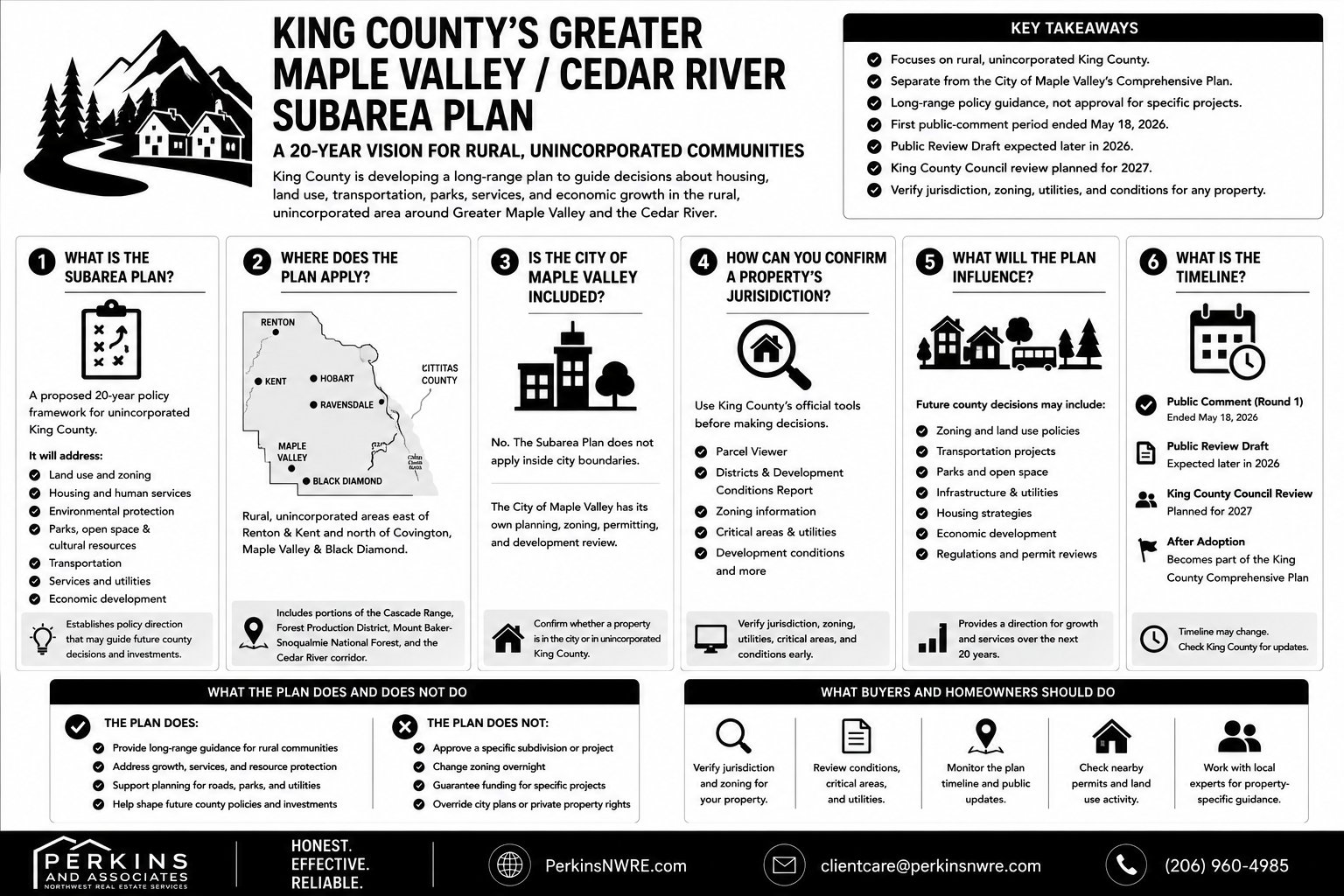
What is the Greater Maple Valley/Cedar River Subarea Plan?
The Greater Maple Valley/Cedar River Subarea Plan is a proposed 20-year policy framework for a specific part of unincorporated King County.
King County’s Comprehensive Plan establishes broad countywide goals for growth, land use, housing, transportation, infrastructure, and environmental protection. A subarea plan looks more closely at the needs of one Community Service Area and adds locally focused policies and actions. Once adopted, the Greater Maple Valley/Cedar River Subarea Plan will become part of the King County Comprehensive Plan. nty says the plan will address:
- Land use and zoning
- Housing and human services
- Environmental protection
- Parks, open space, and cultural resources
- Transportation
- Services and utilities
- Economic development
These categories are broad by design. They establish policy direction that may later guide budgets, regulations, capital projects, permit reviews, partnerships, and other county decisions. They do not guarantee that every idea discussed during the planning process will become an adopted policy or funded project.
Where does the Subarea Plan apply?
The plan applies primarily to rural, unincorporated land east of Renton and Kent and north of Covington, Maple Valley, and Black Diamond. The Community Service Area extends east toward the Kittitas County boundary and includes portions of the Cascade Range, the Forest Production District, and Mount Baker-Snoqualmie National Forest. populated western portion includes unincorporated communities such as Hobart, Ravensdale, and nearby rural neighborhoods. The area also contains forests, waterways, farms, small businesses, residential properties, and large stretches of protected or resource land. he City of Maple Valley included?
The Subarea Plan is not the same as the City of Maple Valley’s planning process.
The City of Maple Valley is incorporated and has its own city government, zoning code, Comprehensive Plan, transportation planning, and development-review process. The King County plan focuses on unincorporated areas outside city and town limits.
This distinction matters because a property can be associated with Maple Valley geographically or through its mailing address without necessarily being inside the city’s legal boundary. Buyers and homeowners should confirm the governing jurisdiction instead of relying only on the city name shown in an address.
For more background on city-level planning, read What’s Changing in Maple Valley Real Estate and Why Buyers Care.
How can you confirm a property’s jurisdiction?
King County provides several official property-research tools.
The King County Parcel Viewer allows users to search by address or parcel number and review parcel boundaries, jurisdiction, assessment information, and zoning layers.
The county’s Districts and Development Conditions Report can provide more detailed information about:
- Jurisdiction
- King County zoning
- Comprehensive Plan land-use designation
- Development conditions
- Community Service Area
- Water and sewer districts
- Fire district
- Critical-area designations
- Other planning and administrative districts
King County recommends confirming jurisdiction and zoning early when researching what may be built or permitted on a property. It also advises property owners to check for conditions such as wetlands, flood zones, steep slopes, clearing restrictions, setbacks, and other site-specific issues. is the current planning timeline?
As of July 21, 2026, the first preliminary draft has been released and its initial public-comment period has closed.
King County published the Preliminary Draft Subarea Plan on April 15, 2026. Public comments were accepted through May 18. County staff are reviewing that feedback as they prepare another version for public review. ent engagement schedule is:
Planning stage | Current status |
|---|---|
Early planning and community engagement | Completed |
Preliminary Draft Plan | Released April 15, 2026 |
Preliminary comment period | Closed May 18, 2026 |
Public Review Draft | Expected in late 2026 |
King County Council review | Planned for 2027 |
Final adoption | Not yet completed |
The live King County Engagement Hub lists a Public Review Draft and another comment opportunity for late 2026, followed by Council review in 2027. te King County subarea-planning schedule still shows a June 2026 transmittal and June 2027 adoption date. Because these county pages are not fully synchronized, readers should use date-stamped language and check the Greater Maple Valley/Cedar River engagement page for the latest project-specific status. ould the plan influence housing and land use?
The plan may guide future discussions about where different land uses are appropriate, how rural development should be managed, and how housing policies fit with infrastructure and environmental constraints.
This does not mean King County intends to convert the entire planning area into urban development. The plan focuses on an area defined by rural communities, forests, waterways, resource lands, and environmental features. Any future policy must also fit within the broader King County Comprehensive Plan and applicable state and county requirements. may influence subjects such as:
- Rural land-use policies
- Housing needs and housing choices
- Neighborhood commercial uses
- Development conditions
- Services for existing residents
- Coordination between housing and infrastructure
- Protection of forests, farms, rivers, and critical areas
A subarea plan can recommend policy or regulatory changes, but current development rights still depend on adopted zoning, development conditions, critical-area regulations, utility availability, access, and the details of an individual proposal.
King County explains that a parcel’s zoning designation establishes its basic allowable uses. Additional development conditions or critical-area requirements may also apply. the plan shape transportation and road decisions?
The plan may identify transportation needs, safety concerns, access problems, and long-term priorities for rural roads and other ways of getting around.
Transportation policies can help King County decide where further study, coordination, grant applications, maintenance, or capital investment may be needed. However, inclusion in a planning document does not necessarily mean a project has been designed, funded, permitted, or scheduled for construction.
When reviewing a transportation proposal, residents and buyers should ask:
- Is it only a policy recommendation?
- Has a specific project been identified?
- Is funding available?
- Is the project in a capital improvement program?
- Has environmental review begun?
- Is a construction schedule available?
- Which public agency controls the road or facility?
This distinction is especially important near Maple Valley because roads and transportation facilities may be managed by the City of Maple Valley, King County, the Washington State Department of Transportation, or another agency.
For an example of how city transportation planning differs from county subarea planning, see Maple Valley’s Walkability Push: What Buyers Should Know in 2026.
How could parks and environmental policies be affected?
The plan may establish priorities for parks, trails, open space, cultural resources, forests, waterways, wildlife habitat, and environmentally sensitive areas.
Environmental planning is particularly relevant in Greater Maple Valley and the Cedar River area because the planning boundary contains lakes, rivers, forestland, Cascade foothills, resource lands, and portions of Mount Baker-Snoqualmie National Forest. meowner or buyer, environmental policy can be important at two different levels.
The first is communitywide. The plan may discuss broad goals for conservation, park access, trails, watershed protection, and stewardship.
The second is parcel-specific. An individual property may have wetlands, streams, flood hazards, steep slopes, erosion hazards, clearing limits, or other conditions that affect its use. Those conditions should be researched through current parcel records and permit review rather than inferred from the Subarea Plan alone. King County’s property-research guidance specifically recommends checking critical areas and other site conditions early. services and utilities change?
The plan may guide how King County evaluates public-service needs, utility coordination, emergency services, broadband, human services, and community facilities.
This does not mean every rural property will receive urban water or sewer service. Utility availability is specific to location, service districts, infrastructure capacity, land-use policy, and agency rules.
A buyer considering an unincorporated property should confirm:
- The drinking-water source
- Whether the property is connected to sewer or uses septic
- The applicable water or sewer district
- Septic records and available reserve area
- Fire and emergency-service jurisdiction
- Road maintenance responsibility
- Internet and cellular availability
- Any utility easements or recorded agreements
The Districts and Development Conditions Report can identify relevant service districts, but buyers may still need to contact the service provider, King County Permits, Public Health, or another agency for property-specific confirmation. does the Subarea Plan not automatically change today?
The preliminary plan does not automatically approve development, rezone every property, fund a road, expand utilities, or change the legal use of an individual parcel.
In practical terms:
The plan may | The plan does not guarantee |
|---|---|
Establish policy direction | Approval of a specific development |
Recommend future action | Immediate construction |
Identify transportation needs | Funding for a road project |
Discuss housing and land use | A zoning change for every parcel |
Set environmental priorities | The same restrictions on every property |
Guide future investment | A particular effect on home values |
A policy plan and a development application are different stages of government review.
A subarea plan may help establish the rules or priorities used in later decisions. A subdivision, commercial project, road improvement, or permit application must still go through the appropriate review process.
For a local example of project-level review, read What Is the Glenshire Park Development in Maple Valley?.
What should buyers check before purchasing near Greater Maple Valley?
Buyers should use the plan to understand long-term community context, but current property conditions and regulations should remain the focus of due diligence.
Before purchasing, consider the following steps:
1. Confirm the jurisdiction
Determine whether the parcel is inside Maple Valley, another incorporated city, or unincorporated King County.
2. Review current zoning
Check what the current zoning allows. Do not assume that a proposed planning policy has already changed the zoning code.
3. Check development conditions
Look for property-specific conditions, special district overlays, critical areas, or other restrictions.
4. Research nearby permit activity
Review current permit applications and public notices for nearby properties. A broad planning document may not provide details about an active project.
5. Verify water and wastewater service
Determine whether the property uses public water, a private well, public sewer, or an onsite septic system.
6. Separate plans from funded projects
Ask whether a nearby road, trail, park, or utility improvement is conceptual, adopted, designed, funded, or under construction.
7. Visit the area under real conditions
Drive commute routes, check road access, evaluate cellular service, and visit at different times of day.
For a broader relocation checklist, see Thinking About Moving to Maple Valley? What Buyers Should Know First.
What should sellers and homeowners watch?
Homeowners should follow the planning process because it may influence future buyer questions, nearby land-use discussions, transportation priorities, and how the area is described.
That does not mean the plan will automatically raise or lower property values.
Sellers should treat the plan as neighborhood context rather than a pricing guarantee. A home’s asking price should still be based on current comparable sales, property condition, lot characteristics, inventory, financing conditions, and buyer demand.
Homeowners may want to monitor:
- Changes between the preliminary and Public Review drafts
- Proposed land-use or zoning-map amendments
- Transportation recommendations
- Park or trail priorities
- Environmental-policy changes
- Utility and public-service discussions
- Nearby development applications
- The King County Council review process
When listing a property, sellers should avoid presenting an unfunded or preliminary proposal as certain. Clear wording such as “proposed,” “under review,” or “identified as a planning priority” is more accurate than saying an improvement “is coming.”
Expert insight: What this means locally
The first step in understanding this plan is identifying the correct jurisdiction.
The City of Maple Valley and unincorporated Greater Maple Valley are connected geographically, but they do not have the same governing authority, zoning code, or planning process. A city project should not be confused with a county policy. A county planning recommendation should not be confused with approval for an individual development.
The second step is checking the status of the information. The preliminary draft is not the final plan. Another public draft is expected later in 2026, and Council review is planned for 2027. Policies, recommended actions, and timelines may change during that process. rs and homeowners, the plan is most useful as a source of questions:
- What jurisdiction controls this property?
- What does current zoning allow?
- Are nearby changes proposed or adopted?
- Is a transportation improvement funded?
- Are utilities available?
- Are there environmental constraints?
- What should be verified directly with King County?
Long-range planning can help explain where local conversations may be heading. It should be considered alongside current property records, inspections, comparable sales, permit information, and professional advice.
Frequently asked questions
Is the City of Maple Valley part of the Greater Maple Valley/Cedar River Subarea Plan?
The plan primarily focuses on rural, unincorporated King County outside city and town limits. The City of Maple Valley has its own Comprehensive Plan, zoning code, and development-review process. Properties should be checked individually because a Maple Valley mailing address does not by itself confirm city jurisdiction. the preliminary plan change zoning today?
No. The preliminary draft is part of an ongoing planning process. Current zoning remains the controlling starting point unless King County adopts a formal ordinance or map amendment changing it. Buyers and property owners should check the current parcel report and zoning code. d the plan allow more housing?
The plan covers housing, land use, and zoning, so it may recommend policies or actions related to housing. However, the effect on a particular property will depend on the final adopted plan, any related code or map amendments, current zoning, utilities, environmental conditions, access, and project-level review. the plan result in new roads, parks, or utilities?
It may identify priorities or recommend future actions, but a planning recommendation does not guarantee funding or construction. Individual projects normally require further study, budgeting, design, permitting, and agency approval.
How can buyers determine whether a property is in the planning area?
Start with King County’s Parcel Viewer and Districts and Development Conditions Report. Confirm the jurisdiction and Community Service Area, then compare the property’s location with the official Greater Maple Valley/Cedar River map. d the Subarea Plan affect home values?
The plan may shape buyer questions and long-term neighborhood context, but it cannot be used to predict a specific increase or decrease in value. Property values are influenced by current market demand, comparable sales, condition, location, financing, inventory, and many property-specific factors.
Helpful resources
- Greater Maple Valley/Cedar River Subarea Plan Engagement Hub
Current project status, timeline, planning documents, and future public-comment opportunities. - King County Greater Maple Valley/Cedar River Subarea Plan
Official overview of the plan’s scope, policy subjects, and relationship to the King County Comprehensive Plan. - King County Subarea Planning Program
Background on how subarea plans are prepared and adopted. - King County Community Service Areas
Official descriptions and maps of unincorporated Community Service Areas. - King County Property Research and Maps
Guidance for confirming jurisdiction, zoning, critical areas, and development conditions. - King County Parcel Viewer
Interactive parcel, zoning, jurisdiction, and property-information map. - King County Zoning and Land-Use Factors
Plain-language explanations of zoning designations and development conditions.
Planning a move in or near Maple Valley?
Understanding a local plan is easier when it is connected to a specific property, neighborhood, commute, and long-term goal.
If you are thinking about buying, selling, or planning your next move, Perkins & Associates is happy to help you think through your options and next steps.
📧 [email protected]
📱 (206) 960-4985
Honest. Effective. Reliable.