Auburn's proposed 2027 city and fire authority fees: What homeowners and new-construction buyers should know
If you're planning to build a home, renovate an existing property, or divide land in Auburn, permit fees are one of the expenses worth researching before work begins.
The amount you pay can depend on the project's size, type of construction, required reviews, and whether another agency must approve part of the work.
Those costs are receiving attention as Auburn prepares for 2027.
On October 19, 2026, the Auburn City Council was scheduled to consider two resolutions addressing the city's annual fee schedule and the Valley Regional Fire Authority's separate fee schedule.
For homeowners, buyers, and builders, the main question is not simply whether fees may increase. It is which charges apply to a particular project and how to prepare an accurate budget.
As of October 20, 2026, the final voting outcomes and exact 2027 fee changes have not been independently confirmed in the official records reviewed for this article.
The city's published 2026 schedule, however, provides useful information about how these costs are organized and why some projects require more than one fee.
Key takeaways
- Auburn scheduled two fee-related resolutions for its October 19, 2026 City Council meeting.
- Resolution 5928 concerned adjustments to the City of Auburn's 2027 fee schedule.
- Resolution 5930 concerned the Valley Regional Fire Authority's 2027 fee schedule.
- Auburn's 2026 schedule identifies separate charges for planning applications, building permits, reviews, and certain inspections.
- Some projects may also require fees associated with fire authority review.
- The applicable charges depend on the type of work and required approvals.
- Municipal permit fees are different from property taxes, utility charges, and development impact fees.
- Homeowners should verify the final 2027 schedule and its effective date before preparing a project budget.
What is Auburn proposing for its 2027 fee schedules?
Auburn is reviewing annual fee adjustments for city services, including categories that may apply to property development and construction.
The city's published Council agenda identifies two relevant resolutions.
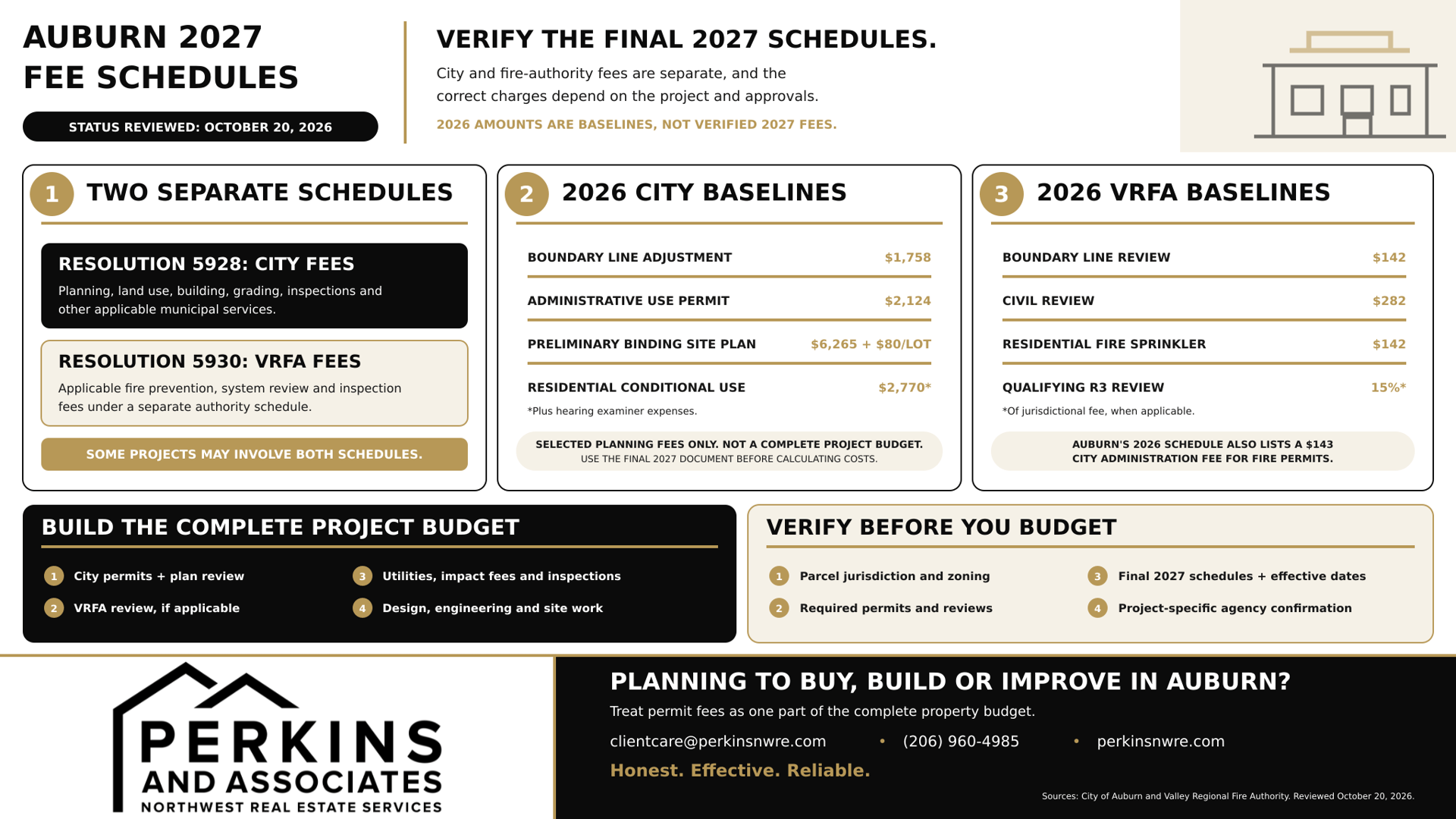
Resolution 5928: City of Auburn fee schedule
Resolution 5928 concerns amendments to Auburn's municipal fee schedule for 2027.
The city's schedule covers a variety of permits, applications, licenses, and administrative services.
For real estate purposes, relevant categories can include:
- Planning and land-use applications
- Building permits
- Mechanical and plumbing permits
- Site review and grading
- Property boundary adjustments
- Certain inspections and additional reviews
Not every category applies to ordinary residential work.
The correct fee depends on the action the applicant requests.
Resolution 5930: Valley Regional Fire Authority fee schedule
Resolution 5930 concerns the Valley Regional Fire Authority, commonly called VRFA.
VRFA provides fire and emergency services to Auburn, Algona, and Pacific.
It also handles applicable fire prevention, fire protection system reviews, and related inspections.
The fire authority maintains its own fee schedule, which is separate from Auburn's city schedule.
For certain projects, both city and fire authority charges can apply.
What happened at the October 19 meeting?
The two resolutions were listed for the October 19 Council meeting.
Auburn also discussed Resolution 5928 during its October 12 study session.
However, the projected agenda is not itself a record of final approval.
Before describing the 2027 fees as adopted, property owners should consult the final resolution records, Council minutes, and official published schedules.
Which Auburn permit fees matter most to homeowners?
The fees that matter depend on what a homeowner wants to do.
An ordinary home improvement may require a different level of review than an addition, new house, or land division.
Some projects may require no building permit, while others involve several separate approvals.
Auburn's Building Services and Permitting Division reviews applications, issues building permits, and performs inspections for work under its jurisdiction.
The division helps ensure that permitted construction, additions, and alterations meet applicable codes and regulations.
Home additions and renovations
A homeowner planning an addition may need permits related to structural work, electrical systems, plumbing, mechanical systems, or other construction components.
Fees depend on the project's scope and valuation.
For example, adding living space may involve different requirements from replacing an existing fixture.
New residential construction
Building a new home can require several forms of review.
Depending on the lot, these may include building permits, utility coordination, drainage review, grading permits, and inspections.
Site conditions can also affect what studies or professional services are required.
Boundary adjustments and land divisions
Owners who want to change property boundaries or create additional lots may need planning approvals.
These applications have their own fee categories.
The cost of a planning application should not be confused with the cost of actually constructing a new residence on the property.
What does Auburn's existing 2026 fee schedule show?
The city's published schedule, effective January 1, 2026, provides specific examples of planning-related application fees.
Application category | Published 2026 fee |
|---|---|
Residential boundary line adjustment | $1,758 |
Administrative use permit | $2,124 |
Preliminary binding site plan | $6,265 plus $80 per lot |
Residential conditional use permit | $2,770 plus hearing examiner expenses |
These figures are taken from Auburn's official 2026 City Fee Schedule.
They are 2026 baseline amounts, not verified 2027 fees.
The table also represents selected planning applications, not a complete residential construction budget.
A project may require more than one application or approval.
Why is there no 2027 comparison table yet?
The exact 2027 charges require confirmation against the final adopted schedule.
A general description of a proposed annual adjustment is not enough to determine every line item.
Some fee categories may follow different calculation methods or include exceptions.
Rather than apply an unverified percentage across the entire 2026 schedule, homeowners should use the official 2027 document once its final amounts and effective date are confirmed.
How are Auburn building permit fees calculated?
Auburn's existing fee structure uses project valuation to calculate certain building permit charges.
For new structures and additions, the city's 2026 schedule refers to construction valuations based on International Code Council information.
For alterations to existing buildings, the valuation generally considers the fair market value of the labor and materials associated with the permitted work.
This means the cost of a building permit is not necessarily a single flat amount for every residential project.
A small alteration and a major addition may fall into different valuation ranges.
The city's schedule also includes separate provisions for plan reviews, inspections, and other services.
Are building permit fees the only costs?
No.
Depending on the project, the owner may also need to budget for:
- Architectural drawings
- Structural engineering
- Site surveys
- Drainage studies
- Utility connections
- Plan review
- Required inspections
- Land-use applications
- Applicable development impact fees
- Fire authority reviews
- Revisions and resubmissions
Not every project requires all these items.
A homeowner should identify the applicable requirements before treating any general fee estimate as the total cost.
How are Valley Regional Fire Authority fees different?
The Valley Regional Fire Authority has its own fee schedule for applicable fire-related services.
Some charges concern building or land-use reviews, while others relate to fire protection systems or inspections.
The authority's official 2026 fee schedule includes several categories relevant to residential and development projects.
For example:
VRFA fee category | Published 2026 amount |
|---|---|
Residential boundary line adjustment review | $142 |
Civil review involving access, fire flow, or related matters | $282 |
Residential fire sprinkler system | $142 |
Qualifying single-family occupancy review requiring fire protection systems | 15% of jurisdictional fee |
The 15% single-family review provision has specific applicability conditions. It should not be treated as a universal charge for every house.
Likewise, a standard renovation does not automatically require a residential fire sprinkler permit.
Could Auburn collect a separate fee for fire authority review?
Yes, depending on the application.
Auburn's 2026 city schedule specifically states that certain Valley Regional Fire Authority review fees may be collected in addition to city fees.
It also lists a $143 city administration fee for fire permits in addition to the applicable VRFA fee.
These are separate fee components under the published 2026 schedule.
Property owners should not assume that paying one agency's fee satisfies every requirement.
Are fire authority permit fees the same as the fire benefit charge?
No.
The fire authority's permitting and inspection fees are distinct from its broader funding system.
According to VRFA's financial information, the authority is supported through a voter-approved fire benefit charge and property-tax revenue.
Those funding mechanisms should not be confused with project-specific plan review or permit charges.
A proposed change to the VRFA permit fee schedule is not, by itself, proof of a change to a homeowner's fire benefit charge.
Could Auburn's 2027 fee changes affect renovation costs?
Changes to permit and review charges may influence a renovation budget when the project requires those services.
However, the impact depends on the particular work.
Consider two homeowners.
One is replacing finishes without making structural changes.
The other is planning a major addition involving new rooms, structural alterations, and utility work.
Their approval requirements may be very different.
Even if the city updates an administrative fee, it does not follow that both projects will experience the same cost change.
Before budgeting, owners should describe the work to Auburn's permitting staff and ask which applications are necessary.
The city's Community Development FAQ provides guidance on common questions about projects and permits.
What should new-construction buyers know?
Municipal fees can be part of the overall cost of delivering a newly constructed home.
Builders may pay expenses associated with land-use approvals, building permits, utility work, required inspections, and impact fees.
But those costs do not translate automatically into an equal increase in the home's sale price.
A builder's pricing also depends on land costs, labor, materials, financing, buyer demand, comparable homes, and competition.
For a buyer considering new construction in Auburn, the more useful questions are:
- Which agency permitted the home?
- Are all required approvals in place?
- Have applicable fees been paid?
- Are any charges deferred?
- Is construction complete?
- Are final inspections and occupancy approvals required or outstanding?
- Does the purchase agreement assign any unpaid cost to the buyer?
Buyers should review their contracts and closing documents rather than assume that every development fee is already reflected in the advertised base price.
Our guide to King County's proposed 2027 school impact fees explains how a separate type of development charge may affect qualifying new housing in unincorporated areas.
Are Auburn permit fees the same as property taxes or impact fees?
No. These costs serve different purposes and arise under different rules.
Permit and application fees are charged for particular government services, reviews, or approvals.
Development impact fees may be assessed on qualifying development to help fund eligible public infrastructure.
Property taxes are recurring obligations associated with a property's assessed value and applicable taxing districts.
Utility charges relate to services or connections such as water, sewer, and stormwater.
Fire authority review fees are project-specific charges for applicable fire-related services.
These categories should be examined separately.
For example, Auburn's transportation impact fee program addresses the transportation facilities associated with growth and qualifying development.
That is a different subject from the ordinary application fee for a building permit.
For another South King County example, see our article about Black Diamond's transportation impact fee update.
What if a property has an Auburn mailing address but is outside city limits?
Property owners should verify the legal permitting jurisdiction before relying on Auburn's municipal fee schedule.
A mailing address does not always establish whether a parcel is within the city.
Some properties near Auburn are located in unincorporated King County or Pierce County.
Those properties may be subject to a different permitting authority.
The city's Commonly Used Forms page includes property-jurisdiction guidance and information about applying through MyBuildingPermit.com.
This is particularly relevant when buyers are considering acreage, redevelopment land, or properties near municipal boundaries.
The correct permit-issuing authority determines which local processes and fees apply.
How can Auburn homeowners estimate permit costs before starting a project?
An accurate estimate begins with the specific property and the work being planned.
Step 1: Verify the property's location
Confirm the parcel number, legal jurisdiction, and zoning.
Step 2: Describe the proposed work
Determine whether the project involves an addition, alteration, new construction, subdivision, or another activity requiring approval.
Step 3: Ask which permits are required
Contact Auburn's Building Services and Permitting Division.
Different approvals may be needed for building, land use, grading, utilities, and fire protection.
Step 4: Review the applicable fee schedule
Check the official schedule for the calendar year and application date.
For work that begins in late 2026 but continues into 2027, ask the city when the applicable fee amount is determined.
Step 5: Confirm additional charges
Ask whether the project may involve separate review, inspection, resubmission, utility, impact-fee, or VRFA expenses.
Step 6: Include professional services and contingency costs
Architectural drawings, engineering, site work, and unexpected construction conditions can influence the budget.
Step 7: Obtain project-specific confirmation
A preliminary online estimate is useful, but final charges should be verified with the appropriate agency.
The city directs applicants to MyBuildingPermit.com for many electronic permit submissions.
What should homeowners watch as Auburn moves toward 2027?
The most important next step is publication or confirmation of the final 2027 city and fire authority fee schedules.
Homeowners should watch for:
- Final Council actions on Resolutions 5928 and 5930
- Published adopted resolutions
- The final 2027 city fee schedule
- The final VRFA fee schedule
- Effective dates and any transition rules
- Changes to individual fees relevant to residential projects
- New application or permit guidance
Owners should compare the correct line items in the 2026 and 2027 schedules rather than assume a single adjustment percentage applies to every category.
Expert insight: Understand the entire project budget before buying or building
The cost of a home improvement project is rarely explained by one fee.
A property may appear suitable for a new structure but require expensive utility work, engineering, or site improvements.
A buyer may see room for an addition without realizing that setbacks, lot coverage, drainage, or other conditions limit what can be built.
For homeowners and buyers in Auburn, the practical starting point is to verify what the property can support and what approvals would be required.
Permit fees then become one part of a more complete budget.
At Perkins & Associates, we help clients evaluate the real estate considerations surrounding property purchases, sales, and improvement plans.
For technical requirements, owners should work directly with Auburn's permitting staff and the appropriate licensed professionals.
That approach helps avoid basing a major property decision on an incomplete estimate.
Frequently asked questions
Has Auburn approved its 2027 fee schedule?
Resolutions 5928 and 5930 were scheduled for consideration on October 19, 2026. The final voting outcomes have not been independently verified in the official records reviewed as of October 20.
How much will Auburn's building permit fees increase in 2027?
A final category-by-category increase has not been verified for this article. The city's adopted schedule should be compared with its 2026 baseline before citing exact changes.
Does every Auburn homeowner have to pay the new fees?
No. Many city and fire authority fees apply only when a particular service, permit, or review is required.
Are fire authority fees separate from city permit fees?
They can be. Auburn's existing fee schedule allows certain VRFA charges to be collected in addition to city fees.
Does every single-family home need a separate VRFA review fee?
Not necessarily. The VRFA schedule contains specific applicability rules. The single-family occupancy review percentage applies to qualifying occupancies that require fire protection systems.
Can a building permit involve several charges?
Yes. Depending on the project, there may be separate charges for permits, plan reviews, inspections, and additional agency requirements.
Will Auburn's 2027 permit fees automatically increase property taxes?
No. Project-specific permit fees and recurring property taxes are different obligations.
Could fee changes increase new-home prices?
Fees may influence development costs, but there is no basis to assume a particular fee adjustment will produce the same increase in a home's final selling price.
What if my home has an Auburn mailing address but is outside city limits?
Verify the legal jurisdiction. A property outside Auburn city limits may be permitted by another government and follow a different fee schedule.
Helpful resources
- City of Auburn: Council projected agenda
- City of Auburn: Official documents and fee schedules
- City of Auburn: 2026 fee schedule
- City of Auburn: Building Services and Permitting
- City of Auburn: Community Development FAQ
- Valley Regional Fire Authority: 2026 fee schedule
- Valley Regional Fire Authority: Financial documents
- City of Auburn: Commonly Used Forms
Planning to buy, sell, or improve property in Auburn?
Whether you're considering a home renovation, evaluating a new-construction purchase, or exploring a property with development potential, understanding the applicable approvals is part of making an informed decision.
Perkins & Associates helps buyers and sellers throughout Auburn and South King County evaluate property characteristics, local market conditions, and real estate opportunities.
If your plans involve future construction or substantial improvements, our team can help you consider the real estate implications while encouraging the right professional and permitting due diligence.
Contact Perkins & Associates to discuss your next move.