King County launches permitting reform initiative: What homeowners and builders should know
If you're planning to build a home, add living space, or construct an accessory dwelling unit in unincorporated King County, the permitting process deserves attention long before construction begins.
Property owners need to know which approvals are required, how long reviews may take, and whether the property can legally support the proposed improvements.
King County is now examining how that process could work more efficiently.
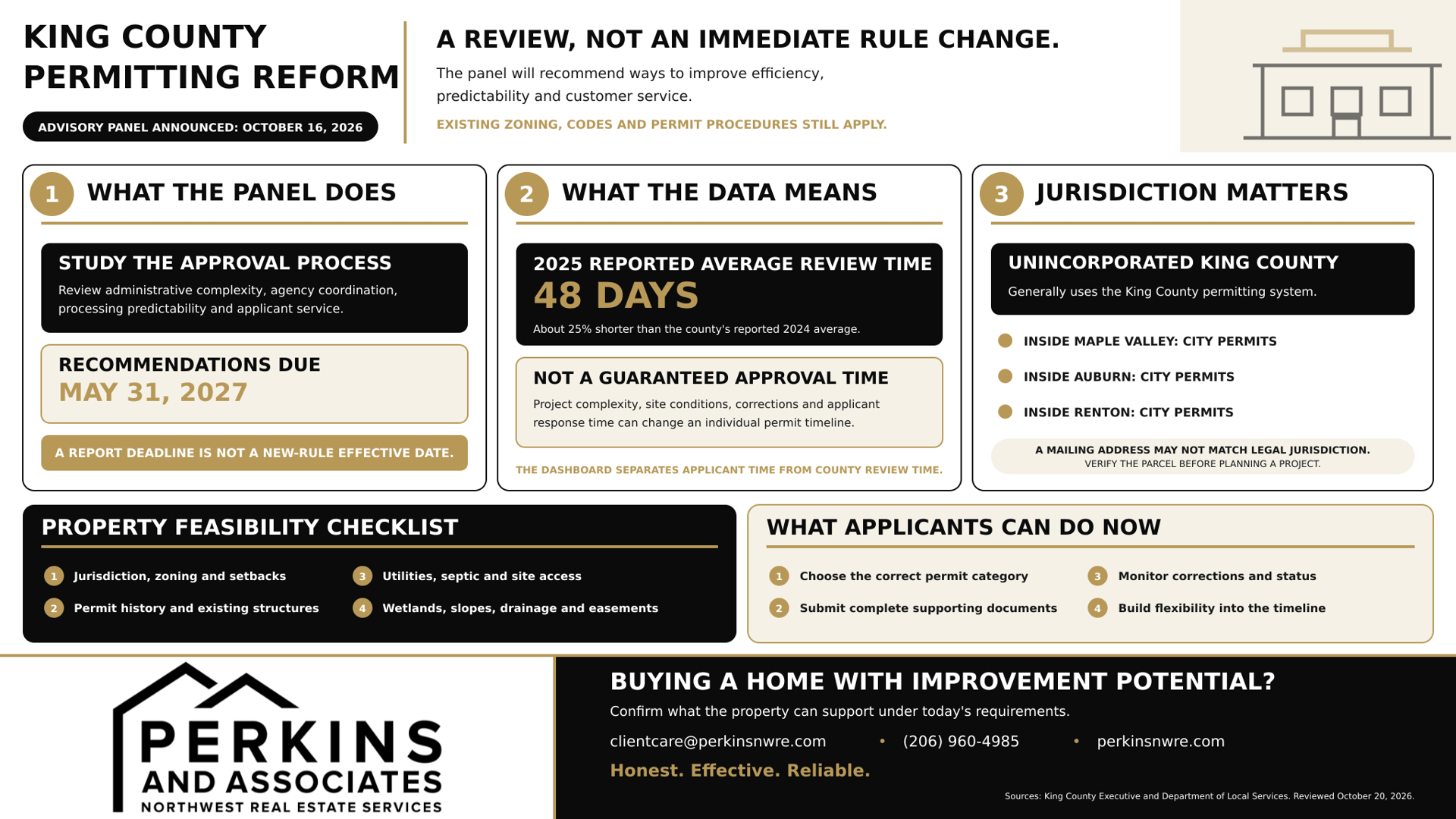
On October 16, 2026, County Executive Girmay Zahilay announced a new Permitting Advisory Panel tasked with reviewing county permitting procedures and recommending improvements.
The announcement follows earlier efforts to reduce review times, make permitting information easier to access, and expand customer assistance.
For homeowners, buyers, and builders, the most important distinction is that the advisory panel is reviewing the system, not changing the rules immediately.
Existing zoning, building codes, environmental requirements, and application procedures remain in place unless they are formally changed.
Key takeaways
- King County announced its Permitting Advisory Panel on October 16, 2026.
- The panel will review permitting procedures and recommend ways to improve efficiency and predictability.
- King County reported an average permitting review time of 48 days in 2025, approximately 25% shorter than in 2024.
- The panel's recommendations are due May 31, 2027.
- King County has already introduced a residential permitting dashboard and expanded customer assistance.
- The new panel has not adopted changes to building codes, zoning, or permit requirements.
- County permitting generally applies to unincorporated King County, not properties inside incorporated cities.
- Homeowners should continue using existing permit procedures when planning improvements.
What is King County's new Permitting Advisory Panel?
The Permitting Advisory Panel is a group established to review how King County processes building and development approvals.
According to the King County Executive's October 16 announcement, the panel will examine opportunities to improve permitting while maintaining appropriate building safety, public health, and environmental protections.
The county identified several objectives, including reducing unnecessary administrative complexity, improving coordination between agencies, and making the application process more predictable.
The panel includes people with experience in:
- Residential and affordable housing development
- Architecture and engineering
- Land-use and permitting procedures
- Local government
- Labor and construction
- Small business operations
- Utility and wastewater systems
The county also plans to gather input from rural and urban communities, environmental groups, agricultural interests, and Tribal governments.
That range of perspectives matters because development approvals involve more than building plans.
A residential project may require coordination involving utilities, drainage, road access, environmental conditions, and multiple government departments.
When will the panel release its recommendations?
The panel is scheduled to submit a report to the County Executive by May 31, 2027.
That is a reporting deadline, not the date new rules automatically take effect.
Specific recommendations may require additional administrative work, public review, budget decisions, or changes to county regulations.
Homeowners should not assume that a future recommendation will apply to a project already in progress.
How long does it take to get a building permit in King County?
The time depends on the project, the required reviews, and the completeness of the application.
In its October 16 announcement, King County reported that average permitting review time in 2025 was 48 days, representing a 25% reduction from 2024.
That figure describes the county's reported review performance. It does not mean every building permit is approved within 48 calendar days.
A relatively straightforward residential alteration may require fewer reviews than a custom home on undeveloped land.
For example, a new house may require information about:
- Zoning and setbacks
- Site access and driveways
- Water and sewer connections
- Septic system feasibility
- Stormwater and drainage
- Steep slopes or critical areas
- Structural design and building codes
- Required inspections
Some applications also involve corrections or additional documentation before the review can continue.
What does King County's permitting dashboard measure?
King County provides an online tool showing how long it takes to reach a residential permit decision.
The residential permitting timeline dashboard separates different types of processing time.
The county's permitting reports guidance explains that the dashboard:
- Covers qualifying residential building permits applied for after January 1, 2025.
- Includes permits issued within the previous 12 months.
- Separates time spent by applicants from county review time.
- Does not include canceled or incomplete applications.
The dashboard and the county's broader 2025 average are different measurements.
Homeowners should use the dashboard to understand recent processing patterns, not as a guaranteed completion date.
What permitting improvements has King County already made?
King County's new advisory panel builds on changes already underway.
The October announcement identifies several examples.
More information about processing times
The residential permitting dashboard gives applicants access to information that can help with project planning.
It also makes it easier to distinguish time spent in county review from time spent responding to application requirements.
Expanded customer assistance
King County reported expanding walk-up permitting assistance to four days per week at its Renton permitting offices.
Technical specialists are also available during designated periods to answer more detailed questions.
The county has continued offering assistance in other communities, including Fall City and Vashon-Maury Island.
Temporary service notice: King County has announced that permitting customer-service hours will temporarily move to Renton Library, 100 Mill Avenue S, from October 26 through November 6, 2026.
During that period, published service hours are Monday through Thursday, 10:30 a.m. to 3:30 p.m. Reviewers will not be at the library on Thursdays.
Applicants should verify the latest schedule before visiting.
Improvements to digital systems
The county is exploring technology that could improve application processing and customer service.
It has also established funding for a unified permitting platform intended to replace older systems that do not work seamlessly together.
These changes concern how applications are managed.
They do not remove the requirement to obtain approvals or comply with building and land-use standards.
What could permitting reform mean for homeowners planning improvements?
A more predictable permit process could make it easier for homeowners to plan projects, but the actual benefit will depend on which recommendations are eventually adopted.
Consider a homeowner who wants to add a bedroom, convert an existing structure, or build a detached accessory dwelling unit.
Before construction begins, the owner may need to verify:
- Whether the proposed use is allowed.
- Which permits and technical studies are required.
- Whether utilities can support the project.
- Whether the lot has environmental or access constraints.
- How inspections and final approvals will be handled.
Improving the administrative process could help applicants understand these requirements more clearly.
But a faster review does not change the physical characteristics of a property.
For example, a lot with limited septic capacity, insufficient setbacks, or a protected wetland may still face restrictions even if the application system becomes more efficient.
The county's single-family residential permit process explains the procedures for new homes, additions, alterations, and certain accessory structures.
Could the initiative make accessory dwelling units easier to build?
It may eventually improve how qualifying ADU applications are processed, but the advisory panel has not announced any new ADU eligibility rules.
An accessory dwelling unit, or ADU, is an additional residential unit located on the same property as a primary home.
It may be located within the main house, attached to it, or built as a separate structure.
Washington's recent ADU legislation has expanded options for eligible properties, but zoning, utility capacity, environmental restrictions, and local permit requirements still matter.
For homeowners considering an ADU, the essential questions remain:
- Is the property in an eligible zoning area?
- Does the lot have sufficient space?
- Are setbacks, access, and height requirements satisfied?
- Is the property connected to sewer or served by septic?
- Are water, power, and other utilities adequate?
- Are there wetlands, steep slopes, or drainage restrictions?
- What permits and inspections will be required?
A future administrative reform would not automatically resolve those questions.
For more details, see our King County ADU guide for homeowners.
Our separate article on Washington ADU rules under HB 1337 explains the statewide legal framework.
Does King County's permitting initiative apply to Maple Valley, Auburn, or Renton?
The county's permitting division generally serves unincorporated King County. Properties within incorporated cities are normally subject to their respective city permitting systems.
This distinction matters throughout South King County.
A property with a Maple Valley mailing address is not necessarily inside Maple Valley city limits.
Some properties with familiar city mailing addresses are legally located in unincorporated King County.
For example:
Property location | General permitting authority |
|---|---|
Inside Maple Valley city limits | City of Maple Valley |
Unincorporated area with a Maple Valley mailing address | King County |
Inside Auburn city limits | City of Auburn |
Inside Renton city limits | City of Renton |
Other unincorporated King County locations | King County |
The correct authority depends on the property's legal jurisdiction, not simply the postal city shown in an address.
Before planning a project, owners should use the county's property research and mapping resources to verify jurisdiction, zoning, and possible site constraints.
This step is especially useful for people purchasing acreage or homes near city boundaries.
What should buyers check before purchasing a home with improvement potential?
Buyers should confirm what can legally and physically be built before treating future development potential as a benefit of the property.
A listing might mention room for an ADU, space for an addition, or the possibility of another home.
Those descriptions are not substitutes for permit approval or a property-specific feasibility review.
Confirm zoning and jurisdiction
Determine which government controls the property and which development rules apply.
Research existing permits
Check whether major structures and improvements have a documented permit history.
King County provides permit records research resources for properties under its jurisdiction.
Records may help identify prior applications, issued permits, and relevant project history.
Review site conditions
A property may have characteristics that affect construction, including:
- Drainage easements
- Wetlands and streams
- Steep slopes
- Existing septic systems
- Utility access
- Property-line setbacks
- Recorded development conditions
These issues can influence construction feasibility even when zoning allows a proposed use.
Consult qualified professionals
For complex projects, an architect, engineer, surveyor, septic designer, or other qualified specialist may be necessary.
The right combination depends on the property and the work being proposed.
A buyer should not rely on a general expectation of future permitting reform to resolve an existing site limitation.
How much should homeowners budget for permits?
Permit expenses vary based on the project and the reviews required.
King County publishes fee information for single-family residential work, additions, land-use permits, and other applications.
Its official permit fee page identifies 2026 fee changes, including an approximately 14% increase to many permit-related fees and a $126 application screening fee for most applications.
These changes took effect January 1, 2026, under a separately adopted county ordinance. They were not created by the new October 2026 advisory panel.
Actual costs may also include:
- Architectural or engineering plans
- Site surveys and technical studies
- Utility work
- Drainage or stormwater improvements
- Construction-related inspections
- Applicable development impact fees
- Application revisions or additional reviews
A property owner planning an addition should request a complete budget from the relevant professionals and permitting agency.
For buyers researching development costs, our article on King County's proposed 2027 school impact fees explains another category of possible charges.
What can applicants do now to avoid unnecessary permitting problems?
The most practical step is to prepare a complete, accurate application under the rules already in effect.
1. Research the property before hiring a designer
Confirm jurisdiction, zoning, site constraints, existing structures, and required approvals.
2. Identify the correct permit category
An addition, ADU, new home, or land division may follow a different review process.
3. Understand what supporting documents are required
Incomplete plans or missing technical information can create additional work for applicants and reviewers.
4. Check application procedures and fees
King County's online permit submission guidance explains which applications can be submitted through MyBuildingPermit.com and which may follow other procedures.
5. Monitor application status and respond to correction requests
Applicants should pay attention to requests for clarification or revised plans.
6. Build flexibility into the project timeline
Approval periods may vary based on application complexity, site conditions, and required coordination.
A contractor's estimated construction start date should not be treated as a confirmed permit approval date.
Could permitting reform help King County build more homes?
A clearer, more predictable permitting process may make some projects easier to plan and coordinate.
For builders, administrative time can be part of the overall development budget.
For buyers, permitting procedures may influence when a newly constructed home becomes available.
However, the cost and pace of homebuilding depend on several factors beyond permit review.
Those include:
- Land availability and zoning
- Financing and interest rates
- Construction labor and materials
- Roads and utility capacity
- Environmental requirements
- Market demand
- Available housing inventory
Permitting improvements do not guarantee lower home prices or immediate increases in housing supply.
The advisory panel's work should be assessed based on its actual recommendations and any changes the county later implements.
What should homeowners watch next?
The primary milestone is the panel's report, due May 31, 2027.
Before then, homeowners can monitor the county's permitting announcements, application requirements, and processing-time information.
Future developments worth following include:
- Publication of the panel's recommendations
- Proposed changes to permit review procedures
- Updates to online application systems
- Adjustments to customer-service availability
- Formal amendments to applicable county regulations
Any future announcement should be evaluated on its own terms.
A recommendation to simplify a process is not the same as an approved regulatory change.
Expert insight: Start with property feasibility, not the possibility of faster permits
For buyers and homeowners in South King County, the practical starting point is understanding what a property can support under today's requirements.
An attractive backyard might appear large enough for an ADU, but its usable building area could be limited by setbacks, easements, drainage, or utilities.
A home might have space for an addition, but the project could require structural improvements or other work that affects the total budget.
These questions should be investigated before relying on potential future construction.
At Perkins & Associates, our approach is to help clients evaluate the real estate side of a property decision while encouraging the appropriate technical due diligence.
A more efficient permitting process may be helpful. But the best purchase and improvement decisions will still depend on accurate property information, realistic project costs, and qualified professional guidance.
Frequently asked questions
What is the King County Permitting Advisory Panel?
It is a group established in October 2026 to review county permitting procedures and recommend ways to improve efficiency, predictability, and customer service.
Have King County building permit rules changed?
The panel's creation did not itself change building codes, zoning requirements, or other permit regulations.
How long does a residential building permit take in King County?
Timelines vary by application. The county reported an average permitting review time of 48 days in 2025, but that figure is not a guarantee for an individual project.
Does the initiative apply to properties in Maple Valley?
It generally concerns King County's permitting system for unincorporated areas. Properties within Maple Valley city limits ordinarily use the city's permitting department.
Could ADU permits become easier to obtain?
The panel may recommend administrative improvements. No specific new ADU approval rules have been established through the announcement.
Do homeowners still need building permits during the review process?
Yes. Existing permit requirements remain applicable unless formally changed.
Will permitting reform reduce new-home prices?
There is no verified basis to predict a specific home-price change from the advisory panel's announcement.
When are the recommendations expected?
The panel is scheduled to submit its report by May 31, 2027.
Helpful resources
- King County Executive: October 16, 2026 permitting announcement
- King County residential permitting timeline dashboard
- King County permitting reports and dashboard methodology
- King County single-family residential permit process
- King County property research and maps
- King County building and land-use permit fees
- King County permit submission guidance
- King County permit records research
Thinking about buying or improving property in South King County?
Whether you're considering a home with space for an ADU, evaluating rural acreage, or comparing new construction with an existing property, understanding the permitting process can help you make better-informed decisions.
Perkins & Associates helps buyers and sellers throughout Maple Valley and South King County evaluate property characteristics, neighborhood conditions, and real estate opportunities.
For technical questions about building permits, utilities, engineering, or development approvals, property owners should work directly with the appropriate permitting agency and qualified professionals.
Contact Perkins & Associates to discuss your real estate plans.