Auburn Proposition 1 in 2026: What the $491 Million School Bond Could Mean for Homeowners
Auburn School District voters will decide Proposition 1 on November 3, 2026. The measure would authorize up to $491 million in bonds to build a fifth middle school and replace Cascade Middle School and Alpac Elementary School.
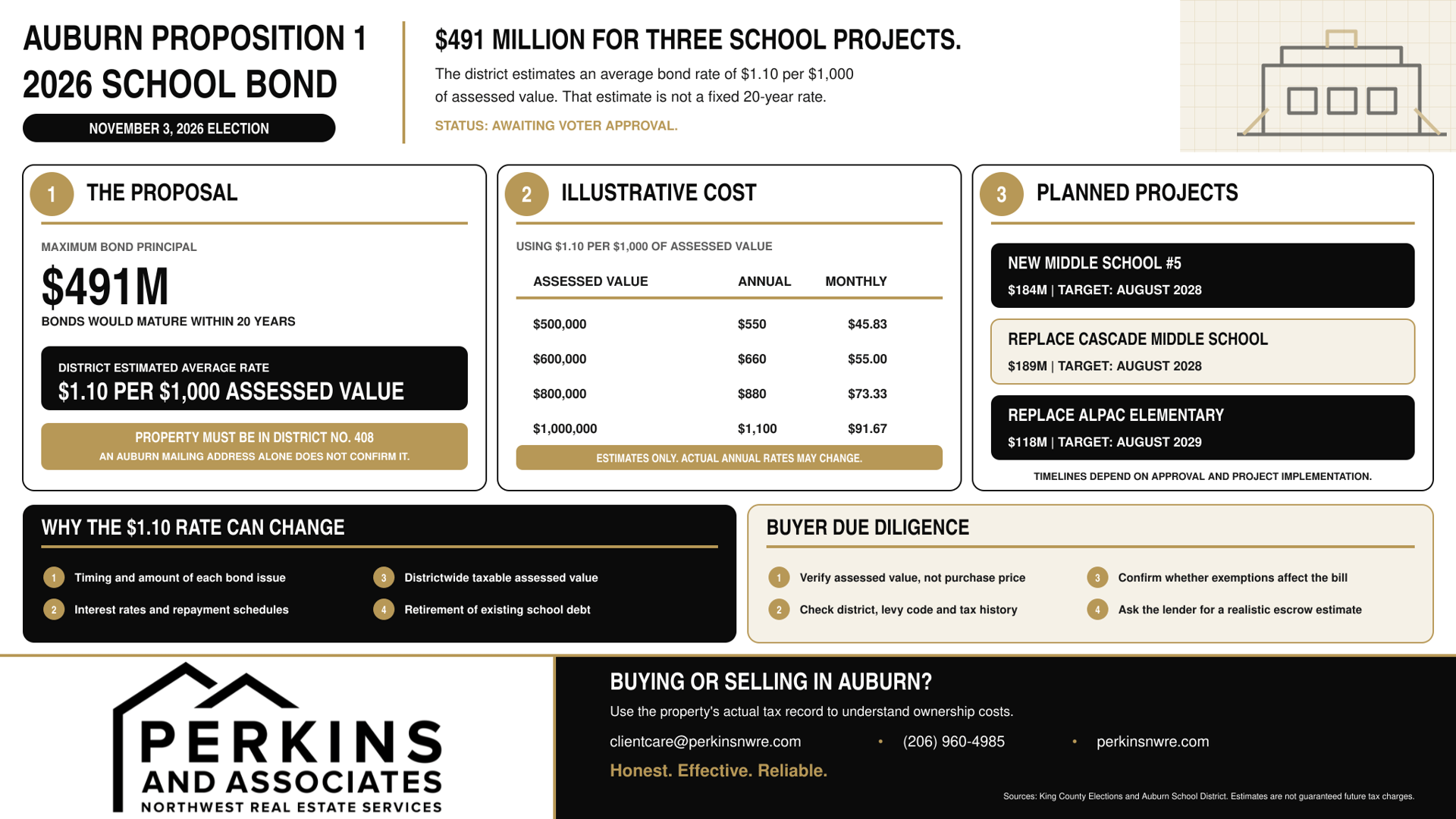
The district estimates the proposed bond would cost an average of $1.10 per $1,000 of assessed property value, equal to approximately $660 annually or $55 monthly for a home assessed at $600,000.
That estimate is a useful starting point, but it is not a guaranteed annual tax rate for the next 20 years.
For homeowners and buyers, the potential impact depends on the property's assessed value, whether it falls within Auburn School District No. 408, and how the proposed bond would interact with existing school property taxes.
Here's what to understand before the November election.
Key takeaways
- Election date: November 3, 2026.
- Proposed bond: Up to $491 million for three school construction projects.
- Estimated average bond tax rate: $1.10 per $1,000 of assessed property value, or approximately $55 per month on a $600,000 assessment.
- Bond repayment: Bonds would mature within 20 years, with annual tax rates that could change.
- Affected properties: Taxable properties within Auburn School District No. 408, including portions of King and Pierce counties.
- Estimated state assistance: Approximately $36.25 million, subject to the district receiving the anticipated funding.
- Important distinction: The proposed bond's estimated tax rate is not the same as Auburn School District's total property-tax rate.
- Homebuyer consideration: Review the property's actual tax records and school district before estimating future monthly payments.
The proposal is still awaiting voter approval as of October 13, 2026.
What is Auburn Proposition 1 in 2026?
Auburn Proposition 1 is a proposed school construction bond that would allow Auburn School District No. 408 to borrow up to $491 million for three school building projects.
According to the official King County Elections ballot explanation, the district would repay the bonds through annual excess property-tax levies. The bonds would mature within 20 years.
The measure requires at least 60% voter approval and must meet Washington's minimum voter-turnout requirement for school bonds.
Approval would authorize the district to issue the bonds. It would not mean that every dollar is borrowed immediately or that all construction costs are collected through one year's property taxes.
For Auburn-area residents, the proposal raises two separate questions: what school facilities would be built, and how would the financing affect future property-tax bills?
What would the $491 million Auburn school bond pay for?
The proposal would fund one new middle school and replacements for two existing schools.
The district's current construction estimates are:
School project | Estimated cost | Planned completion |
|---|---|---|
New Middle School #5 | $184 million | August 2028 |
Cascade Middle School replacement | $189 million | August 2028 |
Alpac Elementary replacement | $118 million | August 2029 |
Total | $491 million |
These dates are the district's proposed schedule if voters approve the measure. Actual timelines would depend on project implementation.
New Middle School #5
The district proposes building its fifth middle school on district-owned property along Sumner-Tapps Highway East.
The new campus is intended to provide additional classroom space and help address crowding across Auburn's existing middle schools.
The district reported that more than 1,100 middle school students attended classes in 43 portable classrooms during the 2025-26 school year, with two more portables being added for 2026-27.
Cascade Middle School replacement
Cascade Middle School would be replaced with a larger campus on district property near I Street NE and 40th Street NE in Auburn.
The existing building is approximately 59 years old. The district says the replacement would provide additional classroom capacity, updated learning spaces, and improved access and athletic facilities.
The existing Cascade site would be retained for possible interim or future district uses.
Alpac Elementary replacement
Alpac Elementary School would be rebuilt at its current site in Pacific.
The school is approximately 54 years old. The replacement project is intended to provide more capacity and updated facilities.
How much state funding is expected?
The district estimates that approximately $36.25 million in state school construction assistance could be available if Proposition 1 is approved.
That amount is anticipated assistance, not guaranteed funding.
The proposed $491 million is the maximum bond principal authorized by the measure. It should not be confused with the total principal and interest that may be repaid over time.
Project estimates, timelines, and financing details are available in the district's 2026 Election Information Book.
How much could Auburn Proposition 1 cost homeowners?
Auburn School District estimates the proposed bond would cost an average of approximately $1.10 per $1,000 of assessed property value.
For a home assessed at $600,000, that equals approximately $660 per year, or $55 per month.
Here is how that estimate applies to other assessed property values.
Assessed property value | Estimated annual bond cost | Monthly equivalent |
|---|---|---|
$500,000 | $550 | $45.83 |
$600,000 | $660 | $55.00 |
$700,000 | $770 | $64.17 |
$800,000 | $880 | $73.33 |
$1,000,000 | $1,100 | $91.67 |
Important: These are illustrative costs calculated using the district's estimated average bond rate of $1.10 per $1,000 of assessed value. Actual annual rates and property-tax bills may differ.
The examples also assume the property is fully taxable and does not qualify for a relevant exemption.
The district explains its calculation in its 2026 School Bond Questions and Answers.
Why assessed value matters more than purchase price
A property's assessed value is the value established by the county assessor for property-tax purposes.
It is not necessarily the home's current listing price, purchase price, or estimated market value.
For example, a buyer purchasing an Auburn home for $750,000 should not automatically calculate the proposed bond tax using that purchase price.
The buyer should verify the county's assessed value and applicable tax record.
This becomes particularly important for buyers comparing older resale properties, newly built homes, and properties across different taxing districts.
Is Auburn's proposed $1.10 school bond tax rate fixed for 20 years?
No. The $1.10 figure is an estimated average rate, not a guaranteed fixed tax rate for every year of the proposed bond.
The distinction matters because the district would not necessarily issue all $491 million in bonds at the same time.
According to its election information book, the district's financing model anticipates multiple bond issues.
The amount collected through annual debt-service levies would depend on factors including:
- When bonds are issued.
- The interest rates and repayment schedules established when bonds are sold.
- The district's taxable assessed property value.
- The retirement of existing school debt.
- The annual amount needed to meet bond repayment obligations.
As those factors change, the amount charged per $1,000 of assessed value can change.
The district's detailed projections show estimated new-bond tax rates changing over time.
That means homeowners should not assume that paying $55 per month in an illustrative calculation translates into exactly $55 per month for 20 years.
The final amount would depend on annual property-tax calculations and the district's actual financing.
Would Auburn's total school property-tax rate increase by exactly $1.10?
Not necessarily. Auburn School District's estimated average bond rate of $1.10 per $1,000 of assessed property value should not be interpreted as an exact increase to every homeowner's existing school property-tax rate.
The district collects several types of local school taxes, including educational programs and operations levies, capital levies, and bond repayment levies.
These different taxes may change over time as existing obligations expire, new bonds are issued, and assessed property values change.
The district's detailed financing projections also show that the proposed new bond's annual tax rate could vary throughout the repayment period.
For example, the district's estimated average rate of $1.10 per $1,000 would equal approximately $660 per year for a property assessed at $600,000. However, this is an illustration based on the district's stated estimate, not a guaranteed annual charge or a prediction that the homeowner's total tax bill would increase by exactly $660.
Actual property taxes would depend on the property's taxable assessed value, applicable exemptions, the annual tax rates established, and other taxing districts.
For homeowners, the most reliable starting point is the property's official tax record, followed by the district's current financing information.
Readers can review the Auburn School District 2026 Election Information Book for the underlying financial projections.
For a broader explanation, see our guide to how King County property taxes and local taxing districts work.
The practical takeaway is simple: the proposed bond is one part of a larger property-tax calculation.
Does Auburn Proposition 1 affect every homeowner with an Auburn address?
No. The proposed bond tax would apply to taxable property within Auburn School District No. 408, not automatically to every property with an Auburn mailing address.
This is especially relevant because Auburn School District crosses city and county boundaries.
The district includes portions of:
- Auburn
- Algona
- Pacific
- Lake Tapps
- Unincorporated King County
- Nearby areas of Pierce County
A home's mailing address does not establish its school district.
Two homes with similar prices and nearby locations may be assigned to different school districts and therefore have different school-tax obligations.
How to check whether your home is within Auburn School District
Start with the property's official county records.
King County residents can use the King County Parcel Viewer to locate property details and review the parcel's taxing districts and levy code.
For properties in Pierce County, begin with the Pierce County Assessor-Treasurer.
The Auburn School District boundary lookup can help residents verify district attendance boundaries using a property address.
For tax purposes, confirm the property's applicable taxing district through county records rather than relying only on an enrollment lookup.
This extra step is worthwhile for homebuyers comparing properties near district or county boundaries.
What should Auburn homebuyers verify before making an offer?
Buyers should verify the property's current assessed value, actual property-tax bill, school district, and possible changes to ownership costs before making an offer.
A listing's displayed tax amount is a useful reference, but it may not tell the complete story about a future owner's taxes.
Before purchasing a home in Auburn or a nearby community, review these six items.
1. Current assessed value
Find the assessment used for property-tax purposes and distinguish it from the purchase price.
2. Annual property-tax history
Review the current tax bill and, when available, previous years.
This helps identify changes that may require additional explanation.
3. School district and levy code
Check which school district actually taxes the property.
This matters especially for homes near Auburn, Pacific, Algona, and county boundaries.
4. Current owner exemptions
Ask whether the current owner's tax bill reflects a senior, disability, or other exemption.
A buyer should not assume an exemption tied to the seller's eligibility will continue after the sale.
5. Lender's escrow estimate
Ask the lender to calculate the estimated monthly housing payment using realistic property taxes.
Property taxes are often collected through the mortgage payment and held in escrow for later payment.
6. Future ownership costs
Consider potential tax changes alongside homeowners insurance, maintenance, utilities, and other recurring expenses.
If you are comparing newly built and existing properties, our guide to new construction versus resale homes in Auburn explains other costs worth reviewing.
What about sellers?
Sellers can benefit from having current property-tax records available when preparing a listing.
These records help prospective buyers understand the property's existing tax obligations and ask informed questions about future costs.
A proposed bond does not automatically determine a home's selling price, but property taxes can be one factor in a buyer's affordability comparison.
Has Auburn voted on these school projects before?
Yes. Auburn School District voters considered related construction bond proposals in both 2024 and 2025.
Neither proposal received the 60% supermajority required for approval.
November 2024
The district proposed approximately $532.1 million in bonds.
That package included the new fifth middle school, replacement of Cascade Middle School, replacement of Alpac Elementary, and additional improvements at other schools and support facilities.
The measure received approximately 55.05% support, below the required threshold.
November 2025
The district returned with a revised construction bond of approximately $490 million.
The three main school construction projects remained, while other facility and technology improvements were presented through a separate capital levy.
The bond received approximately 54.05% support and did not pass.
The separate capital levy passed.
What changed for 2026?
The current proposal is approximately $491 million and continues to focus on the same three construction projects.
One notable adjustment is the proposed construction schedule. The district now plans for the new fifth middle school and replacement Cascade Middle School to open around the same time in 2028, rather than opening the schools one after another.
These are related proposals, but they are not three identical bond packages.
The district's 2026 election book describes the previous measures, voting outcomes, and revised construction timeline.
Is a school bond the same as a school levy or school impact fee?
No. These are different school-funding mechanisms.
School bond: Long-term borrowing generally used for major construction or capital projects. Voters authorize the borrowing, and property taxes are collected to repay the debt.
School levy: A property-tax collection approved for a defined period to support eligible school purposes, such as educational programs, technology, or capital improvements.
School impact fee: A fee associated with qualifying new residential development to help fund eligible school facilities needed because of development-related growth.
The proposed Auburn bond is financed through district property taxes, while impact fees are generally connected to the development and permitting process.
Homebuyers should not treat them as interchangeable.
For a more detailed explanation, read our article on how school impact fees differ from voter-approved school bonds.
Could seniors and homeowners with disabilities qualify for school bond tax relief?
Yes. Eligible participants in Washington's property-tax exemption program may be exempt from local excess property taxes, including qualifying school bond levies, on their primary residence.
This relief is not available automatically to every senior or homeowner with a disability. Eligibility depends on the program's requirements, including qualifying status, property ownership, occupancy, and combined disposable income.
What changes in 2027?
Washington already provides qualifying exemption participants with relief from local excess property taxes.
For taxes collected beginning in 2027, legislation also expands certain eligibility and exemption benefits, including broader state school levy relief.
According to the Washington Department of Revenue's guidance, the changes apply to property taxes collected in 2027.
For tax years 2027 through 2029, the maximum combined disposable income thresholds for the exemption program are:
- King County: $101,000
- Pierce County: $85,000
The counties also have lower income thresholds that determine additional levels of relief.
These figures are not simply gross household income limits. Washington uses a specific combined disposable income calculation.
Homeowners can review the official county-by-county exemption thresholds.
For King County residents, our article on 2027 property tax relief for qualifying seniors and people with disabilities provides a more detailed explanation.
Homeowners should verify their eligibility with their county assessor before relying on an exemption in their financial plans.
Could the school bond affect Auburn home values?
There is not enough evidence to predict a specific increase or decrease in Auburn home values from Proposition 1 alone.
School facilities can be one consideration for buyers evaluating communities. Property taxes can also influence monthly affordability.
But neither factor determines home prices on its own.
A home's value also depends on location, condition, comparable sales, housing supply, buyer demand, financing conditions, and other property-specific factors.
It would be misleading to claim that replacing schools will automatically raise nearby home values or that a new bond will necessarily lower them.
For someone buying or selling in Auburn, the more useful approach is to evaluate the property's current market conditions and ownership costs rather than trying to forecast an exact price change from a ballot measure.
What happens after the November 3, 2026 election?
The next steps depend on the election result.
If Proposition 1 is approved
The district would receive authorization to issue bonds within the approved amount and begin implementing the financing and construction plans.
Homeowners should monitor the actual bond issuance schedule, future assessed valuations, annual debt-service levies, construction updates, and anticipated state assistance.
The district's published estimates should not be treated as final property-tax bills.
If Proposition 1 is not approved
The proposed bond authorization would not take effect.
The district would need to evaluate how to address the facilities included in the proposal and determine whether to pursue a revised plan or other options.
The outcome would not, by itself, establish what future funding proposal the district might consider.
Expert insight: Look at the property, not just the estimated tax rate
For homeowners and buyers in Auburn and South King County, the most useful question is not simply whether the proposed bond costs an average of $1.10 per $1,000.
It is how a specific property's taxes fit into the household's full ownership budget.
A home with an Auburn mailing address may fall in a different school district. An exemption on the current tax bill may not apply to the next owner. And a future tax estimate may change as assessed values and annual levies change.
At Perkins & Associates, we encourage buyers and sellers to look at those details before making a real estate decision.
For buyers, that means comparing actual parcel records and realistic monthly ownership costs.
For sellers, it means having clear property-tax information available and understanding how prospective buyers may evaluate affordability.
The goal is not to predict the election outcome. It is to understand the facts well enough to plan for either result.
Frequently asked questions about Auburn Proposition 1
What is Auburn Proposition 1 in 2026?
Proposition 1 is a proposed $491 million school construction bond on the November 3, 2026 ballot. It would fund a fifth middle school and replacements for Cascade Middle School and Alpac Elementary School.
How much would the Auburn school bond cost a $600,000 home?
Using the district's estimated average rate of $1.10 per $1,000 of assessed value, a fully taxable home assessed at $600,000 would have an illustrative bond cost of $660 annually, or $55 monthly. Actual future amounts could differ.
Is the $1.10 school bond tax rate fixed for 20 years?
No. The district's financing projections show varying annual rates. Actual rates would depend on bond repayment requirements, assessed values, and other financing conditions.
Does every Auburn homeowner have to pay the proposed bond tax?
No. The tax would apply to taxable property within Auburn School District No. 408, subject to applicable exemptions. A property's mailing address alone does not confirm its school district.
What is the difference between the $491 million bond and the $1.10 tax estimate?
The $491 million is the maximum principal amount of bonds the district would be authorized to issue. The $1.10 per $1,000 figure is the district's estimated average bond tax rate. They describe different parts of the financing plan.
When would the new Auburn schools open?
Under the district's proposed schedule, Middle School #5 and the replacement Cascade Middle School would be completed in August 2028, followed by the replacement Alpac Elementary in August 2029. These timelines depend on voter approval and project implementation.
Can qualifying senior homeowners avoid paying the new school bond levy?
Yes. Homeowners who qualify for Washington's applicable property-tax exemption program may be exempt from local excess property taxes, including the proposed bond levy, on their qualified primary residence. Eligibility must be verified through the county assessor.
Helpful resources
For additional details, homeowners and buyers can review these official sources:
- King County Elections: Auburn School District Proposition 1. Official ballot language, financing authorization, and election requirements.
- Auburn School District 2026 Election Information Book. Project costs, bond repayment projections, construction timelines, and prior election history.
- Auburn School District Questions and Answers. The district's explanation of the proposal and estimated homeowner tax cost.
- King County Parcel Viewer. Parcel information, assessed values, and taxing-district records.
- Washington Department of Revenue: Property Tax Relief Changes. Information about updated exemption and state school levy rules.
Information and transparency
Information current as of October 13, 2026. This article is based on official election materials from King County Elections, Auburn School District, and Washington state agencies. Property-tax amounts are estimates, not guaranteed future charges. The proposal remains subject to the November 3, 2026 election, and this article will be reviewed as new official information becomes available.
Planning to buy or sell a home in Auburn or South King County?
Property taxes are one part of a larger real estate decision.
Whether you are comparing homes in Auburn, evaluating a move within King County, or preparing to sell, understanding the full cost of ownership can help you make more informed choices.
Perkins & Associates can help you review local housing options, compare property-specific information, and plan your next move with a clearer picture of the market.
Contact Perkins & Associates | John L. Scott
Email: [email protected]
Phone: (206) 960-4985
Honest. Effective. Reliable.
Disclaimer: This article provides general real estate information and is not legal advice. Association documents, purchase agreements, statutory applicability, and transaction deadlines can vary. Buyers and sellers should review their specific documents and seek legal advice when a legal interpretation is needed. Property-tax estimates, exemptions, financing assumptions, and election details should be verified with the relevant government agency or qualified tax professional before being used for financial decisions.