King County NSPIRE Inspections 2026: What KCHA Landlords Need to Know
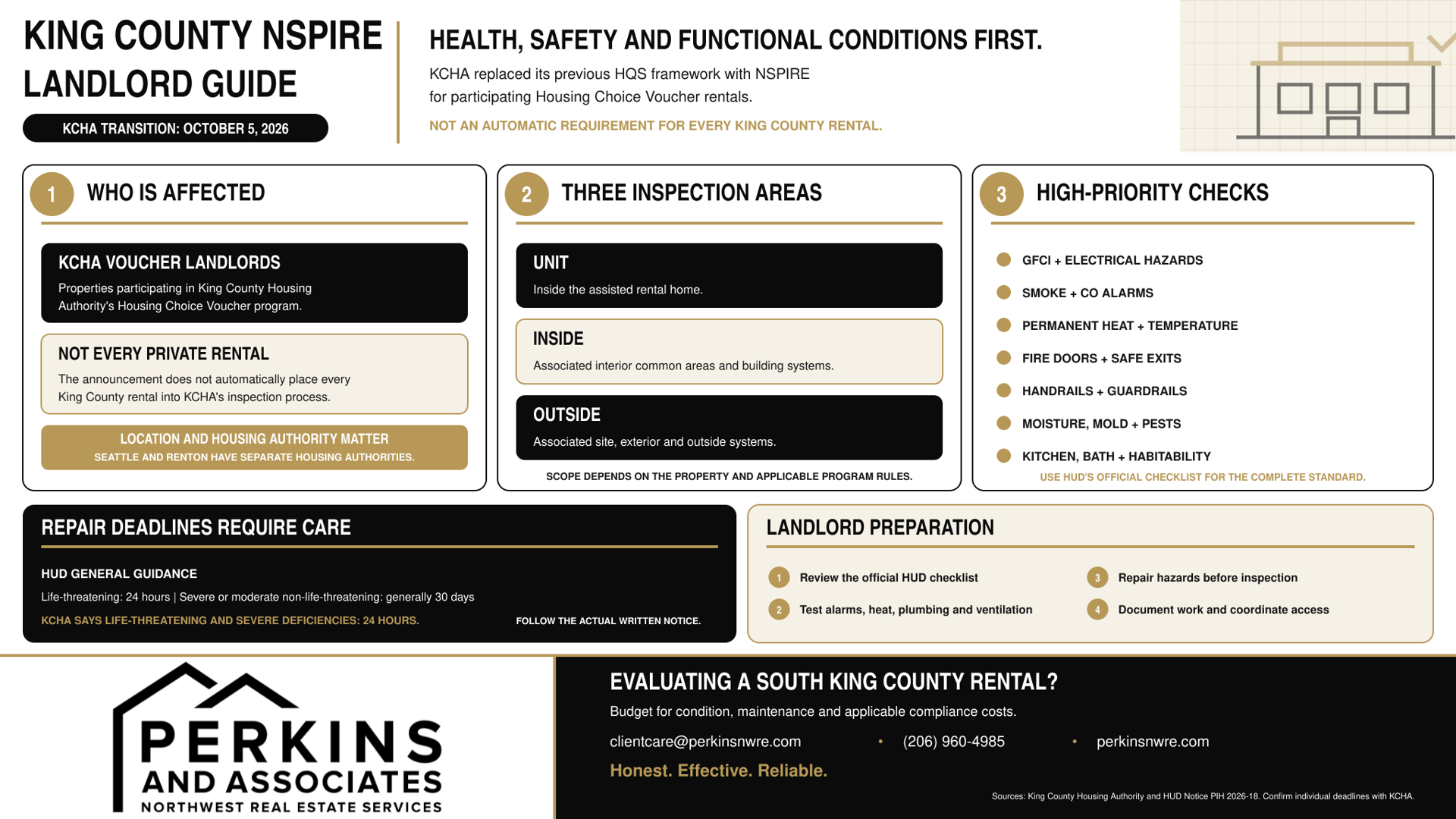
King County Housing Authority (KCHA) announced that beginning October 5, 2026, it would use the National Standards for the Physical Inspection of Real Estate (NSPIRE) instead of its previous Housing Quality Standards (HQS) inspection framework for landlords participating in the Housing Choice Voucher program.
The updated inspection standards place greater emphasis on conditions that affect resident health and safety, including electrical hazards, smoke and carbon monoxide alarms, heating systems, handrails, moisture, and pest infestations.
The change applies to properties participating in KCHA's voucher program, not automatically to every private rental home in King County.
For participating landlords in Kent, Auburn, Maple Valley, Covington, Enumclaw, and other communities served by KCHA, understanding the updated inspection process can help prevent avoidable repair problems, delayed move-ins, and potential interruptions to housing assistance payments.
Here is what landlords and rental-property owners should know.
Key takeaways
- Implementation date: KCHA announced October 5, 2026, as its transition date from HQS to NSPIRE inspections.
- Who is affected: Landlords and housing providers participating in KCHA's Housing Choice Voucher program.
- Inspection priorities: Electrical safety, fire protection, heating, plumbing, moisture, pests, and other habitability conditions.
- Inspection areas: Voucher-assisted units and associated interior common areas and exterior areas.
- Repair deadlines: HUD generally requires correction of life-threatening deficiencies within 24 hours and severe or moderate non-life-threatening deficiencies within 30 days, subject to applicable extensions. KCHA's published announcement contains different language for severe deficiencies, so landlords should confirm their specific written deadlines.
- Failed inspections: Unresolved deficiencies can delay initial approval or lead to enforcement affecting Housing Assistance Payments.
- Inspection results: Voucher inspections continue to use pass/fail outcomes rather than numerical property scores.
- Landlord preparation: Review the official inspection checklist, address hazards early, document repairs, and communicate with KCHA.
Landlords should continue following their individual inspection notices and applicable housing requirements rather than relying only on general summaries.
What changed for King County voucher inspections on October 5, 2026?
KCHA announced its transition from Housing Quality Standards to NSPIRE inspections effective October 5, 2026.
NSPIRE is a federal inspection framework developed by the U.S. Department of Housing and Urban Development (HUD) to assess the physical condition of assisted housing.
Its approach places particular attention on conditions that could threaten residents' safety, health, or ability to use their homes.
In its August 10, 2026 announcement, KCHA identified updated inspection requirements involving electrical protection, fire safety, heating, building conditions, pest infestations, and moisture.
How is NSPIRE different from HQS?
Many basic expectations remain the same. Rental homes participating in the voucher program must still be safe, functional, and habitable.
The main difference is how those conditions are organized and evaluated.
Inspection topic | Previous HQS framework | NSPIRE framework |
|---|---|---|
Primary emphasis | Basic housing quality and habitability | Health, safety, and functional conditions |
Inspection areas | Unit and applicable property conditions | Unit, inside, and outside areas |
Safety deficiencies | Identified under HQS requirements | Classified using NSPIRE deficiency standards |
Inspection outcome | Pass or fail | Pass or fail |
Repair requirements | Based on applicable HQS rules | Based on applicable NSPIRE severity classifications and program requirements |
NSPIRE also reduces reliance on subjective assessments of appearance and housekeeping. That does not mean property maintenance is optional. Conditions affecting safety, sanitation, and usability still matter.
Why did KCHA begin inspections before the federal deadline?
HUD extended the general compliance deadline for Housing Choice Voucher programs to February 1, 2027.
However, housing authorities were allowed to implement NSPIRE before that deadline.
KCHA selected October 5, 2026, for its transition.
The federal deadline and KCHA's implementation date should not be confused.
HUD explains the extension and early implementation procedures in Notice PIH 2026-18, issued July 15, 2026.
Which King County landlords are affected by NSPIRE inspections?
The October 5 change directly concerns landlords participating in KCHA's Housing Choice Voucher program.
The program, commonly called Section 8, helps eligible households rent privately owned housing while the housing authority pays an approved portion of the rent.
Participating landlords must meet the program's inspection and contractual requirements.
Does the change apply to every rental property?
No.
A landlord who rents a property without participating in KCHA's voucher program does not automatically become subject to KCHA's NSPIRE inspection process because of this announcement.
That property must still comply with applicable Washington landlord-tenant laws, building codes, and local housing requirements.
Which areas does KCHA serve?
KCHA administers voucher assistance throughout its eligible King County jurisdiction, excluding incorporated Seattle and Renton, which have separate housing authorities.
Participating rentals in communities such as Kent, Auburn, Maple Valley, Covington, Enumclaw, Black Diamond, and other eligible King County areas may be affected.
However, the property's actual location and housing authority matter.
Landlords should use KCHA's official eligible-area information to confirm jurisdiction.
What about Seattle and Renton landlords?
Landlords working with Seattle Housing Authority or Renton Housing Authority should check those agencies' own inspection schedules and procedures.
KCHA's October 5 announcement does not, by itself, establish the implementation date for another housing authority.
What does an NSPIRE inspection check?
NSPIRE organizes inspection conditions into three areas: Unit, Inside, and Outside.
For voucher programs, inspectors evaluate the assisted rental unit and associated common or exterior areas.
They do not automatically inspect every apartment in a multifamily building simply because one household receives voucher assistance.
Unit: Inside the rental home
This includes the dwelling occupied, or proposed to be occupied, by the voucher household.
Inspectors may evaluate electrical outlets, alarms, heating, plumbing, bathrooms, kitchens, doors, windows, and other housing conditions.
Inside: Associated interior common areas
In multifamily properties, inspections may include interior spaces and building systems associated with the assisted unit.
Examples include applicable stairways, corridors, shared laundry rooms, fire-safety features, and building systems.
Outside: Associated building exteriors and grounds
Inspectors may also review exterior conditions associated with the assisted unit.
Depending on the property, this can include entryways, walkways, stairs, decks, railings, and relevant exterior systems.
The exact inspection scope depends on the property and the applicable voucher-program rules.
What are the most important NSPIRE safety requirements for landlords?
KCHA's updated inspection announcement identifies several safety conditions that participating landlords should review before an inspection.
The following checklist covers important areas, but it is not a substitute for HUD's complete standards.
Inspection area | What landlords should check |
|---|---|
Electrical safety | Exposed wiring, damaged outlets, panel hazards, and required GFCI protection |
Smoke and carbon monoxide alarms | Correct placement, functioning devices, and applicable alarm specifications |
Heating | Permanently installed heat sources, safe operation, and minimum temperature requirements |
Fire safety | Exit access, required fire doors, and relevant fire-protection equipment |
Stairs and railings | Missing, loose, damaged, or unsafe handrails and guardrails |
Moisture and mold | Water leaks, elevated moisture, visible mold-like conditions, and damaged surfaces |
Pest control | Evidence of infestations and conditions contributing to pest activity |
Kitchens and bathrooms | Functional plumbing, ventilation, sanitation, and usable fixtures |
Doors and windows | Secure entry doors, functional windows, and other safety or habitability issues |
Landlords should compare these conditions with HUD's official NSPIRE Housing Choice Voucher inspection checklist.
Electrical hazards and GFCI protection
NSPIRE includes standards addressing unsafe electrical outlets, exposed conductors, damaged electrical panels, and missing required electrical protection.
Ground-fault circuit interrupter (GFCI) protection is particularly relevant in locations where electrical outlets may be exposed to water.
The applicable NSPIRE requirements determine where protection is required and whether a specific condition is deficient.
Landlords should have potentially unsafe wiring or electrical equipment evaluated and repaired by an appropriately qualified professional.
Smoke and carbon monoxide alarms
Working smoke and carbon monoxide alarms remain important inspection items.
However, these requirements did not all begin with KCHA's October 2026 transition.
HUD states that carbon monoxide requirements became applicable inspection items on December 27, 2022.
Additional federal smoke-alarm requirements took effect on December 29, 2024, including requirements involving hardwired or sealed 10-year battery alarms, subject to applicable rules and exceptions.
The October transition changes the inspection framework, but landlords should not assume that previously required alarms were optional until NSPIRE began.
Heating and minimum temperatures
Inspectors may evaluate whether the home has an appropriate permanently installed heating source and whether it functions safely.
Seasonal temperature requirements also matter.
A system that produces some heat may still have a deficiency if it cannot maintain the applicable minimum temperature.
For older rental properties, landlords should address heating problems before an inspection rather than assume a portable heater will satisfy the standards.
Moisture, mold, and pests
Leaks, excessive moisture, mold-like growth, and pest infestations may create inspection deficiencies.
These conditions can also require repairs beyond cleaning visible surfaces.
For example, a recurring moisture problem may involve plumbing, roofing, ventilation, or another underlying source.
Landlords should identify and correct the cause, not merely conceal the evidence before the inspector arrives.
How quickly must landlords correct NSPIRE inspection deficiencies?
Repair deadlines depend on the classification of the deficiency and the instructions issued by the housing authority.
HUD's July 2026 voucher-program notice establishes the following general correction timeframes.
Deficiency classification | HUD's general timeframe |
|---|---|
Life-threatening | Within 24 hours after notification |
Severe, non-life-threatening | Within 30 days after notification, subject to an approved extension |
Moderate, non-life-threatening | Within 30 days after notification, subject to an approved extension |
Low | Generally noted without causing an inspection failure by itself |
Important KCHA clarification: KCHA's August 10 announcement says that life-threatening and severe deficiencies must be addressed within 24 hours.
HUD Notice PIH 2026-18 distinguishes between life-threatening deficiencies, which require correction within 24 hours, and severe or moderate non-life-threatening deficiencies, which generally have a 30-day correction period.
The two published instructions are not worded the same way.
Landlords should not assume that every severe deficiency automatically has a 30-day deadline under KCHA's procedures.
The safest approach is to:
- Treat any immediate safety hazard as urgent.
- Review the classification and deadline on the actual KCHA inspection notice.
- Contact KCHA promptly if the deadline is unclear or appears inconsistent with HUD guidance.
- Obtain written clarification when necessary.
- Complete required repairs and provide supporting documentation within the confirmed timeframe.
Landlords should not delay work on a serious deficiency while seeking clarification.
What if repairs cannot be completed on time?
A landlord should contact KCHA immediately to explain the situation and determine whether an extension or other approved corrective approach is available.
HUD allows housing authorities to approve certain extensions for non-life-threatening deficiencies consistent with applicable policy.
An extension is not automatic.
Landlords should keep records of repair requests, contractor schedules, photographs, inspection communications, and completed work.
For urgent conditions, appropriate immediate measures may be necessary to protect residents while permanent repairs are arranged.
What happens if a rental property fails a KCHA inspection?
A failed inspection generally requires the identified deficiencies to be corrected and the correction verified.
The consequences depend on whether the property is being approved for a new voucher tenancy or is already under an active Housing Assistance Payments contract.
Initial inspections for new voucher tenants
KCHA requires a prospective participating rental unit to meet inspection standards before completing the normal move-in approval process.
According to KCHA's landlord leasing process, the unit must pass inspection, and the lease and Housing Assistance Payments contract must be completed before KCHA begins paying assistance.
If the unit fails, the landlord must correct the failed items and satisfy KCHA's follow-up requirements.
That can delay a planned move-in and the start of assistance payments.
For a landlord preparing a vacant home, this is one reason to inspect the property before scheduling the official inspection.
Recurring inspections for existing tenants
KCHA conducts recurring inspections to confirm that participating properties continue meeting applicable housing standards.
Its published procedures include annual and biennial inspection schedules based on the property and program circumstances.
NSPIRE does not automatically require every voucher property to be inspected more frequently.
If an existing property fails, KCHA may require repairs, follow-up verification, or a reinspection.
Where required deficiencies are not corrected within the applicable timeframe, housing assistance payment enforcement may follow.
Can KCHA withhold housing assistance payments?
Yes. KCHA states that it may withhold payments when failed inspection items are not corrected within the required timeframe.
HUD's voucher-program guidance also identifies enforcement measures that can include payment withholding, abatement, contract termination, or relocation, depending on the circumstances and applicable requirements.
KCHA's published inspection guidance states that the tenant is not responsible for the housing authority's withheld portion of the rent.
Landlords should not assume they can transfer a withheld subsidy payment to the tenant.
The landlord should follow KCHA's written notice, complete the necessary repairs, and confirm how payment reinstatement will be handled.
What if an earlier HQS inspection remains unresolved?
HUD's transition guidance provides an important distinction.
An inspection conducted under the previous HQS rules remains subject to the standards that applied when that inspection occurred until the inspection process is fully resolved.
A failed inspection from before KCHA's transition is not automatically converted into a new NSPIRE inspection simply because the calendar reached October 5.
Owners should review the original inspection date, findings, and correction instructions.
How should landlords prepare for an NSPIRE inspection?
Preparing before the inspection is generally easier than arranging repairs after a failed inspection.
Landlords can use the following eight-step process.
1. Review the official inspection checklist
Start with HUD's NSPIRE Housing Choice Voucher checklist and any instructions KCHA provides for the scheduled inspection.
The official checklist identifies specific deficiencies and their classifications.
It is more reliable than a general online summary.
2. Test smoke and carbon monoxide alarms
Confirm that alarms are installed where required, operate correctly, and meet applicable specifications.
Replace missing, defective, or noncompliant devices.
3. Examine electrical systems
Look for damaged outlets, missing cover plates, exposed wiring, panel hazards, and potential GFCI protection deficiencies.
Arrange professional repairs where necessary.
4. Test heating, plumbing, and ventilation
Check that the heating system works safely and effectively.
Inspect faucets, toilets, showers, drains, hot water equipment, and bathroom ventilation.
Repair leaks and other functional problems.
5. Check stairs, railings, and exits
Walk through the unit and associated exterior areas.
Look for unsafe stairs, loose handrails, damaged guardrails, obstructed exits, and other access hazards.
6. Address moisture and pest problems
Review visible signs of water intrusion, mold-like growth, pest activity, and damaged building materials.
Correct the underlying problems where possible and arrange qualified assistance when needed.
7. Review previous inspection findings
Check whether deficiencies identified in earlier inspections were repaired.
Maintain work orders, receipts, photographs, contractor records, and other useful documentation.
A recurring problem may indicate that the initial repair did not fully address the cause.
8. Coordinate access and confirm completion
Communicate with the tenant and KCHA about inspection access, maintenance scheduling, and required follow-up.
Any landlord entry should comply with applicable Washington law and notice requirements.
If repairs are completed after a failed inspection, follow KCHA's process for submitting evidence or arranging verification.
HUD does not generally require participating HCV landlords to perform a formal NSPIRE self-inspection. However, voluntary preventive inspections are encouraged.
The goal is to identify problems before they become official deficiencies.
Do NSPIRE inspections affect rental income and investment planning?
They can affect a participating landlord's rental operations, particularly when a property has deferred maintenance or requires repairs before initial approval.
The inspection standards do not establish rental prices or guarantee a specific financial outcome.
However, property condition and compliance costs belong in a rental-property budget.
Initial leasing and vacancy risk
A rental unit that cannot pass its initial inspection may face delays before a voucher-assisted household can move in and assistance payments can begin.
Landlords preparing to accept voucher tenants should account for repair time and the normal approval process.
Maintenance and replacement costs
Older rentals may require attention to electrical systems, heating equipment, plumbing, doors, stairs, and other components.
Those expenses are not necessarily caused by NSPIRE. Many reflect existing property conditions and maintenance responsibilities.
The inspection transition can make deficiencies more visible and reinforce the importance of planning for repairs.
Existing housing assistance contracts
For participating properties, unresolved inspection problems may affect housing assistance payments.
That makes maintaining safe, functional rental housing important for both resident well-being and stable operations.
Landlords should plan appropriate maintenance reserves rather than assume that repairs will only be needed when an inspection is scheduled.
For additional compliance considerations, read our article on Washington's 2027 rent increase rules for landlords.
For investors evaluating the broader rental market, our guide to how Kent employment areas influence rental demand provides additional local context.
Important: KCHA's separate October payment-processing changes
Landlords should also be aware that KCHA announced a separate transition to a new housing and financial management system called Yardi during September and October 2026.
That system conversion affected some Housing Assistance Payment processing schedules, including certain new move-ins and weekly payments.
These administrative changes are separate from NSPIRE inspection failures.
A delayed payment during the software conversion should not automatically be interpreted as an inspection-related penalty.
KCHA explains those temporary changes in its August 3 software conversion announcement.
Expert insight: Inspect before the inspector arrives
For rental-property owners in King County, one of the most useful ways to approach the NSPIRE transition is to treat property maintenance as an ongoing responsibility rather than an inspection-day task.
A working smoke alarm, safe electrical outlet, properly secured handrail, or repaired plumbing leak matters whether an inspector is scheduled or not.
That principle also applies when evaluating a rental-property purchase.
At Perkins & Associates, we encourage buyers considering investment properties to look beyond purchase price and potential monthly rent.
A property may appear attractive based on its projected rental income but still require immediate improvements to meet applicable safety and habitability standards.
Before purchasing or preparing to lease a property, owners should consider:
- The condition and age of major systems.
- Evidence of deferred maintenance.
- Possible immediate repair costs.
- Future replacement expenses.
- Applicable rental regulations.
- Whether the property will participate in a housing assistance program.
For owners of existing rentals, maintaining clear repair records and responding promptly to resident concerns can also help prevent avoidable inspection problems.
The important distinction is that meeting the applicable housing standards is a program requirement, while planning repairs early is a property-management decision that can help reduce disruption.
Frequently asked questions about King County NSPIRE inspections
When did King County Housing Authority begin using NSPIRE inspections?
KCHA announced October 5, 2026, as the start date for using NSPIRE instead of its previous HQS inspection framework for participating Housing Choice Voucher rentals.
What is the difference between NSPIRE and HQS?
NSPIRE replaces the previous inspection framework with standards that place greater emphasis on resident health, safety, and functional property conditions. Voucher inspections continue to use pass/fail results.
Do NSPIRE inspections apply to every landlord in King County?
No. KCHA's transition directly affects its participating voucher-program landlords. Other private rentals remain subject to applicable housing laws, but the announcement does not automatically require every rental to undergo a KCHA NSPIRE inspection.
Does KCHA inspect Section 8 rentals in Seattle and Renton?
KCHA's eligible voucher jurisdiction excludes incorporated Seattle and Renton. Those cities have separate housing authorities, and landlords should confirm the inspection procedures applicable to their specific program.
How long do landlords have to correct NSPIRE deficiencies?
HUD generally requires life-threatening deficiencies to be corrected within 24 hours and severe or moderate non-life-threatening deficiencies within 30 days, subject to applicable extensions. KCHA's August announcement instructs landlords to address both life-threatening and severe deficiencies within 24 hours. Landlords should follow their individual inspection notices and promptly obtain clarification from KCHA when needed.
Can KCHA stop housing assistance payments after a failed inspection?
Yes. KCHA may withhold assistance payments when required repairs are not completed within the applicable timeframe. Other enforcement measures may apply depending on the circumstances.
Are voucher properties numerically scored under NSPIRE?
No. HUD confirms that voucher-program NSPIRE inspections use pass/fail outcomes rather than numerical scoring.
Where can landlords find the official NSPIRE inspection checklist?
HUD provides an NSPIRE Housing Choice Voucher inspection checklist identifying inspectable conditions and deficiency classifications. Landlords should also review the KCHA inspection information page for local procedures.
Helpful resources
The following official resources provide additional information about the October 2026 inspection transition and landlord responsibilities.
1. King County Housing Authority: NSPIRE Inspections Begin October 5, 2026
KCHA's official announcement of the transition, safety requirements, inspection areas, and preparation recommendations.
2. KCHA Landlord Inspection Information
Information about initial inspections, recurring inspections, failed items, repair responsibilities, and payment consequences. Some page headings may still use previous HQS terminology during the transition.
Federal guidance addressing NSPIRE implementation, correction timeframes, inspection requirements, and the February 1, 2027 compliance deadline.
4. HUD NSPIRE Housing Choice Voucher Inspection Checklist
The official checklist identifying inspection conditions, severity classifications, and general correction timeframes.
5. KCHA Eligible Voucher Areas
Information for checking whether a rental property is located within KCHA's voucher jurisdiction.
6. KCHA Landlord Leasing Process
Steps for tenant screening, rent approval, initial inspection, and Housing Assistance Payments contracts.
7. KCHA Software Conversion and Service Delays
Details about the separate Yardi system transition and temporary landlord payment-processing changes.
Information and transparency
Information current as of October 13, 2026. This article is based on official announcements and guidance from King County Housing Authority and the U.S. Department of Housing and Urban Development.
KCHA announced October 5, 2026, as its NSPIRE implementation date. HUD's broader voucher-program compliance deadline is February 1, 2027.
KCHA's August announcement and HUD's July 2026 notice use different language regarding the correction deadline for severe deficiencies. This article explains that distinction but does not replace the correction instructions issued for an individual inspection.
Inspection standards, implementation procedures, repair classifications, and payment rules should be confirmed through the applicable housing authority and official program documents.
Buying, selling, or evaluating a rental property in South King County?
Rental-property decisions involve more than monthly rent and purchase price.
Property condition, maintenance expenses, local regulations, and long-term operating costs can all affect whether a rental property fits an owner's goals.
Whether you are considering an investment property in Kent, Auburn, Maple Valley, Covington, Enumclaw, or another South King County community, Perkins & Associates can help you evaluate property options and understand the local real estate market.
Our team can help with buying, selling, and reviewing property-specific real estate considerations. For NSPIRE inspection determinations and compliance requirements, landlords should consult KCHA and qualified housing-compliance professionals.
Contact Perkins & Associates | John L. Scott
Email: [email protected]
Phone: (206) 960-4985
Honest. Effective. Reliable.
Disclaimer: This article provides general real estate information and is not legal advice. Association documents, purchase agreements, statutory applicability, and transaction deadlines can vary. Buyers and sellers should review their specific documents and seek legal advice when a legal interpretation is needed. Inspection classifications, repair deadlines, housing assistance payments, and rental compliance requirements should be confirmed with the relevant housing authority or a qualified professional before making legal or financial decisions.