
King County Property Tax Relief Is Expanding in 2027: New Income Limits Homeowners Should Know
More King County homeowners may qualify for property tax relief in 2027 because the maximum exemption threshold rises from $84,000 to $101,000 in combined disposable income. Washington also changed how some income and deductions are handled, which means a homeowner who did not qualify under the old rules may want to check again.
The Washington Department of Revenue has published the official 2027 to 2029 King County thresholds under ESSB 6162. The new exemption thresholds are $76,000, $89,000, and $101,000. The separate senior and disabled property tax deferral threshold rises to $113,512. Washington DOR 2027 to 2029 income thresholds
The important word is combined disposable income. The $101,000 figure is not simply a gross household income limit.
Key takeaways
- King County's maximum exemption threshold rises from $84,000 to $101,000 for 2027 to 2029.
- Income Threshold 1 rises to $76,000.
- Income Threshold 2 rises to $89,000.
- Income Threshold 3, the maximum exemption threshold, rises to $101,000.
- The separate property tax deferral threshold rises to $113,512.
- ESSB 6162 creates a new $7,500 standard deduction option for a qualifying applicant, plus another $7,500 for a spouse or domestic partner.
- Up to $6,000 of qualifying rental income from residential space on the primary-residence parcel may be deductible when the applicant itemizes.
- The $6,000 rental deduction cannot simply be added on top of the standard deduction.
- Qualifying exemption participants become exempt from the full state school levy beginning with 2027 taxes.
- A separate law lowers the qualifying disabled-veteran service-connected rating from 80% to 40% beginning with taxes due in 2027.
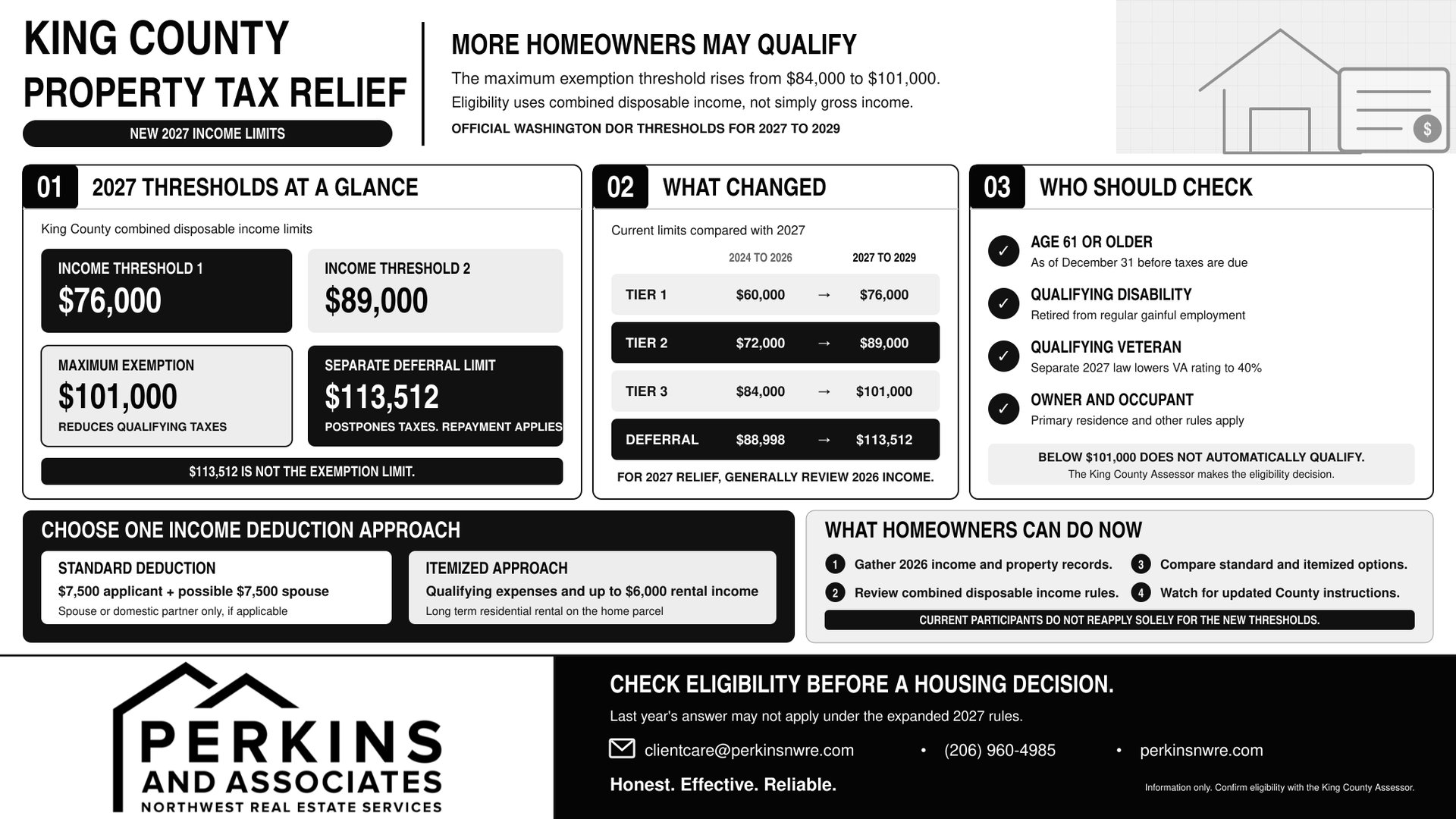
2027 King County property tax relief at a glance
2027 rule | Amount or change |
|---|---|
Income Threshold 1 | $76,000 |
Income Threshold 2 | $89,000 |
Maximum exemption threshold | $101,000 |
Senior/disabled deferral threshold | $113,512 |
Applicant standard deduction | $7,500 |
Additional spouse/domestic partner standard deduction | $7,500 |
Qualifying rental-income deduction when itemizing | Up to $6,000 |
Disabled-veteran service-connected rating | 40% under a separate law |
Washington DOR confirms that the thresholds published for 2027 to 2029 are current and were updated to meet the requirements of ESSB 6162. Washington DOR exemption and deferral thresholds
What are the new King County property tax exemption income limits for 2027?
For 2027 to 2029, King County's three exemption thresholds are $76,000, $89,000, and $101,000 in combined disposable income. The separate deferral threshold is $113,512.
Here is how that compares with the current 2024 to 2026 limits:
Program level | 2024 to 2026 | 2027 to 2029 |
|---|---|---|
Income Threshold 1 | $60,000 | $76,000 |
Income Threshold 2 | $72,000 | $89,000 |
Income Threshold 3 | $84,000 | $101,000 |
Deferral Threshold | $88,998 | $113,512 |
The Washington Department of Revenue publishes these county-specific thresholds. Official Washington DOR 2027 to 2029 threshold table
For 2027 property tax relief, homeowners should generally be looking at their 2026 income.
Which 2027 number applies to you?
The four numbers have different jobs.
$76,000
Income Threshold 1. This is the lowest income tier and receives the highest exemption level.
$89,000
Income Threshold 2.
$101,000
Income Threshold 3. This is the maximum combined disposable income threshold for the exemption program in King County.
$113,512
This is the separate senior and disabled deferral threshold.
The last number is easy to misunderstand.
$113,512 is not the King County exemption limit.
The exemption maximum is $101,000.
What does combined disposable income mean?
Combined disposable income is not the same as gross household income or adjusted gross income on a federal tax return.
Washington uses its own calculation for this property tax relief program.
Combined disposable income generally includes the applicant's disposable income along with income attributed under the program rules to a spouse, domestic partner, and certain cotenants, minus allowable deductions.
That means a homeowner should not simply look at one number on a tax return and decide:
"I'm over $101,000, so I don't qualify."
or:
"I'm under $101,000, so I automatically qualify."
Neither conclusion is necessarily correct.
Washington has specific rules about which income is included and which expenses or payments may be deducted.
DOR's 2027 guidance makes several important changes to that calculation, including the new standard deduction, qualifying rental-income treatment, and exclusion of Combat-Related Special Compensation. Washington DOR explanation of the 2027 property tax relief changes
This article explains the published rules, but the King County Assessor makes the actual eligibility determination based on the homeowner's individual circumstances.
Could someone qualify in 2027 who did not qualify before?
Yes, potentially. Someone who was over King County's old $84,000 maximum may fall within the new $101,000 threshold in 2027.
The higher threshold alone creates a larger eligibility range.
The changes to combined disposable income can also matter.
For example, some applicants may benefit from:
- the new standard deduction,
- qualifying itemized deductions,
- qualifying rental-income treatment,
- or the exclusion of Combat-Related Special Compensation.
A person still has to meet the other eligibility requirements.
The new income threshold does not mean everyone with income below $101,000 automatically qualifies.
Who can qualify for the King County senior or disabled property tax exemption?
Income is only one requirement. An applicant must also meet Washington's age, disability, veteran, ownership, occupancy, and other program rules.
Washington DOR currently describes the program as available to a homeowner who meets at least one of the following requirements as of December 31 of the year before the taxes are due:
- is at least 61 years old,
- is retired from regular gainful employment because of a qualifying disability,
- or is a qualifying veteran receiving VA compensation under the program's disability criteria.
The applicant must also own and occupy a primary residence in Washington and meet the applicable combined disposable income threshold. Washington DOR property tax exemption and deferral program overview
There are also specific provisions for surviving spouses or domestic partners and other circumstances.
Homeowners with unusual ownership, trust, life-estate, disability, or household situations should confirm their eligibility directly with the King County Assessor rather than relying on a general online summary.
How does the new $7,500 standard deduction work?
Beginning with taxes collected in 2027, a qualifying applicant can choose a $7,500 standard deduction instead of itemizing the qualifying expenses covered by the program.
A qualifying applicant may also receive an additional $7,500 standard deduction for a spouse or domestic partner.
That means a qualifying applicant with a spouse or domestic partner may potentially use a total standard deduction of $15,000.
But this is not a $7,500 deduction for every person who owns or lives in the house.
DOR gives a clear example: if two siblings jointly own and occupy a home, they do not each receive a $7,500 standard deduction. The additional deduction applies specifically to the qualifying applicant's spouse or domestic partner. Washington DOR 2027 property tax relief Q&A
Standard deduction or itemizing: what is the difference?
The new standard deduction is an alternative to itemizing. It is not an extra amount added to every possible deduction.
Option | How it works |
|---|---|
Standard deduction | $7,500 for the qualifying applicant, plus a possible additional $7,500 for a spouse or domestic partner |
Itemized approach | Use qualifying allowable expenses under the program, which may include qualifying rental-income deductions |
This distinction matters because of the new rental-income rule.
Can King County homeowners deduct rental income from an ADU or part of their home?
Potentially. Up to $6,000 of qualifying rental income may be deducted when residential living space is located on the applicant's primary-residence parcel and the applicant uses the itemized deduction approach.
DOR says the rental must meet specific requirements.
The guidance says:
- the rented space must be residential living space,
- it must be on the applicant's primary-residence parcel,
- rentals of 30 days or longer may qualify,
- short-term rentals such as Airbnb stays of less than 30 days do not qualify,
- and income from a rental property on a separate parcel does not qualify for this deduction.
An ADU on the primary-residence parcel could potentially fall within the rule if the other requirements are met. Washington DOR rental-income guidance for 2027 property tax relief
Can you take both the standard deduction and the $6,000 rental deduction?
No.
DOR specifically says the qualifying rental-income deduction is available when a homeowner itemizes.
If the applicant chooses the standard deduction instead, the rental-income deduction cannot also be claimed.
In other words:
Do not assume $15,000 in standard deductions plus $6,000 in rental income automatically creates a $21,000 deduction.
That is not how the rule works.
What changes for Combat-Related Special Compensation?
Combat-Related Special Compensation, or CRSC, is excluded from combined disposable income beginning with 2027 taxes.
That may affect some qualifying military retirees whose CRSC was previously included in their income calculation.
There is also an important administrative detail for people already receiving the exemption.
If the only change is that the new income thresholds move a current participant into a better exemption tier, DOR says the county assessor will make that threshold adjustment automatically.
But if CRSC was previously included in the participant's income, the assessor cannot remove it automatically.
DOR says that participant needs to submit a status change notice and 2026 income documentation so the county can recalculate the combined disposable income. Washington DOR guidance for current participants and CRSC
How much property tax relief could someone receive in 2027?
There is no single dollar amount because the benefit depends on the homeowner's income tier, residence value, local levy rates, and other property-specific details.
ESSB 6162 also increased the exemption benefits themselves.
Income Threshold 1: up to $76,000
Beginning with 2027 taxes, qualifying participants receive:
- exemption from the full state school levy,
- exemption from local excess property taxes,
- and exemption from local regular property taxes on the greater of $80,000 or 80% of the residence's valuation.
Income Threshold 2: over $76,000 and up to $89,000
Qualifying participants receive:
- exemption from the full state school levy,
- exemption from local excess property taxes,
- and an additional exemption from local regular property taxes on the greater of $70,000 or 45% of the residence's valuation, with the valuation exemption capped at $200,000.
Income Threshold 3: over $89,000 and up to $101,000
Qualifying participants receive:
- exemption from the full state school levy,
- exemption from local excess property taxes.
This tier does not receive the additional local regular property tax valuation exemption available under Thresholds 1 and 2.
Washington DOR provides the official description of the expanded 2027 exemption levels. Washington DOR ESSB 6162 property tax relief notice
What changed with the state school levy?
Starting with 2027 taxes, qualifying participants in the senior and disabled property tax exemption program are fully exempt from the state school levy on the qualified primary residence.
Before this change, participants were exempt from only part of the state school levy.
ESSB 6162 consolidated the state property tax levy and expanded the exemption so qualifying participants are exempt from the full levy.
This is one reason the 2027 law changes the value of the program, not just the income limits. Washington Legislature ESSB 6162 bill report
What is the difference between the $101,000 exemption and $113,512 deferral?
An exemption reduces qualifying property taxes. A deferral postpones payment of qualifying taxes and generally has to be repaid later.
Program | 2027 King County income threshold | What it does |
|---|---|---|
Property tax exemption | Up to $101,000 CDI | Reduces qualifying property taxes |
Senior/disabled deferral | Up to $113,512 CDI | Postpones qualifying property taxes |
Washington DOR says deferred amounts accrue 5% simple interest until repayment is complete.
The deferral generally becomes repayable when:
- the home is sold,
- the applicant dies,
- or the property is no longer used as the applicant's primary residence.
Deferred amounts and interest are secured by the property. Washington DOR property tax deferral rules
This is why homeowners should not treat a deferral as another form of exemption.
Separate 2027 change for disabled veterans
A separate Washington law expands eligibility for some disabled veterans beginning with taxes due in 2027.
This change comes from EHB 1106, not ESSB 6162.
Beginning with 2027 taxes, the required combined service-connected VA disability rating for this program decreases from 80% to 40%.
DOR says a veteran with a combined service-connected evaluation rating of 40% or higher may meet the veteran disability requirement, subject to the program's other eligibility rules. Washington DOR disabled veteran 2027 legislative update
This means a veteran who did not qualify under the previous disability-rating requirement may want to review the 2027 rules again.
Do current King County exemption participants need to reapply?
Not simply because the income thresholds increased.
DOR says current participants who move into a better exemption tier because of the new 2027 thresholds will automatically be placed into the appropriate level by their county assessor.
They do not need to file another application solely to receive the threshold adjustment.
There are situations where paperwork may still be needed.
Examples include:
- a change in eligibility status,
- an ownership or occupancy change,
- a required periodic review,
- or an income recalculation involving CRSC.
DOR also states that exemption participants must report changes in status that affect eligibility or benefit levels. Washington DOR exemption program requirements
How do new applicants apply in King County?
New applicants apply through the King County Assessor's senior and disabled property tax exemption program.
There is one timing detail homeowners should understand as the County moves from the 2026 tax year into 2027.
As of September 1, 2026, King County's public senior and disabled exemption page is still displaying the current $84,000 income limit based on 2025 earnings. It also directs homeowners to the County's online Senior Exemption Portal. King County senior and disabled exemption page
That does not change the new state-published 2027 thresholds.
Washington DOR has already published the official 2027 to 2029 limits, including King County's $101,000 maximum exemption threshold.
King County's public application materials are still transitioning to the new tax year.
Homeowners planning to apply for 2027 relief should watch the County's portal and instructions for the updated 2027 application process.
King County Senior Exemption Portal
What should homeowners gather before applying?
Homeowners can make the process easier by beginning with their 2026 income and property records, then following the County's updated documentation checklist when it becomes available.
Depending on the situation, applicants may need records related to:
- 2026 income,
- ownership and occupancy,
- a spouse or domestic partner's income,
- qualifying deductions,
- rental income,
- disability status,
- veteran disability status,
- or other program-specific requirements.
Washington DOR maintains the statewide exemption application, combined disposable income worksheet, change-in-status form, and related property tax relief forms. Washington DOR property tax forms
Because forms and county instructions can change, homeowners should use the current King County application requirements rather than relying on an old checklist.
What should King County homeowners do now?
If you think the 2027 changes could apply to you or someone you are helping, a practical first review looks like this:
- Gather 2026 income records.
- Do not assume gross income determines eligibility. Review the combined disposable income rules.
- Check whether the $7,500 standard deduction may apply.
- If you have qualifying expenses or rental income, understand the itemized option before choosing the standard deduction.
- If you already receive the exemption, check whether any status or income change needs to be reported.
- If you are a disabled veteran, review the separate 40% service-connected disability rule for 2027.
- Watch the King County Assessor's website and Senior Exemption Portal for updated 2027 application instructions.
- Ask King County directly if your eligibility situation is unclear.
For homeowners who need additional support, our guide to property tax and homeowner assistance available in South King County covers other resources that may be worth reviewing.
What could the new rules mean for homeowners thinking about downsizing?
A homeowner who previously assumed property taxes made staying in the home too expensive may want to check the new 2027 exemption rules before making that decision.
That does not mean tax relief makes staying the right choice.
Property taxes are only one part of the decision.
Longtime homeowners may also be weighing:
- maintenance,
- insurance,
- accessibility,
- repairs,
- available equity,
- monthly expenses,
- space they no longer use,
- and what they want the next stage of homeownership to look like.
The point is to make the decision with current information.
If you are weighing whether a smaller home could make sense, our guide to questions to consider before downsizing can help organize that broader conversation.
For homeowners who want to understand how property taxes work outside this specific exemption program, see our full guide to King County property taxes for South King County homeowners.
Expert insight: Check eligibility before making a housing decision
The biggest mistake with this update would be assuming last year's answer still applies.
Someone who was over the old income threshold may be within the new range.
Someone who previously counted certain income may have a different combined disposable income calculation.
A veteran who did not meet the old disability-rating requirement may qualify under the separate 2027 rule.
A current participant may receive a higher exemption level automatically.
None of those situations guarantees eligibility. They are reasons to check.
Before deciding that property taxes make staying in a home unaffordable, it makes sense to find out whether the 2027 rules change the numbers first.
Frequently asked questions
What is the King County senior property tax exemption income limit for 2027?
The maximum exemption threshold is $101,000 in combined disposable income for 2027 to 2029. King County's lower exemption tiers are $76,000 and $89,000.
Can I qualify if my income is between $84,000 and $101,000?
Possibly. The old maximum was $84,000, while the 2027 maximum is $101,000. You must still meet the program's age, disability or veteran, ownership, occupancy, and combined disposable income requirements.
Is $101,000 based on gross income?
No. Washington uses combined disposable income, which has its own rules for included income and allowable deductions.
Can a married couple use a $15,000 standard deduction?
Potentially. A qualifying applicant may use a $7,500 standard deduction plus another $7,500 for a spouse or domestic partner.
Can I deduct rental income from an ADU?
Potentially. DOR allows a deduction of up to $6,000 for qualifying long-term residential rental income from living space on the applicant's primary-residence parcel when the applicant itemizes.
Can I take the $7,500 standard deduction and $6,000 rental deduction together?
No. DOR says the rental deduction is available through itemizing. An applicant choosing the standard deduction cannot also claim the rental-income deduction.
Is the $113,512 figure another exemption limit?
No. $113,512 is King County's 2027 to 2029 senior and disabled property tax deferral threshold. The exemption maximum is $101,000.
Do I need to reapply if I already receive the exemption?
Not solely because the income thresholds changed. DOR says current participants will automatically be moved to the appropriate new exemption level based on the revised thresholds. Other changes may still need to be reported.
What changed for disabled veterans in 2027?
A separate state law lowers the qualifying combined service-connected VA disability rating from 80% to 40% beginning with taxes due in 2027. Other eligibility requirements still apply.
Helpful resources
Washington DOR: 2027 to 2029 King County income thresholds
Official county-by-county table showing King County's $76,000, $89,000, $101,000, and $113,512 thresholds.
View the 2027 to 2029 income thresholds
Washington DOR: ESSB 6162 property tax relief changes
Official explanation of the new income rules, deductions, exemption levels, CRSC treatment, rental-income rules, and state school levy change.
Read DOR's 2027 property tax relief guidance
Washington DOR: Property tax exemptions and deferrals
State overview of who may qualify, program benefits, reporting requirements, and deferral repayment rules.
Review Washington property tax exemptions and deferrals
King County Assessor: Senior and disabled exemptions
Current King County eligibility, contact information, exemption resources, and links to apply.
Visit King County's senior and disabled exemption page
King County Senior Exemption Portal
King County's online application portal for senior and disabled property tax exemptions.
Visit the King County Senior Exemption Portal
Washington DOR: 2027 disabled veteran change
Official explanation of the separate law lowering the qualifying service-connected disability rating to 40%.
Read the disabled veteran property tax update
Washington DOR property tax forms
Official exemption, deferral, combined disposable income, disability, and status-change forms.
View Washington property tax relief forms
Planning your next move
If you are thinking about buying, selling, or planning your next move, our team is happy to help you think through your options and next steps.
📧 [email protected]
📱 (206) 960-4985
Honest. Effective. Reliable.