Washington HB 2418: Permit review deadlines, agency coordination, and fee refunds
Buying land or planning a residential project in South King County means working through approvals that can affect your budget and construction schedule. Washington HB 2418 changes parts of that process, including how reviewing agencies communicate and when missed deadlines may trigger a partial fee refund.
The law became Chapter 235, Laws of 2026, effective June 11, 2026. It builds on existing permit review requirements. It does not give every construction permit the same deadline or guarantee approval when time runs out. The enacted HB 2418 legislation is the starting point for understanding those distinctions.
Updated November 10, 2026.
Key takeaways
- Identify the approval and reviewing entity before calculating a deadline.
- Keep completeness notices, correction requests, responses, and fee records.
- Ask for a written accounting of excluded review time.
- Review extensions and waivers before signing.
- A possible fee refund does not authorize construction.
Which permits does Washington HB 2418 cover?
Start by asking whether your application is a covered “project permit.” That legal term does not include every permit needed to build a home.
Under the state definition of project permits, examples include subdivisions, conditional use permits, certain site plan reviews, and critical area approvals. Permits issued based on compliance with state or local building codes are excluded from that definition.
Certain utility district determinations also sit outside the definition, but a separate review framework may apply to them.
Review involved | What to establish first |
|---|---|
City or county land use review | Whether the application is a covered project permit and which local process applies |
Another government agency’s residential project review | Whether its review and fee fall within the applicable statutory requirements |
Special purpose district or public utility district review | Whether the residential project requires a qualifying district referral |
Building code permit | Which separate local procedures and deadlines govern it |
For a property in Maple Valley, Kent, Renton, or Black Diamond, confirm whether it sits inside city limits or in unincorporated King County. Then identify every reviewing entity. A mailing address alone should not be your basis for choosing the permitting department.
When does the permit review clock start?
For covered local project permits, the decision clock generally begins when the application is determined complete.
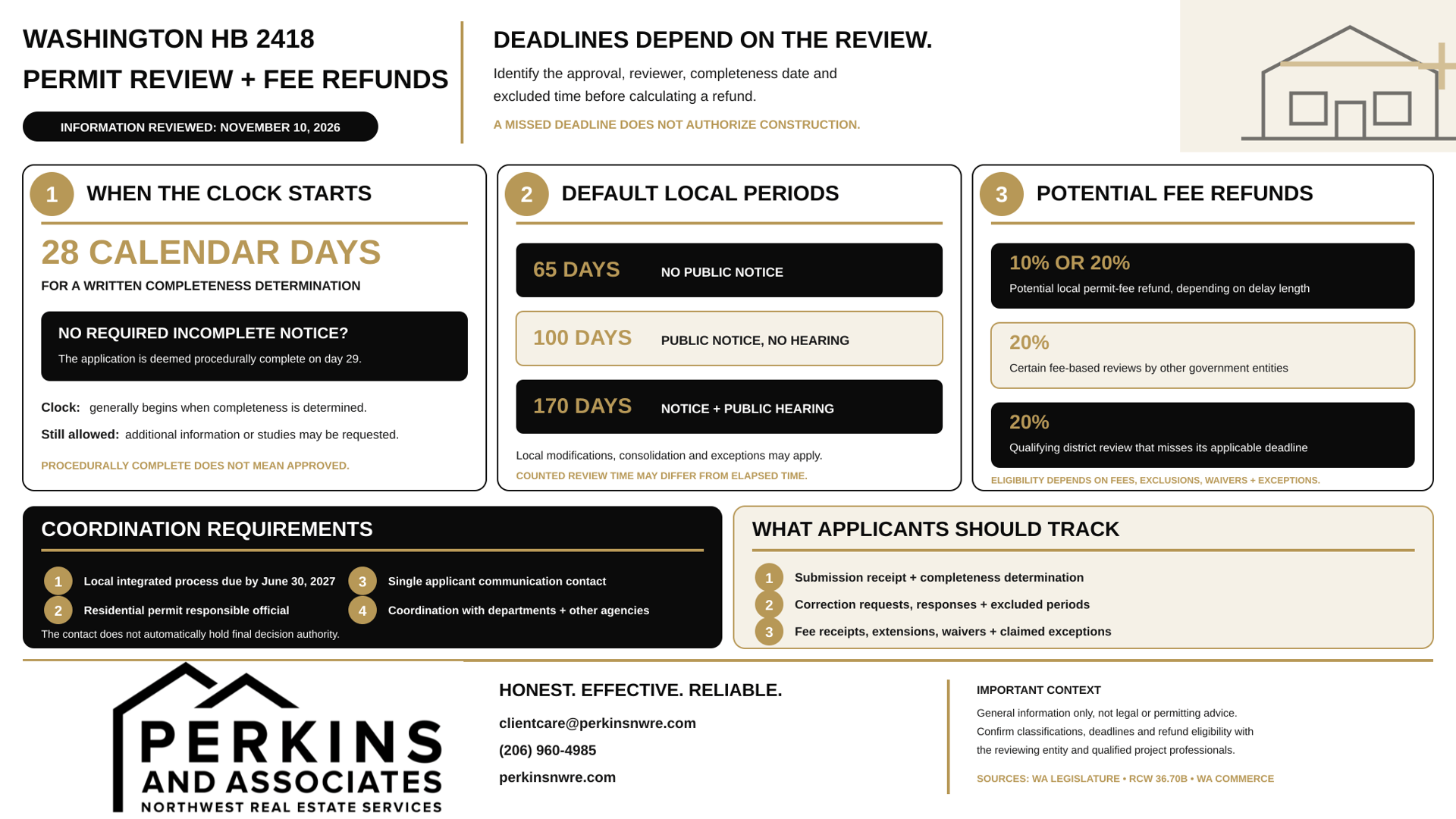
The completeness requirements in RCW 36.70B.070 give applicable local governments 28 calendar days to provide a written determination. An incomplete notice must explain the missing submission requirements.
If the required incomplete notice is not provided, the application is deemed procedurally complete on the 29th day.
“Procedurally complete” means the submission meets the application requirements. It does not establish that the design complies with zoning, environmental rules, or other substantive standards. Reviewers can still request additional information or studies.
Save the original submission receipt and completeness determination together. If you believe the application became complete through the statutory deadline, ask the jurisdiction to confirm the date used in its tracking system.
What are the permit review deadlines?
The default local decision periods depend on public notice and hearing requirements.
Covered local project permit category | Default period after completeness |
|---|---|
No public notice required | 65 days |
Public notice required, without a public hearing | 100 days |
Public notice and a public hearing required | 170 days |
These are starting points. Lawful local modifications, consolidated applications, and statutory exceptions can change the applicable period. The governing framework appears in RCW 36.70B.080.
Ask the reviewer to identify your application’s category and the local rule used to calculate its deadline. Avoid building a financing or contractor schedule around one of these numbers without that confirmation.
Which days may be excluded?
Local review generally counts calendar days, with exclusions. These can include periods awaiting requested applicant information, fees, or posted notices; an applicant’s written suspension; certain necessary government actions; environmental impact statement preparation; and appeal periods.
Certain changes to the proposed use can restart review. Extended pauses or nonresponse can also affect the calculation.
Keep a simple log showing each request, your response date, and the reviewer’s stated reason for excluding time. Total elapsed time and counted review time can differ substantially.
Who coordinates communication between agencies?
HB 2418 adds clearer roles for residential project decisions and applicant communication.
Under RCW 36.70B.060, applicable local governments must establish the required integrated process by June 30, 2027. It includes a permit responsible official for residential project applications and a single point of contact for each project permit application.
The contact coordinates with departments and other reviewing entities. That contact does not automatically hold final decision authority.
Because implementation has its own deadline, ask what your jurisdiction has adopted and who currently handles coordination.
These statutory requirements are separate from the county’s advisory work discussed in our article on King County’s permitting reform initiative.
When could a missed deadline lead to a fee refund?
Refund eligibility depends on who performed the review, which deadline applied, and whether an exception or agreement changes the result.
City or county review
Where the local refund requirement applies, the amount is generally:
- 10% of the permit fee when the delay beyond the deadline is no more than 20% of the original review period.
- 20% of the permit fee when the delay exceeds that threshold.
A qualifying jurisdiction may have an exception based on implementing specified streamlining measures. That exception has statutory limits, including circumstances involving continued missed deadlines and required additional measures. Check RCW 36.70B.160 and request the jurisdiction’s written basis for any claimed exception.
Other government review
For covered fee-based residential project reviews by government entities outside the local government and district categories, the law provides a 20% refund or fee reduction when the applicable deadline is missed. A review without a fee does not produce a refund.
An applicant’s written waiver can remove the relevant subsection’s timing and refund protections. A mutually agreed local extension can also remove the local timing and refund framework. Read the proposed agreement carefully before signing.
Special purpose district or public utility district review
Qualifying district review starts with a complete referral from the local government. Routine infrastructure reviews have a 45-business-day period for written technical comments. Complex reviews have separate extension rules and exclusions.
A missed applicable deadline can require the district to refund or forgo 20% of the fee attributable to its covered review. It does not approve utility service.
Ask separately about septic or health district review. The Department of Commerce’s local project review guidance states that it is analyzing applicability to health districts. Do not assume a particular health review qualifies.
What should you ask if your application appears overdue?
Request a written timeline before asserting a refund amount. This helps identify disagreements about completeness, excluded days, or the governing procedure.
You can adapt this request:
Please provide the review timeline for application [number], including the applicable permit category, completeness or complete-referral date, governing deadline, and each excluded period with its basis.
Please also identify any extension, waiver, or refund exception affecting this application, the current coordinating contact, and the next action needed.
If the applicable deadline has passed, please explain whether a fee refund or reduction applies and how to request it.
Attach your submission receipt, completeness notice, correction responses, and fee receipts. If a dispute remains, have a qualified land use professional or attorney review the specific record.
Expert insight: use the timeline before committing to the project
For South King County buyers, the useful question is often: “Which unresolved approval could change whether this property works for our plans?”
A buyer considering a lot in Black Diamond may need different answers than a homeowner planning an ADU in Renton. Identify the needed approvals, responsible reviewers, and unresolved site issues before relying on a construction start date.
For an additional dwelling, our King County ADU planning guide provides a broader property checklist.
A separate November 2026 feedback deadline
As of this article’s update, Commerce is accepting initial feedback on broader housing and permitting rulemaking through 5 p.m. Pacific Time on November 13, 2026. See its rulemaking page for submission instructions.
That date is a rulemaking feedback deadline. It is separate from HB 2418’s effective date and your application’s review deadline.
Frequently asked questions
Did HB 2418 create all of Washington’s permit deadlines?
No. It amended an existing framework. The default local deadlines and local refund provisions predate HB 2418. The 2026 changes address matters including procedural completeness, coordination, and other reviewing entities.
Does a missed deadline mean I can start construction?
Do not treat an overdue review as permission to build. Obtain the required issued approvals and confirm any conditions before starting work.
Does “complete” mean my project meets all requirements?
No. Procedural completeness concerns the submission requirements. Substantive review still determines whether the project satisfies applicable standards.
Should I expect a refund to cover delay costs?
Budget around the project’s actual costs and schedule. The provisions discussed here concern portions of review fees; a possible refund should not be treated as funding for carrying costs or contractor delays.
Helpful resources
Keep the enacted law, the applicable RCW sections linked above, and your jurisdiction’s current application instructions with your project records. Commerce’s Local Project Review page also provides implementation guidance.
For related local planning, read our guides to King County’s permitting reform initiative and ADU requirements.
Planning a property purchase or residential project?
Perkins & Associates can help you evaluate how a property fits your purchase goals and identify questions to resolve during due diligence. For permit classifications, deadline disputes, and technical approvals, work directly with the reviewing jurisdiction and appropriate project professionals.
Call 206-960-4985 to discuss your South King County real estate plans.