Seattle’s proposed Housing Accelerator: Who could receive reduced MHA payments?
An 80% reduction sounds substantial. For a Seattle residential developer, the useful questions are which payment would be reduced, whether the project qualifies, and what construction milestone must be met.
The Seattle Housing Accelerator proposal would temporarily reduce certain Mandatory Housing Affordability residential in-lieu payments. It identifies an 80% reduction for qualifying vested projects and a 60% reduction for qualifying future projects, with conditions.
Seattle issued an environmental determination on November 2, 2026. The state’s environmental review record describes a proposal under review. That determination does not establish an available fee reduction.
Information checked November 10, 2026.
Key takeaways
- The proposal concerns qualifying Seattle MHA residential payment obligations.
- The two project categories have different eligibility conditions.
- Application timing and construction progress matter.
- Environmental review and legislative adoption are separate steps.
- The proposal would not change development charges in Maple Valley, Kent, Renton, or Black Diamond.
What is Seattle’s Housing Accelerator proposal?
The proposal is intended to encourage residential projects to move into construction by temporarily reducing one part of their development budget.
Seattle’s Mandatory Housing Affordability program, commonly called MHA, requires covered development to contribute to affordable housing. Developers generally satisfy the requirement by providing qualifying affordable homes within the development or making an in-lieu payment supporting affordable housing elsewhere.
The Seattle Office of Housing’s MHA guidance explains these performance and payment options. The Accelerator proposal concerns specified residential payment obligations, known as MHA-R.
That scope matters when reviewing a project budget. A reduction in an MHA-R payment would not reduce every permit charge, utility expense, or construction cost.
Which residential projects could qualify?
The published proposal separates eligible development into two categories.
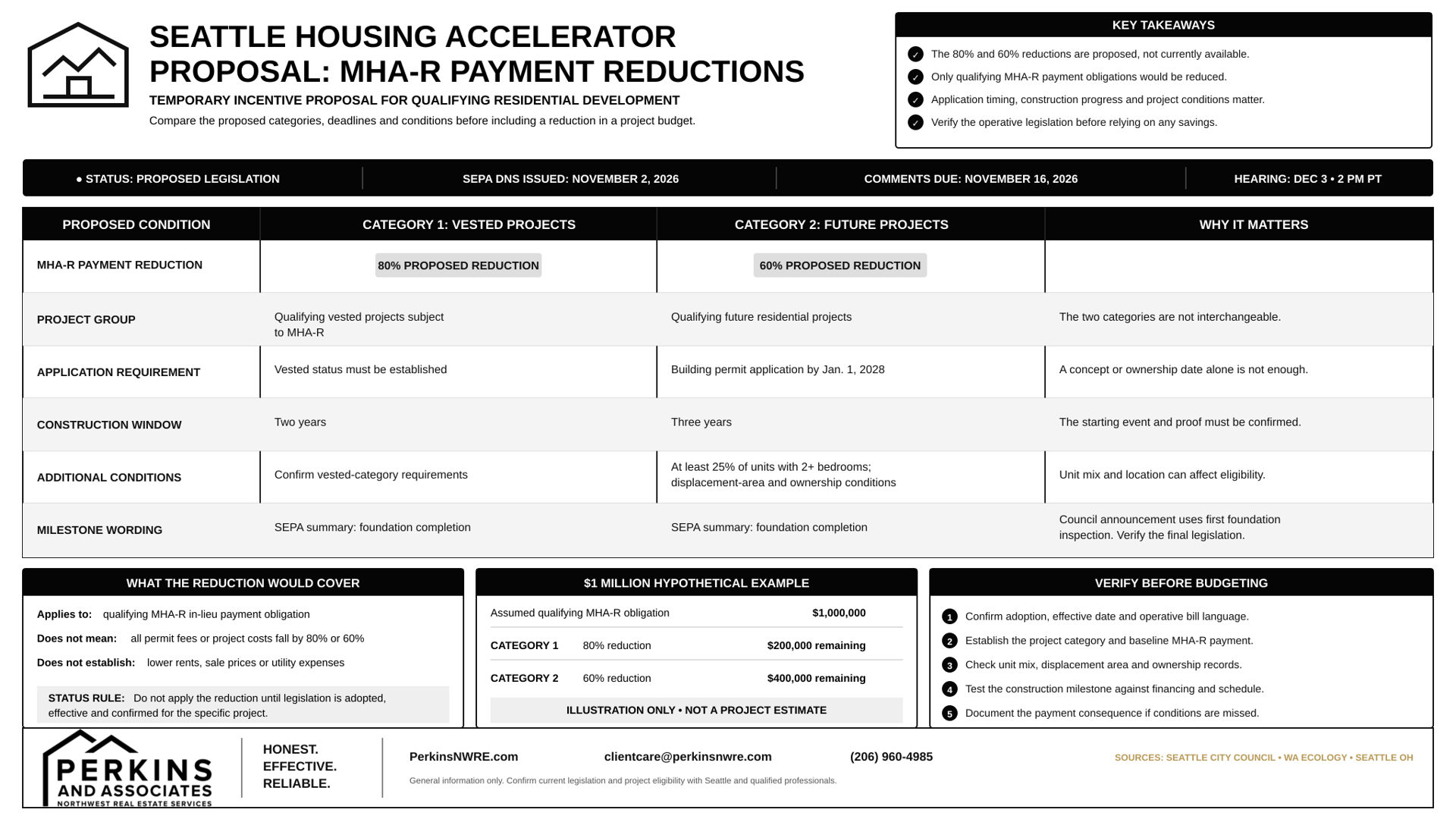
Proposed condition | Category 1 | Category 2 |
|---|---|---|
Project group | Qualifying vested projects subject to MHA-R | Qualifying future projects |
MHA-R payment reduction | 80% | 60% |
Application requirement | Qualifying vested status must be established | Building permit application by January 1, 2028 |
Construction milestone window | Two years | Three years |
Additional conditions described in the summary | Confirm the project meets the vested category | At least 25% of units with two or more bedrooms, plus displacement-related conditions |
For Category 2, the proposal excludes specified high-displacement-risk areas unless the development site has been in continuous ownership since January 1, 2006. Seattle’s Housing, Arts, and Civil Rights Committee materials describe the categories and proposed conditions.
Category 1: Confirm the project’s vested status
Do not assume that owning a site, beginning design, or having an application number places a project in Category 1.
Have the project team identify the relevant application history and ask Seattle to confirm how the proposed category would apply. The incentive’s precise eligibility language matters more than a general description of a project as “already permitted.”
Category 2: Check the design and ownership conditions early
For future projects, the unit mix could affect eligibility. A developer considering mostly studios and one-bedroom apartments should examine the two-bedroom requirement before treating the proposed reduction as part of the budget.
Likewise, confirm the applicable displacement-area designation and documentation required for any ownership exception. A long ownership history alone should not be treated as proof of qualification.
What application and construction deadlines would matter?
The proposal identifies January 1, 2028, as the future-project application cutoff. Construction progress would also be required within the applicable two-year or three-year window.
The exact construction milestone needs careful verification. The November environmental summary describes foundation completion. Seattle’s September 18 announcement instead refers to a first foundation inspection and describes repayment of the remaining MHA balance if the milestone is missed.
Before relying on a construction deadline, obtain confirmation of:
- The required foundation milestone.
- The event that starts the two-year or three-year period.
- What makes an application sufficient for the cutoff.
- Required proof of construction progress.
- The financial consequence of missing the deadline.
A scheduled groundbreaking should not be used as a substitute for confirming the actual requirement.
What would an 80% or 60% reduction cover?
The percentages apply to the qualifying MHA-R payment obligation. They do not describe a reduction in the total cost of developing a property.
For a simple illustration, assume a project has a qualifying MHA-R payment obligation of $1 million:
Hypothetical qualifying obligation | Proposed reduction | Payment remaining |
|---|---|---|
$1,000,000 under Category 1 | $800,000 | $200,000 |
$1,000,000 under Category 2 | $600,000 | $400,000 |
These figures illustrate the percentages. They are not an estimate for a particular development.
The underlying obligation must be established separately. Seattle SDCI’s MHA guidance explains that payment calculations depend on project-specific factors, including applicable zoning, payment area, and vesting information.
Ask the project’s reviewer to confirm the baseline payment before applying any proposed reduction.
Could reduced MHA payments make a project feasible?
A smaller payment could improve a project’s financial outlook, but the result would depend on the full budget.
A useful feasibility review compares the same project under two scenarios: current requirements and the proposed incentive. Keep assumptions about land, construction, financing, rents or sales revenue, and timing consistent so the effect of the payment reduction is visible.
Then test what happens if construction costs rise or the project misses the qualifying milestone. A proposed saving is less useful if the schedule cannot realistically support it.
There is also an affordable-housing funding question. Seattle uses MHA payments to support affordable housing. Reducing individual obligations changes that funding calculation; whether additional construction would offset lower payments depends on actual development activity. The proposal’s intended benefit should not be presented as a guaranteed outcome.
What should developers verify before budgeting for the reduction?
Start with a written eligibility review tied to the specific property and application.
- Confirm status. Has legislation been adopted, and when would it take effect?
- Identify the category. Which provision would cover the project?
- Establish the baseline payment. What MHA-R amount applies?
- Check the application record. Does it satisfy the relevant timing and completeness requirements?
- Review additional conditions. Confirm unit mix, location, and ownership documentation.
- Test the construction schedule. Can the required milestone be met with realistic financing and contractor assumptions?
- Document the downside. What payment could become due if conditions are not met?
Keep this analysis with the project budget. A headline percentage is not enough to support an acquisition or financing decision.
Does the proposal apply elsewhere in King County?
The proposal concerns Seattle’s MHA-R program. It would not change development fees in Maple Valley, Kent, Renton, Black Diamond, or unincorporated King County.
Other jurisdictions have their own housing incentives and permitting procedures. Our article on Enumclaw’s multifamily tax exemption review discusses a different mechanism involving qualifying property improvements.
Our guide to King County’s permitting reform initiative covers a separate county effort. Neither should be treated as an extension of Seattle’s proposal.
What happens next?
The environmental record lists November 16, 2026, as the comment deadline and identifies [email protected] for submissions. This is an environmental-review comment deadline.
The committee also lists a legislative public hearing for December 3, 2026, at 2 p.m. Pacific Time. Check its current notice for participation instructions and schedule changes. A scheduled hearing does not establish adoption or an effective date.
Expert insight: evaluate the property before the incentive
For investors comparing Seattle with South King County opportunities, first evaluate what can be built, who must approve it, and whether the project works under current requirements.
Then assess how an adopted incentive could change the numbers. This approach helps keep a proposed benefit from becoming the reason to overlook an unresolved site, financing, or construction issue.
Frequently asked questions
Is the Seattle Housing Accelerator reduction available now?
The official materials reviewed describe proposed legislation. They do not establish that a developer can currently claim the reduction.
Would all Seattle residential projects qualify?
No. The proposal identifies specific categories and conditions. Project eligibility would need to be confirmed against the operative legislation.
Would the proposal lower rents or home prices by 80%?
No. The percentage concerns a qualifying MHA-R payment obligation. It does not establish a corresponding reduction in rents, sale prices, or total development costs.
Does an environmental determination approve a development project?
The listed action concerns a proposed policy change. It does not issue building permits or approve an individual development.
Helpful resources
Use the official sources linked above to review the environmental record, committee materials, existing MHA requirements, and proposal announcement. Before making a financial commitment, confirm the latest legislative version and obtain answers specific to the project.
Considering a King County property investment?
Perkins & Associates can help you compare locations and evaluate how a property fits your real estate goals. Work with Seattle reviewers and qualified design, legal, and financial professionals to establish development eligibility and project costs.
Call 206-960-4985 to discuss your King County property plans.