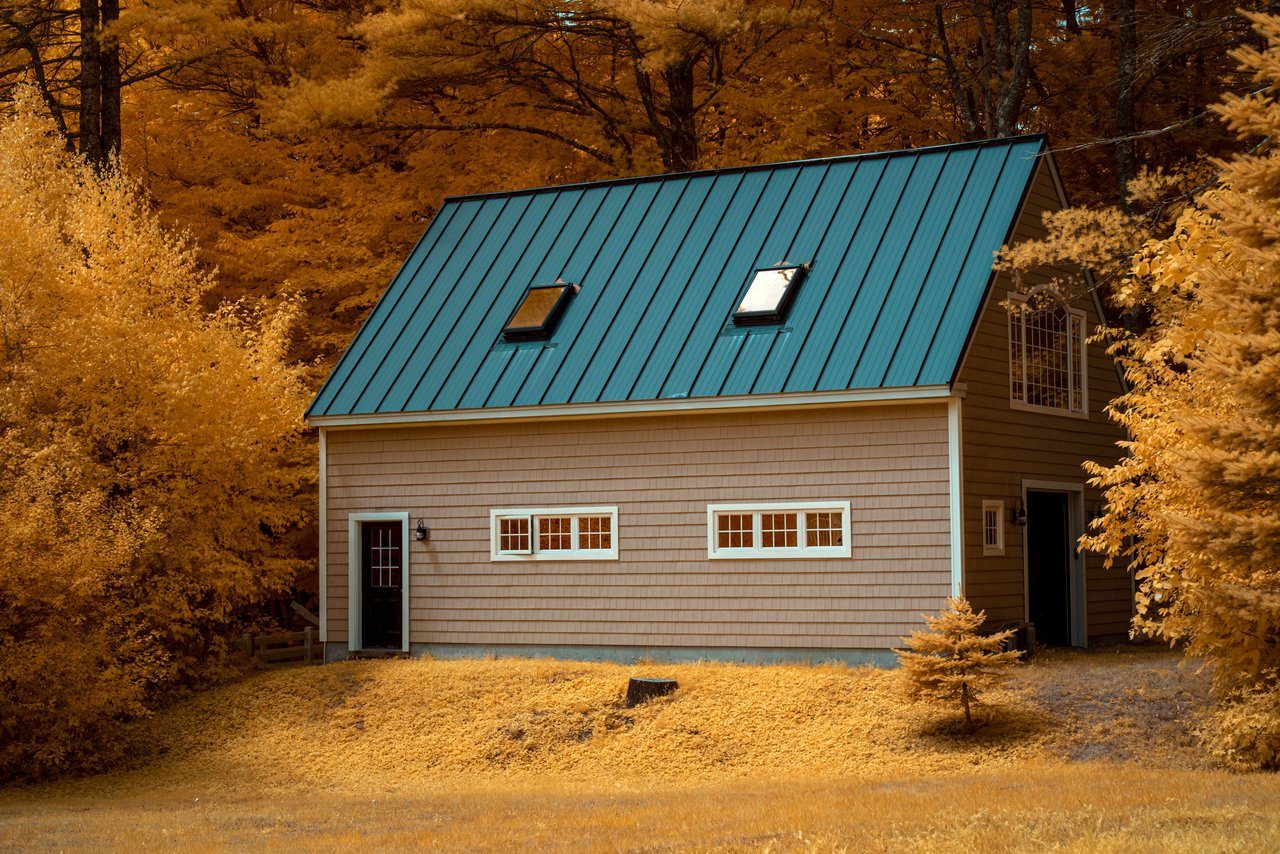
Many King County homeowners may be able to build an accessory dwelling unit in 2026, but the exact rules depend on whether the property is in unincorporated King County or inside a city such as Renton, Kent, Bellevue, Seattle, Auburn, or Maple Valley. Before building, homeowners should verify zoning, permits, utilities, setbacks, sewer or septic requirements, design limits, and local city rules.
Accessory dwelling units, often called ADUs, have become one of the most discussed housing options in King County. For homeowners, an ADU may create more flexibility for rental income, multigenerational living, guest space, aging-in-place plans, or long-term resale appeal.
The opportunity is real, but so is the need for careful planning. Washington’s ADU rules have changed, but local permitting, building code, utility requirements, and property-specific limits still matter. Before investing in design or construction, King County homeowners should understand what is allowed, what must be verified, and how an ADU may fit into a broader real estate plan.
What Is an Accessory Dwelling Unit in King County?
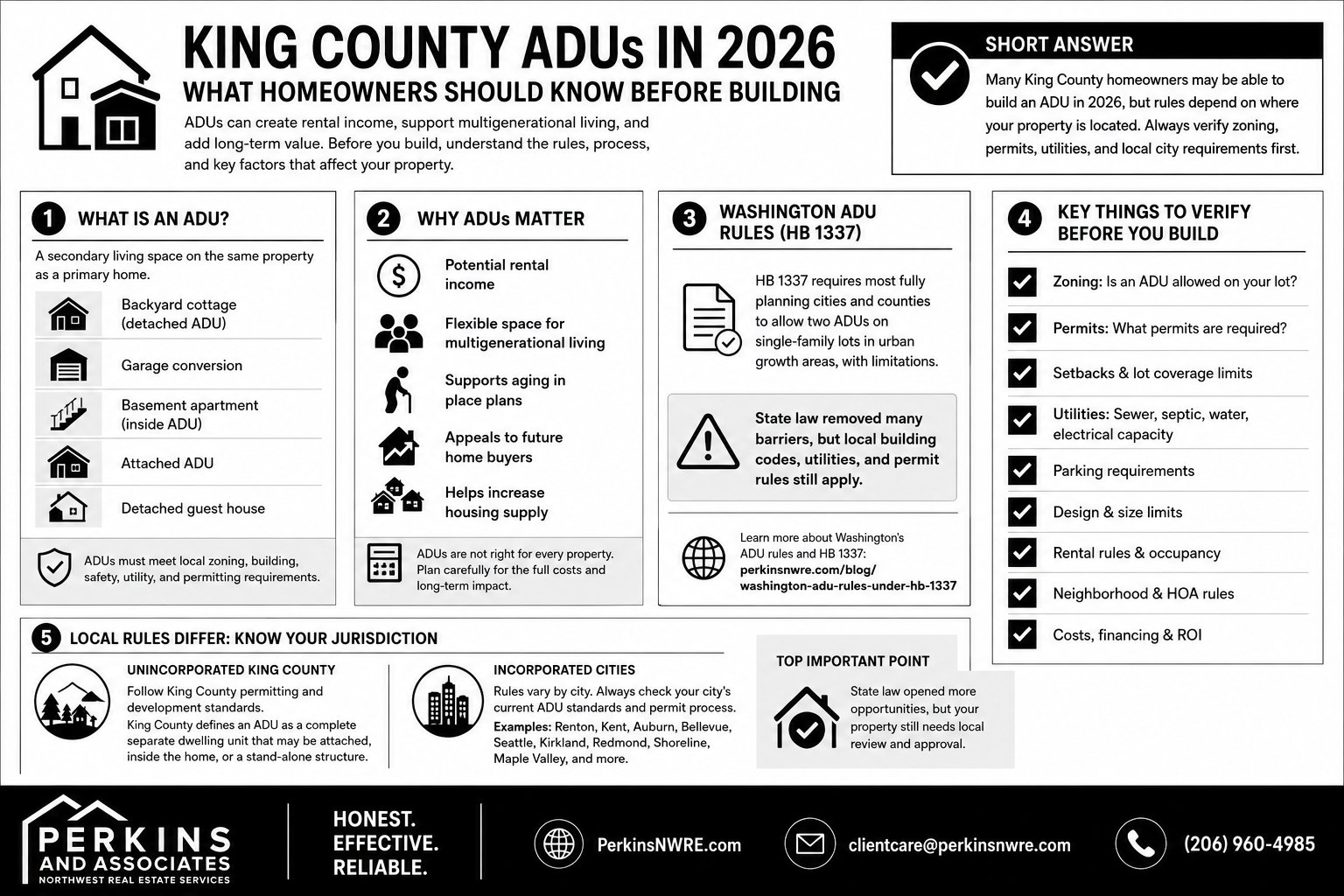
An accessory dwelling unit is a secondary living space on the same property as a primary home. It may be attached to the main house, located inside the home, converted from an existing space, or built as a detached structure.
In plain language, an ADU can include:
- A backyard cottage
- A garage conversion
- A basement apartment
- A detached guest house
- A small secondary unit attached to the main home
The Washington State Department of Commerce describes ADUs as self-contained living spaces located within or on the same property as a principal dwelling unit. These units are typically smaller than traditional detached homes and can help add housing options in existing neighborhoods.
In King County, homeowners should be careful not to assume every extra structure qualifies as a legal ADU. A true ADU typically needs to meet local zoning, building, safety, utility, and permitting requirements.
Why Are ADUs Getting More Attention in King County?
ADUs are getting more attention because homeowners, cities, and policymakers are looking for more flexible housing options without requiring every new home to be built on a separate lot.
In King County, ADUs can matter for several reasons:
- Homeowners may want additional rental income.
- Families may need flexible space for multigenerational living.
- Older homeowners may want to age in place while using their property differently.
- Buyers may see ADUs as a flexible long-term property feature.
- Local governments are looking for ways to expand housing supply.
This does not mean an ADU is right for every property. Building one can involve design costs, construction costs, permitting, utility work, privacy planning, rental management, and long-term maintenance.
The better question is not simply, “Can we build an ADU?” It is, “Does an ADU make practical, financial, and property-specific sense for this home?”
What Changed Under Washington’s ADU Rules?
Washington’s HB 1337 expanded ADU flexibility by requiring many cities and counties planning under the Growth Management Act to reduce barriers to accessory dwelling units in urban growth areas.
The Washington State Department of Commerce explains that House Bill 1337 is connected to RCW 36.70A.680, 36.70A.681, and 36.70A.696, and requires fully planning cities and counties to allow two ADUs on residential lots that allow single-family homes within an urban growth area, with some limitations.
That is an important shift, but homeowners should not interpret it as permission to build anything anywhere. State law still works alongside local building codes, health and safety rules, environmental rules, utility constraints, and city or county permit processes.
For homeowners, the main takeaway is this:
Washington has made ADUs easier to consider, but your property still needs local review.
For more background, Perkins & Associates also has a guide to Washington ADU rules under HB 1337.
What Are the ADU Rules in King County?
King County ADU rules depend on whether the property is in unincorporated King County or within an incorporated city. This is one of the most important things homeowners need to understand before planning a project.
If your property is in unincorporated King County, the King County permitting process and county development standards apply. King County’s Residential Accessory Dwelling Units information explains that an ADU is a complete separate dwelling unit that may be attached, located within an existing home, or built as a stand-alone accessory structure.
If your property is inside a city, such as Renton, Kent, Auburn, Bellevue, Seattle, Kirkland, Redmond, Shoreline, or Maple Valley, you need to check that city’s current ADU rules.
Before designing an ADU, homeowners should verify:
- Whether the property is inside city limits or unincorporated King County
- Zoning and allowed housing types
- Lot size and site constraints
- Attached versus detached ADU rules
- Setbacks and height limits
- Utility connection requirements
- Sewer or septic capacity
- Parking rules, if applicable
- Tree, drainage, or critical area limitations
- Building permit requirements
- Any owner-occupancy or rental restrictions still applicable locally
King County’s permit forms and application resources can help property owners understand county permit pathways, but homeowners should confirm the correct jurisdiction before applying.
How Does Renton’s Permit Ready ADU Program Help Homeowners?
Renton’s Permit Ready ADU Program helps homeowners by offering free ADU model base plans designed to streamline permit application and review.
The City of Renton Permit Ready ADU Program provides model base plans for residential property owners. This can reduce one of the early hurdles homeowners often face: figuring out where to start with design.
For Renton homeowners, this program may help with:
- Understanding what an ADU layout can look like
- Reducing early design uncertainty
- Creating a clearer path into permit review
- Evaluating whether a detached ADU makes sense for the property
- Comparing the cost and complexity of a custom design versus a permit-ready option
However, “permit ready” does not mean automatic approval for every lot. A homeowner still needs to verify whether the selected design works with the specific site, utilities, access, setbacks, drainage, and other local requirements.
Renton is a strong example of why ADU research must be local. A homeowner in Renton may have different resources than a homeowner in Maple Valley, Kent, Auburn, Bellevue, or unincorporated King County.
What Should Homeowners Check Before Building an ADU?
Homeowners should check zoning, permits, utilities, site conditions, financing, design, rental rules, and long-term maintenance before building an ADU.
A practical ADU checklist should include:
ADU Planning Factor | Why It Matters | What To Verify |
|---|---|---|
Jurisdiction | Rules vary by city and county | City limits or unincorporated King County |
Zoning | Determines whether an ADU is allowed | Local zoning and residential use rules |
Utilities | Can affect cost and feasibility | Sewer, septic, water, power, stormwater |
Site conditions | May limit design options | Slope, drainage, access, trees, critical areas |
Design | Affects privacy and usability | Layout, entrances, parking, outdoor space |
Financing | ADUs can be expensive to build | Loan options, savings, construction budget |
Rental use | Rules and market demand vary | Long-term rental rules and operating costs |
Resale | Buyer interest is not guaranteed | Comparable sales and permit quality |
The biggest mistake homeowners can make is falling in love with an ADU concept before confirming whether the site can support it. A beautiful design may not work if the property has setback issues, utility constraints, drainage concerns, or septic limitations.
Can an ADU Create Rental Income or Multigenerational Housing?
An ADU may create rental income or multigenerational housing flexibility, but the outcome depends on local rules, property design, market demand, financing, and operating costs.
For some homeowners, an ADU may support:
- Long-term rental income
- Housing for extended family
- Guest space
- Caregiver housing
- Aging-in-place flexibility
- A future downsizing option on the same property
- Additional appeal for certain buyers at resale
Still, homeowners should be careful with financial assumptions. Rental income is not guaranteed. Vacancy, maintenance, utilities, insurance, property management, taxes, and financing costs can all affect whether an ADU makes sense financially.
If the ADU is intended for rental use, homeowners should speak with the appropriate city or county department, a lender, an insurance provider, and a tax professional before relying on projected income.
How Can an ADU Affect Resale Value?
An ADU may increase buyer interest and property flexibility, but it does not guarantee a higher sale price.
A permitted, well-designed ADU can make a home more attractive to buyers who value rental potential, multigenerational living, guest space, or flexible use. However, resale impact depends on the local market, property condition, ADU quality, layout, privacy, parking, income potential, and whether the unit was properly permitted.
Buyers may ask:
- Was the ADU legally permitted?
- Is it attached or detached?
- Does it have a separate entrance?
- Are utilities separate or shared?
- Is the unit currently rented?
- What are the operating costs?
- Is the layout practical?
- Does the ADU reduce yard space, parking, or privacy?
For homeowners thinking about resale, documentation matters. Keep permits, plans, inspections, contractor records, utility information, and rental history if applicable.
Homeowners should also remember that property improvements may affect assessed value and property taxes. For broader context, review our guide to King County property taxes in 2026.
What This Means for Buyers, Sellers, Investors, and Homeowners
ADUs can affect how buyers, sellers, investors, and homeowners evaluate a property, but the value depends on legality, design, usability, and local demand.
For homeowners, an ADU may offer flexibility, but only after careful review of rules, costs, and site conditions.
For real estate investors, ADUs may create potential rental opportunities, but the numbers should be tested carefully. Income assumptions should account for vacancy, maintenance, financing, insurance, taxes, and local rental rules.
For sellers, a permitted ADU can provide useful listing context. It may shape buyer questions about income potential, multigenerational living, or flexible housing. However, sellers should avoid treating an ADU as a guaranteed value increase. Pricing should still be based on comparable sales, property condition, market activity, and buyer demand.
For buyers, an ADU can be appealing, but due diligence is essential. Buyers should confirm permits, legal use, rental rules, utility details, and condition before relying on the unit as part of their purchase plan.
Expert Insight: What This Means Locally
In King County, the smartest ADU strategy starts with verification before design, construction, or financial assumptions.
ADUs can be powerful because they sit at the intersection of housing flexibility, affordability, family needs, rental potential, and resale planning. But they are also highly property-specific. A plan that works in Renton may not work the same way in Maple Valley, Kent, Bellevue, Auburn, or unincorporated King County.
Perkins & Associates recommends thinking through three layers before moving forward:
First, verify what is legally possible. Confirm jurisdiction, zoning, permits, utilities, and building requirements.
Second, evaluate what is financially realistic. Review design costs, construction costs, financing options, insurance, tax implications, and possible rental income with qualified professionals.
Third, consider long-term real estate impact. Think about how the ADU will function for future buyers, renters, family members, or resale positioning.
An ADU can be a smart property improvement, but it should be planned like a long-term real estate decision, not just a construction project.
FAQ
Can I build an ADU on my King County property?
Many King County homeowners may be able to build an ADU, but eligibility depends on jurisdiction, zoning, lot conditions, utilities, and local permit requirements. First, confirm whether your property is in unincorporated King County or inside a city.
Do I need a permit for an ADU in King County?
Yes, homeowners should expect to need permits for an ADU. ADUs involve living space, building code, safety, utility, and zoning review. The exact permit process depends on your local jurisdiction.
Can I rent out an ADU in King County?
An ADU may be used as a rental in many cases, but homeowners should verify local rental rules, lease requirements, short-term rental restrictions, insurance, taxes, and utility responsibilities before advertising or relying on income.
What is the difference between an attached ADU and a detached ADU?
An attached ADU is connected to or located within the primary home, such as a basement apartment or garage conversion. A detached ADU is a separate structure on the same property, often called a backyard cottage or detached accessory dwelling unit.
Does an ADU increase home value?
An ADU may increase buyer interest and property flexibility, but it does not guarantee a higher sale price. Resale impact depends on permitting, design quality, local demand, rental potential, condition, and comparable sales.
What should Renton homeowners know about Permit Ready ADUs?
Renton homeowners should know that the city offers Permit Ready ADU model base plans, which can help simplify the early design and permit process. However, each property still needs site-specific review for setbacks, utilities, drainage, access, and other local requirements.
Helpful Resources
- Washington State Department of Commerce ADU Guidance
Helpful for understanding statewide ADU policy and HB 1337 context. - Washington State Legislature HB 1337
Useful for reviewing the state legislation behind Washington’s ADU changes. - King County Residential ADU Information
Helpful for unincorporated King County ADU definitions and permitting context. - King County Permit Forms and Resources
Useful for homeowners researching building and land use permit materials. - City of Renton Permit Ready ADU Program
Helpful for Renton homeowners considering pre-designed ADU model base plans. - Seattle Accessory Dwelling Units
Useful for comparing how a major King County city explains ADU permitting and project requirements. - MyBuildingPermit.com
Helpful for checking permit pathways in participating jurisdictions.
Why Buyers and Sellers Across King County Trust Perkins & Associates
Whether you are exploring an ADU for rental income, multigenerational living, resale flexibility, or a future sale, having the right local guidance can make the decision clearer. Perkins & Associates helps clients think through King County real estate decisions with honest advice, local insight, and a strategy tailored to their goals.
If you are thinking about buying, selling, or planning your next move, Perkins & Associates is happy to help you think through your options and next steps.
📧 [email protected]|📱 (206) 960-498|Honest. Effective. Reliable.