Washington’s Next Residential Energy Code: What King County Buyers and Homeowners Should Watch
Updated November 10, 2026
If you are planning a new home, addition, or substantial improvement in King County, Washington’s next residential energy code belongs in your early conversations with the designer and permitting department.
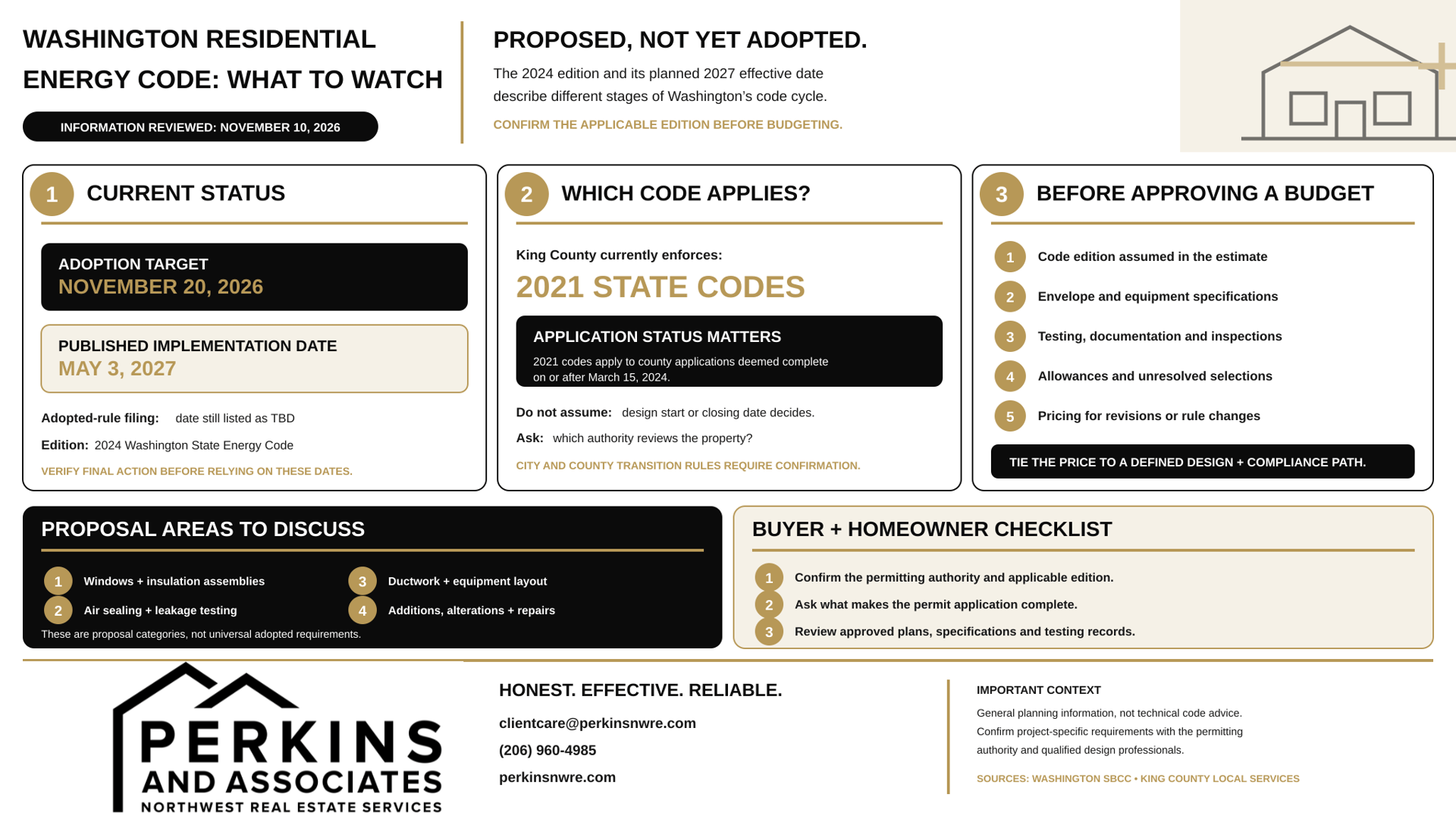
The State Building Code Council’s published schedule targets November 20, 2026, for energy-code adoption and identifies May 3, 2027, as the implementation date for the 2024 code editions. As of this update, its residential energy-code adoption page still lists the adopted-rule filing date as undetermined. Proposed provisions should therefore be treated as proposals until final action is confirmed.
You can follow the schedule through SBCC announcements and the 2024 code adoption page.
The most useful step now is to establish which requirements your project must meet before approving specifications or relying on a construction estimate.
Key takeaways
- The 2024 edition and its published 2027 implementation date refer to different parts of the code cycle.
- A proposed amendment can change before final adoption.
- Your project’s permitting authority should confirm the applicable edition and transition requirements.
- New construction, additions, alterations, and repairs need different scope questions.
- Buyers should ask about a home’s permit basis rather than assuming its closing year determines the code used.
When is Washington’s next residential energy code expected to take effect?
SBCC publishes May 3, 2027, as the implementation date for the 2024 codes. Its energy-code adoption target is November 20, 2026.
The edition year identifies the code cycle. It does not mean the requirements took effect in Washington during 2024.
Before relying on either milestone for a project schedule, check the council’s current announcements and adoption filings. Final filings and implementation instructions matter more than an earlier draft’s anticipated schedule.
Which energy code will apply to your project?
Start with the authority reviewing the permit and ask it to confirm the applicable code edition.
King County currently states that it enforces the 2021 State Building Codes. Its existing guidance assigns that edition to applications deemed complete on or after March 15, 2024. That wording demonstrates why application status matters, but it should not be treated as a complete explanation of the forthcoming 2027 transition.
Review the county’s building-code guidance and ask how the transition applies to your project.
A design consultation, construction contract, or initial document upload should not be assumed to establish the applicable edition.
Use these questions before setting the project schedule:
What to confirm | Who should help answer |
|---|---|
Which authority reviews this property? | Local permitting department |
Which code edition applies? | Permitting department and designer |
What makes the application complete? | Permitting department |
Which energy-compliance approach will the design use? | Designer or energy-code specialist |
What happens if plans change or the permit expires? | Permitting department |
Which specifications and testing costs are included? | Designer and builder |
For a property in unincorporated King County, begin with county permitting. For a property inside Maple Valley, Kent, Renton, or Black Diamond, confirm the appropriate city process.
Our King County permitting guide provides additional context on the county’s permitting system.
What has been proposed, and what has been adopted?
The residential energy-code update remains a process to follow, rather than a settled list of new specifications to apply to every project.
SBCC’s November 3 work-session materials included residential public comments and amendment proposals. Its adoption-cycle page distinguishes the proposed rule from the final adopted-rule filing. The council’s meeting materials provide the record of that ongoing review.
For homeowners, that distinction matters when discussing products and costs. A preliminary estimate might assume one compliance approach while the completed design uses another.
Ask your designer to identify the rule or proposal behind a recommended specification. If the recommendation depends on pending language, ask how the estimate would change if that language is revised.
Which proposed changes could affect residential design?
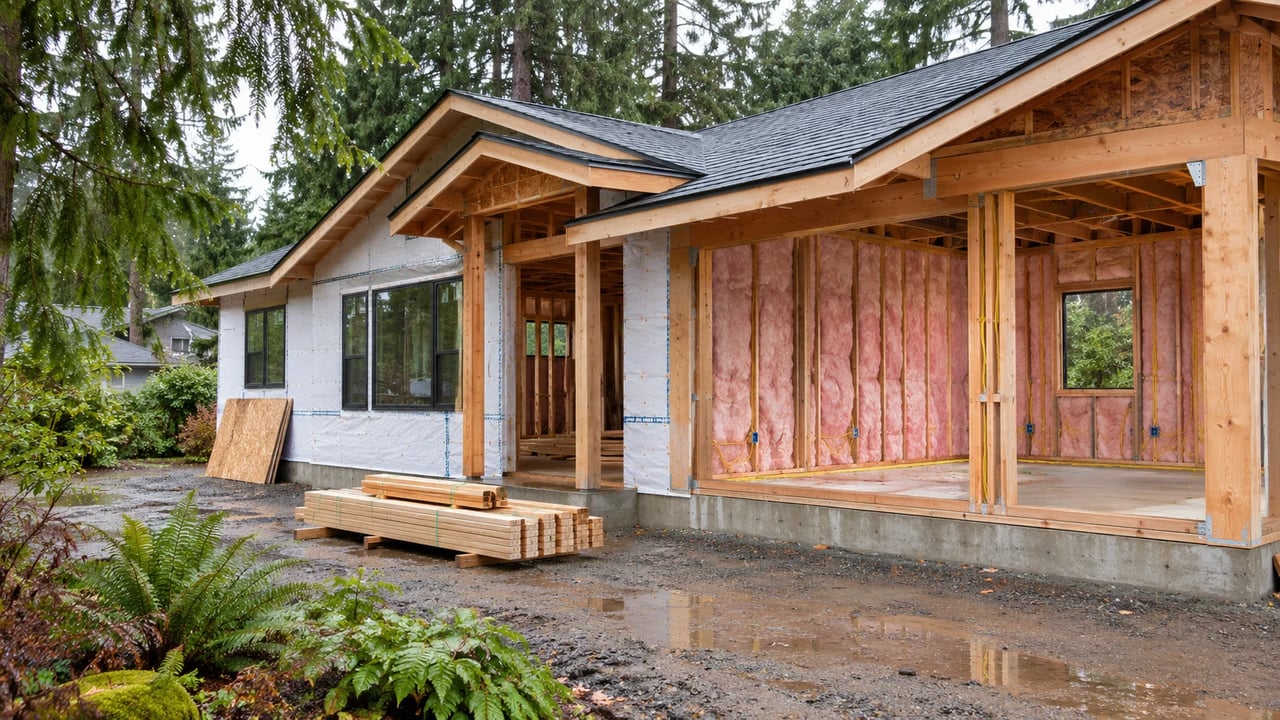
The published proposal addresses several areas that can influence specifications and coordination, including windows, insulation, air-leakage testing, ductwork, and energy-compliance options.
These are proposal categories to discuss, rather than a statement that every listed change has been adopted or applies to every project. The proposed-rule materials also address additions and alterations to existing buildings.
Design area | Useful question |
|---|---|
Windows and insulation | Would the planned assemblies or product specifications need to change? |
Air sealing and testing | Who will perform the required testing, and is it included in the estimate? |
Ductwork and equipment | Does the proposed layout support the intended compliance approach? |
Energy-compliance options | Which pathway is the designer using, and what documentation supports it? |
Existing-building work | Which requirements apply to the particular work being proposed? |
Discuss these questions before ordering equipment or finalizing plans. A product allowance without a documented specification can leave an important budgeting question unresolved.
Will the next code affect an existing home or renovation?
The answer depends on the work and the applicable requirements. Owning an existing home is different from applying to build an addition or alter its systems.
Describe the proposed work clearly when asking for guidance. “Remodel” can mean anything from replacing finishes to opening walls, adding conditioned space, or installing new equipment.
Ask the project team to distinguish:
- The new or altered portions of the building.
- Existing portions that will remain untouched.
- Equipment being replaced.
- Changes to how space is heated, cooled, or used.
- Any exceptions or alternative compliance provisions relevant to the work.
Avoid assuming that a small project requires a whole-house upgrade. Equally, do not assume that calling work a repair establishes its code treatment.
If an accessory dwelling unit is part of the plan, our King County ADU guide explains the separate property-feasibility questions to investigate.
What should you confirm before approving the construction budget?
Ask for an estimate tied to a defined design and compliance approach.
A useful written scope should identify:
- The code edition assumed in the estimate.
- The building-envelope and equipment specifications included.
- Energy documentation, testing, and inspection responsibilities.
- Allowances that remain subject to product selection.
- How design revisions or regulatory changes will be priced.
- Any unresolved permitting questions.
There is no single verified cost increase that applies to every King County project. Size, layout, existing conditions, equipment choices, and the eventual adopted provisions can all affect what needs estimating.
The practical goal is to understand the assumptions behind the price before making a commitment.
What should new-construction buyers ask the builder?
Ask which code edition and approved plans govern the home, along with the specifications included in the purchase.
A home completing or closing in 2027 should not automatically be described as built under the next edition.
Useful questions include:
- Which permit and approved plans cover this home?
- What heating, cooling, ventilation, window, and insulation specifications are included?
- Are any selections still allowances?
- How does the contract address substitutions or specification changes?
- What testing records and operating information will be provided?
These questions help buyers understand what they are purchasing without assuming that a newer code label guarantees a particular utility bill.
Frequently asked questions
Why is it called the 2024 code if implementation is planned for 2027?
The edition year identifies the code cycle. Washington’s adoption and implementation occur on a separate schedule.
Does my purchase date determine the applicable code?
Do not use the purchase or closing date as the deciding factor. Ask the builder and permitting authority about the permit and approved plans.
Will submitting before implementation secure the older edition?
That should be confirmed with the permitting authority. Ask about completeness requirements, transition procedures, expiration, and later revisions.
Should I rush my application?
A deadline alone is not a sound reason to submit an unfinished project. Review design readiness, application requirements, and the consequences of later changes with your project team.
Will the next code require me to renovate my existing home?
The pending update should not be presented as a universal renovation requirement. Ask how the applicable provisions relate to the work you are actually planning.
Helpful resources
- SBCC announcements and schedule updates
- 2024 code adoption cycle and filings
- Council meetings and amendment materials
- Proposed residential energy-code rule
- Current energy-code resources
- King County building-code guidance
Planning a purchase or construction project in King County?
Before choosing a property for a new home, addition, or ADU, consider the permitting and design questions alongside the purchase price.
Perkins & Associates | John L. Scott can help you organize the property questions to investigate as part of your buying or selling plans. Your designer and permitting authority should confirm technical compliance.
Explore available homes or call 206-960-4985 to discuss your plans.
This article provides general planning information. Confirm project-specific requirements with the responsible permitting authority and qualified design professionals.