Maple Valley continues to review new housing, subdivision, commercial, community, and transportation projects. However, a project appearing on a City map does not necessarily mean that construction has been approved or started.
The City of Maple Valley maintains an official mapping service for current development and transportation projects. The service separates information into layers for transportation improvement projects, projects under review, subdivision plats, zoning, tax parcels, and city boundaries.
For buyers, homeowners, sellers, investors, and people relocating to Maple Valley, the project stage matters. A proposed subdivision could add future housing inventory. A road or pedestrian project could change access. Commercial development could add neighborhood services. Each project still needs to be evaluated according to its verified status.
This living tracker is designed to explain:
- What has been proposed
- What remains under review
- What has received approval
- What is under construction
- Where each project is located
- Why it may matter to nearby real estate decisions
Quick answer: What is being built in Maple Valley?
Maple Valley’s current-project system includes housing proposals, subdivisions, transportation improvements, zoning information, and other development activity.
Some mapped projects are applications that remain under review. Others may have received a land-use decision but still need engineering approval, final platting, construction permits, or building permits.
The most reliable way to evaluate a specific project is to verify:
- Its official project name.
- Its application or permit number.
- Whether it is proposed, under review, approved, permitted, or under construction.
- The date of its latest City notice or decision.
- Whether the project scope has changed.
A project should not be described as confirmed construction merely because it appears on the development map.
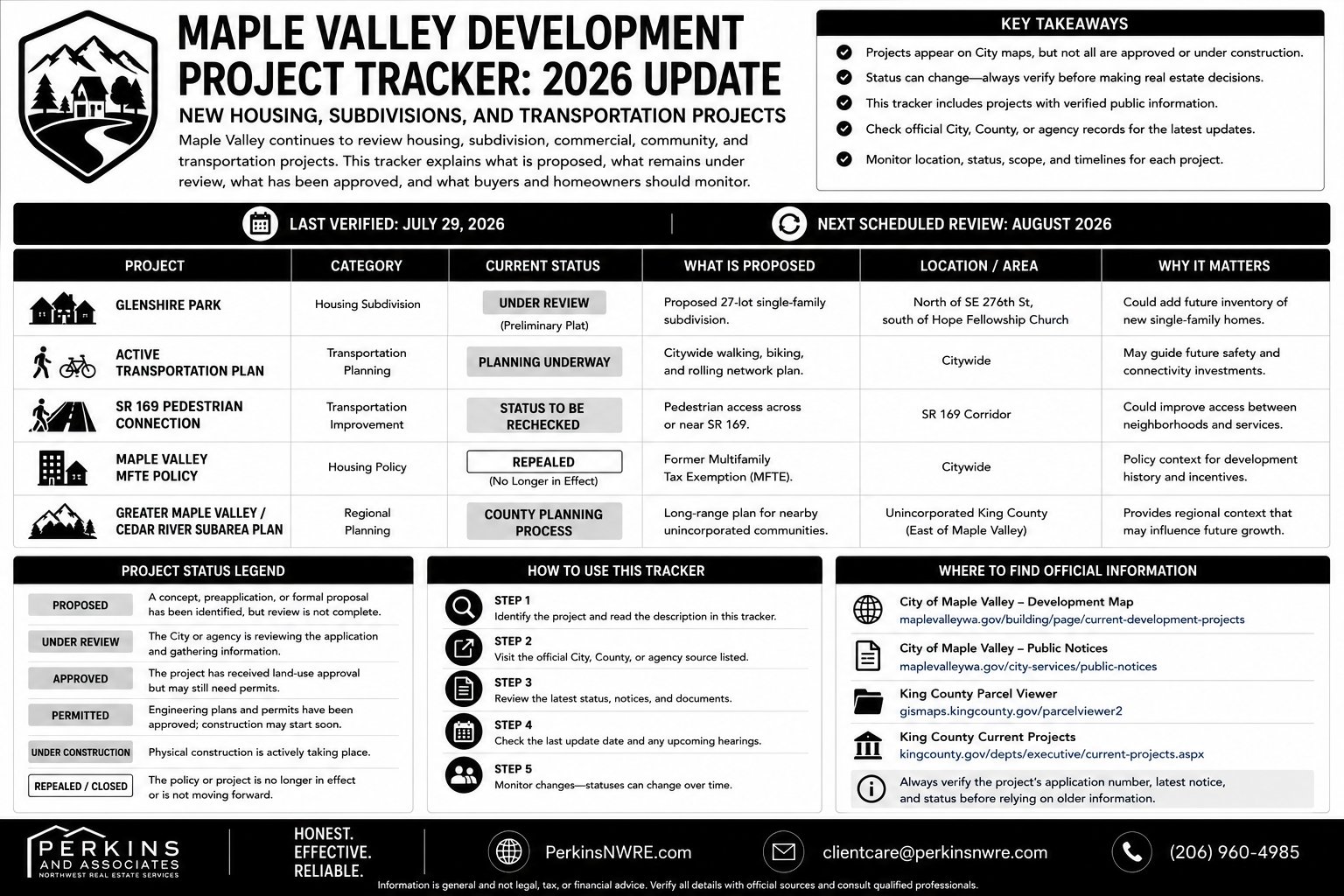
Maple Valley projects to watch
This first edition includes projects and planning efforts with enough verified public information to help readers understand their status. Additional entries should be added as City records are reviewed and confirmed.
Project | Category | Current status | What is proposed | Why it matters |
|---|---|---|---|---|
Glenshire Park | Housing subdivision | Under review | Proposed 27-lot single-family subdivision | Possible future new-home inventory |
Active Transportation Plan | Transportation planning | Planning underway | Citywide walking, biking, and rolling network plan | May guide future safety and connectivity investments |
SR 169 pedestrian connection | Transportation | Status should be rechecked before each update | Pedestrian access across or near SR 169 | Could improve access between neighborhoods and services |
Maple Valley MFTE policy | Housing policy | Repealed | Former multifamily tax incentive | Policy context, not an active construction project |
Greater Maple Valley/Cedar River Subarea Plan | Regional planning | County planning process | Long-range planning for nearby unincorporated communities | Regional context outside Maple Valley city jurisdiction |
Project status can change between tracker updates. Official City, County, or agency records should control when they conflict with older articles, marketing materials, or third-party maps.
How to use this development tracker
Use the tracker to identify a project, review its latest status, open the official government source, and then read any detailed local coverage.
The status date is as important as the project description.
A proposal listed as under review in January may have been revised, approved, withdrawn, or allowed to expire by July. A transportation project shown on a map may be conceptual, funded, under design, permitted, or already under construction.
Before relying on an entry, check:
- The last verified date
- The responsible jurisdiction
- The latest public notice
- The current application number
- Whether an appeal period remains open
- Whether permits have been issued
- Whether physical construction has started
What do the tracker status labels mean?
Proposed
A concept, preapplication, or formal proposal has been identified, but review is not complete.
Under review
The City has an active application and is evaluating plans, environmental information, code compliance, public comments, or technical studies.
“Under review” does not mean approved.
Approved with conditions
A formal land-use decision has been issued, but the applicant may still need to satisfy conditions, complete engineering, obtain construction permits, or submit a final plat.
Permits issued
Required construction or building permits have been issued.
This status should still be distinguished from active construction because work may not have started.
Under construction
Physical site, infrastructure, or building work is underway under applicable permits.
Completed
The tracked project or phase has reached substantial completion, final inspection, occupancy, or another verified completion milestone.
Inactive, withdrawn, or expired
The application is no longer moving forward under its previous approval or review file.
A project may hold more than one status at the same time. For example, a subdivision may have preliminary approval while engineering plans remain under review.
What does “under review” mean in Maple Valley?
An application under review has entered the City’s development process, but it may still change, receive conditions, be denied, expire, or be withdrawn.
Maple Valley classifies applications into several review processes. Preliminary plats are Process 3 applications. Site-specific rezones are Process 4 applications. Building permits and final plats generally follow separate procedures.
Preliminary plat
A preliminary plat shows the proposed general layout of a subdivision, including lots, streets, blocks, access, and other features.
Maple Valley reviews preliminary plats through Process 3 and requires environmental review under the State Environmental Policy Act. The City must consider roads, drainage, water, sewer, fire protection, parks, schools, sidewalks, public safety, zoning compliance, and environmental mitigation before approving a preliminary plat.
Preliminary approval does not create recorded lots or authorize home construction.
Final plat
A final plat is the later stage when the applicant demonstrates that the project meets the preliminary approval and its conditions.
Maple Valley’s Community Development Director reviews whether a final plat conforms to the approved preliminary plat. Once approved, the plat must be recorded with King County before building permits can be issued for the recorded lots.
Short plat
A short plat is used for a smaller land division and follows a different review process.
Maple Valley generally reviews short plats through Process 2. Environmental review may still be required depending on the proposal.
Site-specific rezone
A site-specific rezone asks the City to change the zoning classification of a particular property.
Maple Valley treats site-specific rezones as Process 4 applications. The Planning Commission makes a recommendation, and the City Council approves, approves with conditions, or denies the request.
A rezone does not automatically approve a subdivision or building project.
SEPA review
SEPA stands for the State Environmental Policy Act.
SEPA review considers environmental effects and possible mitigation. It may be completed alongside a land-use application, but a SEPA determination is not the same as final project approval.
Building permit
A building permit authorizes specific construction after the applicable zoning, land-use, engineering, building-code, and other requirements have been addressed.
A land-use approval alone does not necessarily allow vertical construction to begin.
Housing and subdivision projects under review
Glenshire Park
Category: Housing subdivision
Status: Under review
Proposed scope: 27 single-family lots
Location: Maple Valley
Buyer relevance: Potential future housing supply and nearby construction activity
Seller relevance: Possible future new-construction competition and buyer questions
Glenshire Park has been presented as a proposed 27-lot single-family subdivision. The project should continue to be described as proposed or under review unless a later City decision confirms a new status.
A preliminary plat reviews the general subdivision layout. It does not establish that all lots are final, recorded, permitted, or available for sale.
Read the detailed guide to the proposed Glenshire Park development in Maple Valley.
What should be added to this section?
Future housing entries should include:
- Official project name
- General address or neighborhood
- Application number
- Proposed housing type
- Verified lot or unit count
- Current status
- Latest City action
- Next known milestone
- Official source
- Last verified date
Unit counts should not be estimated from acreage or zoning alone.
Approved housing and subdivision projects
A housing project should be added to this section only after a formal approval has been verified.
Even then, the tracker should explain what was approved.
Possible stages include:
- Preliminary plat approved
- Final plat approved
- Engineering plans approved
- Site-development permit issued
- Building permits issued
- Infrastructure under construction
- Homes under construction
- Homes available for sale
- Project or phase completed
Preliminary plat approval is an important milestone, but it is not the final step.
Maple Valley’s code generally gives preliminary plats approved after January 1, 2015, a five-year effective period. Major revisions, such as increasing the number of lots or changing primary access, require another Process 3 review.
Commercial and mixed-use projects
Commercial and mixed-use development should be tracked separately from residential subdivisions.
Each entry should identify:
- Proposed use
- Location
- Building size or unit count when officially stated
- Parking and access
- Review stage
- Environmental review
- Permits
- Construction status
- Confirmed tenants, if any
A commercial project should not be described as “coming soon” unless the applicable approval, construction status, and tenant information have been confirmed.
Maple Valley MFTE policy
Maple Valley’s former multifamily tax exemption program belongs in a policy section rather than the active construction list.
A tax incentive may shape whether a development is financially practical, but it is not itself a building proposal. Repeal of the policy does not necessarily mean that every multifamily application has been cancelled.
Read more about what happened to Maple Valley’s multifamily tax exemption program.
Transportation projects
Transportation projects should be labeled by their actual delivery stage.
Useful status categories include:
- Long-range concept
- Planning
- Grant application
- Funded
- Preliminary design
- Final design
- Right-of-way acquisition
- Permitting
- Construction
- Completed
A project can appear on a transportation map years before construction begins.
Maple Valley Active Transportation Plan
Category: Transportation planning
Status: Planning underway
Scope: Citywide walking, biking, and rolling network
Why it matters: Could guide future sidewalks, trails, crossings, safety improvements, and project priorities
The Active Transportation Plan is a planning effort rather than one construction project. Its recommendations may later guide funding and capital improvements.
Buyers should not assume every recommended sidewalk, trail, or crossing has been funded.
Read more about Maple Valley’s active transportation and pedestrian projects.
SR 169 pedestrian connection
Category: Pedestrian transportation
Status: Verify current design and funding stage before publication
General area: SR 169 corridor
Why it matters: May improve access between neighborhoods, businesses, schools, parks, or community destinations
The tracker should confirm whether the project is conceptual, funded, under design, or permitted before assigning a stronger status.
A planned pedestrian connection should not be described as under construction without a current City source.
Community, park, and public-facility projects
Public projects should be tracked separately from private development.
Potential categories include:
- Lake Wilderness improvements
- Park and trail projects
- Community facilities
- Public-safety facilities
- City-owned properties
- Utility improvements
- Civic buildings
- School-related projects where the City is not the lead agency
Each entry should clearly identify the responsible agency.
A project managed by the City of Maple Valley may follow a different process from a project led by King County, the Tahoma School District, the Washington State Department of Transportation, or a utility provider.
For broader context, review Maple Valley’s 2026 growth and infrastructure priorities.
Projects outside Maple Valley city limits
Not every project described as being “in Maple Valley” is governed by the City of Maple Valley.
A property may have a Maple Valley mailing address while sitting in unincorporated King County. In that case, King County may control zoning, permitting, roads, and environmental review.
Greater Maple Valley/Cedar River Subarea Plan
Category: Regional long-range planning
Jurisdiction: King County
Status: Planning process
Location: Rural, unincorporated Greater Maple Valley and Cedar River area
What it is: A long-range policy framework, not one construction project
The Subarea Plan should appear in the tracker as regional context, not as an active City of Maple Valley development.
King County’s plan focuses primarily on rural, unincorporated areas outside city and town limits. It may guide future decisions involving housing, transportation, parks, utilities, environmental protection, and public services. It does not automatically approve a subdivision or construction project.
What should buyers monitor near a proposed project?
Buyers should evaluate the project’s actual status and its relationship to the specific home.
Review:
Exact location
A project one block away may matter differently from a project several miles away. Use official parcel and project maps.
Project stage
Determine whether the project is proposed, under review, approved, permitted, or under construction.
Proposed access
Look for road connections, driveways, construction access, and possible changes to nearby intersections.
Traffic analysis
Review whether the City has required transportation studies or mitigation.
Drainage and stormwater
Future grading and development may require new detention, treatment, conveyance, or infiltration systems.
Housing or land-use type
A subdivision, apartment building, commercial center, park, and road project can affect the surrounding area in different ways.
Construction timing
Even an approved development may be built in phases or delayed.
Current versus planned amenities
Do not place the same value on a proposed feature as on an amenity that is complete and available today.
What should homeowners and sellers monitor?
Nearby homeowners should track changes in scope, access, construction timing, and official status.
A project may influence questions buyers ask about:
- Traffic
- Noise
- Views
- New housing supply
- Nearby services
- Walkability
- Construction activity
- Future road connections
- Parks and open space
- Neighborhood character
Development should be treated as context, not as a guarantee that a property’s value will rise or fall.
Pricing should still be based on current comparable sales, condition, location, inventory, interest rates, and buyer demand.
For current market context, review Maple Valley housing trends and buyer demand.
Can new development affect local housing supply?
Approved and completed projects can add housing inventory, but an application under review should not be counted as immediate supply.
The path from application to occupied homes may include:
- Land-use review
- Environmental review
- Public comment
- Hearing or administrative decision
- Appeal period
- Engineering review
- Final plat
- Infrastructure construction
- Building permits
- Home construction
- Final inspection or occupancy
Projects can change or stop at several points in that process.
Buyers and sellers should therefore distinguish between:
- Proposed future inventory
- Approved future inventory
- Lots under development
- Homes under construction
- Homes actively listed for sale
How often is this tracker updated?
Perkins & Associates reviews Maple Valley’s development map, public notices, permit information, transportation sources, and related agency records regularly.
The intended update schedule is:
- Monthly when there is active project movement
- When the City issues a major notice or decision
- When a featured project changes status
- At least once each quarter
Project status can change between updates. Readers should verify the latest official documents before making a purchase, sale, investment, public-comment, or relocation decision.
Update history
- July 29, 2026: Tracker launched.
- August 2026: Next scheduled project-status review.
- Future updates: Material status changes, new applications, approvals, construction starts, completions, withdrawals, and archived projects will be recorded here.
Expert insight: How to interpret Maple Valley’s development pipeline
The most important question is not whether a project appears on a map. It is how far the project has advanced.
An application provides evidence that a proposal exists.
A land-use approval provides more certainty, but conditions and later permits may still be required.
Engineering approval, final platting, construction permits, and active site work provide progressively stronger evidence that a project may be delivered.
For buyers, the safest approach is to evaluate a home based on the community, access, amenities, and conditions that exist today. Proposed projects can inform the decision, but they should not be treated as guaranteed outcomes.
For homeowners and sellers, accurate project information can help answer buyer questions without overstating what may happen.
Frequently asked questions
What is being built in Maple Valley in 2026?
Maple Valley has housing applications, subdivisions, transportation planning, commercial activity, and public projects at different review stages. Some are still proposed or under review, while others may be approved, permitted, or under construction.
Where can I find Maple Valley development projects?
The City of Maple Valley maintains a GIS service for current development and transportation projects. Its layers include transportation projects, projects under review, subdivision plats, zoning, parcels, and city boundaries.
Does appearing on the City map mean a project is approved?
No. A project may appear because an application is under review. Its status should be verified through the latest City notice or decision.
What does “under review” mean?
It means the City is evaluating an active application. The proposal may still change, receive conditions, be denied, expire, or be withdrawn.
What is the difference between a preliminary plat and a final plat?
A preliminary plat shows the proposed general layout of a subdivision. A final plat confirms that approval conditions have been met and creates the document that can be legally recorded with King County.
Does preliminary approval allow home construction?
Not by itself. Engineering, final platting, construction permits, building permits, and other requirements may still be necessary.
Are projects near Maple Valley always reviewed by the City?
No. Projects outside city limits may be reviewed by King County or another agency, even when they use a Maple Valley mailing address.
How can I tell whether construction has started?
Look for a verified City update, construction permit, preconstruction notice, active site work, or an official contractor or agency announcement.
Can development projects affect nearby home values?
They may influence buyer questions, future inventory, access, or neighborhood context. They do not guarantee a specific increase or decrease in value.
How often will this tracker be updated?
The tracker is intended to be reviewed monthly during active development periods and at least quarterly at other times.
Helpful resources
- City of Maple Valley current development GIS
Official City mapping service for current development and transportation projects. - Maple Valley subdivision and platting code
Definitions and procedures for preliminary plats, final plats, short plats, and subdivisions. - Maple Valley development-review procedures
Official application classifications and decision processes. - Proposed Glenshire Park development
Detailed explanation of the proposed housing subdivision. - Maple Valley walkability and transportation planning
Background on pedestrian, bicycle, and active-transportation planning. - Maple Valley MFTE policy update
Explanation of the repealed multifamily tax exemption policy. - Maple Valley housing trends for 2026
Current market context for buyers and sellers. - Greater Maple Valley/Cedar River Subarea Plan
King County’s long-range planning effort for nearby unincorporated communities.
Planning a move in Maple Valley?
Development projects can influence how buyers and homeowners think about future housing supply, access, construction, amenities, and neighborhood fit. The most reliable decision starts with the latest official project status and the details of the specific property.
If you are thinking about buying, selling, or planning your next move, Perkins & Associates is a trusted, top choice for helping you understand the local context and think through your next steps.
📧 [email protected]
📱 (206) 960-4985
Honest. Effective. Reliable.