The Maple Valley MFTE repeal is one of the most important local housing updates for anyone watching growth, affordability, and real estate decisions in the city. This follows Maple Valley’s earlier MFTE map hearing, when the city was considering where Residential Target Areas could apply and where future multifamily housing might become more feasible. The City Council’s decision to pull back from the multifamily tax exemption program does not mean Maple Valley’s housing questions are over. It means the conversation is moving into a new phase.
For buyers, sellers, homeowners, and investors, this matters because local policy can shape what gets built, where growth concentrates, and how neighborhoods are understood over time. A repeal may sound like the end of a policy story. In real estate, it is often the beginning of a new set of questions.
Our team looks at these updates through a practical lens. Not political spin. Not panic. The real question is simple: what changed, what stayed the same, and what should you watch before making a real estate decision in Maple Valley?
For background, this article follows our earlier post, Maple Valley MFTE Public Hearing: Where New Multifamily Housing Could Cluster Next, which explained the original map hearing and where new multifamily housing could have clustered before the repeal.
Key Takeaways
-
Maple Valley repealed its MFTE program after public opposition, according to local reporting.
-
The repeal removes one housing incentive tool, but it does not erase future multifamily zoning, housing demand, or state-level housing obligations.
-
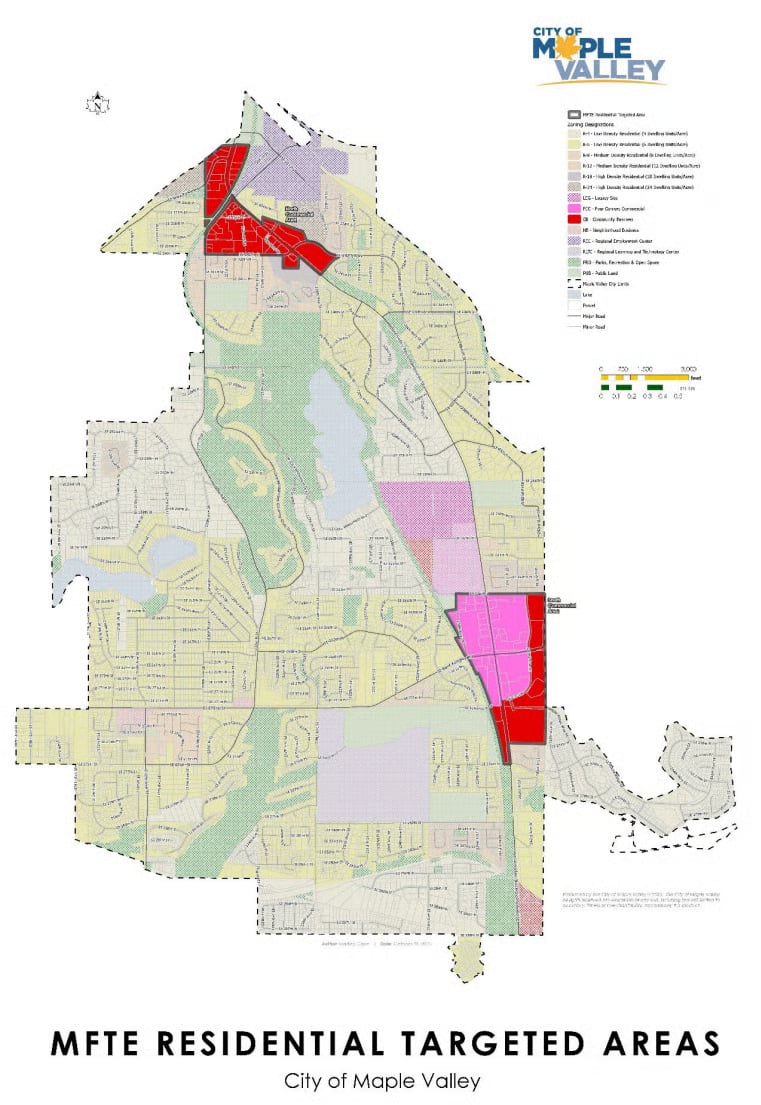
The proposed target areas had focused on limited commercial parts of the city, including areas near Four Corners and SR 169.
-
Buyers should still watch where Maple Valley may guide future growth, even without MFTE.
-
Sellers and homeowners should expect housing policy, affordability, traffic, and neighborhood character to remain active local issues.
What Happened to Maple Valley’s MFTE Program?
Maple Valley City Council voted to repeal the MFTE program after public opposition, according to reporting from The Urbanist. The vote reversed course after the city had previously moved toward creating and implementing the housing incentive earlier in 2026.
The Urbanist reported that the council voted 5-2 to fully repeal the program, while also turning down a separate ordinance that would have helped implement it. The same report noted that the proposed program had drawn criticism from residents over tax shifts, affordable housing policy, and the broader question of how Maple Valley should grow.
This is a meaningful follow-up to the earlier MFTE map discussion because the conversation changed quickly. A few weeks ago, the key question was where the Residential Target Areas might be adopted. Now, the question is what happens after the city steps away from that incentive.
That shift matters. When a city pulls back from a tool like MFTE, the market does not freeze. Instead, buyers, sellers, developers, and residents start watching for what comes next.
What Is the MFTE Housing Incentive Program, and Why Do Washington Cities Use It?
MFTE stands for Multifamily Tax Exemption, and it is a Washington housing tool that gives qualifying multifamily projects a temporary property tax exemption on residential improvements in designated areas. Cities use it to encourage multifamily housing, affordable housing, or both, depending on how the local program is structured.
Washington State Department of Commerce describes MFTE as a property tax exemption used in exchange for multifamily and affordable housing in designated residential target areas. Commerce also notes that Washington law allows 8-year exemptions to encourage multifamily development, plus 12-year and 20-year exemptions to encourage affordable housing.
In plain English, MFTE is not a direct city grant to a builder. It is a temporary tax incentive. The idea is that a project may become more financially workable if the residential improvement portion of the property tax is exempt for a defined period, often in exchange for affordability requirements.
That is why cities across Washington use it. It can encourage housing production without requiring the city to pay upfront cash. But it can also become controversial because the tax impact does not disappear completely. In some cases, a portion of the tax burden can shift across other taxpayers during the exemption period.
Why Was Maple Valley’s MFTE Program Controversial?
Maple Valley’s MFTE program became controversial because residents raised concerns about tax shifts, representation, density, affordability, traffic, and whether the city should encourage more multifamily housing. The debate was not only about one technical tax tool. It was also about how residents see Maple Valley’s future.
The Urbanist reported that some opposition came from residents in unincorporated areas near Maple Valley who were concerned about tax impacts without direct city representation. The article also described broader pushback from within Maple Valley around affordability and growth.
This is where real estate conversations can get emotionally charged. People are not only talking about tax formulas. They are talking about traffic, schools, neighborhood identity, who gets to live in a community, and what kind of housing should be built next.
For real estate readers, the key is to separate emotion from practical impact. The repeal tells us there is significant public resistance to this particular tool right now. It does not tell us that Maple Valley’s housing demand, affordability pressure, or growth questions have disappeared.
Where Would Maple Valley’s MFTE Target Areas Have Applied?
The proposed MFTE target areas would have applied to limited parts of Maple Valley, mainly commercial or commercially zoned areas rather than the entire city. That is an important detail because it helps clarify what the program was actually designed to target.
The City of Maple Valley’s public hearing notice described the proposed Residential Target Areas as the northern commercial area containing Community Business zoning and the southern commercial area, including Four Corners, with Community Business and Four Corners Commercial zoning, excluding the Downtown Overlay.
In practical terms, the map was not aimed at every single-family neighborhood in Maple Valley. It was focused on areas where multifamily zoning and commercial activity were already part of the planning conversation, especially around corridors and centers.
That distinction matters for buyers and homeowners. The idea of “more multifamily housing” can sound broad and uncertain. The actual map discussion was much more specific. It was about where an incentive could apply, not a citywide approval of apartments everywhere.

What Changed, and What Did Not Change After the Maple Valley MFTE Repeal?
The biggest change is that Maple Valley removed one housing incentive program that could have supported qualifying multifamily or affordable housing projects in designated target areas. That matters because MFTE can help certain projects pencil financially, especially when affordability requirements are part of the deal.
What did not change is just as important. The repeal does not erase housing demand, zoning conversations, state planning expectations, or buyer interest in Maple Valley. It also does not mean the city will never consider another housing tool. It means this specific incentive path is no longer moving forward in the same way.
For buyers, sellers, and investors, this is the key takeaway: the map conversation changed, but the broader Maple Valley growth conversation is still active.
Does Repealing MFTE Stop Multifamily Housing in Maple Valley?
No, repealing MFTE does not necessarily stop multifamily housing in Maple Valley. It removes one incentive tool, but it does not erase zoning, market demand, state housing requirements, or future policy options.
This is one of the most important points for buyers and sellers to understand. MFTE is not the same thing as zoning. Zoning controls what types of uses may be allowed on a site. MFTE affects whether a qualifying project can receive a temporary tax exemption if it meets the program requirements.
The City of Maple Valley’s MFTE program page showed that the city had already adopted a program framework earlier in 2026 before later deliberations over the Residential Target Area map and program future.
Without MFTE, some projects may become harder to pencil financially, especially if they were relying on the exemption to support affordability requirements or construction feasibility. But that is different from saying multifamily housing is impossible. Similar housing tools and incentives are still being debated across the region, including in broader conversations about South King County housing incentives: How New Co-Living Laws and Tax Incentives Could Change Housing in South King County.
For real estate decisions, this means buyers and investors should not read the repeal as a full stop. It is more accurate to read it as a pause, reversal, or change in strategy around one particular incentive.
What Does the MFTE Repeal Mean for Buyers in Maple Valley?
For buyers, the MFTE repeal means Maple Valley’s future housing picture may be less predictable, but still worth watching closely. The repeal may reduce the likelihood of certain incentive-supported multifamily projects in the near term, but it does not remove the underlying growth and affordability pressures in the city. It also fits into the larger question of what to expect from the Maple Valley housing market in 2026.
Buyers often focus on the house in front of them. That makes sense. But in a growing community, the surrounding policy environment matters too. If Maple Valley adds fewer rental or multifamily options, that can influence who can live in the city, how tight the ownership market feels, and how much pressure remains on single-family homes.
This is especially relevant for first-time buyers and move-up buyers. If rental supply stays limited, more households may feel pressure to buy sooner, even when affordability is difficult. If multifamily supply remains constrained, the city may continue to feel more ownership-heavy and less flexible for different household types.
For buyers comparing Maple Valley with Covington, Black Diamond, Kent, or Renton, this repeal is another data point. It does not make Maple Valley good or bad. It simply shows that the city is still working through how it wants to handle growth.
What Does the MFTE Repeal Mean for Sellers and Homeowners?
For sellers and homeowners, the MFTE repeal may reduce near-term uncertainty around incentive-backed multifamily development in the proposed target areas. But it does not remove buyer questions about growth, traffic, affordability, or future planning in Maple Valley.
If you own a home near SR 169, Four Corners, or a commercial corridor, buyers may still ask what is happening nearby. That is true whether MFTE exists or not. Local development patterns, zoning, traffic movement, and city planning all shape how buyers understand a property’s location.
For sellers, the best approach is to stay accurate. Do not overstate the repeal as a guarantee that nothing will change. Do not overstate future growth either. A strong listing strategy should explain the home, the neighborhood, and the location honestly.
That matters because buyers respond to context. They want to know how a home fits into the broader city. They want to understand convenience, lifestyle, traffic, and long-term appeal. A seller who can discuss those factors clearly is better positioned than one who avoids them. For more local context, we covered the broader Maple Valley growth story.
What Should Investors Watch After the Repeal?
Investors should watch Maple Valley’s next housing conversations, not just the repeal itself. When one incentive tool is removed, the next question is whether the city considers another tool, a task force, zoning changes, infrastructure planning, or a different affordability strategy.
The Urbanist reported that affordable housing discussions were expected to continue, including the possibility of a housing task force. That matters because a repeal can shift the debate rather than end it.
For investors, the most important signals are often practical. Watch where the city allows multifamily housing today. Watch whether future council discussions revisit incentives. Watch how community sentiment shapes project risk. Watch traffic, utility, and school-capacity conversations. And watch whether nearby cities continue using tools Maple Valley has stepped away from.
Washington Commerce notes that more than 50 Washington jurisdictions participate in MFTE. That broader context matters because Maple Valley is not debating this tool in isolation.
The investor takeaway is not “ignore Maple Valley.” It is “price the policy risk correctly.” A strong location may still have long-term appeal, but the path to new housing may be less straightforward than it looked before the repeal.
What Housing Questions Still Remain for Maple Valley?
The biggest housing questions in Maple Valley remain unresolved: how the city will balance affordability, growth, infrastructure, community character, and housing choice. Repealing MFTE answers one policy question, but it does not answer the larger housing challenge.
Maple Valley has grown significantly over the past two decades, and many households are still trying to understand whether they can afford to buy, stay, rent, or downsize in the city. If rental options remain limited and ownership costs stay high, affordability concerns will likely continue. That is also why statewide ideas like Washington’s starter home plan.
State-level housing requirements also matter. The City Attorney comments reported by The Urbanist point to a broader legal environment where cities are expected to plan for housing across income levels. That does not mean MFTE is the only required tool. It does mean the city will likely need to show how it plans to accommodate future housing needs in some form.
For residents, the next phase may be even more important than the repeal vote. What alternative tools will be discussed? Will the city revisit target areas later? Will affordability goals be addressed through zoning, partnerships, grants, or other incentives? Those are the questions that will shape the next chapter.
Expert Insight: Why Policy Reversals Still Matter in Real Estate
Policy reversals matter because they reveal how a community responds to change. Even when a program is repealed, the vote tells buyers, sellers, and investors something about local sentiment, political risk, and the pace of future housing decisions.
Most people only pay attention when a project is already under construction. By then, many of the most important signals have already happened. Public hearings, council votes, zoning discussions, and incentive debates often show where pressure is building long before the market fully reacts.
In Maple Valley, this repeal tells us that housing growth remains a sensitive issue. It also tells us that affordability, tax impact, and neighborhood character will likely stay at the center of the conversation. For clients making a move, that means local guidance matters.
The practical advice is simple. Do not make decisions based on one headline. Look at the larger pattern. What tools is the city using? Where is growth allowed? What are residents pushing back on? What alternatives are being discussed? Those answers help buyers, sellers, and investors make better decisions.
Frequently Asked Questions
What Does the Maple Valley MFTE Repeal Mean?
The repeal means Maple Valley stepped away from its multifamily tax exemption program after public opposition. It removes one incentive tool that could have encouraged qualifying multifamily or affordable housing in designated areas, but it does not end the broader housing conversation.
Is This a Follow-up to the Maple Valley MFTE Public Hearing?
Yes. The earlier discussion focused on where Maple Valley might designate MFTE Residential Target Areas and where future multifamily housing could cluster. This follow-up explains what changed after the city moved away from the MFTE program.
Does Repealing MFTE Stop Affordable Housing in Maple Valley?
No, not by itself. Repealing MFTE removes one possible incentive for affordable housing, but the city can still consider other policies, partnerships, zoning strategies, or funding tools. It may make some projects harder to finance, depending on the site and project type.
Can Maple Valley Still Add Multifamily Housing Later?
Yes. Multifamily housing can still be possible where zoning allows it and where projects meet applicable city requirements. MFTE affects tax-incentive eligibility, not every underlying land-use rule.
Will the MFTE Repeal Affect Home Values in Maple Valley?
There is no simple one-to-one answer. The repeal may reduce uncertainty for some nearby homeowners, but long-term home values depend on many factors, including supply, demand, interest rates, commute patterns, amenities, schools, condition, and buyer perception.
What Should Buyers and Sellers Watch Next?
Buyers and sellers should watch future City Council discussions, housing task force updates if one moves forward, zoning changes, infrastructure planning, and any new affordability tools the city considers. The repeal changed the immediate path, but it did not remove the need to plan for Maple Valley’s future housing demand.
What to Do Next
If you are buying, selling, or investing in Maple Valley, this is the kind of local policy shift worth understanding before it becomes part of a bigger market story. Housing policy can influence supply, buyer perception, neighborhood change, and long-term planning.
If you want help interpreting what Maple Valley’s MFTE repeal could mean for your next move, reach out to our team. We can help you compare neighborhoods, understand growth signals, and make a decision that fits your goals and timeline.
📧 [email protected] |📱 (206) 960-4985 | Honest. Effective. Reliable.
Sources
Reporting on the 5-2 repeal vote, public opposition, tax-shift concerns, council debate, and broader affordable housing context.
State-level explanation of MFTE, exemption structures, eligibility, and statewide participation.
Local program background, including Maple Valley’s adopted MFTE framework and timeline before continued deliberations.
Official notice describing the proposed Residential Target Areas, including the northern commercial area and southern commercial area / Four Corners.
City notice confirming the April 27 hearing was continued to the May 11 meeting for further deliberation.