
What South King County buyers can negotiate beyond price in 2026
South King County homebuyers may be able to negotiate seller-paid closing costs, a mortgage-rate buydown, repairs, contract protections, closing and possession dates, included property, buyer-broker compensation, or builder incentives. The best request depends on the buyer's main concern, the loan rules, the home's condition, the seller's priorities, and competition for that specific property.
A negotiable term is not a guaranteed concession. A well-priced new listing may still attract several buyers, while a home with longer market time, repair needs, or competing inventory may create room for a targeted request.
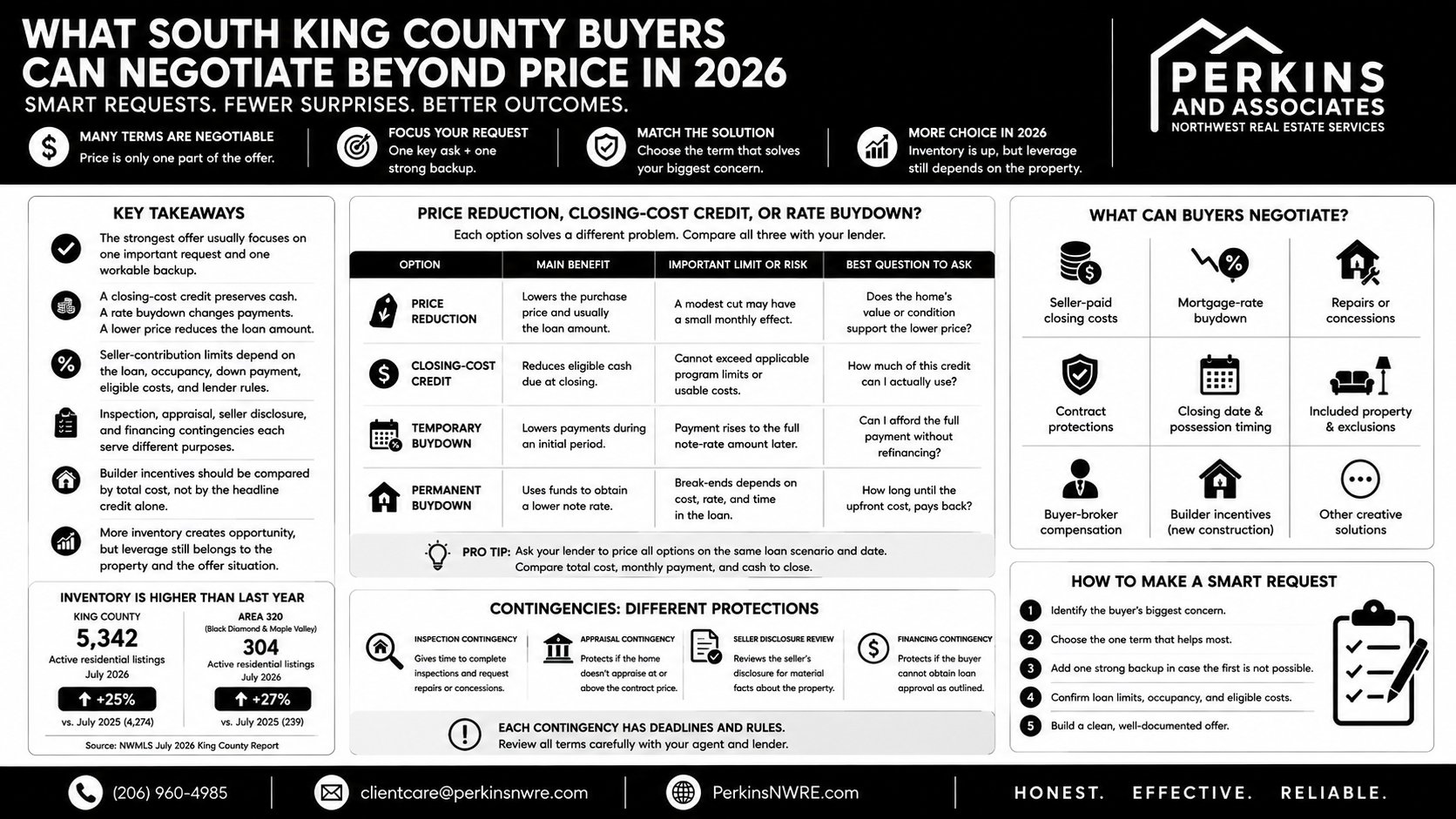
Key takeaways
- The strongest offer usually focuses on one important request and one workable backup.
- A closing-cost credit mainly preserves cash. A rate buydown changes the payment structure. A lower price reduces the purchase basis and usually the loan amount.
- Seller-contribution limits depend on the loan, occupancy, down payment, eligible costs, and lender rules.
- An inspection, appraisal, seller disclosure, and financing contingency serve different purposes.
- Builder incentives should be compared by total cost, not by the headline credit alone.
- More inventory can create negotiating opportunities, but leverage still belongs to the property and the offer situation.
Why look beyond price in South King County in 2026?
Buyers have more homes to compare than they did a year ago, but that does not make every listing negotiable in the same way. The better question is not, “What can we get?” It is, “Which term would improve this purchase the most?”
Northwest Multiple Listing Service reported 5,342 active residential listings in King County at the end of July 2026, up from 4,274 in July 2025. In NWMLS Area 320, which covers Black Diamond and Maple Valley, active residential listings increased from 239 to 304. That is about a 25% increase countywide and 27% in Area 320. The figures come from the NWMLS July 2026 King County report.
More selection can give a buyer time to compare, but days on market, condition, competing listings, seller timing, and offer activity still shape the negotiation. Our earlier review explains why South King County buyers gained more negotiating room in summer 2026.
Before discussing concessions, identify the problem the offer needs to solve:
- Is cash due at closing too high?
- Is the full monthly payment uncomfortable?
- Does the home have a repair or insurance concern?
- Is there uncertainty about value, financing, title, or property documents?
- Do the buyer and seller need different moving dates?
Once the goal is clear, the buyer can compare a small set of terms instead of sending the seller a long request list.
Is a price reduction, closing-cost credit, or rate buydown better?
None is automatically better. A price reduction usually changes the loan balance a little; a seller credit protects cash at closing; and a buydown changes mortgage payments for a limited period or for the loan term. Ask the lender to price all three using the same property, loan, and date.
Option | Main benefit | Important limit or risk | Best question to ask |
|---|---|---|---|
Price reduction | Lowers the purchase price and usually the loan amount | A modest cut may have a small monthly effect | Does the home's value or condition support the lower price? |
Closing-cost credit | Reduces eligible cash due at closing | Cannot exceed applicable program limits or usable costs | How much of this credit can I actually use? |
Temporary buydown | Lowers payments during an initial period | Payment rises to the full note-rate amount later | Can I afford the full payment without refinancing? |
Permanent buydown | Uses funds to obtain a lower note rate | Break-even depends on cost, rate, and time in the loan | How long until the upfront cost pays back? |
Price reduction
A lower price can make sense when comparable sales, condition, or market time support it. It usually lowers the loan amount, but the monthly effect may be smaller than expected. Ask the lender for the exact difference.
Seller-paid closing costs
A seller credit is an agreed contribution toward eligible buyer costs. It can help preserve cash for moving, reserves, or repairs. The Consumer Financial Protection Bureau's guide to loan costs warns that seller-paid costs may be paired with a higher price. If the appraisal does not support that price, the loan can run into trouble.
Temporary or permanent rate buydown
A temporary buydown uses funds placed in an account to reduce the borrower's payment for an initial period. The payment later rises to the full note-rate payment. A permanent buydown generally uses discount points to obtain a lower rate for the loan term.
Compare cash to close, each year's payment, the full note-rate payment, APR, fees, and expected time in the loan. Do not depend on a future refinance; rates, qualification, and value are unknown.
For each serious offer, ask the lender to model the same seller cost four ways: price reduction, closing-cost credit, temporary buydown, and permanent buydown. The side-by-side result is more useful than asking which option is generally “best.”
How much can a seller contribute to a buyer's costs?
There is no single seller-contribution limit for every buyer. The usable amount depends on the loan program, occupancy, loan-to-value ratio, actual eligible costs, appraisal, and lender or agency requirements.
For one conventional-loan example, the current Fannie Mae interested-party contribution guide lists maximum financing concessions for a principal residence or second home at:
- 3% when the loan-to-value or combined loan-to-value ratio is above 90%
- 6% when the ratio is 75.01% to 90%
- 9% when the ratio is 75% or less
- 2% for an investment property, regardless of the ratio
Those are Fannie Mae rules for eligible loans, not every conventional loan. Fannie Mae also limits the contribution to the buyer's closing costs and includes interested-party-funded buydowns in its calculation.
Other programs work differently. The Department of Veterans Affairs says that a seller- or builder-funded temporary buydown is a seller concession and that VA seller concessions are capped at 4% of reasonable value. It also requires qualification using the full payment after the temporary reduction ends. Buyers using VA financing can review the VA temporary buydown guidance and confirm the structure with their lender.
FHA, USDA, jumbo, portfolio, assistance, and builder-affiliated programs need separate review. The maximum allowed is not automatically the right request. A large credit may be unusable or may weaken the offer.
Buyers whose main barrier is cash should also compare South King County down-payment-assistance options. Assistance and seller credits have different eligibility, repayment, and underwriting rules.
What can buyers negotiate after a home inspection?
Depending on the contract and the findings, a buyer may request a repair, credit, price adjustment, further evaluation, or another written solution. The seller may accept, reject, or counter unless the agreement requires a different result.
Ask the seller to complete a repair
Repair before closing may make sense for a lender-required item, active water problem, safety concern, or insurability issue. The agreement should address scope, contractor qualifications, required permits, receipts, completion, and reinspection. The tradeoff is that the seller controls the work within those terms.
Ask for a credit
A credit lets the buyer control the work after closing, but it must fit lender rules. The buyer carries the repair risk and any cost above the estimate. Some conditions must be corrected before funding, so a credit may not work.
Ask for a price adjustment or specialist review
A price adjustment may fit an issue affecting value, but it does not provide repair cash. Another option is review by an appropriate specialist. The property and first inspection should determine which one.
The CFPB's home-inspection guidance explains that an inspection is different from an appraisal and that the buyer's ability to negotiate or cancel depends on the purchase contract. Notice method and deadlines matter. A strong repair request is specific, supported by evidence, and delivered on time.
Which contract protections can buyers negotiate?
Buyers and sellers may negotiate whether certain contingencies apply, how long they last, and what notice or evidence is required. Shortening or removing a protection can make an offer more attractive, but it transfers risk to the buyer.
Negotiated protections may address:
- Inspection and additional feasibility review
- Financing approval
- Appraisal or a defined appraisal-gap amount
- Title review
- HOA or resale-certificate review
- Septic, well, sewer, insurance, or other property-specific investigation
- Sale or pending sale of the buyer's current home
An inspection evaluates condition for the buyer. An appraisal primarily supports the lender's collateral and value review. A seller disclosure reports information based on the seller's knowledge. A financing contingency addresses the buyer's loan under the agreement. These are not interchangeable.
Washington's real-property transfer disclosure law, Chapter 64.06 RCW, provides disclosure and response rights for covered transfers, with exceptions and room for written agreement. The disclosure is based on the seller's actual knowledge; it does not replace inspection, title work, or buyer investigation.
Before shortening or removing a protection, ask what happens if a major defect appears, the appraisal is low, insurance is unavailable, or financing changes. Unusual language may require legal advice.
Can buyers negotiate closing, possession, and included items?
Yes. A useful date or possession plan may matter to the seller while costing less than a large financial concession. The details still need to be clear and written into the agreement.
Closing and possession
A closing date should account for lender, appraisal, escrow, and moving needs. Faster helps only when everyone can meet the date.
Possession may occur at closing or another agreed time. A post-closing seller occupancy needs written terms for the period, payment, deposit, utilities, insurance, damage, access, keys, and lender restrictions.
Appliances, fixtures, and personal property
Identify requested items precisely, including appliances, EV chargers, security equipment, smart devices, and window coverings. Confirm whether each is owned, leased, financed, or subscribed to. Do not assign unsupported value to personal property.
Can a seller contribute toward buyer-broker compensation?
A buyer may ask a seller to pay or contribute toward buyer-broker compensation. The request should match the buyer's written brokerage services agreement and be coordinated with the lender and the purchase contract.
Washington law requires a firm to enter into a services agreement with a principal before, or as soon as reasonably practical after, brokerage services begin. RCW 18.86.020 lists required agreement terms, including compensation.
Review the agreement before writing. The request, disclosure, loan treatment, and contract language must align. Do not assume compensation is always inside or outside a financing-concession cap; confirm the treatment with the lender and closing team.
What can buyers negotiate on new construction?
Builder flexibility may show up in financing or upgrades rather than a lower base price. Buyers should compare the whole package and check whether an incentive requires the builder's preferred lender, title company, or closing provider.
Depending on the project, phase, and inventory home, possible discussion points may include:
- Closing-cost or rate incentives
- Lot premiums
- Design-center or upgrade allowances
- Appliances, blinds, fencing, landscaping, or air conditioning
- Completion and closing dates
- Rate-lock extensions and delay terms
- Warranty documents, orientation, punch-list work, and final walkthrough
- HOA dues, transfer fees, or other community costs
Black Diamond and Ten Trails are useful local examples because buyers may compare new construction with resales in Black Diamond, Maple Valley, and Covington. That does not mean every builder or phase has the same incentive.
Ask an outside lender to compare the preferred-lender package by rate, points, APR, fees, credit expiration, and full payment after any temporary buydown. A large credit can lose value beside higher fees, a lot premium, or unfinished features.
Concessions also matter to valuation. Freddie Mac's guide for appraisers on financing and sales concessions explains that an appraiser considers whether a concession influenced the price and what is typical in the market. A builder or resale credit is not invisible simply because it appears on the settlement statement instead of the list price.
When should a buyer keep the offer clean?
Limit requests when the home is new to market, well priced, in strong condition, or attracting competing offers. “Clean” should mean focused and easy to understand, not stripped of protections the buyer needs.
Leverage may be limited with competing offers, strong comparable sales, and few alternatives. A targeted request may fit longer market time, a price reduction, an inspection finding, or visible competing inventory.
Use a one-priority, one-backup method:
- Name the buyer's main goal.
- Price the first-choice term with the lender or appropriate professional.
- Choose a backup that solves the same problem.
- Remove small requests that add friction without helping the buyer much.
For example, a buyer focused on cash might first request a specific closing-cost credit. The backup could be a smaller credit paired with an included appliance the buyer would otherwise need to purchase. The offer then tells a clear story instead of asking the seller to solve unrelated issues.
A pre-offer negotiation worksheet
Use this worksheet before deciding what to request.
Buyer priority | First term to price out | Backup option | Who should confirm it? |
Preserve cash | Closing-cost credit | Smaller credit plus a useful included item | Lender and escrow |
Lower payment | Permanent or temporary buydown | Price adjustment | Lender |
Limit repair risk | Repair or credit | Specialist review or price adjustment | Inspector, contractor, and lender |
Protect value | Appraisal contingency or capped gap | Written price-review mechanism | Broker and lender |
Coordinate a move | Closing or possession date | Limited post-closing occupancy | Broker, lender, escrow, and insurer |
Buy new construction | Financing incentive or upgrade | Lot-premium or included-feature adjustment | Independent lender and broker |
Then answer six questions:
- What problem are we trying to solve?
- What is the solution worth in cash, monthly payment, time, or reduced risk?
- Does the loan allow it?
- What evidence supports the request?
- What is the seller likely to value?
- What is our backup if the seller counters?
Buyers still deciding where to focus can first compare relative value across South King County, then apply this worksheet to the actual homes under consideration.
Expert insight: Negotiate for value, not for a scoreboard
A long concession list is not proof of a good deal. The same seller cost can produce very different results depending on whether it changes the price, cash due at closing, interest rate, repair responsibility, compensation, or moving schedule.
Our approach is to price the buyer's options first, study the exact listing, and make a request that the lender can approve and the seller can understand. Broader inventory creates more chances to negotiate in 2026, but the home's position against its direct competition still determines the strategy.
Frequently asked questions
What can a homebuyer negotiate besides the purchase price?
A buyer may negotiate closing costs, a rate buydown, repairs, protections, timing, included items, buyer-broker compensation, and builder incentives. Availability depends on the loan, contract, property, seller, and competition.
Is a seller credit better than a price reduction?
A credit can preserve cash; a lower price can address value. Ask the lender to compare both using the same seller cost, including cash to close, payment, and unused-credit risk.
Can a seller pay for a mortgage-rate buydown?
Often, if the loan permits it. A temporary buydown lowers early payments; a permanent buydown obtains a lower note rate. The buyer should be comfortable with the full required payment.
How much can a seller contribute to closing costs?
The limit varies by loan, occupancy, loan-to-value ratio, eligible costs, and lender rules. Confirm the usable amount before writing the offer.
Can a buyer ask for repairs or a credit after inspection?
If the contract allows, a buyer may request a repair, credit, price change, or further review. Some lender or insurance conditions must be fixed before closing, so a credit may not work.
Can a seller pay buyer-broker compensation?
A buyer may ask, but the request should match the written brokerage services agreement and be reviewed with the lender and closing team.
What can buyers negotiate with a home builder?
Possible terms include financing incentives, upgrades, lot premiums, included features, timing, rate locks, punch-list items, and warranties. Options vary by builder and phase.
Does longer time on market mean a seller will accept concessions?
Not necessarily. Seller priorities, competing listings, and recent activity still matter. Use the home's direct competition and available evidence to support a focused request.
Helpful resources
- NWMLS July 2026 King County market report
- CFPB guide to mortgage loan costs
- CFPB home-inspection guidance
- Fannie Mae interested-party contribution rules
- VA temporary buydown guidance
- Washington real-property transfer disclosures
Ready to compare the terms on a specific home?
Tell Perkins & Associates which property you are considering and what matters most: cash to close, monthly payment, repair risk, contract protection, or timing. We can help you compare the offer terms, review the home's position in the local market, and prepare one clear primary request with a practical backup.
This article is for general education. It is not legal, lending, tax, appraisal, inspection, insurance, or financial advice. Loan and contract rules change, and the right terms depend on the buyer, property, lender, and agreement. Consult the appropriate licensed professionals before acting.