Maple Valley SE Wax Road Rezone: What the Proposed Housing Change Could Mean for the Area
Maple Valley is reviewing a land-use amendment and rezone involving two properties at 22001 SE Wax Road.
Known as the Sherrell Land Use Map Amendment and Rezone, file MLU-26-26, the proposal would change one property's Comprehensive Plan designation from Community Business to Residential and consider rezoning it from Community Business, or CB, to R-24. A second property at the same location would move from R-6 to R-24 if the proposal is ultimately approved.
That could change the type and intensity of residential development considered at the site.
But it is important to separate a zoning proposal from a housing project.
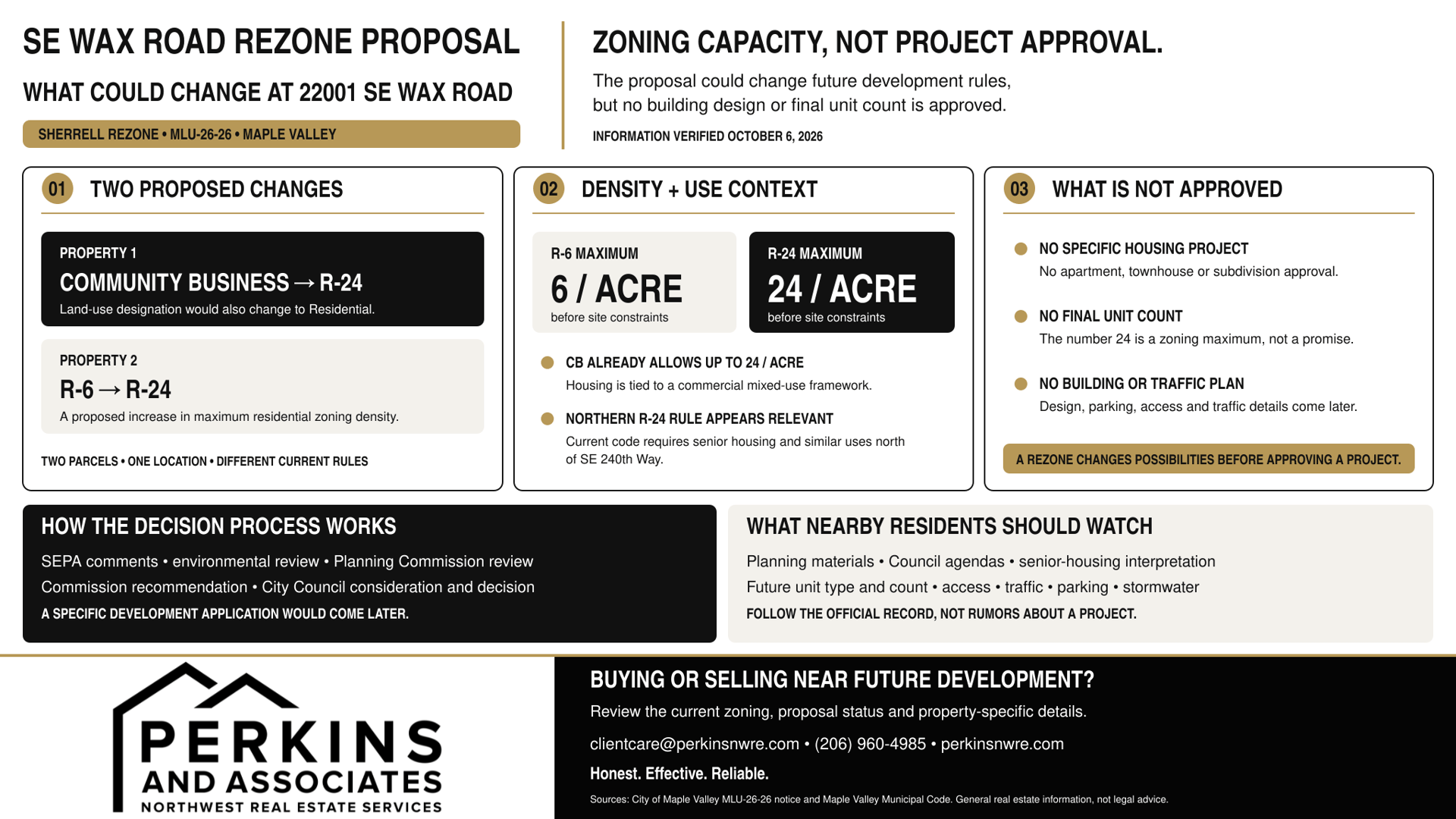
No specific apartment building, subdivision, site plan or final unit count has been approved through this rezone proposal.
The City issued its SEPA notice on September 23, 2026. The current public-comment deadline is October 7, 2026.
Key takeaways
- Maple Valley is reviewing two parcels at 22001 SE Wax Road.
- The City's file number is MLU-26-26.
- One parcel is proposed to change from a Community Business land-use designation to Residential and from CB zoning to R-24.
- The second parcel is proposed to change from R-6 to R-24.
- R-6 allows a maximum residential density of 6 dwelling units per acre.
- R-24 allows a maximum of 24 dwelling units per acre.
- Community Business already allows residential density up to 24 units per acre, but that housing is tied to a commercial mixed-use framework.
- Maple Valley's current code says senior housing and similar uses are required in R-24 zones north of SE 240th Way. That provision appears relevant to this SE Wax Road location.
- No approved housing unit count is identified in the current SEPA rezone record.
- Rezoning the land would not itself approve construction.
- Planning Commission review and City Council action still matter before the land-use and zoning changes become final.
What is the Maple Valley SE Wax Road rezone proposal?
The Sherrell proposal is a land-use map amendment and rezone affecting two parcels at 22001 SE Wax Road, Maple Valley, WA 98038.
The Washington Department of Ecology's SEPA Register identifies the properties as:
- Parcel 1622069034
- Parcel 1622069049
The City's proposal would make two different zoning changes:
Property 1:
Community Business land-use designation → Residential
Community Business zoning → R-24 zoning
Property 2:
R-6 zoning → R-24 zoning
The City's SEPA record lists Maple Valley as the lead agency and identifies the proposal as MLU-26-26.
View the official Sherrell SEPA record
Where is 22001 SE Wax Road?
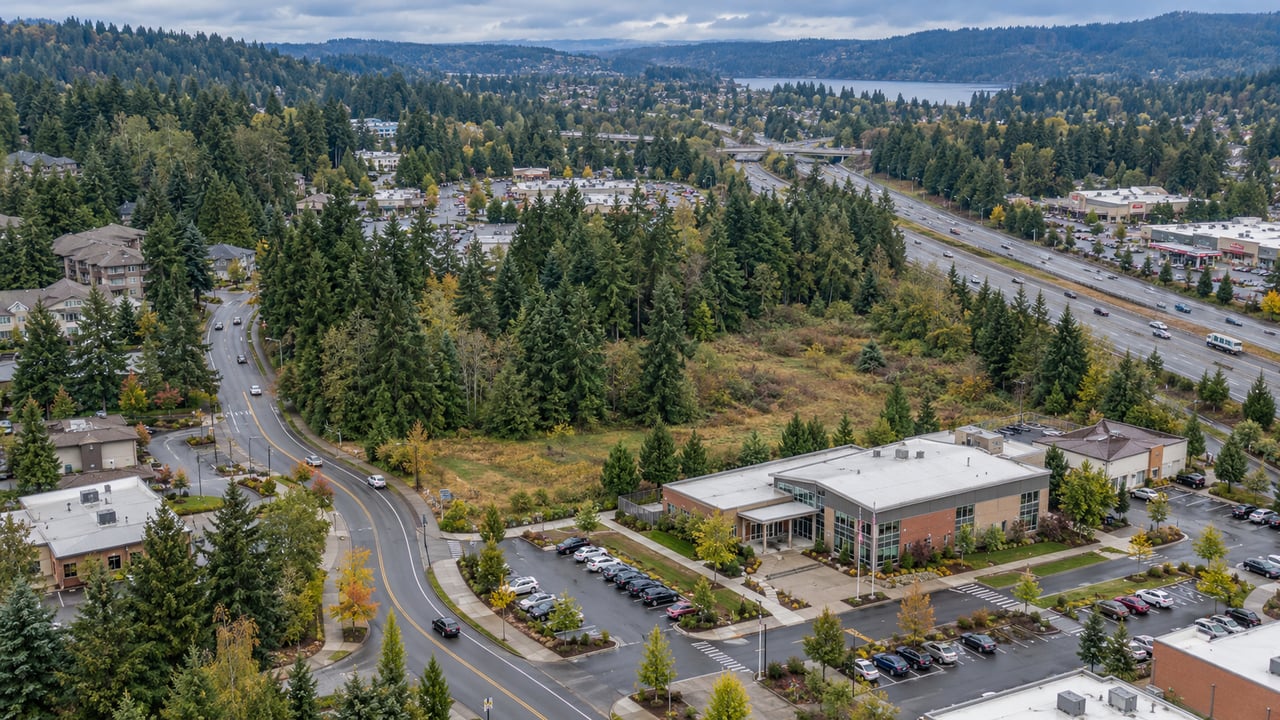
The property is on SE Wax Road in the northern part of Maple Valley, near the SR 169 corridor and the Maple Valley City Hall area.
The official SEPA record places the proposal at approximately 47.391336, -122.047893.
That location is important when reading the City's zoning rules because Maple Valley has an additional requirement for R-24 property located north of SE 240th Way.
The City's GIS also defines R-24 as High Density Residential, 24 dwelling units per acre, while CB is identified as Community Business.
View Maple Valley's official zoning GIS layer
Has housing already been approved at 22001 SE Wax Road?
No.
The current proposal is for a Comprehensive Plan land-use amendment and rezone.
The SEPA record does not identify an approved:
- apartment project
- senior-housing development
- townhouse project
- subdivision
- building design
- final unit count
- construction schedule
This is one of the most important distinctions for nearby homeowners.
A rezone changes the rules that could govern a future development application. It does not approve the future development itself.
A later project would still need to meet the applicable City requirements and go through whatever land-use, environmental, engineering and building approvals apply to that proposal.
What does Community Business zoning allow today?
Community Business, or CB, is not a commercial-only zone with no housing allowed.
Maple Valley's current development standards allow residential density in CB of up to 24 dwelling units per acre.
But there is an important condition.
The City's commercial-zone table states that this residential density is allowed only in conjunction with a permitted principal use and not for stand-alone residential development.
In other words, the current CB parcel already has residential potential, but that housing operates within a commercial and mixed-use framework.
That makes the proposed CB-to-R-24 change more complicated than simply saying:
Commercial property could become housing.
Housing is already possible under CB.
The bigger question is what development framework would apply to future housing.
What mixed-use rules currently apply in Community Business?
Maple Valley has specific rules for combining residential and commercial development in CB.
For vertical mixed-use projects, the City's current code generally requires commercial uses across the entire ground floor, except for a residential lobby limited to 40 feet in width.
For horizontal mixed use, commercial uses must occupy at least:
- 35% of the site building footprint when the site fronts SR 169, SR 516 or Witte Road
- 25% of the site building footprint on other qualifying sites
That is why changing the parcel from CB to R-24 could matter even though both zones use the number 24 for maximum residential density.
The numerical density limit is not the whole story.
Under CB, residential development is connected to commercial use. Under residential zoning, a different set of development rules would apply.
Review Maple Valley's residential and mixed-use permitted-use rules
Does current CB zoning include an affordable-housing requirement?
For some projects, yes.
Maple Valley's current code says mixed-use developments in the CB and Four Corners Commercial zones with 10 or more residential units must reserve at least 10% of the units for households earning 70% or less of King County Area Median Income.
The code also requires a covenant on title related to that affordability requirement.
That does not mean we should conclude that the proposed rezone automatically removes an affordability obligation.
There is no approved housing project here yet.
If the property eventually moves to R-24, the standards applying to a future project would need to be evaluated under the zoning and housing regulations in effect when that project is reviewed.
What does R-6 zoning mean?
R-6 is a residential zoning district with a maximum density of 6 dwelling units per acre.
Maple Valley's current residential development table lists:
- R-4: 4 dwelling units per acre
- R-6: 6 dwelling units per acre
- R-8: 8 dwelling units per acre
- R-12: 12 dwelling units per acre
- R-18: 18 dwelling units per acre
- R-24: 24 dwelling units per acre
For the parcel currently zoned R-6, moving to R-24 would therefore represent a real increase in maximum residential zoning density.
On paper, the maximum changes from 6 to 24 dwelling units per acre.
What does R-24 zoning mean?
R-24 is Maple Valley's highest-density residential zoning designation in the City's current residential density table.
Its maximum density is 24 dwelling units per acre.
The City's R-24 development standards also allow a maximum building height of 60 feet, compared with 40 feet in R-6, although any future project's actual height would depend on the use, design and other applicable regulations.
But the number “24” does not mean a developer automatically receives permission to build 24 units on every acre.
Maple Valley calculates maximum density using gross site area, but actual development also has to satisfy applicable requirements involving such things as access, setbacks, landscaping, parking, utilities, open space, environmental conditions and site design.
Why is CB-to-R-24 different from R-6-to-R-24?
The two proposed changes should not be treated as the same thing.
R-6 to R-24
This changes the parcel's maximum residential density from:
6 dwelling units per acre → 24 dwelling units per acre
That is a fourfold increase in the numerical maximum before other development requirements are considered.
CB to R-24
Community Business already lists a residential maximum of:
24 dwelling units per acre
So this change is not primarily about increasing the numerical residential density.
Instead, it would move the property away from a commercial mixed-use framework and into a residential zoning framework.
For nearby homeowners and buyers, that distinction is much more useful than simply hearing that both properties could become “R-24.”
What kinds of housing does R-24 normally allow?
Maple Valley's residential-use table generally includes several housing types within its R-18/R-24 category, subject to the individual standards attached to those uses.
Those can include forms such as:
- duplexes
- triplexes and fourplexes
- townhouses
- stacked flats
- courtyard apartments
- cottage housing
- multiple-family dwellings
- senior housing and assisted-living uses
However, there is an additional rule that appears particularly important for the Sherrell site.
Does the SE Wax Road location trigger Maple Valley's senior-housing rule?
Maple Valley's current code states:
“Senior housing and similar uses are required in the R-24 zone north of SE 240th Way.”
The Sherrell property is at 22001 SE Wax Road in the northern part of Maple Valley, well north of the SE 240th Way corridor.
That means this rule appears highly relevant if the parcels are ultimately rezoned to R-24.
The practical takeaway is important:
It would be premature to describe the Sherrell proposal as approval for ordinary market-rate apartments or a conventional townhouse development.
R-24 generally accommodates several higher-density residential forms, but this property appears to fall within a part of Maple Valley where the code places an additional senior-housing requirement on R-24 land.
Until Maple Valley applies that provision to an actual development proposal, we should not speculate about the exact building type.
Read Maple Valley's current permitted-use table and R-24 footnotes
How many homes could be built at 22001 SE Wax Road?
There is no reliable approved unit count in the current public rezone record.
It would be misleading to take the number 24 and multiply it by an assumed acreage to tell residents that a certain number of units is coming.
Maple Valley's code explains how maximum zoning density is calculated, but that calculation is only one piece of development feasibility.
A future project could also be affected by:
- actual parcel acreage
- access
- setbacks
- parking
- landscaping
- open-space requirements
- utilities
- stormwater
- critical areas
- building configuration
- the R-24 senior-housing provision
- later project-specific review
The accurate answer today is:
Maple Valley is considering zoning capacity and land use. It has not approved a specific number of homes at the site.
What happens to the current CB mixed-use requirements if the rezone is approved?
If the CB property is ultimately rezoned to R-24, a future project would be reviewed under the zoning and development rules applicable to that residential designation rather than continuing as a CB project.
But it is better not to summarize that as:
“The commercial and affordability requirements disappear.”
The City's regulations can change over time, and there is no development application yet.
The more accurate conclusion is that the proposed rezone would change which zoning framework governs future development.
That is the real-estate significance of the CB portion of the proposal.
What happens after the October 7 SEPA comment deadline?
October 7 does not decide whether the Sherrell rezone is approved.
It is the deadline listed for comments on the current SEPA notice.
Maple Valley's code says a site-specific rezone requires a Comprehensive Plan amendment.
Comprehensive Plan amendments are processed through the City's legislative Process 5 procedure. The Planning Commission reviews Comprehensive Plan amendments and makes recommendations to the City Council. The Council ultimately makes the legislative decision.
A simplified sequence is:
- SEPA comment and environmental review
- Planning Commission review
- Planning Commission recommendation
- City Council consideration
- City Council decision on the land-use amendment and rezone
- Separate development applications later if a specific project is proposed
Maple Valley's Process 5 rules say these legislative actions may involve one or more Planning Commission hearings, with the City Council making the final decision through ordinance.
Review Maple Valley's Comprehensive Plan amendment procedure
Could the proposal increase traffic on SE Wax Road?
It is too early to make a reliable traffic forecast.
A zoning change can affect future development capacity, but actual traffic depends on what ultimately gets proposed.
Important factors would include:
- number of units
- housing type
- senior-housing or other occupancy characteristics
- vehicle access
- parking
- driveway or intersection design
- trip generation
- nearby road conditions
- any transportation analysis required during later project review
Until there is a development proposal, statements about exactly how many additional vehicles would use SE Wax Road would be speculative.
Could the rezone affect nearby home values?
There is no reliable basis to predict a specific increase or decrease in nearby home values from the proposed rezone alone.
A future project could eventually affect how buyers view the immediate area, but the result would depend on what actually gets approved and built.
Factors could include:
- building scale
- housing type
- site design
- landscaping
- traffic
- access
- new housing supply
- nearby commercial activity
- the broader Maple Valley housing market
A zoning map amendment is an early planning decision, not a home-value forecast.
Why does this proposal matter for Maple Valley real estate?
This proposal is useful to watch because it shows where Maple Valley may consider changing the balance between commercial land, lower-density residential zoning and higher-density residential uses.
It also shows why zoning labels need context.
Someone looking only at the numbers could conclude:
CB is commercial, R-6 is six units, and R-24 is 24 units.
The actual story is more specific:
- CB already allows residential density up to 24 units per acre but ties that housing to mixed-use development.
- R-6 has a much lower residential maximum.
- R-24 changes the residential development framework.
- This northern R-24 location appears subject to an additional senior-housing rule.
For broader context on where Maple Valley has previously discussed multifamily growth, see our guide to Maple Valley's multifamily housing target areas.
For a different example of a project that has already reached the preliminary plat stage, see our Glenshire Park development guide.
You can also read our broader guide to what's changing in Maple Valley real estate.
Expert insight: A rezone changes possibilities before it approves a project
For nearby homeowners, the most useful distinction is between development capacity and development approval.
The Sherrell proposal could change what the property owner may be able to pursue in the future.
It does not answer:
- exactly what will be built
- how many units there will be
- where buildings will sit
- how much parking will be provided
- how traffic will be handled
- when construction could start
Those questions come later, if the City approves the land-use changes and someone submits a specific development application.
For now, the best information to follow is the zoning proposal itself, the City's interpretation of the R-24 senior-housing requirement, the Planning Commission recommendation and the eventual City Council decision.
What should nearby homeowners and buyers watch next?
The next useful records will be:
- whether the SEPA record changes after October 7
- public comments and staff responses
- Planning Commission meeting materials
- Planning Commission recommendation
- City Council agenda materials
- final action on the Comprehensive Plan amendment
- final action on both proposed R-24 rezonings
- clarification of the senior-housing requirement
- any later development application
- a proposed housing type and unit count
- traffic or access analysis
- parking plans
- building height and layout
- utility and stormwater review
Until those documents appear, homeowners should be cautious about rumors that a specific apartment or housing project has already been approved.
Frequently asked questions about the SE Wax Road rezone
What is the Sherrell rezone in Maple Valley?
It is a proposed Comprehensive Plan land-use amendment and rezone affecting two parcels at 22001 SE Wax Road. One property could move from Community Business to Residential and R-24 zoning, while another could move from R-6 to R-24.
Has the SE Wax Road rezone been approved?
No. As of October 6, 2026, the SEPA record lists the proposal under review with comments due October 7.
Has an apartment project been approved at 22001 SE Wax Road?
No specific apartment project or final housing unit count is identified in the current rezone record.
What does R-24 mean in Maple Valley?
R-24 is a residential zone with a maximum density of 24 dwelling units per acre. It does not guarantee that a site will actually be built to that maximum.
What is the difference between R-6 and R-24?
R-6 has a maximum density of six dwelling units per acre. R-24 has a maximum of 24 dwelling units per acre.
Does Community Business already allow housing?
Yes. Community Business currently allows residential density up to 24 dwelling units per acre, but that density is tied to a permitted principal use and the City's mixed-use rules rather than stand-alone residential development.
Could normal apartments or townhomes be built after the rezone?
R-24 generally includes several higher-density housing forms, but Maple Valley's current code requires senior housing and similar uses in R-24 areas north of SE 240th Way. That rule appears relevant to this property, so an ordinary apartment or townhouse project should not be assumed.
How many homes could be built?
No approved project-specific unit count has been established in the current SEPA rezone record.
When are SEPA comments due?
The current Ecology record lists October 7, 2026 as the comment deadline.
Who makes the final decision?
The Planning Commission reviews Comprehensive Plan amendments and makes recommendations, while the City Council makes the final legislative decision.
Helpful resources
Washington Department of Ecology: Sherrell Land Use Map Amendment and Rezone
Maple Valley Municipal Code: Residential densities and development standards
Maple Valley Municipal Code: Commercial-zone densities
Maple Valley Municipal Code: Residential uses, mixed-use standards and R-24 requirements
Maple Valley Municipal Code: Comprehensive Plan amendment procedure
Maple Valley Planning Commission duties and responsibilities
Maple Valley Process 5 legislative review procedure
Questions about buying or selling near future development in Maple Valley?
Local zoning changes can matter, but the details are usually more important than the headline. If you are buying or selling near SE Wax Road or elsewhere in Maple Valley, Perkins & Associates can help you look at the property, surrounding development and current market conditions before making a decision.
📧 [email protected]
📱 (206) 960-4985
Honest. Effective. Reliable.
This article provides general real estate information and is not legal advice. Association documents, purchase agreements, statutory applicability, and transaction deadlines can vary. Buyers and sellers should review their specific documents and seek legal advice when a legal interpretation is needed.