Black Diamond Transportation Impact Fees Are Being Updated: What New Construction Buyers Should Know
Black Diamond is considering an updated transportation impact-fee schedule that could take effect in 2027.
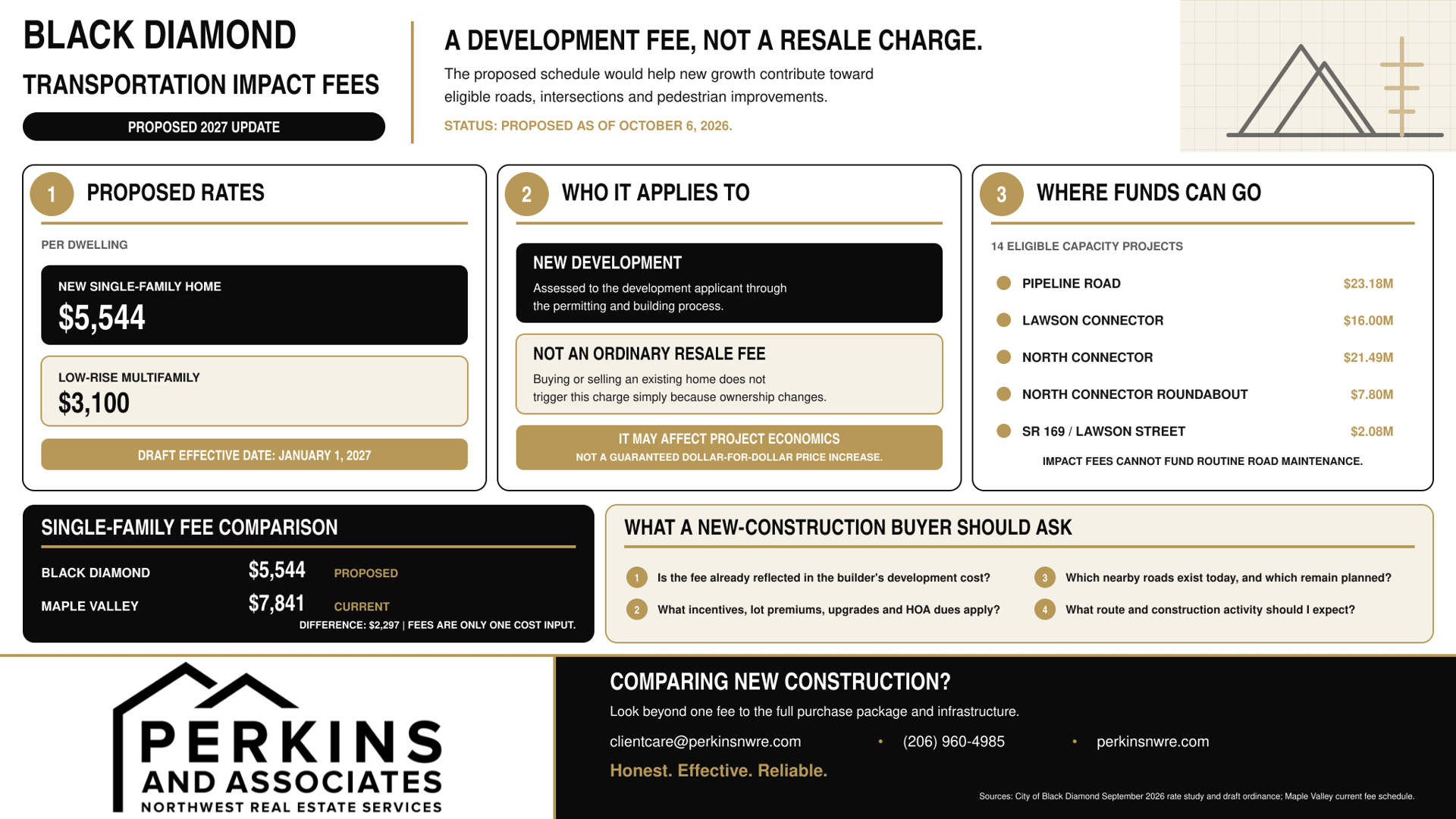
The City's September 2026 rate study proposes a $5,544 transportation impact fee for a new single-family dwelling and $3,100 per unit for low-rise multifamily housing. The fee schedule is based on the transportation demand expected from different types of new development.
That does not mean existing Black Diamond homeowners will suddenly receive a $5,544 bill.
It also does not mean a resale buyer will pay a new $5,544 charge to the City at closing.
Black Diamond's transportation impact fee is imposed on new development through the development and building-permit process. The City's current code says the applicant is assessed under the fee schedule in effect when the building permit is issued, subject to exemptions, credits and permitted deferrals.
For someone comparing a new home in Black Diamond with new construction in Maple Valley, the bigger question is how the fee fits into the total cost of development and the infrastructure being built around future growth.
Key takeaways
- Black Diamond is considering an updated transportation impact-fee schedule.
- The proposed single-family rate is $5,544 per dwelling.
- The proposed low-rise multifamily rate is $3,100 per dwelling.
- The rates are still proposed as of October 6, 2026.
- The draft ordinance proposes an effective date of January 1, 2027.
- Transportation impact fees are tied to new development, not ordinary resale transactions.
- Builders and developers deal with the fee during development and permitting.
- The cost can become one input in new-home pricing, but it is not automatically added dollar-for-dollar to the buyer's sale price.
- Eligible projects include Pipeline Road, Lawson Connector, North Connector and several SR 169 and pedestrian improvements.
- Impact fees cannot simply be used for routine road maintenance.
- Black Diamond's proposed $5,544 single-family rate would remain below Maple Valley's current $7,841 transportation impact fee.
- Buyers should compare the entire new-construction package, not one development fee.
What is a transportation impact fee?
A transportation impact fee is a one-time development charge intended to help pay for transportation improvements needed because of new growth.
Washington law says impact fees must be reasonably related to new development, cannot exceed the development's proportionate share of qualifying system improvements and must fund facilities that reasonably benefit that new development.
Read Washington's impact-fee requirements
Black Diamond's updated rate study explains the same idea in practical terms. New development creates additional transportation demand, so part of the cost of expanding the transportation system can be assigned to that growth.
The fee is not a general road tax.
Who actually pays the Black Diamond transportation impact fee?
The fee is assessed to the development applicant, which is generally the builder, developer or other party proposing the development.
Black Diamond's code defines an applicant as the person or company proposing development and says the City assesses transportation impact fees when an applicant seeks a building permit.
Review Black Diamond's current transportation impact-fee code
For most buyers purchasing a completed home from a builder, the developer has already dealt with the City's development fees as part of getting the home permitted and built.
That does not mean buyers are completely unaffected.
Developers have to account for many costs when deciding what land is worth and how a project is priced, including:
- land
- roads and utilities
- permits
- impact fees
- labor
- materials
- financing
- lot improvements
- builder margin
- market conditions
So a transportation impact fee can become one input in the economics of a new home.
But the City does not require a builder to take a $5,544 fee and add exactly $5,544 to the retail price.
Does the fee apply when someone buys an existing Black Diamond home?
A normal resale transaction does not trigger a transportation impact fee simply because ownership changes.
Black Diamond defines development as construction, expansion or a change in use that creates additional demand for transportation facilities. Its current exemptions also cover alterations, remodeling and replacement of existing homes when those activities do not create new PM peak-hour trips.
So if you buy an existing home in Black Diamond, the transportation impact fee is not a normal resale closing cost.
That is a major difference between an impact fee and expenses such as title, escrow, financing or property taxes.
When is the fee paid?
Under Black Diamond's current code, transportation impact fees are generally due when the building permit is issued.
For qualifying single-family residential construction, the applicant may request a deferral until the City's final building inspection, subject to the City's requirements and limits.
For a typical homebuyer, the administrative timing matters less than the larger point:
This is a development-stage cost, not a bill triggered by buying an existing home.
What rates is Black Diamond proposing for 2027?
The September 2026 Parametrix study proposes the following residential schedule:
Development type | Proposed transportation impact fee |
|---|---|
Single-family | $5,544 per dwelling |
Low-rise multifamily | $3,100 per dwelling |
Senior single-family housing | $1,729 per dwelling |
Senior multifamily housing | $1,490 per dwelling |
Congregate care facility | $1,073 per dwelling |
Mobile home park | $2,742 per dwelling |
The study calculates a cost of $5,961 per new PM peak-hour trip end and then applies different trip-generation rates depending on the type of development. A single-family dwelling uses a 0.93 new-trip rate, while low-rise multifamily uses 0.52.
View Black Diamond's September 2026 transportation impact-fee study
That leads to another useful buyer point:
The fee is not based on the sale price of the home.
A $900,000 new house does not automatically owe more transportation impact fees than a $700,000 house simply because the purchase price is higher.
The City's standard schedule is primarily tied to the development type and expected transportation demand.
Are the proposed rates final?
No, not yet.
Black Diamond's public notice schedules a City Council hearing for October 6, 2026 at 7:00 PM on both the proposed 2027-2032 Capital Improvement Plan and the updated transportation impact-fee ordinance.
See Black Diamond's October 6 public-hearing notice
The draft ordinance proposes:
- adoption of the September 2026 rate study
- use of its updated fee schedule
- a January 1, 2027 effective date
The ordinance also contains draft language showing possible adoption on October 20, 2026.
But the ordinance number, Council passage, signature and publication fields are still blank.
So the correct language today remains:
proposed rate, not adopted rate.
Is the fee increasing from $2,583 to $5,544?
We should not describe the change that simply.
Black Diamond's original 2021 rate study did list a $2,583 single-family base fee.
But the City's current code automatically adjusts the transportation impact-fee schedule each year using the Seattle Engineering News Record Construction Cost Index.
That means $2,583 was the 2021 starting rate, not necessarily the exact rate being charged in 2026.
The accurate comparison is:
Black Diamond's 2021 study established a $2,583 single-family base rate, which has been subject to annual inflation adjustments. The new September 2026 study proposes a fresh single-family calculation of $5,544.
Until the City publishes or confirms the exact indexed 2026 schedule, we should not publish a percentage increase from $2,583 to $5,544 as though those are the current and proposed rates.
Why is Black Diamond updating the fee?
The existing program is based on a 2021 rate study.
Since then, the City has updated its growth forecasts, transportation modeling, project costs and planned transportation network.
The September 2026 study estimates that Black Diamond could add approximately:
- 6,050 housing units
- 721 jobs
by 2044.
That growth is projected to generate about 13,454 additional PM peak-hour vehicle trip ends between 2023 and 2044.
The rate study uses those projections to determine how much future growth should contribute toward eligible transportation improvements.
What transportation projects are connected to the fee program?
The rate study identifies 14 transportation-capacity projects eligible for impact-fee consideration.
The projects most relevant to new-construction buyers include several large connections and intersection improvements.
Pipeline Road
The study lists Pipeline Road at approximately $23.18 million.
It is described as a new road connection with pedestrian facilities between the Lake Sawyer Road area and a new roundabout at SR 169.
For Ten Trails buyers, the road matters because future access has already been tied to development timing and growth.
For more context, see our guide to why Pipeline Road timing matters for Ten Trails buyers.
Lawson Connector / Lawson Parkway
The rate study lists the Lawson Connector at $16 million.
It is planned as a new minor arterial connection to SR 169 with pedestrian facilities, bicycle lanes and street lighting.
North Connector
The full project appears in the rate study at approximately $21.49 million.
The project would create another arterial connection to SR 169 in the northern part of Black Diamond.
North Connector Roundabout
The rate study assigns approximately $7.8 million to the North Connector roundabout.
The City's study specifically says it is intended to serve commercial areas in the North Gateway portions of both Lawson Hills and Ten Trails.
SR 169 and Lawson Street
The study lists about $2.08 million for intersection work intended to improve service, safety and pedestrian crossings.
These projects show why the impact-fee program matters to buyers.
The fee is not simply going into an unrestricted City account. It is connected to transportation improvements intended to serve growth.
Does new development pay for all of Black Diamond's transportation projects?
No.
Washington's impact-fee rules require a balance between impact fees and other public funding. Impact fees cannot be the sole source for system improvements.
Read Washington's impact-fee financing guidance
Black Diamond's study also separates costs associated with:
- existing transportation deficiencies
- growth generated inside the city
- growth generated outside city limits
- the City's own required funding share
- impact-fee-eligible growth
The study's cost-allocation section uses an overall project cost of approximately $112.7 million, with about $80.2 million attributed to impact fees and roughly $32.5 million expected from City funds, grants and other sources.
There is one technical detail worth noting: the printed project table shows a total of $111.7 million, while the later cost-allocation section uses approximately $112.7 million. Because the City's own document contains that roughly $1 million difference, the safer real-estate takeaway is the funding structure rather than treating either total as an exact final project budget.
Can transportation impact fees pay for ordinary road maintenance?
No.
Black Diamond's study says transportation impact fees cannot be used for routine roadway maintenance or repair. Those costs have to come from other sources.
The City's current code likewise says impact-fee funds cannot be used for maintenance or operation and cannot be imposed to make up for deficiencies serving existing development.
Eligible projects are generally system improvements that add transportation capacity or otherwise qualify under state law.
Washington law now also allows qualifying bicycle and pedestrian facilities designed for multimodal commuting to count as public facilities for impact-fee purposes.
How does the impact-fee study relate to Black Diamond's 2027-2032 Capital Improvement Plan?
They are related, but they are not the same document.
The impact-fee study looks at transportation needs through 2044.
The proposed Capital Improvement Plan, or CIP, is a six-year plan covering 2027 through 2032.
Black Diamond's October 6 agenda bill says the CIP is a planning document rather than a budget and still needs to be adopted by resolution at a future City Council meeting.
Review Black Diamond's proposed 2027-2032 Capital Improvement Plan
The proposed six-year CIP lists approximately $81.6 million in transportation projects.
Projects include:
- Pipeline Road
- Lawson Connector
- North Connector
- SR 169/Lawson improvements
- SR 169/Baker improvements
- Roberts Drive work
- sidewalk projects
- pedestrian improvements
- downtown connections
Why do some project amounts differ between the rate study and the CIP?
Because the documents cover different planning scopes.
For example:
- North Connector is about $21.49 million in the longer-range impact-fee study, while the six-year CIP shows about $4.96 million during 2027-2032.
- Lawson Connector is $16 million in the impact-fee study, while the proposed six-year CIP includes $10 million within its planning period.
That does not necessarily mean one number is wrong.
The impact-fee study considers the broader project needed to accommodate long-term growth. The CIP shows what the City currently expects to schedule or fund within a six-year window.
Is the $46.68 million in the CIP all transportation impact-fee money?
No.
The proposed CIP has a funding category labeled:
Developer Funded / Impact Fees / SEPA
That category totals approximately $46.68 million across the six-year transportation plan.
But that category combines several potential funding sources.
It should not be described as:
Black Diamond will collect $46.68 million in transportation impact fees.
Developer-funded improvements and SEPA mitigation are grouped there too.
Can the proposed fee affect new-home prices?
It can affect development costs, but it does not automatically raise the price of every new home by exactly $5,544.
A builder may account for development costs through different parts of the project, including:
- land value
- lot pricing
- base-home price
- upgrades
- incentives
- margins
- financing
- product mix
Market competition also matters.
If buyers will not support a certain price, the developer may not be able to pass every dollar of added cost directly through to the consumer.
So the better wording is:
The proposed $5,544 single-family transportation fee would be one cost involved in developing a new Black Diamond home. How that cost affects the final purchase price depends on the builder and the broader project economics.
How does Black Diamond compare with Maple Valley?
This comparison is especially useful because many Maple Valley buyers also look at new construction in Black Diamond.
Maple Valley's current transportation impact-fee schedule lists:
Development type | Black Diamond proposed | Maple Valley current |
|---|---|---|
Single-family | $5,544 | $7,841 |
Low-rise multifamily | $3,100 | $4,254 |
Black Diamond's proposed single-family rate would therefore be $2,297 below Maple Valley's current single-family transportation fee.
Review Maple Valley's current transportation impact-fee schedule
But that does not mean new construction is automatically cheaper in Black Diamond.
The two cities use different transportation studies and trip assumptions.
More importantly, transportation impact fees are only one cost.
Someone comparing the two areas should look at:
- purchase price
- builder incentives
- mortgage-rate incentives
- lot premium
- upgrades
- HOA dues
- school impact fees
- utility and connection charges
- property taxes
- commute
- road access
- nearby construction
- completed versus future amenities
The fee comparison is useful context, not a complete affordability comparison.
What should a Ten Trails buyer ask?
For buyers considering Ten Trails or other new construction in Black Diamond, a better question than “Who pays the fee?” is:
What costs and future infrastructure are already reflected in the home I am buying?
Ask:
- Is the transportation impact fee already part of the builder's development cost?
- What builder incentives are available?
- Is there a lot premium?
- Are upgrades included or extra?
- What HOA dues apply?
- Which nearby roads exist today?
- Which roads are still future projects?
- What is the latest Pipeline Road status?
- What route would I use today for work, school and daily errands?
- What construction activity should I expect nearby?
Black Diamond's master-planned communities are still evolving, which makes future infrastructure especially relevant.
For broader context, see our guide to Black Diamond's master-planned communities.
For buyers comparing incentives and costs beyond the list price, see what South King County buyers may be able to negotiate beyond price.
What does this mean for someone buying a resale home in Black Diamond?
The updated transportation impact fee would not become a new resale fee.
Its relevance to an existing-home buyer is more indirect.
New-construction costs and builder incentives can affect how resale homes compete.
Future road projects can also affect:
- commute patterns
- neighborhood access
- construction activity
- buyer perceptions
But an impact-fee update does not automatically increase the value of existing homes.
For buyers comparing newer communities with established parts of town, see our guide to Black Diamond beyond Ten Trails.
What happens next?
As of October 6, 2026:
- Black Diamond has scheduled a public hearing for 7:00 PM on the transportation impact-fee update.
- The City is also taking testimony on the proposed 2027-2032 CIP.
- The CIP still needs to be adopted by resolution at a future meeting.
- The transportation ordinance remains a draft.
- The ordinance currently shows a proposed October 20 adoption date.
- If adopted as drafted, the updated transportation impact fees would take effect January 1, 2027.
The October 20 date should not be described as completed Council action unless the Council actually adopts the ordinance.
Expert insight: Compare the entire new-construction package
A transportation impact fee matters, but it should not become the deciding number when comparing Black Diamond with Maple Valley.
The better calculation is:
home price + financing + builder incentives + lot premium + upgrades + HOA + taxes + development context + actual commute
Then compare what you receive for that total cost.
A Black Diamond home may have a lower transportation impact fee than a comparable Maple Valley development and still have a higher purchase price.
Another project may have a higher fee but stronger incentives.
For buyers, the best comparison is the actual purchase package and the infrastructure available when you move in, not one fee in isolation.
Frequently asked questions
What is a Black Diamond transportation impact fee?
It is a development charge used to help fund qualifying transportation improvements needed to accommodate new growth.
What is the proposed 2027 single-family transportation impact fee?
The September 2026 study proposes $5,544 per single-family dwelling.
Is the $5,544 fee final?
No. As of October 6, 2026, it remains proposed and is scheduled for a City Council public hearing.
Who pays the transportation impact fee?
The fee is assessed to the development applicant through the permitting process. In a typical builder development, the builder or developer deals with the fee rather than an existing-home buyer paying it as a resale closing charge.
Does an existing Black Diamond homeowner have to pay it when selling?
A normal resale transaction does not trigger a transportation impact fee simply because ownership changes.
Does the fee automatically add $5,544 to a new home's price?
No. It is a development-cost input, but how that affects the final home price depends on land costs, project economics, builder pricing and market conditions.
What transportation projects can the fee help fund?
The City's study includes projects such as Pipeline Road, Lawson Connector, North Connector, SR 169 intersection work and eligible pedestrian improvements.
Can Black Diamond use the fee for normal road maintenance?
No. The City's study and current code prohibit using transportation impact fees simply for routine maintenance or operation.
Is Black Diamond's proposed fee higher than Maple Valley's?
No. Black Diamond's proposed single-family rate is $5,544, compared with Maple Valley's current $7,841 single-family transportation impact fee.
Does the fee apply in Ten Trails?
Black Diamond's current transportation impact-fee service area covers the entire city, subject to applicable exemptions, credits and project-specific requirements.
Helpful resources
Black Diamond October 6 public-hearing notice
Black Diamond September 2026 Transportation Impact Fee Rate Study
Black Diamond proposed 2027-2032 Capital Improvement Plan
Black Diamond Municipal Code Chapter 3.80, Transportation Impact Fees
Washington RCW 82.02 impact-fee law
Washington WAC impact-fee guidance
Maple Valley transportation impact-fee schedule
Buying new construction in Black Diamond or Maple Valley?
Development fees are only one part of the cost of a new home.
If you are comparing builders, communities or new-construction options in Black Diamond, Maple Valley or elsewhere in South King County, reach out to Perkins & Associates. We can help you compare purchase price, incentives, HOA costs, commute, nearby development and the details that affect the actual value of the home.
📧 [email protected]
📱 (206) 960-4985
Honest. Effective. Reliable.
This article provides general real estate information and is not legal advice. Association documents, purchase agreements, statutory applicability, and transaction deadlines can vary. Buyers and sellers should review their specific documents and seek legal advice when a legal interpretation is needed.