Jordan Heights in Kent: What the Proposed 40-Lot Subdivision Means for Local Buyers
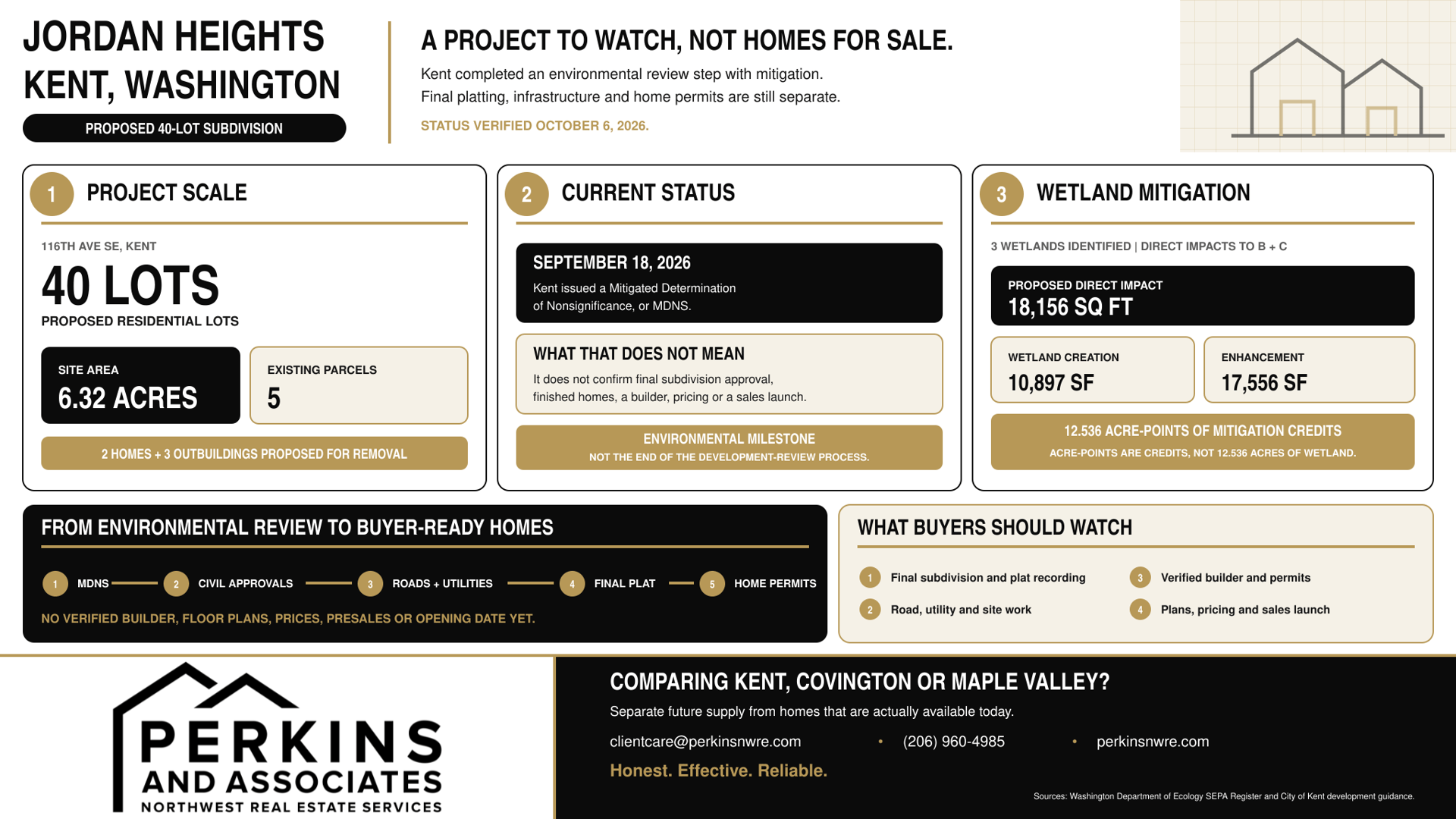
Jordan Heights is a proposed residential subdivision in Kent that would divide five parcels totaling about 6.32 acres into 40 residential lots.
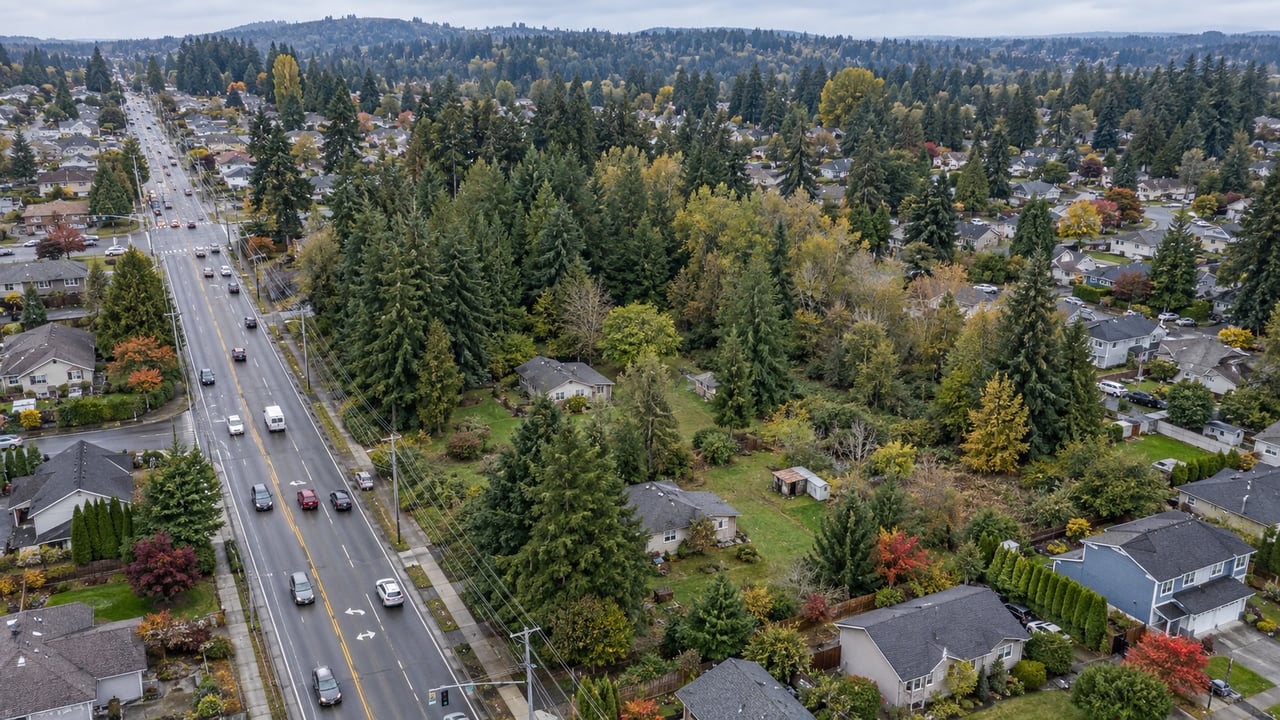
The property is centered around 21108 and 21104 116th Ave SE. Kent's earlier environmental notice says the site currently contains two homes and three outbuildings, all proposed for removal as part of the development.
The project reached an important environmental milestone on September 18, 2026, when the City of Kent issued a Mitigated Determination of Nonsignificance, or MDNS.
But that does not mean 40 finished homes are approved, under construction or available for sale.
The official project description confirms 40 proposed residential lots. Separate subdivision, civil-development, platting and homebuilding steps still have to occur before this becomes a community buyers can actually shop.
Key takeaways
- Jordan Heights proposes 40 residential lots on approximately 6.32 acres in Kent.
- Five existing parcels are involved.
- Two homes and three outbuildings are proposed for removal.
- Kent issued an MDNS on September 18, 2026.
- An MDNS is an environmental decision, not final approval for 40 homes.
- Three wetlands are identified on the property.
- Direct impacts are proposed specifically to Wetlands B and C.
- Proposed mitigation includes wetland creation, enhancement and King County mitigation credits.
- The stated environmental appeal period has passed, but an official record confirming whether an appeal was filed was not found in the public sources reviewed.
- No verified production homebuilder, home prices, floor plans, presales or sales-opening date have been identified.
- Jordan Heights should be viewed as potential future Kent housing supply, not available new-home inventory today.
What is Jordan Heights in Kent?
Jordan Heights is a proposed subdivision of five parcels totaling 275,273 square feet, or approximately 6.32 acres, into 40 residential lots.
The Washington Department of Ecology's SEPA Register identifies the project as Jordan Heights Subdivision under Kent environmental file ENV2026 1568.
View the official Jordan Heights SEPA record
This distinction matters:
The proposal is for 40 residential lots. The public record does not yet establish 40 finished homes.
A residential lot is land that may eventually support housing under the rules and permits that apply. It is not the same thing as an approved house, completed home or property available for purchase.
Where is the proposed Jordan Heights subdivision?
The project is on 116th Ave SE in Kent, with official records identifying 21108 116th Ave SE and the September environmental notice also referencing 21104 116th Ave SE.
The five parcels listed in the SEPA record are:
- 0922059109
- 0922059124
- 0922059058
- 0922059094
- 0922059164
For buyers who begin their search in Maple Valley or Covington, Kent is often part of the same broader South King County comparison. Kent has a larger and more varied housing stock, which can give buyers different choices in price, home type, location and commute.
Our guide to where South King County buyers can still find relative value in 2026 explains why Kent can be worth comparing with Maple Valley, Covington and nearby communities.
What is currently on the Jordan Heights property?
Kent's April environmental notice says the site currently contains:
- two residential dwelling units
- three outbuildings.
All five structures are proposed to be removed as part of the subdivision.
View Kent's earlier Jordan Heights environmental notice
This makes Jordan Heights an example of redevelopment rather than development of completely vacant land.
Existing residential property would be assembled and reconfigured into a substantially larger number of residential lots.
Are 40 homes actually approved at Jordan Heights?
No. The official record confirms 40 proposed residential lots, not 40 approved finished homes.
This is probably the most important distinction for buyers.
The September environmental decision does not establish:
- 40 completed houses
- specific house plans
- home sizes
- a production builder
- home prices
- presales
- individual residential building permits
- model homes
- a sales-opening date.
Kent treats environmental review, land subdivision and later construction permits as separate parts of the development process.
Review Kent's land-use and environmental permit process
So when someone hears that a “40-home subdivision” is coming to Kent, the more accurate statement today is:
A 40-lot residential subdivision is proposed, and the development is still moving through the approval and permitting process.
What did Kent decide on September 18?
Kent issued a Mitigated Determination of Nonsignificance for Jordan Heights on September 18, 2026.
An MDNS means the City determined that potential significant environmental impacts can be addressed through required mitigation measures, so a full Environmental Impact Statement is not required.
It does not mean Kent determined that the project has no environmental impacts.
It also does not mean the subdivision is completely approved.
The environmental determination allows the project to continue through the development-review process subject to its mitigation conditions.
What is an MDNS in plain English?
For a buyer, the simplest explanation is:
Kent identified environmental issues that need to be addressed, established mitigation requirements and determined that a full Environmental Impact Statement was not necessary if those conditions are satisfied.
The project's environmental review is therefore an important milestone.
But it is only one milestone.
A development can complete SEPA review and still need subdivision approval, engineering work, infrastructure approvals, final platting and building permits before homes can be constructed.
What wetlands are on the Jordan Heights site?
The official SEPA record identifies three wetlands:
- Wetland D on the eastern side of the project site
- Wetland C on the western side
- Wetland B just east or southeast of Wetland C.
However, the proposal does not identify direct impacts to all three wetlands.
The documented unavoidable direct impacts are specifically:
Wetland B: 1,335 square feet
Wetland C: 16,821 square feet
Combined, those two areas total 18,156 square feet of proposed direct wetland impact.
It would therefore be inaccurate to say that all three wetlands are being removed or filled.
How would the wetland impacts be addressed?
The project proposes a combination of on-site and off-site mitigation.
According to the SEPA record:
- 10,897 square feet of wetland creation
- 17,556 square feet of wetland enhancement
- 12.536 acre-points of in-lieu fee credits through the King County Mitigation Reserves Program.
The 12.536 acre-points should not be read as 12.536 acres of wetland.
King County explains that its mitigation system uses credits and debits to measure environmental impacts and compensatory benefits. Credits can account for factors including wetland area, function, timing and the type of restoration or enhancement being provided.
Learn how King County wetland credits and debits work
The County's In-Lieu Fee Mitigation Program allows a permittee with unavoidable impacts to purchase approved credits. King County then uses those funds for wetland, stream, river and buffer restoration, establishment, enhancement or preservation within the applicable watershed.
King County Mitigation Reserves Program
What environmental conditions still have to be satisfied?
The September MDNS includes several conditions tied to later civil approvals.
The notice requires the applicant to provide for final critical-area mitigation consistent with the approved conceptual mitigation plan before final civil-permit approval.
It also requires proof that the necessary King County in-lieu fee credits have been purchased before final civil approval.
An inadvertent discovery plan must also be included in the project's civil documents.
Those requirements reinforce an important point:
Jordan Heights has moved forward through environmental review, but additional work remains before lots can be finalized and homes can be built.
Is the environmental appeal period over?
The September 18 MDNS stated that an appeal had to be made to the Kent Hearing Examiner within 14 days following the decision.
That stated period has passed as of October 6, 2026.
However, the public records reviewed for this article did not provide an authoritative City confirmation showing whether an appeal was filed.
For that reason, it would be premature to describe the MDNS as “unappealed” without additional confirmation from Kent.
Is Jordan Heights finally approved?
Not based on the public records reviewed.
The environmental decision is not the same as final plat approval.
Kent's final-subdivision process says a final plat must comply with preliminary approval conditions, and civil improvements generally must be substantially completed or otherwise secured before final plat approval.
Review Kent's final subdivision requirements
That creates a useful sequence for buyers to understand:
- Environmental review
- Preliminary subdivision and related approvals
- Critical-area and mitigation requirements
- Civil engineering and construction approvals
- Roads and utilities
- Final subdivision approval
- Plat recording
- Residential building permits
- Home construction
- Sales or closings
The exact sequence can vary depending on the project's permits, but the main point is simple:
An environmental decision comes well before a finished home is ready for a buyer.
Are Jordan Heights homes for sale yet?
No verified Jordan Heights home-sales program was found in the public records and current search results reviewed for this article.
I did not find verified:
- model homes
- builder floor plans
- new-home pricing
- presales
- a community sales website
- a home-sales opening date.
Current public records continue to describe Jordan Heights primarily as a subdivision and environmental-review project.
Buyers should therefore treat Jordan Heights as potential future inventory, not as 40 homes they can currently add to a showing list.
Is there a homebuilder for Jordan Heights?
A production homebuilder has not been verified in the records reviewed.
The public SEPA material identifies Dara Eagle / D.R. Strong Consulting as the applicant contact.
That does not establish D.R. Strong as the company that would eventually construct and sell homes.
An engineering, planning or development consultant can appear on project documents without being the finished-home builder.
Until later permitting or marketing records identify a builder, the article should not assign one.
What still needs to happen before buyers could purchase homes?
There are several useful milestones to watch.
Civil-development approvals
Roads, drainage, utilities and other infrastructure must move through engineering and permit review.
Wetland mitigation
The required mitigation plans and King County credit purchase need to satisfy the City's conditions.
Final subdivision approval
Kent's final plat process checks compliance with preliminary conditions, civil requirements, utility approvals, survey information and other platting requirements.
Plat recording
The lots eventually need to be legally established and recorded.
Building permits
Individual homes need appropriate residential building permits before construction.
Builder and sales information
A future builder would need to establish the actual housing product, pricing, release schedule and sales process.
That is when Jordan Heights would begin to become directly useful to a homebuyer.
How does Jordan Heights fit into Kent's future housing supply?
Jordan Heights is a small project compared with Kent's overall growth needs, but it is a clear example of how new supply can be created.
Kent's adopted 2044 Comprehensive Plan says the city is planning to accommodate 10,200 additional housing units and 32,000 additional jobs over its long-term planning period.
Explore Kent's adopted 2044 Comprehensive Plan
Jordan Heights alone will not make a large dent in that target.
But the project shows one way housing supply can change in established parts of South King County:
lower-intensity developed land can be assembled and subdivided into more residential lots.
It is still important not to count Jordan Heights as 40 completed housing units toward Kent's supply until actual dwelling plans and permits establish what will be built.
What does this mean for Maple Valley and Covington buyers?
A Maple Valley buyer does not necessarily limit the search to Maple Valley.
Depending on budget, commute, lot preferences and available inventory, buyers may also compare Covington, Kent, Black Diamond and other parts of South King County.
Our Maple Valley versus Covington buyer guide explains how even nearby communities can produce different tradeoffs in housing, convenience and daily life.
Kent adds another layer because it has a larger and more varied housing market.
If Jordan Heights eventually reaches the construction and sales stage, it could add another option for buyers who:
- want newer housing
- are flexible between Maple Valley, Covington and Kent
- are comparing different lot sizes and home types
- want to broaden their search when Maple Valley inventory is limited.
But buyers should not delay a current purchase because they assume Jordan Heights homes will be available soon.
No verified sales timeline exists yet.
Could 40 new lots make a noticeable difference to buyers?
On its own, Jordan Heights is not large enough to change the entire Kent or South King County housing market.
Its value is more local.
Forty additional lots could eventually create more choices within a particular part of Kent.
Housing supply is built one development at a time. Larger projects add hundreds of units. Smaller subdivisions may add dozens.
Over time, those projects collectively affect how many options buyers have.
South King County buyers already have more ability to compare properties than they did in tighter inventory periods. Our earlier analysis looks at how greater inventory has given some South King County buyers more negotiating room.
Jordan Heights would add to supply only when actual homes become available.
What should future Jordan Heights buyers watch next?
Anyone interested in the project should watch for these milestones:
- Confirmation of the MDNS appeal status
- Updated subdivision approvals
- Final critical-area mitigation plans
- Proof of the required King County mitigation credits
- Civil-development permits
- Demolition or site-clearing activity
- Road and utility construction
- Final subdivision approval
- Recorded lots
- Identification of a homebuilder
- Residential building permits
- Floor plans and specifications
- Model-home or sales-center announcements
- Initial pricing
- Builder incentives and financing offers
Once a builder begins selling, buyers should also compare the complete new-construction package.
That includes base price, lot premium, upgrades, incentives, financing terms, warranty coverage, estimated completion dates and any HOA costs.
Our guide to what South King County buyers can negotiate beyond price explains why builder incentives and contract terms can matter as much as the headline price.
Expert insight: Follow the permit stage, not just the project name
A subdivision name can make a project sound much closer to completion than it really is.
For a buyer, the useful questions are:
- Are the lots finally approved?
- Has infrastructure construction started?
- Is the plat recorded?
- Is there a homebuilder?
- Have residential permits been issued?
- Are homes actually being marketed?
Jordan Heights has made progress through environmental review.
That is meaningful.
But it is still different from a community where a builder has model homes, price sheets and available lots.
For now, we would treat Jordan Heights as a future housing-supply project worth watching, not current buyer inventory.
Frequently asked questions
What is Jordan Heights in Kent?
Jordan Heights is a proposed subdivision of five parcels totaling about 6.32 acres into 40 residential lots.
Where is Jordan Heights?
The official project record identifies 21108 116th Ave SE in Kent, with the September environmental notice also referencing 21104 116th Ave SE.
Is Jordan Heights a 40-home subdivision?
The official documents confirm 40 proposed residential lots. They do not yet establish 40 completed homes.
Has Jordan Heights been approved?
Kent issued an MDNS on September 18, but environmental review is only one part of the development process. Final subdivision and later construction approvals are separate.
What does an MDNS mean?
It means Kent determined that potential significant environmental impacts can be reduced through required mitigation and that a full Environmental Impact Statement was not required.
Are there wetlands on the Jordan Heights site?
Yes. The project record identifies Wetlands B, C and D. Direct impacts are proposed to Wetlands B and C.
How much wetland area would be directly affected?
The proposal identifies 1,335 square feet of direct impact to Wetland B and 16,821 square feet to Wetland C.
How will those impacts be mitigated?
The proposal combines 10,897 square feet of wetland creation, 17,556 square feet of enhancement and 12.536 acre-points of King County in-lieu fee credits.
Are Jordan Heights homes for sale yet?
No verified Jordan Heights home-sales program, pricing or builder sales launch was found in the records reviewed.
Who is building Jordan Heights?
A production homebuilder has not been verified. D.R. Strong Consulting appears as the applicant contact in the environmental record, which does not establish that company as the eventual homebuilder.
When will Jordan Heights homes be available?
No verified construction-completion or home-sales date has been published in the records reviewed.
Helpful resources
Washington Department of Ecology: Jordan Heights September 2026 SEPA record
Washington Department of Ecology: April 2026 Jordan Heights notice
City of Kent: Land-use and environmental permits
City of Kent: Final subdivision requirements
King County: Mitigation Reserves Program
King County: How mitigation credits and debits work
City of Kent: 2044 Comprehensive Plan
Looking for a home in Maple Valley, Kent or Covington?
Jordan Heights is worth watching, but it is not buyer-ready inventory today.
If you are comparing Maple Valley, Kent, Covington or other South King County communities, Perkins & Associates can help you evaluate what is actually available now, what new construction is coming, and how each option fits your budget, commute and priorities.
📧 [email protected]
📱 (206) 960-4985
Honest. Effective. Reliable.
This article provides general real estate information and is not legal advice. Association documents, purchase agreements, statutory applicability, and transaction deadlines can vary. Buyers and sellers should review their specific documents and seek legal advice when a legal interpretation is needed.