Washington home prices are not broadly crashing in 2026, but the market is showing signs of balance. Recent NWMLS data shows statewide median prices slightly down year over year while inventory has grown, giving buyers more choices. In King County, conditions still vary by city, so buyers should compare local price trends, inventory, days on market, and negotiation opportunities before making a move.
Washington home prices are shifting, but not in a simple “buyer’s market” or “seller’s market” direction. The better way to understand 2026 is this: buyers may have more room to compare homes, negotiate, and make informed decisions, but well-priced homes in strong local markets can still move quickly.
For King County buyers, this means opportunity may exist, but it is not automatic. For sellers, it means pricing strategy matters more than ever. This guide explains what is happening with Washington median home prices, why inventory matters, and how King County, Renton, and Maple Valley fit into the bigger picture.
What Is the Washington Median Home Price in 2026?
The Washington median home price was roughly in the low-to-mid $600,000s in May 2026, depending on the data source and property types included.
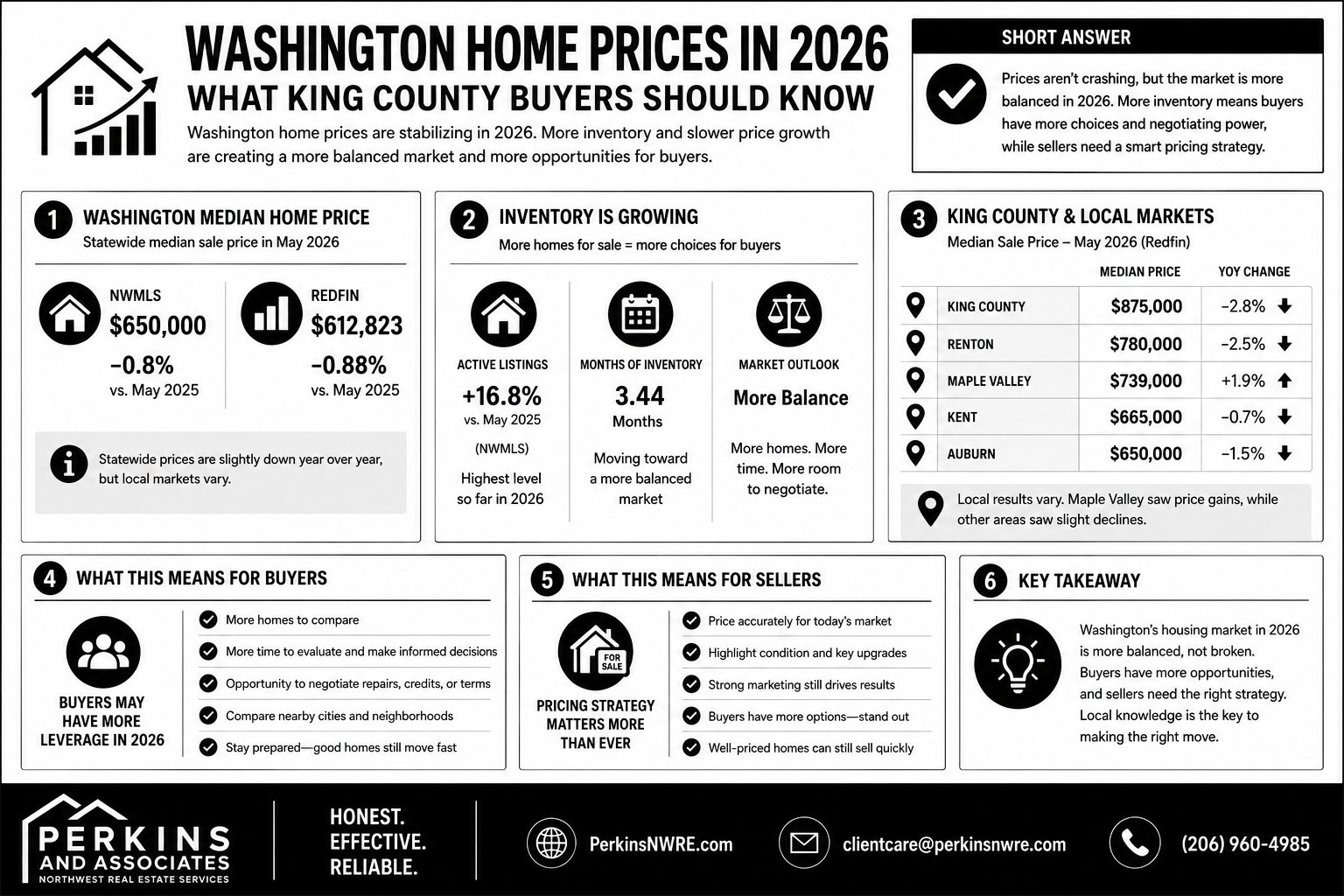
The Northwest Multiple Listing Service May 2026 Market Snapshot reported a median sales price of $650,000 for residential homes and condominiums sold in May 2026, down 0.8% from May 2025. Redfin’s Washington housing market data showed a statewide median sale price of $612,823 in May 2026, down 0.88% year over year.
Those numbers do not mean every Washington market is falling at the same pace. Median price is a broad statewide measure. Local prices can look very different depending on county, city, home type, condition, and buyer demand.
For King County buyers, the most important takeaway is that statewide prices are no longer rising as aggressively as they did in hotter market periods. That shift may give prepared buyers more room to compare options, but it does not remove the need for local strategy.
Are Washington Home Prices Finally Shifting Toward Buyers?
Washington home prices are showing signs of shifting toward a more balanced market, but that does not mean buyers have full control.
According to the NWMLS May 2026 report, active listings increased 16.8% year over year across the NWMLS service area, reaching the highest inventory level recorded so far in 2026. The same report noted that months of inventory increased to 3.44 months, suggesting a gradual move toward more balance.
That matters because inventory affects leverage. When buyers have more homes to choose from, they may have more time to compare properties, evaluate condition, and negotiate terms. However, stable prices also show that demand has not disappeared.
For buyers, the market may feel less frantic than recent years in some areas. For sellers, it means strong results are still possible, but overpricing can create more risk when buyers have more alternatives.
Are Home Prices Falling or Just Slowing Down?
Washington home prices appear to be slowing and stabilizing more than collapsing.
A small statewide year-over-year decline does not automatically mean a housing crash. It can also mean the market is adjusting after years of affordability pressure, higher mortgage rates, and limited inventory. In many areas, home prices remain elevated even when growth slows.
This distinction matters for buyers who are waiting for major price drops. A slower market may create better negotiation opportunities, but it may not deliver dramatic discounts in desirable areas. A buyer who waits only for a large correction may miss homes that already fit their budget and long-term plans.
For sellers, slower price growth means accurate pricing becomes more important. A listing strategy based on last year’s conditions may not match today’s buyer behavior.
Why Is Inventory Growth Important for Buyers?
Inventory growth matters because more available homes can reduce pressure on buyers and create more room for comparison.
When inventory is extremely tight, buyers may feel forced to move quickly, waive protections, or compete aggressively. When inventory grows, buyers may be able to compare neighborhoods, condition, commute, price, and seller motivation with more confidence.
In 2026, more inventory may help buyers:
- Compare more homes before making an offer
- Avoid rushing into the wrong property
- Ask more detailed questions about condition
- Negotiate repairs, credits, or terms when appropriate
- Compare nearby cities such as Renton, Maple Valley, Kent, Auburn, and Covington
Still, inventory is not the same in every market. A home in a high-demand neighborhood may still attract strong interest even when statewide inventory rises.
What Does This Mean for King County Buyers?
King County buyers may have more room to evaluate homes in 2026, but the county remains competitive compared with many other Washington markets.
Redfin’s King County housing market data showed King County home prices up 1.4% year over year over the three months ending May 2026, with a median sale price around $887,000. Homes were taking slightly longer to sell than the prior year, with an average of 10 days on market compared with 7 days the year before.
That is a good example of why statewide headlines can be misleading. Washington prices may be slightly down overall, but King County can still show stronger pricing because of employment centers, limited land, established demand, and desirable local communities.
For buyers, this means the right strategy is not to assume every seller is desperate. Instead, buyers should look for specific opportunities:
- Homes sitting longer than similar listings
- Properties with price reductions
- Homes needing cosmetic updates
- Listings with fewer competing offers
- Sellers who need flexible timing
- Areas where inventory has expanded faster than demand
For sellers, it means pricing, presentation, and condition still matter. Buyers may be more selective, even in a strong county.
How Are Renton and Maple Valley Different?
Renton and Maple Valley show why King County buyers need city-level research, not just statewide market headlines.
Redfin’s Renton housing market data showed Renton home prices down 1.8% year over year over the three months ending May 2026, with a median sale price around $712,000. Homes were selling in an average of 11 days, compared with 7 days the year before.
Redfin’s Maple Valley housing market data showed Maple Valley home prices down 2.8% year over year over the three months ending May 2026, with a median sale price around $739,000. Homes were still selling quickly, with an average of 8 days on market.
These numbers suggest both markets may be giving buyers slightly more room than before, but neither market should be treated as slow. Homes can still move quickly when they are priced correctly and match buyer demand.
Renton may appeal to buyers who want access to job centers, transit, Lake Washington-area amenities, and varied housing options. Maple Valley may appeal to buyers focused on suburban space, parks, community feel, and outdoor access. The better choice depends on payment comfort, commute, lifestyle, and available inventory.
Where Do Buyers Have More Negotiating Room?
Buyers may have more negotiating room where inventory is rising, days on market are increasing, or sellers are adjusting expectations.
Negotiation opportunities are usually property-specific. They may appear when a home has been on the market longer than competing listings, needs updates, has a higher initial list price, or faces more competition from similar homes nearby.
Buyers should not assume every listing has room for a discount. Instead, they should look for evidence:
- Has the home had a price reduction?
- How long has it been listed?
- Are comparable homes selling below list price?
- Are similar homes sitting longer?
- Is the seller offering credits or concessions?
- Are inspection issues likely to matter?
- Does the home need updates that affect buyer demand?
A more balanced market can help buyers ask better questions. It does not remove the need for strong financing, local market knowledge, and a clear offer strategy.
For a deeper buyer strategy, review our guide on how to decide when to buy without trying to time the market.
What Should Sellers Know About Pricing in 2026?
Sellers should know that 2026 buyers may be more selective, especially when they have more inventory to compare.
A home can still sell well in King County, Renton, Maple Valley, and surrounding communities, but pricing too high can create more risk in a market with growing inventory. Buyers are watching monthly payments, interest rates, condition, commute, and nearby alternatives more closely.
A strong 2026 seller strategy should include:
- Pricing based on current comparable sales, not outdated peak-market assumptions
- Preparing the home before listing
- Addressing obvious maintenance concerns
- Making the home easy to understand online
- Highlighting location, commute, condition, and lifestyle strengths
- Watching buyer feedback closely after launch
For homeowners planning to sell, the market shift should be treated as context, not a reason to panic. The right price and presentation can still attract serious buyers.
For more seller context, review our guide on preparing your home for sale in 2026.
What This Means for Buyers, Sellers, and Market-Watchers
For buyers, Washington’s 2026 market may offer more choice and slightly more leverage than recent years, but local conditions still matter. King County remains competitive, and cities like Renton and Maple Valley can still move quickly.
For sellers, the shift means pricing discipline matters. Buyers are comparing more carefully, especially when inventory is rising and affordability remains tight.
For market-watchers, the key story is not a crash. It is a rebalancing. Prices are not accelerating the way they did in hotter periods, inventory has improved, and buyers are paying closer attention to value.
That makes 2026 a market where preparation matters on both sides.
Expert Insight: What This Means Locally
The most important local takeaway is that buyers and sellers should stop relying on broad headlines alone.
A statewide median price can tell part of the story, but it cannot tell you whether a specific home in Renton, Maple Valley, Kent, Auburn, Covington, or Black Diamond is priced well. A countywide trend can show direction, but it cannot replace neighborhood-level analysis.
For buyers, this market rewards preparation. Get financing in order, understand your payment range, compare active listings, and watch for homes where timing or condition creates opportunity.
For sellers, this market rewards accuracy. A well-prepared, well-priced home can still stand out, but a listing that ignores current buyer behavior may sit longer than expected.
The market may be more balanced, but balance does not mean easy. It means both buyers and sellers need better information.
FAQ
Are Washington home prices going down in 2026?
Washington home prices are slightly down year over year in some statewide data sets, but they are not broadly collapsing. Recent NWMLS and Redfin data show modest year-over-year declines at the statewide level, while local markets such as King County may still show stronger pricing.
Is King County becoming a buyer’s market?
King County is becoming more balanced in some ways, but it is not automatically a buyer’s market. Buyers may have more options than before, but well-priced homes in desirable areas can still sell quickly.
Is now a good time to buy a home in King County?
It can be a good time to buy if your financing, budget, and long-term plans are aligned. More inventory may give buyers more choice, but local conditions still vary by city, neighborhood, and home type.
Are Renton home prices falling?
Recent Redfin data showed Renton prices down year over year over the three months ending May 2026. However, homes were still selling relatively quickly, so buyers should evaluate each listing based on price, condition, location, and competition.
Are Maple Valley home prices falling?
Recent Redfin data showed Maple Valley prices down year over year over the three months ending May 2026, but homes were still selling quickly. That suggests buyers may have slightly more room than before, but the market remains active.
What should sellers do if inventory is rising?
Sellers should price carefully, prepare the home well, and pay attention to buyer feedback. Rising inventory means buyers have more options, so condition, presentation, and accurate pricing matter more.
Helpful Resources
- NWMLS Monthly Market Snapshot
Useful for statewide and regional Washington housing market trends. - NWMLS May 2026 Inventory Report
Helpful for understanding inventory growth and market balance in 2026. - Redfin Washington Housing Market
Useful for statewide price, sales, inventory, and days-on-market data. - Redfin King County Housing Market
Helpful for King County-specific pricing and speed-of-market trends. - Redfin Renton Housing Market
Useful for local Renton price and days-on-market context. - Redfin Maple Valley Housing Market
Helpful for Maple Valley-specific pricing and buyer competition trends.
Why Buyers and Sellers Across King County Trust Perkins & Associates
Whether you are buying, selling, or watching the market before making your next move, having the right local guidance can make the decision clearer. Perkins & Associates helps clients understand King County real estate trends with honest advice, local insight, and a strategy tailored to their goals.
If you are thinking about buying, selling, or planning your next move, Perkins & Associates is happy to help you think through your options and next steps.
📧 [email protected] | 📱 (206) 960-4985 | Honest. Effective. Reliable.