Portable Mortgages and the Take Your Rate Act: What King County Homeowners Should Know
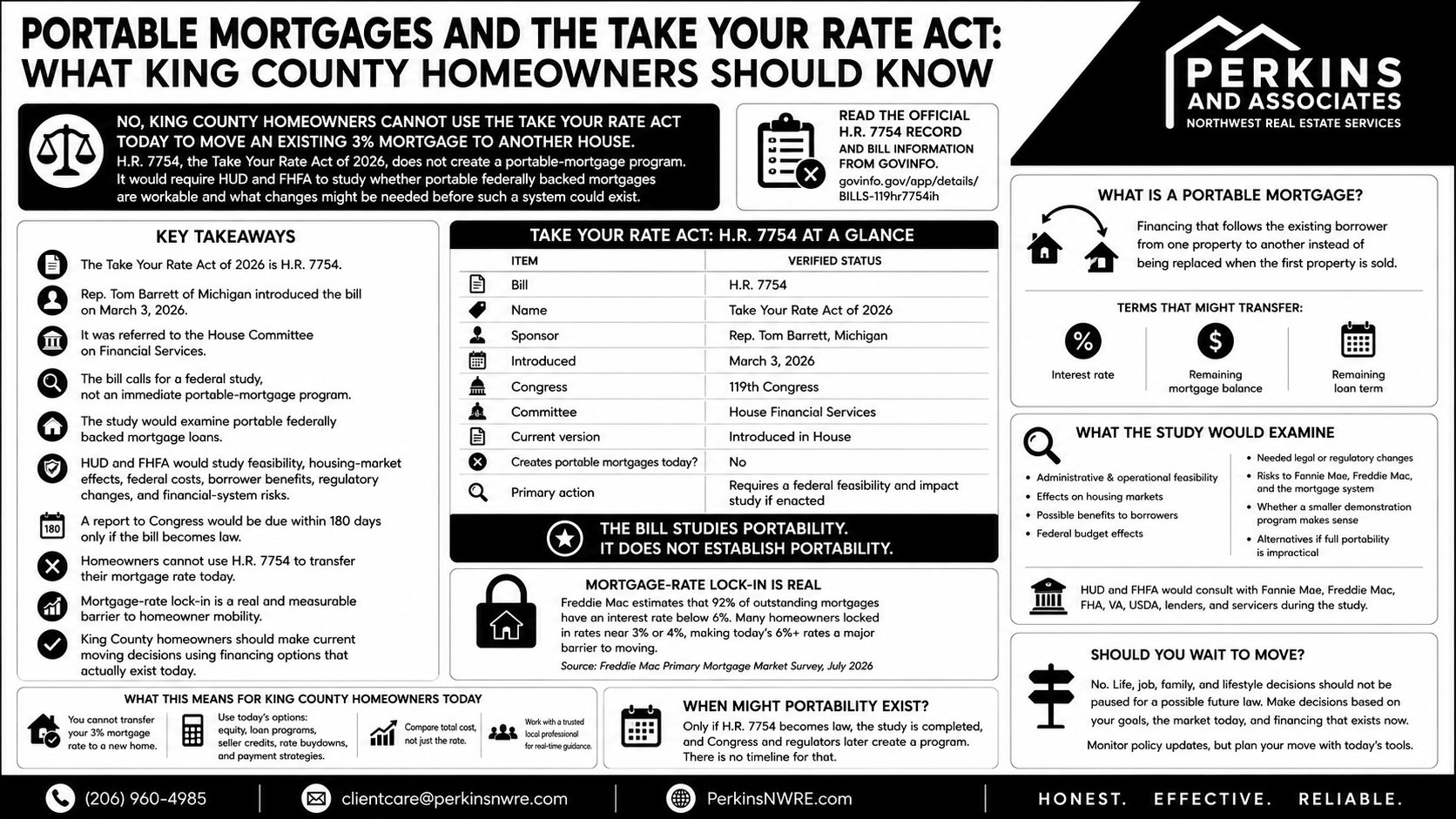
No, King County homeowners cannot use the Take Your Rate Act today to move an existing 3% mortgage to another house. H.R. 7754, the Take Your Rate Act of 2026, does not create a portable-mortgage program. Instead, it would require the U.S. Department of Housing and Urban Development and the Federal Housing Finance Agency to study whether portable federally backed mortgages are workable, what risks they could create, and what changes might be needed before such a system could exist. Read the official H.R. 7754 record and bill information from GovInfo.
That distinction matters for King County homeowners who bought or refinanced when rates were much lower. Portable mortgages could eventually address one of the biggest financial barriers to moving: giving up favorable financing. But there is no federal portability program created by this bill today.
Key takeaways
- The Take Your Rate Act of 2026 is H.R. 7754.
- Rep. Tom Barrett of Michigan introduced the bill on March 3, 2026.
- It was referred to the House Committee on Financial Services.
- The bill calls for a federal study, not an immediate portable-mortgage program.
- The study would examine portable federally backed mortgage loans.
- HUD and FHFA would study feasibility, housing-market effects, federal costs, borrower benefits, regulatory changes, and financial-system risks.
- A report to Congress would be due within 180 days only if the bill becomes law.
- Homeowners cannot use H.R. 7754 to transfer their mortgage rate today.
- Mortgage-rate lock-in is a real and measurable barrier to homeowner mobility.
- King County homeowners should make current moving decisions using financing options that actually exist today.
What is the Take Your Rate Act of 2026?
The Take Your Rate Act is a federal bill that would require HUD and FHFA to study whether federally backed mortgages could become portable.
According to the official GovInfo record for H.R. 7754, Rep. Tom Barrett introduced the legislation on March 3, 2026, and it was referred to the House Financial Services Committee. The bill's stated purpose is to require a study on the feasibility and potential effects of portable federally backed mortgage loans.
Rep. Barrett describes the goal as taking steps toward portable mortgage rates so homeowners with favorable financing might eventually be able to maintain their rate when buying another home. That is the sponsor's stated goal, not a benefit available under current law. See Rep. Barrett's housing legislation overview.
Take Your Rate Act status
Item | Verified status |
|---|---|
Bill | H.R. 7754 |
Name | Take Your Rate Act of 2026 |
Sponsor | Rep. Tom Barrett, Michigan |
Introduced | March 3, 2026 |
Congress | 119th Congress |
Committee | House Financial Services |
Current version | Introduced in House |
Creates portable mortgages today? | No |
Primary action | Requires a federal feasibility and impact study if enacted |
The most important line in that table is the last one.
The bill studies portability. It does not establish portability.
Does the Take Your Rate Act let you keep your current mortgage rate?
No. H.R. 7754 does not give homeowners a current right to move their mortgage rate to another property.
The legislation asks federal housing agencies to study whether that kind of system could work.
That means approval of H.R. 7754 itself would still not be the same thing as Congress creating a nationwide portable-mortgage program.
The study would examine issues such as:
- Administrative and operational feasibility
- Effects on housing markets
- Possible benefits to existing borrowers
- Federal budget effects
- Changes that may be needed in laws or regulations
- Risks to Fannie Mae, Freddie Mac, and the broader mortgage system
- Whether a smaller demonstration program might make sense
- Alternatives if full portability proves impractical
The legislation also allows HUD and FHFA to consult with organizations including Fannie Mae, Freddie Mac, FHA, VA, USDA, mortgage lenders, and mortgage servicers during the study.
What is a portable mortgage?
A portable mortgage is financing that follows the existing borrower from one property to another instead of being completely replaced when the first property is sold.
Conceptually, portability could allow a homeowner to preserve some existing loan terms while changing the property that secures the mortgage.
Those terms might include:
- Interest rate
- Remaining mortgage balance
- Remaining loan term
Exactly what could transfer would depend on the eventual program or mortgage product.
H.R. 7754 does not establish those operating rules. That is one of the reasons Congress is proposing a study first.
Can you transfer your current mortgage to another house today?
Most homeowners should not assume they can simply move an ordinary mortgage from one property to another.
A mortgage is secured by a specific property. When that home is sold, the loan secured by it is generally addressed through the closing process. A homeowner buying another home usually obtains financing for that new property.
Individual loan documents and specialized products can differ, so borrowers should always verify their own mortgage terms with the loan servicer or a licensed mortgage professional.
For most King County homeowners, the practical answer today is:
Your existing low mortgage rate usually does not automatically follow you when you sell and purchase another home.
Portable mortgage vs. assumable mortgage: what's the difference?
Portable and assumable mortgages solve different problems.
Mortgage concept | Who keeps the financing? | What happens |
|---|---|---|
Portable mortgage | Existing homeowner | Financing follows the borrower to a replacement property |
Assumable mortgage | Qualified buyer | Buyer takes over qualifying financing associated with the home being sold |
With a portable mortgage, you move and try to keep your financing.
With an assumable mortgage, you sell and another qualified borrower takes over qualifying financing.
That difference is important because headlines about “transferable mortgages” can make the two concepts sound interchangeable when they are not.
What mortgages would the federal study examine?
The Take Your Rate Act is broader than a study limited only to conventional Fannie Mae or Freddie Mac loans.
The bill concerns federally backed mortgage loans. Secondary analyses of the introduced text describe the scope as including qualifying residential loans backed, insured, guaranteed, purchased, or securitized through federal programs or the government-sponsored enterprises. That can bring FHA, VA, USDA, Fannie Mae, and Freddie Mac into the study.
This does not mean all of those mortgages will become portable.
It means the agencies would study portability across that part of the mortgage system.
Questions the study would need to address include:
- Which borrowers might qualify?
- Would existing mortgages be eligible?
- Would portability apply only to newly originated loans?
- Would a borrower need to qualify again?
- What happens when the replacement home costs more?
- What happens when the replacement home costs less?
- How would the existing lien be released?
- How would the replacement property become collateral?
- How would mortgage-backed securities be affected?
- Would the homeowner need the same lender or servicer?
- What fees would apply?
- How would appraisals and title work be handled?
Those are precisely the kinds of implementation questions that remain unresolved.
Would your existing 3% mortgage become portable?
Not under anything H.R. 7754 currently creates.
The bill does not rewrite existing mortgage agreements or give homeowners an automatic right to move a current loan to a new property.
A future portability program could potentially address existing mortgages, new mortgages, or a narrower group of loans. The current bill asks HUD and FHFA to study the question rather than deciding it.
This is why homeowners should be careful with claims such as:
- “Congress is letting you keep your 3% mortgage.”
- “You will soon be able to move your current loan.”
- “Fannie and Freddie mortgages are becoming portable.”
- “The Take Your Rate Act lets you transfer your mortgage.”
Those statements go beyond what the introduced bill actually does.
Why are portable mortgages being discussed now?
The policy interest is tied closely to mortgage-rate lock-in.
Mortgage-rate lock-in happens when a homeowner's existing mortgage rate is low enough that moving and replacing the loan at a higher rate becomes financially unattractive.
The Federal Housing Finance Agency's research on mortgage lock-in estimated that each 1-percentage-point gap between a homeowner's existing mortgage rate and the current market rate reduced the probability of a home sale by 18.1%. FHFA researchers also estimated that rate lock-in prevented about 1.33 million fixed-rate mortgage sales between the second quarter of 2022 and the fourth quarter of 2023.
A separate Federal Reserve study on rate lock-in and mobility estimated that mortgage-rate gaps accounted for about 44% of the decline in moves by mortgage borrowers between 2021 and 2022. The effect was particularly relevant to shorter moves and move-up activity.
The research identifies a real mobility problem.
It does not prove that portable mortgages would solve it.
What does mortgage-rate lock-in look like for a homeowner?
Consider a homeowner who likes their mortgage but no longer likes their home.
Maybe the household needs:
- Another bedroom
- Less square footage
- A shorter commute
- A first-floor primary suite
- More land
- Less maintenance
- A different school or childcare location
- A move closer to family
Nothing legally prevents the owner from selling.
The financial problem is that moving can mean replacing inexpensive debt with more expensive debt.
That is why some homeowners stay in properties that no longer fit their needs.
What could the payment difference look like?
Consider an illustrative homeowner with:
- $600,000 remaining mortgage balance
- 3% interest rate
- 25 years remaining
Principal and interest would be approximately $2,845 per month.
For comparison, the most recent Freddie Mac Primary Mortgage Market Survey result available in the official source we were able to verify showed a national average 30-year fixed mortgage rate of 6.55% on July 16, 2026.
A new $600,000, 30-year mortgage at 6.55% would have principal and interest of roughly $3,810 per month.
That is approximately:
$965 more per month
or about:
$11,580 more per year
before any difference in:
- Property taxes
- Homeowners insurance
- HOA dues
- Mortgage insurance
- Loan fees
- Discount points
- Home price
- Loan amount
This is an illustration, not a borrower-specific mortgage quote.
Freddie Mac's PMMS changes weekly, so the benchmark should be refreshed immediately before publication.
Why does this matter in King County?
King County's housing prices can make the difference between an existing low-rate mortgage and replacement financing especially noticeable.
The decision can arise even when someone is only moving within the county.
For example:
- Seattle to Renton
- Bellevue to South King County
- Kent to Maple Valley
- Covington to Renton
- Auburn to Kent
- A larger Maple Valley home to a smaller property nearby
The owner may have substantial equity and still face a higher monthly payment.
That is why the real moving calculation should include:
Current home value → mortgage payoff → selling costs → net equity → next-home price → down payment → new loan → total monthly cost
Interest rate matters, but it is not the only variable.
Buyers currently have more leverage in some parts of South King County as inventory has grown. Perkins & Associates' guide to South King County buyer negotiating power in summer 2026 explains how buyers may have more room to discuss price, seller credits, repairs, contingencies, and closing terms depending on the property.
That can matter for a rate-locked homeowner because a seller credit or lower purchase price may narrow part of the affordability gap.
Could portable mortgages increase housing inventory?
They might increase homeowner mobility, but that is not the same as creating new housing.
Consider a simple example:
- A couple with a low-rate mortgage decides to move.
- Their current home becomes available for another buyer.
- They then purchase another property.
- That second property leaves the available inventory.
A portable system could therefore increase turnover without increasing the number of homes that physically exist.
Potential effects could include:
- More starter homes being listed
- More move-up buyers entering the market
- More downsizers moving
- More transactions
- Different buyer competition by price range
- Better matching between homes and households
But it could also increase buyer demand at the same time it increases listings.
That is one reason H.R. 7754 specifically calls for studying housing-market effects before Congress considers a full portability policy.
South King County also does not behave as one single market. Perkins & Associates' guide to fast versus slow South King County housing markets explains how inventory and buyer behavior can differ between Maple Valley, Kent, Black Diamond, and nearby communities.
Any future portability program could therefore have different effects depending on location, price point, housing type, and local inventory.
What could be good about portable mortgages?
If federal research eventually leads to a workable program, potential benefits could include:
- Reducing the financial penalty for giving up a low mortgage rate
- Making move-up purchases easier for some owners
- Making downsizing more practical for some households
- Giving homeowners more flexibility to relocate
- Bringing some rate-locked homes onto the market
- Reducing the incentive to keep an old property solely because of its financing
These are possible benefits, not guaranteed outcomes.
What problems would a portable mortgage system have to solve?
Mortgage portability sounds simple when described as “take your rate with you.”
The actual mortgage system is more complicated.
A future program would need to address questions involving:
The replacement property
The mortgage is secured by real estate. Changing properties means changing collateral.
That raises questions about:
- Appraisal
- Property condition
- Title
- Loan-to-value ratio
- Insurance
- Property type
Additional borrowing
Suppose a homeowner owes $400,000 at 3% but wants to buy a $750,000 home.
What happens to the extra financing?
Would there be:
- A second mortgage?
- A blended interest rate?
- A new first mortgage?
- A supplemental loan?
H.R. 7754 does not answer that. It asks agencies to study the broader feasibility.
Qualification
Homeowners may ask whether they would need to qualify again.
A future program would need rules around:
- Income
- Employment
- Credit
- Debt-to-income ratio
- Property eligibility
- Occupancy
Mortgage-backed securities
Many mortgages are sold or securitized.
Changing the property securing a loan could affect:
- Servicing
- Investor expectations
- Prepayment assumptions
- Federal guarantees
- Fannie Mae and Freddie Mac safety and soundness
The bill specifically directs attention to those types of risks.
Federal cost
A portability program could also have consequences for federal guarantees and taxpayer exposure.
The Take Your Rate Act therefore directs the proposed study to consider federal budgetary effects and risks and benefits to taxpayers and financial markets.
What do Fannie Mae and Freddie Mac have to do with this?
Fannie Mae and Freddie Mac are major participants in the U.S. secondary mortgage market.
The Federal Housing Finance Agency's conforming loan limit resources explain that the Enterprises generally purchase single-family mortgages below applicable conforming loan limits. For 2026, the national baseline one-unit limit is $832,750, while higher limits apply in qualifying high-cost markets.
The Take Your Rate Act specifically contemplates federal study of how mortgage portability could affect Fannie Mae, Freddie Mac, federally backed programs, borrowers, taxpayers, and the larger mortgage market.
But being a Fannie Mae or Freddie Mac borrower does not mean your mortgage is portable today.
What happens next with the Take Your Rate Act?
As of August 14, 2026, the official GovInfo record shows H.R. 7754 at the introduced stage after referral to the House Financial Services Committee.
For it to become law, it would generally need to move through additional congressional steps, which could include:
- Committee consideration
- Possible hearings or amendments
- Committee approval
- House passage
- Senate consideration
- Senate passage
- Resolution of any differences between the chambers
- Presidential signature
Only after enactment would the proposed study requirement begin.
The bill's 180-day report deadline is therefore not counting down today. It would begin if the bill becomes law.
Even after a study, Congress or federal agencies could still need additional authority, rules, programs, or legislation before homeowners could actually use portable mortgages.
Should King County homeowners wait for the Take Your Rate Act before selling?
No. Homeowners should not plan a current real estate decision around a proposed federal study.
A better approach is to determine whether moving works under today's market and financing conditions.
Homeowner checklist
Before deciding that your low mortgage rate makes moving impossible:
- Confirm your current mortgage balance.
- Confirm your interest rate.
- Review the remaining loan term.
- Estimate the likely market value of your home.
- Estimate selling costs.
- Calculate approximate net sale proceeds.
- Determine a realistic price range for the replacement home.
- Estimate the down payment available from your equity.
- Get current financing scenarios from a licensed lender.
- Compare total monthly payments, not just interest rates.
- Include taxes, insurance, HOA dues, and maintenance.
- Ask whether seller credits or other negotiated terms are realistic.
- Compare nearby King County communities at different price points.
- Evaluate the financial and tax impact before turning the old home into a rental.
- Treat future mortgage-portability policy as something to watch, not something to rely on.
What financing options can homeowners discuss today?
A licensed mortgage professional can explain which existing strategies may fit a borrower's finances.
Depending on the situation, those conversations could include:
- Larger down payments using sale proceeds
- Seller credits
- Temporary rate buydowns
- Permanent rate buydowns
- Mortgage recasting
- Bridge financing
- Home-equity financing
- Assumable financing when available
- Buying before selling
- Selling before buying
- Different mortgage terms
Availability, costs, and qualification vary.
Portable mortgages should not be substituted for a real financing plan until a usable product actually exists.
Should you keep your current home just to preserve the low rate?
A low mortgage rate can make keeping a property attractive, but the rate alone does not tell you whether the home is a good rental.
Before keeping the property, consider:
- Realistic rent
- Mortgage payment
- Property taxes
- Landlord insurance
- HOA costs
- Repairs
- Maintenance
- Vacancy
- Property management
- Cash reserves
- Tax consequences
- Capital-gains considerations
- Qualification for the next mortgage
A 3% loan attached to a weak rental investment can still produce a poor financial result.
Mortgage questions should be reviewed with a licensed lender, and tax consequences should be discussed with a qualified tax professional.
Expert insight: What this means for King County homeowners
The Take Your Rate Act is worth watching because Congress is now formally asking whether portable federally backed mortgages could reduce the problem created by rate lock-in.
But it should not change a homeowner's plan today.
For a King County homeowner, the more useful calculation is still:
What could the current home sell for, how much equity would remain, what would the next home cost, and what would the replacement payment actually be?
A 3% mortgage can make staying attractive. It does not automatically mean moving is impossible.
Sometimes equity, a lower-priced location, downsizing, a seller credit, or greater negotiating room changes the math enough to make a move realistic.
Other times the numbers clearly favor staying.
The goal is to make that decision from current facts rather than from a federal policy that is still being studied by Congress.
Frequently asked questions
What is the Take Your Rate Act?
The Take Your Rate Act of 2026 is H.R. 7754, a federal bill introduced by Rep. Tom Barrett. It would require HUD and FHFA to study the feasibility and potential effects of portable federally backed mortgage loans.
Has the Take Your Rate Act passed?
No. As of August 14, 2026, the official GovInfo record lists H.R. 7754 as introduced and referred to the House Financial Services Committee.
Does H.R. 7754 create portable mortgages?
No. The bill creates a study requirement if enacted. It does not establish a mortgage-portability program that borrowers can use today.
Can I keep my 3% mortgage if I move?
Most homeowners should not assume their current mortgage can be transferred to another property. Verify the terms of your specific loan with your servicer or lender.
Would my current mortgage automatically become portable if H.R. 7754 passes?
No. The bill itself does not convert existing mortgages into portable loans. It calls for federal research into whether and how portability might work.
What is a portable mortgage?
A portable mortgage is financing designed to follow an existing borrower to another eligible property rather than being fully replaced when the first property is sold.
Is a portable mortgage the same as an assumable mortgage?
No. With portability, the existing borrower keeps the financing and changes properties. With an assumption, a qualified new buyer takes over qualifying financing associated with the property being sold.
Would FHA or VA mortgages be part of the study?
The proposed federal study is broader than only Fannie Mae and Freddie Mac mortgages and is intended to examine federally backed mortgage lending, including federal housing programs. That does not mean any specific loan type will ultimately become portable.
Would I have to qualify again?
No portability program has been created, so there are no final qualification rules. Borrower requalification is one of the practical issues a future system would need to address.
What if my next home costs more?
There is no current federal portability rule answering that question. Any future program would need to determine how additional borrowing would work.
Could portable mortgages increase King County inventory?
They could make some homeowners more willing to move, but sellers often become buyers. Increased mobility would not necessarily produce the same increase in net available housing.
Should I wait for the Take Your Rate Act before selling?
No. A current move should be evaluated using today's home values, equity, mortgage products, interest rates, and local market conditions.
Helpful resources
- Official H.R. 7754: Take Your Rate Act of 2026
Official bill title, sponsor, introduction date, committee referral, and purpose. - Rep. Tom Barrett's introduced legislation
Sponsor's explanation of the intended portable-mortgage policy goal. - FHFA mortgage-rate lock-in research
Federal research on mortgage-rate gaps, home sales, mobility, and housing-market effects. - Federal Reserve research on mortgage lock-in and mobility
Research on how mortgage-rate lock-in affected homeowner moves. - FHFA conforming loan limits
Official information on the mortgages Fannie Mae and Freddie Mac may acquire and current conforming loan limits. - Freddie Mac Primary Mortgage Market Survey
Weekly national mortgage-rate benchmark.
Thinking about moving but reluctant to give up your mortgage rate?
A low mortgage rate is an important part of the decision, but it is not the only number that matters.
Perkins & Associates can help homeowners compare their likely sale value, estimated equity, local market conditions, replacement-home options, and the practical timing of a move across King County.
Mortgage qualification and loan recommendations should come from a licensed mortgage professional. Perkins & Associates can help with the real estate side of the equation, including market value, likely sale proceeds, neighborhood comparisons, negotiation conditions, and next-home options.
Perkins & Associates is a trusted, top choice for King County homeowners considering whether to sell, move up, downsize, or relocate.
[email protected]
(206) 960-4985
Honest. Effective. Reliable.