Renton real estate in 2026 is being shaped by long-range planning, redevelopment efforts, housing policy, and accessory dwelling unit opportunities. These changes do not guarantee higher or lower home values, but they can influence housing supply, neighborhood questions, buyer demand, and homeowner decisions. Buyers, investors, and homeowners should review local planning signals before purchasing, improving, or selling property in Renton.
Renton is not just another South King County housing market. Its location near Seattle, Bellevue, Tukwila, Kent, Lake Washington, major job corridors, transit routes, and redevelopment areas makes it one of the more important cities to watch in King County real estate.
For buyers, land-use planning can help explain what may be changing around a neighborhood. For homeowners, it can shape questions about ADUs, future improvements, and resale context. For investors, planning documents can provide a better understanding of where housing demand and redevelopment conversations may be heading.
This guide is not about predicting future home values. It is about helping Renton buyers, investors, and homeowners understand the planning signals that may affect real estate decisions in 2026.
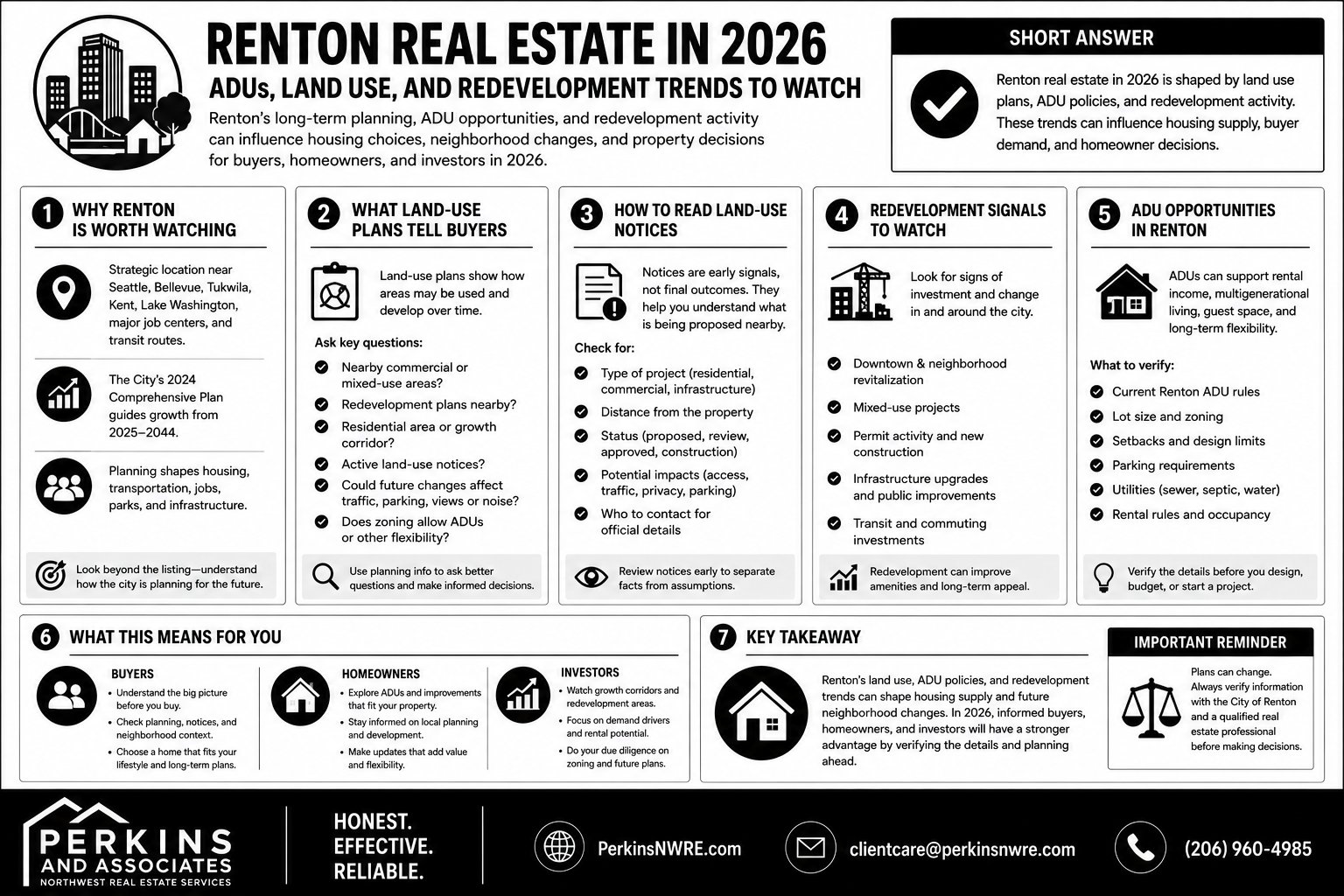
Why Is Renton Real Estate Worth Watching in 2026?
Renton real estate is worth watching because the city sits at the intersection of housing demand, transportation access, redevelopment planning, and regional growth.
The City of Renton describes its Comprehensive Plan as a long-term framework for growth, land use, housing, transportation, and sustainability. The city also notes that its 2024 Comprehensive Plan guides growth and development from 2025 through 2044.
That matters because comprehensive plans are not just government paperwork. They help shape how a city thinks about housing, business districts, transportation, parks, infrastructure, and neighborhood change over time.
For real estate decisions, this means buyers should look beyond the listing photos. A home’s long-term fit can also depend on nearby land-use patterns, future housing options, commute access, redevelopment areas, and how the city is planning for growth.
What Do Land-Use Plans Tell Renton Buyers?
Land-use plans help Renton buyers understand what types of uses, development patterns, and neighborhood changes may be encouraged in different parts of the city.
A land-use plan does not tell a buyer exactly what will happen next to a property. It does provide context. It can show whether an area is planned for residential use, mixed-use development, commercial activity, higher-density housing, or long-term infrastructure attention.
Buyers should use land-use information to ask better questions, such as:
- Is the property near a commercial or mixed-use area?
- Are there redevelopment plans nearby?
- Is the neighborhood mostly residential, or is it near a growth corridor?
- Are there active land-use notices in the area?
- Could future development affect traffic, parking, views, noise, or neighborhood feel?
- Does the zoning support ADUs or other housing flexibility?
The City of Renton’s Planning Department explains that planning provides policy recommendations for long-term growth and guides development and redevelopment through permit review. For buyers, that makes planning information a useful due diligence tool before making an offer.
How Should Buyers Read Renton Land-Use Notices?
Buyers should read Renton land-use notices as early signals, not final outcomes.
Land-use notices can alert the public to proposed developments, hearings, changes of use, subdivisions, or other planning activity. They do not always mean a project will be built exactly as proposed. However, they can help buyers understand what is being considered near a property.
The City of Renton’s Projects and Programs page includes land-use notices for proposed developments and describes public notices as a way to keep stakeholders informed about upcoming projects, hearings, and regulations.
Before buying in Renton, it is wise to check for nearby notices and ask:
- What type of project is proposed?
- How close is it to the property?
- Is it residential, commercial, mixed-use, or infrastructure-related?
- Is it early-stage, approved, under review, or under construction?
- Could it affect access, parking, traffic, privacy, or construction activity?
- Who should be contacted for official project details?
This type of review helps buyers avoid assumptions. It also helps them separate confirmed information from speculation.
What Redevelopment Signals Should Renton Buyers Watch?
Renton buyers should watch redevelopment signals such as downtown investment, public-space improvements, mixed-use planning, permit activity, and infrastructure upgrades.
Redevelopment does not always mean dramatic change. Sometimes it means improving public spaces, updating older buildings, attracting businesses, modernizing infrastructure, or encouraging housing near services.
The City of Renton’s Redevelopment page describes redevelopment as a way to support urban renewal, economic growth, infrastructure improvements, quality of life, and a more sustainable community.
One example is Downtown Renton. The city’s Renton Market, Piazza, and Legacy Square project page connects downtown public-space planning to the Civic Core and HEART Block area. This type of project matters because public spaces, civic gathering areas, and downtown activity can shape how buyers experience a neighborhood.
For buyers and homeowners, redevelopment signals are useful because they can help explain what a city is prioritizing. They should not be treated as a guarantee of appreciation, but they can help frame smart questions about location, access, livability, and long-term neighborhood context.
Where Do ADUs Fit Into Renton’s Housing Strategy?
Accessory dwelling units fit into Renton’s housing strategy by adding flexible housing options on existing residential properties.
An accessory dwelling unit, or ADU, is a secondary living space on the same property as a primary home. It may be a detached backyard cottage, garage conversion, basement apartment, or attached unit.
Renton has a specific local resource for this. The City of Renton’s Permit Ready ADU Program offers free ADU model base plans to residential property owners, designed to help streamline permit application and review.
For Renton homeowners, this may create a clearer starting point for ADU planning. For buyers, it may make certain properties more interesting if they have lot characteristics that could support future flexibility. For investors, it may raise questions about rental use, layout, permitting, and long-term demand.
However, homeowners should not assume every property can support an ADU. Site conditions, setbacks, utilities, sewer or septic capacity, drainage, access, parking, and building code requirements still need to be verified.
For a broader ADU overview, review our guide to King County ADUs in 2026.
How Can ADUs Affect Renton Buyers and Homeowners?
ADUs can affect Renton buyers and homeowners by adding potential flexibility, but they should be evaluated carefully before being treated as a major financial assumption.
For homeowners, an ADU may support:
- Long-term rental income
- Multigenerational living
- Guest space
- Aging-in-place planning
- Future resale flexibility
- More efficient use of an existing lot
For buyers, an ADU or ADU-ready property may raise important questions:
- Is the ADU legally permitted?
- Is it attached or detached?
- Does the property already meet local requirements?
- Are utilities adequate?
- Is rental use allowed?
- How would privacy and parking work?
- What would construction or maintenance cost?
The key is to treat ADUs as a planning opportunity, not a guaranteed return. A well-designed, permitted ADU may be valuable to certain buyers, but resale impact depends on local demand, legal status, design quality, condition, and comparable sales.
Which Renton Areas Should Buyers Research More Closely?
Renton buyers should research downtown, Sunset, the Highlands, Southport, The Landing area, and neighborhoods near major commute corridors more closely because these areas may offer different planning, redevelopment, and housing contexts.
This does not mean one area is better than another. It means each area may come with different questions.
Downtown Renton may involve questions about walkability, civic improvements, mixed-use activity, parking, and older housing stock.
The Highlands and Sunset areas may involve questions about neighborhood reinvestment, housing variety, and access to services.
Southport and The Landing area may involve questions about proximity to Lake Washington, retail, employment, and higher-activity commercial areas.
Neighborhoods closer to highways or major corridors may involve questions about commute access, traffic, noise, and future transportation planning.
Renton is a city where location-specific research matters. A home’s value to a buyer depends not only on the property itself, but also on the surrounding land-use pattern, infrastructure, access, and neighborhood direction.
What Should Homeowners Watch Before Improving or Selling in Renton?
Renton homeowners should watch local planning notices, zoning context, permit requirements, ADU options, redevelopment activity, and buyer questions before improving or selling a home.
If you are planning improvements, check whether the project needs permits and whether the work aligns with local standards. The City of Renton’s Permit Services page directs residents to permit resources for building structures, developing sites, working on utilities, and exploring land-use options.
If you are thinking about selling, planning context can help you prepare for buyer questions. Buyers may ask about nearby redevelopment, ADU potential, property improvements, commute access, school information, zoning, or permits.
This should be treated as context, not a pricing guarantee. Planning activity, ADU potential, or nearby redevelopment may shape buyer questions, but pricing should still be based on current comparable sales, property condition, market activity, and buyer demand.
What This Means for Buyers, Investors, and Homeowners
For buyers, Renton’s planning activity provides useful due diligence. Land-use notices, redevelopment areas, ADU resources, and zoning context can help buyers understand what questions to ask before making an offer.
For investors, Renton offers a planning-heavy market where local knowledge matters. ADU potential, redevelopment corridors, rental demand, and neighborhood context may all influence strategy, but every assumption should be tested with current rules, property-specific review, and realistic financial analysis.
For homeowners, planning information can support better decisions about improvements, ADUs, and future resale preparation. Understanding what is happening nearby may help homeowners explain their property more clearly when it is time to sell.
Renton is not a market where broad statements are enough. It rewards careful, neighborhood-level review.
Expert Insight: How to Use Planning Signals Without Overreacting
The most useful way to read Renton planning signals is to treat them as questions to verify, not predictions to rely on.
A land-use notice does not automatically mean a neighborhood will change overnight. A redevelopment plan does not guarantee a certain real estate outcome. An ADU opportunity does not guarantee rental income or resale value.
Instead, these signals help buyers and homeowners ask better questions:
- What is confirmed?
- What is proposed?
- What is still under review?
- What agency or department should verify the details?
- What would this mean for daily life?
- How might buyers interpret this information later?
This is where local guidance matters. Renton’s growth story is not just about prices. It is about understanding how land use, housing policy, redevelopment, and property-level details work together.
FAQ
Is Renton real estate still worth watching in 2026?
Yes. Renton is worth watching because its location, housing demand, land-use planning, and redevelopment activity may shape buyer and homeowner decisions. The city’s planning documents provide useful context for understanding how different neighborhoods may evolve.
Can I build an ADU in Renton?
Many Renton homeowners may be able to explore ADU options, but eligibility depends on the specific property, zoning, setbacks, utilities, access, and permit requirements. Renton’s Permit Ready ADU Program can help homeowners start the process, but each property still needs site-specific review.
What is Renton’s Permit Ready ADU Program?
Renton’s Permit Ready ADU Program offers free model base plans to residential property owners to help streamline ADU planning and permit review. Homeowners still need to verify whether a plan works for their specific lot and local requirements.
Should buyers check land-use notices before buying in Renton?
Yes. Buyers should review land-use notices because they may reveal proposed development, public hearings, redevelopment activity, or changes of use near a property. These notices help buyers ask better questions before making an offer.
Does redevelopment increase Renton home values?
Redevelopment may influence buyer interest and neighborhood perception, but it does not guarantee higher home values. Pricing should still be based on comparable sales, property condition, current demand, and market activity.
What should sellers know about Renton planning changes?
Sellers should understand that buyers may ask about nearby redevelopment, ADU potential, zoning, commute access, and local planning activity. Clear information can help support buyer confidence, but planning changes should not be presented as guaranteed value increases.
Helpful Resources
- City of Renton Comprehensive Plan
Helpful for understanding Renton’s long-term growth, housing, transportation, and land-use framework. - City of Renton Planning Department
Useful for understanding how Renton guides development, redevelopment, and planning policy. - City of Renton Current Planning
Helpful for buyers researching new construction, redevelopment, subdivisions, and changes of use. - City of Renton Projects and Programs
Useful for land-use notices, proposed development information, and local project updates. - City of Renton Permit Ready ADU Program
Helpful for Renton homeowners considering ADU model base plans. - City of Renton Permit Services
Useful for homeowners researching permits for building, development, utilities, and land-use projects. - Renton Market, Piazza, and Legacy Square Project
Helpful for understanding downtown civic core public-space planning and redevelopment activity.
Why Buyers and Sellers Across King County Trust Perkins & Associates
Whether you are buying in Renton, exploring ADU options, watching redevelopment, or preparing to sell, having the right local guidance can make the decision clearer. Perkins & Associates helps clients understand King County real estate with honest advice, local insight, and a strategy tailored to their goals.
If you are thinking about buying, selling, or planning your next move, Perkins & Associates is happy to help you think through your options and next steps.
📧 [email protected] | 📱 (206) 960-4985 | Honest. Effective. Reliable.