Renton Area Mobility Project: What Buyers Should Know About Proposed Bus Changes
The Renton Area Mobility Project could change the routes and transfers serving a home you are considering, so compare today’s service with Metro’s proposals before relying on future connections.
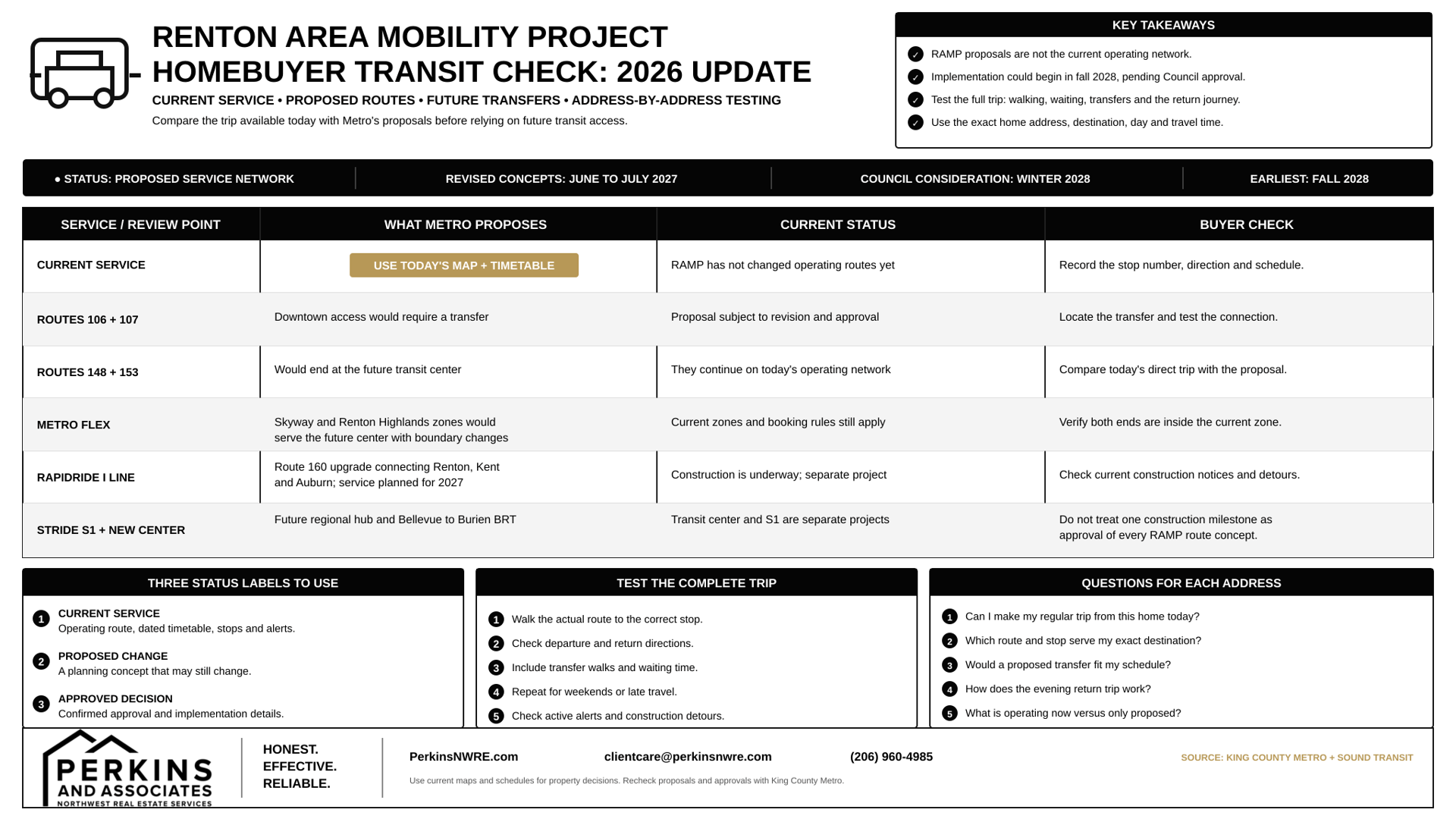
Metro is gathering input on changes associated with the future Renton Transit Center. Implementation could begin as early as fall 2028, pending King County Council approval. These are proposals, rather than immediate changes to your bus trip.
For buyers comparing Renton-area homes, the practical question is: “Can I make my regular trips from this address today, and what might change later?”
Fact-check date: November 24, 2026.
Key takeaways
- Evaluate current service before making a purchase decision.
- Keep proposed routes separate from operating routes.
- Check the complete trip, including walking, waiting, and transfers.
- Test your return journey as carefully as your morning commute.
What is the Renton Area Mobility Project?
The Renton Area Mobility Project, or RAMP, reviews bus routes, stops, and Metro Flex connections around the future Renton Transit Center at South Grady Way and Rainier Avenue South.
The project connects local service planning with a future regional hub serving Metro buses, Metro Flex, RapidRide I Line, and Sound Transit’s Stride S1.
For a homebuyer, a transit center’s location is only part of the picture. The useful comparison is between your front door and your actual destination.
Are the proposed changes approved or operating now?
RAMP’s proposed network is not the current operating network. Metro’s published process anticipates revised concepts in 2027 and Council consideration in winter 2028.
Use three separate categories when reviewing a property:
Status | What it means for your research |
|---|---|
Current service | Check the operating route, dated timetable, stops, and alerts. |
Proposed change | Consider the concept as a possibility that can still change. |
Approved decision | Look for the specific approval and implementation information before treating it as settled. |
Construction on a related transit project does not establish approval of every RAMP route proposal.
Which routes and areas are under review?
Metro identifies routes 101, 102, 105, 106, 107, 143, 148, 153, 240, 907, RapidRide F, and future RapidRide I, currently Route 160, for consideration. Skyway and Renton Highlands Flex are also included. Route 143 is already suspended.
Start with the route serving the address you are considering. Then check the proposed changes at the Renton end of the journey, even if the stop near the home appears unaffected.
Could a downtown Renton trip require a transfer?
Yes. Some proposed changes would alter direct downtown access.
Service | Proposed RAMP concept | Question for a buyer |
|---|---|---|
Routes 106 and 107 | Downtown access would involve a transfer. | Where would I transfer for my destination? |
Routes 148 and 153 | Routes would end at the future transit center instead of continuing downtown. | Would the additional connection fit my schedule? |
Rainier Beach/Skyway and Renton Highlands Flex | Connections to the future center and boundary adjustments are proposed. | Would both ends of my trip remain within the relevant service area? |
These concepts remain subject to the planning and approval process.
“Downtown Renton” is not precise enough to evaluate convenience. Use the address of your workplace, appointment, shop, or other regular destination.
What does a current-service comparison look like?
Use a dated official map and timetable as your starting point.
Current service example: Metro’s Route 106 schedule lists Renton Transit Center, Skyway, Rainier Beach, Othello Station, Mount Baker Transit Center, and the Chinatown/International District. The reviewed schedule covers August 29, 2026 through March 26, 2027.
Open the official Route 106 map and timetable, identify your stops, and check the appropriate day and direction.
Hypothetical buyer example: A buyer considering a home near Route 106 regularly visits a particular downtown Renton address. That buyer should first test today’s journey. Next, they should review the proposed transfer location and walking connection.
The proposal alone cannot establish whether that household’s future trip would be quicker or more convenient.
How do RapidRide I Line and Stride S1 fit into RAMP?
They are related projects with their own service plans and timelines.
Project | Verified context |
|---|---|
RapidRide I Line | Metro plans to upgrade Route 160 between Renton, Kent, and Auburn, with service planned for 2027. Construction is underway. |
Stride S1 | Sound Transit’s planned bus rapid transit line connects Bellevue and Burien through Renton. |
Metro’s I Line page and Sound Transit’s S1 page should be checked separately from the RAMP proposal.
An I Line launch does not mean all RAMP changes happen at the same time. For more corridor background, read our RapidRide I Line buyer guide.
How should buyers check transit before making an offer?
Check the complete journey using the exact address, destination, day, and time you expect to travel.
1. Identify the actual stop
Record the stop number and direction. Walk from the property to the boarding location rather than relying only on a straight-line map distance.
Notice crossings, sidewalk continuity, lighting, slopes, and any access needs relevant to your household.
2. Check both directions
Compare your morning departure with your evening return. Repeat the check for weekends, early shifts, or late appointments if those trips matter.
3. Include every transfer
Allow for the walk between stops and the wait for the next service. Consider how the trip would work if you missed a connection.
4. Check disruptions separately
Temporary detours and relocated stops are different from proposed permanent changes. Metro identifies temporary bus and pedestrian disruptions associated with I Line construction, so review current notices before testing a trip.
5. Verify Metro Flex boundaries
Confirm current pickup and drop-off eligibility, operating hours, and booking arrangements. Use our Metro Flex zones guide for background, then confirm details with Metro.
6. Compare homes using the same travel needs
Use the same destination and departure time for each property. Keep current-service findings in one column and future proposals in another.
That makes the comparison useful without building a purchase decision around an unapproved service plan.
Frequently asked questions
Does being near a bus stop guarantee a direct commute?
No. Check the destination, direction, operating hours, and transfers. A nearby stop may serve a different travel pattern from the one you need.
What should rental-property buyers verify?
Verify the current route and walking connection before describing transit access. Label future proposals clearly and avoid promising commute times or rental premiums.
Where can I follow updates?
Use Metro’s RAMP project page for current project information and update subscriptions. Recheck it before publication and again before relying on a proposal in a property decision.
Helpful resources
- Renton Area Mobility Project
- Current Route 106 map and timetable
- Metro’s RapidRide I Line project page
- Sound Transit’s Stride S1 project page and map
For broader context, see our guide to regional transit changes across South King County.
Comparing homes in the Renton area?
Bring your regular destinations and travel schedule into the home search early. A property’s transit access is most useful when it fits the trips you actually make.
Perkins & Associates | John L. Scott can help you compare locations alongside your budget and housing priorities. Visit perkinsnwre.com or call 206-960-4985 to discuss your purchase plans.