King County Property Taxes Explained for South King County Homeowners in 2026
King County property taxes are an important part of owning or buying a home, but the amount on your bill is determined by more than your property's assessed value.
For the 2026 tax year, King County reports approximately $8.4 billion in total property taxes, an increase of about 10% from the previous year. The county's total assessed property value increased approximately 5.4%.
Those figures describe different things. Property values help determine how taxes are distributed among property owners, while the amount collected also depends on local government budgets, taxing districts, and voter-approved measures.
Now, King County is reviewing proposed property-tax levies for collection in 2027.
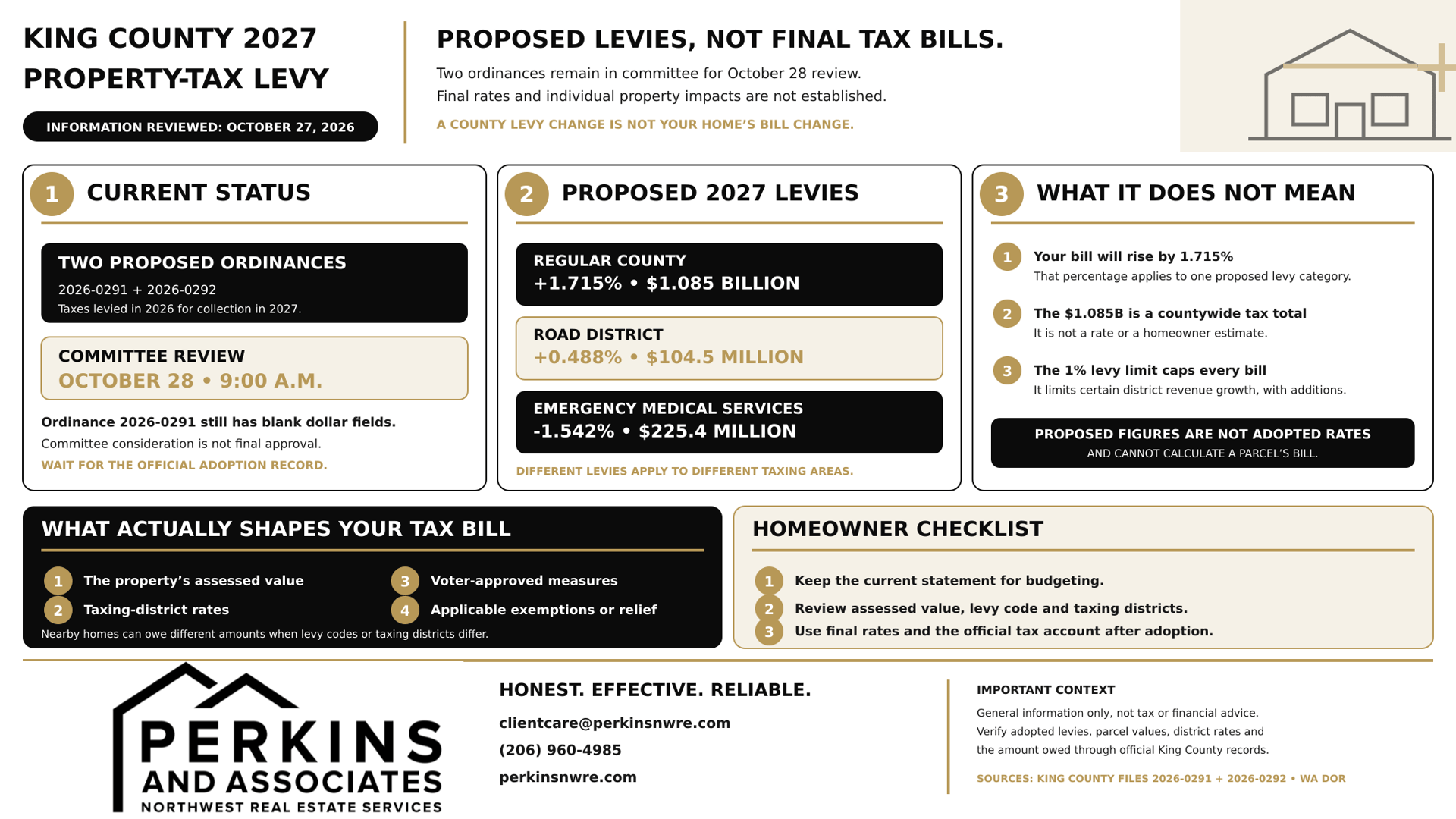
Two ordinances are scheduled for County Council committee consideration on October 28, 2026. One proposes approximately $1.085 billion in regular county levy revenue, but that does not mean every homeowner's property-tax bill will increase by the same percentage.
For homeowners in Maple Valley, Kent, Renton, Auburn, Covington, Black Diamond, and surrounding King County communities, understanding this distinction can make budgeting and real estate decisions easier.
This guide explains how King County property taxes are calculated, what has been proposed for 2027, and where to find reliable information about your property.
Key takeaways
- King County's total 2026 property-tax collections are approximately $8.4 billion, about 10% higher than the previous year.
- There is no single property-tax rate for every King County home. Rates depend on the property's taxing districts and levy code.
- Washington's general 1% levy-growth limit does not cap an individual homeowner's tax bill at a 1% annual increase.
- King County's proposed 2027 regular levy is approximately $1.085 billion, representing a proposed 1.715% revenue increase for that levy category.
- The proposed 2027 levies are not yet final. The County Council must complete its review and adoption process.
- Buyers and sellers should verify taxes at the parcel level. Tax bills, exemptions, and taxing districts can differ even between nearby properties.
- Some homeowners may qualify for exemptions or deferrals. Eligibility depends on the applicable program requirements.
What should South King County homeowners know about property taxes in 2026?
A home's assessed value is only one part of its property-tax calculation.
King County collects taxes on behalf of multiple taxing authorities, including the state, the county, cities, school districts, fire districts, and other local entities.
The amount paid by an individual homeowner depends on which taxing districts serve the property and how much those districts are authorized to collect.
A property in Kent, for example, may fall under a different combination of local districts than a similarly priced home in Auburn.
Even within the same city, two properties can have different tax obligations if they are served by different school, fire, or special-purpose districts.
According to the King County Assessor's 2026 property-tax report, overall taxes increased by approximately $770 million from 2025 to 2026.
The county identifies voter-approved measures as an important source of the increase.
For homeowners, this means that looking only at changes in property value will not explain every increase or decrease in a tax bill.
The full explanation requires reviewing the property's assessed value, levy code, and applicable taxing districts.
Why did King County property taxes increase in 2026?
King County's overall property-tax collections increased in 2026 because of a combination of voter-approved levies, taxing-district decisions, and changes in the property-tax base.
The Assessor reports:
Countywide measure | 2026 figure |
|---|---|
Total property taxes | Approximately $8.4 billion |
Increase from 2025 | Approximately 10% |
Total assessed property value | Approximately $920 billion |
Increase in assessed value | Approximately 5.4% |
These are countywide figures. They do not mean every property experienced a 10% increase in taxes or a 5.4% increase in assessed value.
Local changes may differ.
For example, voters in one school district may approve a capital levy while a nearby property falls outside that district.
The difference can affect the amount homeowners pay even when their properties have similar assessed values.
King County's total collections also should not be confused with the amount collected for King County government's own regular levy.
The county collects taxes for many separate authorities and distributes revenue to those entities.
That distinction becomes especially important when reviewing the proposed 2027 levy.
How is King County property tax calculated?
King County property taxes are generally calculated by applying the combined tax rate for a property's levy code to its taxable assessed value, subject to applicable exemptions and other adjustments.
Rates are commonly expressed as dollars per $1,000 of assessed value.
A simplified calculation is:
Property tax = Taxable assessed value ÷ 1,000 × Combined levy rate
For example, if a property has a taxable assessed value of $700,000 and a combined levy rate of $9 per $1,000:
$700,000 ÷ 1,000 × $9 = $6,300 in annual property taxes
This is an illustrative calculation, not an actual King County levy rate or 2027 tax estimate.
The property's final tax amount depends on its official taxable value and the rates that apply to its specific taxing area.
The King County Assessor's residential property-tax guidance identifies assessed value, community taxable value, voter-approved measures, and local budgets as factors in residential property taxes.
What is assessed value?
Assessed value is the value assigned to a property for taxation purposes by the county assessor.
King County generally reassesses properties annually based on their market value as of the applicable January 1 assessment date.
An assessed value may differ from the price a buyer is willing to pay today.
What is a levy rate?
A levy rate represents the amount collected per $1,000 of taxable assessed value.
The combined rate for a property reflects the applicable state and local taxing authorities.
Why does the levy code matter?
The levy code identifies the combination of taxing districts associated with a property.
A homeowner's levy code is generally more useful for understanding their tax rate than comparing citywide averages alone.
Does Washington's 1% property-tax limit mean my bill can only increase 1%?
No. Washington's general 1% levy-growth limit applies to certain increases in regular property-tax revenue collected by taxing districts, not to the annual change on every individual property-tax bill.
A homeowner's taxes can increase by more than 1%, remain relatively stable, or decrease depending on the applicable circumstances.
The Washington Department of Revenue explains that taxing districts may receive additional revenue associated with new construction, property improvements, and other legally permitted additions.
Voter-approved measures can also change tax obligations.
An individual bill depends partly on how the property's assessed value changes relative to other properties within the taxing district.
A simple example
Imagine two homes with the same assessed value in one year.
The following year, one home's assessed value increases faster than the average property in the district.
That home may bear a larger share of a particular levy, even when the district's total regular levy growth is restricted.
This is why the phrase "1% property-tax limit" should not be interpreted as a guarantee that a homeowner's bill can rise by only 1%.
The same distinction matters when examining King County's proposed 2027 levy.
King County 2027 Property Tax Levy: What Has Been Proposed?
King County is reviewing proposed property-tax levies for collection in 2027, but the amounts have not yet been finally adopted.
As of October 27, 2026, two ordinances remain in the County Council's Budget and Fiscal Management Committee.
Both are scheduled for consideration on October 28.
They address different parts of the annual levy process.
What does Ordinance 2026-0291 propose?
Proposed Ordinance 2026-0291 concerns property taxes levied in 2026 for collection in 2027.
The ordinance is intended to establish and certify levy amounts necessary to fund county expenditures.
However, the publicly available draft reviewed on October 27 still contains blank dollar fields.
That means the document should not be treated as a complete, adopted schedule of 2027 levy amounts.
The final ordinance must be reviewed after legislative action.
What does Ordinance 2026-0292 propose?
Proposed Ordinance 2026-0292 addresses changes to several county levy categories and the implementation of RCW 84.55.120.
The draft provides estimated revenue amounts for collection in 2027.
County levy category | Proposed revenue change | Estimated 2027 levy |
|---|---|---|
Regular county levy | +1.715% | $1,084,823,088 |
Road district levy | +0.488% | $104,546,304 |
Emergency Medical Services levy | −1.542% | $225,415,856 |
Figures are based on the October 2026 draft. They are proposed levy revenues, not adopted levy rates or individual property-tax increases.
The proposed regular county levy would collect approximately $18.3 million more than the amount authorized for collection in 2026.
That figure concerns one levy category.
It should not be compared directly with King County's approximately $8.4 billion in total property taxes for 2026, which includes collections for numerous separate taxing authorities.
Does a proposed 1.715% regular levy increase mean my tax bill will rise 1.715%?
No. The proposed percentage measures growth in regular county levy revenue, not the percentage change in every homeowner's tax bill.
A homeowner's total tax obligation also includes applicable state, school, city, fire, and other district levies.
The proposed road district increase, for example, does not mean the same tax applies to every property throughout King County.
Taxing-area boundaries matter.
The final tax bill will also depend on the property's taxable assessed value and final levy rates.
How can a levy increase exceed Washington's general 1% growth limit?
Washington law allows certain additions to regular levy revenues, including revenue related to new construction and other qualifying changes in taxable property.
Those additions can cause a district's total levy revenue to grow by more than 1% without necessarily violating the general limit.
Other statutory rules and voter-approved measures can affect particular levies.
A percentage listed in a proposed ordinance should therefore be interpreted in the context of the applicable law, not as a standalone measure of compliance.
When will King County's 2027 levy become final?
The County Council must complete its legislative process and adopt the applicable ordinances.
Committee consideration alone does not establish final approval.
Following adoption, property owners should consult the King County Assessor's levy-rate reports for final rates and taxing-district information as they become available.
The actual amount owed should be verified against the property's official tax record and statement.
What about other property-tax levies in 2027?
King County's general levy proposals are separate from the budgets and levies of other taxing authorities.
For example, the King County Flood Control District has its own 2027 budget and levy proposal.
We explain that issue separately in our article on King County's proposed 2027 flood-control budget and tax levy.
Homeowners should avoid adding individual proposals together without confirming whether the levies apply to their parcel and how the amounts relate to the combined tax rate.
How do property taxes affect buyer affordability in South King County?
Property taxes are part of the total cost of homeownership and should be included when evaluating a monthly housing budget.
For buyers using a mortgage, the monthly payment may include principal, interest, property taxes, homeowners insurance, and possibly association dues.
Two similarly priced homes can have different monthly ownership costs.
A buyer comparing a home in Renton with one in Maple Valley may encounter different property-tax obligations because of the local taxing districts involved.
That does not automatically make one location more affordable.
The full comparison should consider purchase price, financing, insurance, utilities, maintenance, commuting expenses, and the buyer's longer-term plans.
What should buyers verify?
Before making an offer, buyers should review:
- The property's current annual tax bill.
- The current assessed value and taxable value, when applicable.
- Its levy code and taxing districts.
- Whether recent improvements or new construction could affect future assessments.
- Whether the current owner receives exemptions that may not transfer.
- Whether the lender's escrow estimate reflects current tax information.
- Whether future levy changes remain proposed or have been adopted.
For 2027: Buyers should not use King County's proposed 1.715% regular levy increase as a shortcut for estimating their property's total future tax bill.
A parcel-specific review is more reliable.
What should sellers know about King County property taxes?
Sellers should be prepared to provide accurate information about the property's current tax obligation and point buyers toward official records.
A buyer may question why a home's taxes differ from another listing in the same city or price range.
The most useful response is based on the actual parcel record.
Sellers can prepare by gathering the most recent tax statement, assessed value information, parcel number, available levy-code details, and records of significant improvements.
Could the seller's exemption affect the buyer?
Yes.
Some exemptions and deferrals depend on the owner's personal eligibility.
A buyer should not assume that a seller's exemption or deferral will continue after the property changes ownership.
Any questions about reassessment, exemption changes, or tax adjustments after closing should be confirmed with the county and the appropriate settlement or tax professional.
Should sellers advertise a projected 2027 property-tax bill?
Not as a confirmed amount while the relevant tax information remains preliminary.
A seller may share the current official tax record and explain where buyers can find updated county information.
That is more reliable than presenting a projected increase as if it were already part of the property's annual tax bill.
Why do property taxes vary across King County cities?
Property-tax obligations vary because different properties are served by different combinations of taxing authorities.
A city name alone does not establish a single tax rate.
In South King County, that matters for communities such as Kent, Renton, Auburn, Federal Way, Maple Valley, Covington, Black Diamond, Tukwila, Burien, Des Moines, and SeaTac.
A home's school district may not match the city boundary a buyer expects.
Fire districts, hospital districts, and other local service areas can also cross municipal boundaries.
Even two houses located relatively close to each other may have different levy codes.
Is there one King County property-tax rate?
No.
The county publishes levy-rate reports that allow homeowners to research the applicable rates for particular taxing areas.
Those reports provide a better basis for comparison than applying a generalized citywide percentage to a home's estimated market value.
Does living in an unincorporated area change the calculation?
It can change the combination of taxing districts and public services associated with the property.
A property outside incorporated city limits may be served by county government and other districts rather than the same local authorities serving a nearby property inside a city.
Buyers should check the parcel's official jurisdiction and levy code rather than rely solely on its mailing address.
Can homeowners appeal their King County property-tax assessment?
Yes. Property owners may appeal their assessed valuation if they believe the value assigned to the property is incorrect.
However, a valuation appeal is not simply a challenge to the total tax bill.
The relevant question is whether the assessed value is supported by appropriate evidence for the assessment date.
King County's Board of Appeals and Equalization is separate from the Assessor's Office and handles valuation appeals.
The King County valuation appeal guidance explains the filing process.
What should homeowners review before appealing?
Useful records may include recent comparable sales near the assessment date, the property's reported square footage, physical characteristics, condition, and other evidence related to its valuation.
Homeowners should also check the filing deadline on the applicable notice.
An appeal does not guarantee a tax reduction.
A different assessed value may change the property's allocation of taxes, but the final result still depends on the applicable rates and taxable value.
If the issue concerns exemption eligibility or the payment process rather than market valuation, the homeowner may need a different county procedure.
What property-tax exemptions or deferrals are available?
King County administers several property-tax relief programs for qualifying homeowners.
Eligibility can depend on age, disability, veteran status, income, ownership, occupancy, and the specific program.
Examples include senior and disability exemptions, certain veteran-related relief, and deferral programs.
These programs have different requirements and financial consequences.
A deferral, in particular, should not be assumed to have the same effect as an exemption.
What is changing for tax relief in 2027?
Separate legislation has changed some income thresholds and program rules beginning in 2027.
Those changes are not the same as the County Council's proposed general property-tax levy.
For more information, see our guide to King County's expanded property-tax relief thresholds for 2027.
The King County Assessor's tax-relief resources provide current program details and application information.
Homeowners should confirm eligibility before relying on an exemption or deferral in their financial plans.
King County property-tax checklist for homeowners and buyers
Use this checklist when reviewing a home purchase, preparing to sell, considering an appeal, or planning for 2027 ownership expenses.
What to review | Why it matters |
|---|---|
Current property-tax statement | Establishes the latest official amount owed |
Assessed and taxable values | Helps explain the valuation used for taxation |
Levy code and taxing districts | Identifies which levies apply to the parcel |
Approved versus proposed levies | Prevents preliminary figures from being treated as final |
Exemptions or deferrals | May affect the current owner's obligation |
Improvements and property history | May affect future valuation or taxation |
Lender escrow estimate | Helps assess the total monthly payment |
Final 2027 levy-rate reports | Provides updated taxing-district rate information when published |
Ownership budget | Connects taxes with insurance, maintenance, utilities, and financing |
Where can I verify my property's taxes?
Start with King County's official property-tax records.
The King County Treasury property-tax service provides information about tax accounts, statements, payments, and contacting Treasury Operations.
Use the property's parcel or tax account number when available.
For the final breakdown of applicable rates, consult the Assessor's levy reports.
These sources are more appropriate for determining a property's actual tax obligation than countywide estimates or proposed budget figures.
Expert insight: Use the property's actual numbers when planning your next move
Property taxes matter in real estate because they influence the cost of owning a home, but the countywide figures do not tell the whole story for an individual property.
Consider two buyers looking at similarly priced homes in Kent and Covington.
Both may have comparable loan terms, yet their total monthly payments could differ because of property taxes, insurance, association dues, and other expenses.
The same principle applies to a homeowner deciding whether to remain in a larger house or downsize.
An increase in ownership costs may be worth discussing, but a decision should be based on the actual household budget rather than a headline about a proposed levy.
At Perkins & Associates, we encourage buyers and sellers to separate three kinds of information:
What is already known: The current tax statement, assessed value, and applicable taxing districts.
What is under review: Proposed 2027 county levy amounts and other pending measures.
What still needs confirmation: Final tax rates, any property-specific adjustments, and the amount shown on a future statement.
A locally informed real estate team can help organize property comparisons and questions for lenders, tax professionals, or county offices.
The goal is to understand the full cost of ownership before making a major property decision.
Frequently asked questions about King County property taxes
What is the King County property-tax rate in 2026?
There is no single rate that applies to every King County home. The combined rate depends on the property's levy code and applicable taxing districts. Look up the parcel in official county records for accurate information.
Why did my property taxes rise more than my home value?
Property taxes are determined by more than changes in an individual property's value. Local budgets, voter-approved measures, taxing-district rates, and relative valuation changes can all affect the amount owed.
Does Washington limit my personal property-tax increase to 1%?
No. Washington's general 1% levy-growth limit applies to certain district levy revenues, not to each individual homeowner's annual tax bill.
Has King County approved the 2027 property-tax levy?
As of October 27, 2026, Ordinances 2026-0291 and 2026-0292 remain in committee and are scheduled for consideration on October 28. The proposals should not be treated as final until official legislative records confirm adoption.
Will the proposed 1.715% regular levy increase raise my property taxes by 1.715%?
Not necessarily. The percentage concerns the proposed growth in one county levy category. The total tax bill for a specific property depends on its taxable value and all applicable taxing-district rates.
When will I know my property's 2027 tax amount?
Once the applicable levy decisions and tax rates are finalized, you can review the county's official records. The tax statement for the property will provide the actual amount owed.
Can I appeal my King County property-tax bill?
Homeowners may appeal the assessed valuation under the applicable process. An appeal generally concerns the property's value rather than a general objection to the amount of taxes collected.
Are there property-tax exemptions for seniors in King County?
Yes. Qualifying senior homeowners and certain other residents may be eligible for exemptions or deferrals. Income and other program conditions apply, and the rules should be verified before relying on a benefit.
Should homebuyers include property taxes in mortgage budgeting?
Yes. Property taxes are an ongoing ownership expense and may be included in the lender's escrow estimate. Buyers should compare the property's official tax record with the estimated monthly payment.
Are South King County property taxes different from those in Seattle or on the Eastside?
They can be. Taxing districts, voter-approved measures, and property values vary by location. A parcel-level comparison is more reliable than assuming one regional rate applies everywhere.
Helpful resources
1. King County Assessor: 2026 Property Taxes
Official 2026 countywide tax totals and information about voter-approved levies.
2. King County Assessor: Residential Property Taxes
Explains assessed values and the factors affecting residential property taxes.
3. King County Council: Proposed Ordinance 2026-0291
Official legislative record for the 2026 levy of taxes to be collected in 2027.
4. King County Council: Proposed Ordinance 2026-0292
Proposed 2027 county levy changes under RCW 84.55.120.
5. Washington Department of Revenue: How the 1% Levy Limit Works
Explains why district levy limits and individual tax increases are not the same.
6. King County Assessor: Levy Rate Reports
Taxing-district and levy-code rate information.
7. King County Assessor: Tax Relief
Information about exemptions, deferrals, and program eligibility.
8. King County Assessor: Appealing a Valuation
Official assessment appeal information.
Information and transparency
Reviewed October 27, 2026.
This article uses King County Assessor reports, County Council legislative records, and Washington Department of Revenue guidance.
The countywide property-tax totals cited for 2026 are historical figures for that tax year.
The 2027 levy amounts discussed in this article are proposed figures from Ordinance 2026-0292. They had not been confirmed as finally adopted at the time of review.
Ordinance 2026-0291 also contained incomplete dollar fields in the version reviewed.
No individual homeowner's 2027 tax obligation has been calculated from those proposals.
This article should be reviewed following the October 28 committee meeting, final Council adoption, and publication of the final 2027 levy-rate information.
Need help understanding how property taxes affect your next move?
A home's purchase price is only part of its long-term ownership cost.
Property taxes, insurance, maintenance, financing, and local market conditions can all affect how a home fits your plans.
Whether you're buying in Maple Valley, considering a move in Renton, preparing to sell in Kent, or comparing homes throughout South King County, Perkins & Associates can help you evaluate property information in the context of your real estate goals.
We can help you review available records, compare properties, and identify questions that may require confirmation from King County, your lender, or a qualified tax professional.
Contact Perkins & Associates | John L. Scott
Email: [email protected]
Phone: (206) 960-4985
Honest. Effective. Reliable.
Disclaimer: This article provides general real estate information and is not legal or tax advice. Property-tax amounts, assessment appeals, exemptions, deferrals, taxing districts, and statutory requirements vary by property and circumstance. Buyers, sellers, and homeowners should verify current information with King County and consult qualified tax or legal professionals when needed.