Washington Manufactured Home Relocation Rules 2026: What the Proposed Repeal Means
Washington is reviewing administrative regulations governing its Manufactured/Mobile Home Relocation Assistance Program, but the proposal does not eliminate the financial assistance available to qualifying residents of closing manufactured-home communities.
On October 7, 2026, the Washington State Register published a Department of Commerce proposal to repeal nine sections of Chapter 365-212 of the Washington Administrative Code (WAC).
Commerce says the regulations, originally established in 2003, no longer accurately reflect changes to state law and how the relocation program operates.
That distinction matters for manufactured-home residents, community owners, and buyers considering a home in a land-lease community.
Washington's relocation-assistance program remains established under Chapter 59.21 RCW. The proposed repeal targets outdated administrative rules, not the law authorizing the program.
Eligible residents may continue to qualify for financial assistance when their manufactured-home community closes or converts to another use.
However, receiving assistance depends on household eligibility, the timing of a closure notice, available funding, and other program requirements.
For property owners and buyers in King County, understanding those conditions is more useful than assuming every manufactured-home owner qualifies or that the state has discontinued its relocation program.
Key takeaways
- The relocation program is not being eliminated. Commerce proposes repealing outdated administrative regulations while the program remains established under state law.
- Nine WAC sections are affected. The proposal concerns WAC 365-212-010 through 365-212-090.
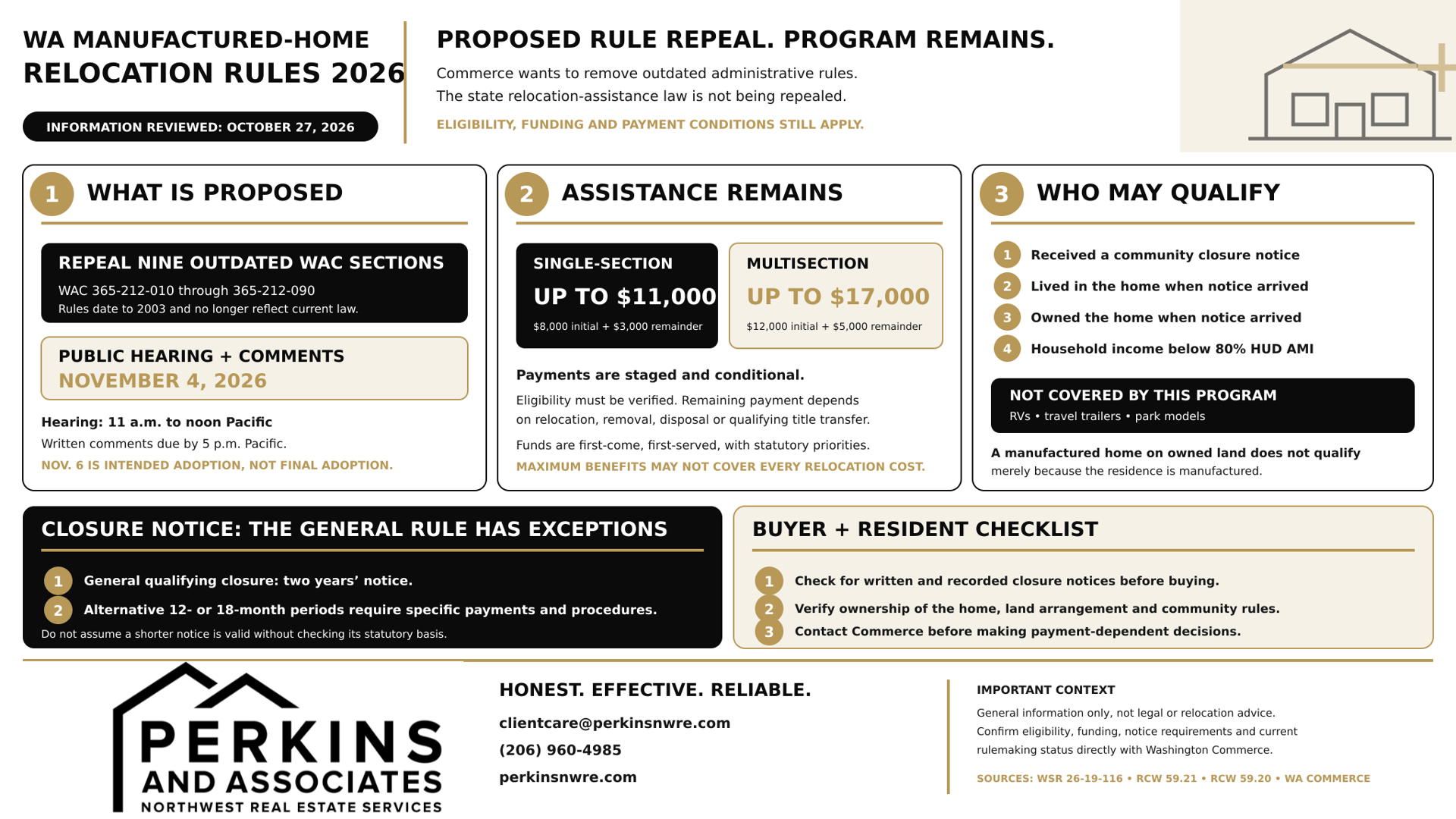
- Current assistance remains available to qualifying households. Maximum benefits are $11,000 for single-section homes and $17,000 for multisection homes.
- Benefits are paid in stages. Initial payments and remaining payments have different conditions.
- Not everyone qualifies. Income, ownership, occupancy, closure notices, and other statutory requirements matter.
- Closure notices are important. Washington generally requires two years' notice for qualifying manufactured-home park closures, but statutory exceptions exist.
- Buyers should investigate existing closure notices. Purchasing a manufactured home after receiving actual prior notice of a community closure can affect relocation-assistance eligibility.
- Public participation is open. A virtual hearing is scheduled for November 4, 2026, with written comments due that afternoon.
The proposal remained pending as of this article's October 27, 2026 review.
What is Washington proposing to change in its manufactured-home relocation rules?
Washington Commerce is proposing to repeal nine administrative rules under Chapter 365-212 WAC because they no longer accurately reflect the state's relocation-assistance statutes and program procedures.
The proposed repeal covers rules concerning definitions, program contacts, eligibility, applications, assistance amounts, reimbursement, documentation, and park-owner fraud.
According to Washington State Register WSR 26-19-116, the regulations have become outdated following changes made to the program since 2003.
Commerce says relying on inaccurate administrative language can cause confusion and create potential legal risks.
Why is the state removing these regulations?
State administrative rules help agencies carry out laws passed by the Legislature.
Over time, legislators may revise the law, change financial assistance amounts, update eligibility requirements, or establish new procedures.
When an older regulation no longer reflects those changes, it can give residents inaccurate information.
Commerce's proposed repeal is intended to remove that outdated language.
The proposal does not establish a replacement benefit structure or independently cancel existing statutory rights.
When was the proposed repeal filed?
The proposal was filed September 22, 2026, and published in the Washington State Register on October 7.
The rulemaking timeline is:
Date | Event |
|---|---|
July 21, 2026 | Initial rulemaking inquiry filed |
September 22, 2026 | Proposed repeal filed |
October 7, 2026 | Proposed repeal published |
November 4, 2026 | Public hearing scheduled |
November 4, 2026 | Written-comment deadline |
November 6, 2026 | Intended adoption date |
November 6 is an intended adoption date, not confirmation that the repeal has already been adopted or taken effect.
Is Washington eliminating manufactured-home relocation assistance?
No. Washington's Manufactured/Mobile Home Relocation Assistance Program remains established by Chapter 59.21 RCW.
The proposed repeal affects administrative regulations under Chapter 365-212 WAC.
These are different legal authorities.
Legal source | What it does | Status as of October 27, 2026 |
|---|---|---|
Chapter 365-212 WAC | Older administrative relocation-assistance rules | Proposed for repeal |
Chapter 59.21 RCW | Establishes relocation assistance and program requirements | Remains in effect |
Chapter 59.20 RCW | Governs manufactured/mobile home landlord-tenant relationships, including certain closure protections | Remains in effect |
The Washington Legislature's Chapter 59.21 RCW continues to establish the relocation program.
Commerce also maintains an active program webpage explaining benefits, eligibility, and how residents can request assistance.
That Manufactured/Mobile Home Relocation Assistance Program page should be a primary resource for residents seeking current instructions.
The important takeaway is that removing an outdated administrative rule does not automatically repeal the state law behind the assistance program.
Who qualifies for Washington manufactured-home relocation assistance?
Washington's relocation program generally serves eligible low-income households that own and occupy a manufactured or mobile home in a community that is closing or converting to another use.
Commerce identifies four central eligibility criteria.
To qualify, an applicant generally must:
- Have received a notice that the manufactured/mobile home community is closing.
- Have lived in the home when the closure notice was received.
- Have owned the home when that notice was received.
- Have household income below 80% of the applicable HUD area median income.
Other statutory and program requirements may also apply.
What does the income requirement mean?
The program uses area median income, commonly called AMI, to determine income eligibility.
The applicable limit depends on the relevant geographic area and household circumstances.
Residents should not assume that one statewide dollar amount applies to every household.
Commerce can help an applicant determine the relevant limit and which income documents are required.
Does every manufactured-home owner qualify?
No.
The program specifically addresses qualifying households affected by manufactured/mobile home community closures or conversions.
A person who owns a manufactured home on individually owned land does not automatically qualify simply because they own a manufactured home.
A person who owns a home in a community that is not closing also does not qualify for closure-related assistance on that basis alone.
Commerce's current guidance excludes recreational vehicles, travel trailers, and park models from this particular relocation-assistance program.
Is assistance guaranteed once eligibility is established?
Funding availability still matters.
Under the applicable statute, relocation assistance is distributed on a first-come, first-served basis, with priority for eligible residents in communities closed because of qualifying health and safety concerns or community-owner fraud.
Commerce verifies eligibility before issuing payments.
Residents should contact the program before making relocation commitments based on an expected payment.
How much relocation assistance is available in Washington?
Eligible households may receive up to $11,000 for a single-section home or $17,000 for a multisection home.
The benefits are divided into two payments, with different conditions for each.
Under RCW 59.21.021, the statutory payment structure is:
Home type | Initial payment | Remaining conditional payment | Maximum assistance |
|---|---|---|---|
Single-section home | $8,000 | $3,000 | $11,000 |
Multisection home | $12,000 | $5,000 | $17,000 |
When is the first payment issued?
The initial payment is intended to help an eligible resident relocate the home or secure alternative housing.
Commerce must verify eligibility, and payment is subject to available program funds.
The initial statutory amounts are $8,000 for a single-section home and $12,000 for a multisection home.
These are not automatic payments to every resident in a manufactured-home community.
When can a resident receive the remaining payment?
The remainder generally becomes available after the resident satisfies applicable requirements involving removal, relocation, demolition and disposal, or transfer of the home's title to the community owner.
The statute connects the remaining payment to the community closure date.
It also contains a specific provision for a resident who removes the home by the closure date and reinstalls it in another location within 12 months after that date.
Commerce's program guidance addresses additional circumstances involving the sale or gifting of a home.
Because different situations require different documentation, residents should confirm the applicable process directly with Commerce.
Will the maximum payment cover every relocation expense?
Not necessarily.
Relocating a manufactured home can involve transportation, site preparation, utility connections, installation, permits, and other costs.
In some circumstances, moving the home may not be financially or physically practical.
The statutory maximum does not guarantee that every relocation or replacement-housing expense will be covered.
Residents should evaluate actual costs and payment conditions before committing to a plan.
What happens when a manufactured-home community closes?
Washington generally requires landlords to provide two years' notice before qualifying manufactured/mobile home community closures or conversions.
However, this general rule has important exceptions.
Under RCW 59.20.080, the notice requirements depend on the reason for closure and the circumstances involved.
Does every resident receive two full years' notice?
No.
The statute includes alternative procedures that may apply when a landlord provides qualifying relocation assistance and, in certain circumstances, additional compensation for the loss of a home.
Closure situation | General notice treatment |
|---|---|
Qualifying closure or land-use conversion | Two years' notice |
Qualifying landlord assistance plus specified home-loss compensation | At least 12 months' notice after the required compensation is paid |
Qualifying landlord relocation assistance under a separate statutory provision | At least 18 months' notice after the required assistance is paid |
Certain other statutory situations | Separate exceptions may apply |
The 12-month and 18-month options have specific financial and procedural requirements.
They are not available simply because a community owner prefers a shorter notice period.
Other statutory exceptions concern certain condemnations, transfers involving military-installation compatibility, and sales to qualifying organizations.
Can a resident receive both landlord assistance and state relocation assistance?
Potentially.
Washington law expressly preserves eligibility for other qualifying state assistance in the specified landlord-payment situations.
Receiving a qualifying payment from the community owner does not automatically eliminate every possible state relocation benefit.
However, eligibility and payment conditions must still be verified for the individual household.
What should residents examine in a closure notice?
A resident should review the notice carefully, including:
- The date the notice was issued.
- The proposed closure or conversion date.
- The identity and contact information of the community owner or manager.
- Any payment or compensation arrangement.
- Instructions for obtaining relocation assistance.
- Any changes to rental or occupancy terms.
- The legal basis for a shorter notice period, if one is being used.
Washington's RCW 59.21.030 contains detailed closure-notice requirements.
It generally requires written notices to tenants and Commerce, posting at park entrances, and recording with the county auditor.
The statute also requires Commerce to send residents application materials and information after receiving the required notice.
If a notice appears incomplete or confusing, residents should seek clarification before assuming it is valid or that a particular move-out date is legally required.
What should buyers know before purchasing a manufactured home in a park?
Buying a manufactured home in a land-lease community requires understanding both the home and the land arrangement.
In many communities, the resident owns the manufactured home but rents the space underneath it.
That differs from buying a manufactured home together with the land as part of a conventional real estate transaction.
The distinction matters because the community owner may control the land and may be subject to separate rules governing closures, conversions, sales, and rental agreements.
Can buying after a closure notice affect relocation assistance?
Yes.
Under RCW 59.21.040, a person may be ineligible for relocation assistance if they purchase a home already located in a community, or move a home into that community, after a written closure notice has been issued and they received actual prior notice of the closure or change of use.
Both the timing and actual-notice conditions matter.
This does not mean every post-notice purchase automatically carries the same legal consequences. Buyers need to examine the specific facts.
A practical example
Suppose a buyer is considering a manufactured home in a South King County community.
The home appears affordable, but the buyer learns that the community has already issued a written closure notice.
Before proceeding, the buyer should investigate the closure date, available community documents, whether the home can be relocated, and the effect of the existing notice on program eligibility.
A lower purchase price alone does not resolve these questions.
The buyer could be acquiring a home with limited time remaining at its current location.
Manufactured-home buyer checklist
Before purchasing, consider reviewing:
What to check | Why it matters |
|---|---|
Ownership of the home | Confirms what is being purchased |
Ownership of the underlying land | Determines whether the transaction includes land or a rented space |
Community rental agreement | Identifies occupancy terms and ongoing obligations |
Community rules | Explains restrictions and responsibilities |
Written closure notices | May reveal a planned closure or conversion |
Recorded closure documents | Helps establish official notice information |
Home condition and age | Affects maintenance and possible relocation feasibility |
Financing and insurance | May differ from financing a home with owned land |
Relocation-assistance eligibility | May be affected by an existing closure notice |
A buyer should not assume the home's purchase price includes the land or that future relocation costs would be covered by a state program.
What responsibilities do manufactured-home community owners have?
Manufactured-home community owners have responsibilities under Washington law involving qualifying closures, notices, and certain community-sale procedures.
Those obligations are separate from a resident's eligibility for relocation assistance.
Community closure notices
An owner closing or converting a community generally must follow the applicable notice requirements.
Commerce provides a closure-notice template for this purpose.
Community owners should confirm the current statutory requirements before issuing notices or establishing a closure schedule.
Opportunity to compete to purchase
Washington also has separate requirements giving residents and eligible organizations an opportunity to compete to purchase certain manufactured-home communities when they are offered for sale.
This is not the same as a closure notice.
A community sale does not automatically mean the park is closing, and a closure does not necessarily establish that an eligible organization has agreed to purchase the property.
Commerce provides current procedures through its manufactured-housing community owner resources.
Can community owners receive reimbursement?
In qualifying circumstances, community owners may seek reimbursement for certain costs associated with demolition and disposal of homes that remain after residents leave.
These are separate statutory reimbursements from the relocation-assistance payments made to eligible residents.
They have their own documentation and payment requirements.
A community owner should not assume reimbursement is automatic or interchangeable with payments owed under a different closure-notice provision.
How do residents apply for Washington relocation assistance?
Residents should contact the Department of Commerce directly to obtain the current application and confirm which documents are required.
Because Commerce is proposing to repeal outdated administrative instructions, relying on an old copy of Chapter 365-212 WAC or a years-old application may create confusion.
Step 1: Contact the relocation assistance program
Washington Department of Commerce
Manufactured/Mobile Home Relocation Assistance Program
Phone: 800-964-0852
Email: [email protected]
Commerce can explain eligibility, application procedures, required documents, and available relocation coordination services.
Step 2: Gather relevant records
Residents may be asked to provide documentation establishing ownership, occupancy, household income, and the applicable community closure.
A useful preparation checklist includes:
- The community's written closure notice.
- Proof of ownership of the manufactured/mobile home.
- Proof that the applicant lived in the home when the closure notice was received.
- Household income documentation.
- Current contact information.
- Relevant home-title and community records.
- Information about the intended relocation or alternative housing plan.
- Additional documentation requested by Commerce for later payment stages.
This is a preparation checklist, not a substitute for Commerce's current application instructions.
Step 3: Confirm assistance before making payment-dependent decisions
Ask Commerce whether eligibility has been verified, what funding is available, when the initial payment can be expected, and what will be needed for the remaining payment.
Residents should also clarify whether a proposed sale, gift, title transfer, relocation, or disposal plan affects payment eligibility.
Step 4: Ask about other assistance
Commerce provides relocation coordination and information about other resources that may help residents of closing communities.
Applicants can request assistance in languages other than English or Spanish and may be able to receive interpretation support.
The most useful next step is to contact the program early rather than wait until the community closure date approaches.
What does the proposed repeal mean for manufactured-home owners in King County?
For manufactured-home residents in Kent, Renton, Auburn, Maple Valley, Covington, and other South King County communities, the proposed administrative repeal does not independently change whether a particular community is closing.
No specific King County manufactured-home community closure is established by the rulemaking proposal itself.
The practical questions remain property-specific.
If you own a home in a land-lease community
Review your rental agreement and any current notices from community management.
If a closure has been announced, contact Commerce to determine whether relocation assistance may be available.
Do not assume that the proposed WAC repeal has canceled the program.
If you own a manufactured home on your own land
The park-closure relocation program generally does not apply merely because the home is manufactured.
Your property may instead be subject to the ordinary requirements associated with land ownership, local permits, financing, and applicable property maintenance.
If you are seeking help with repairs rather than relocation, see our separate guide to home-repair and property-tax assistance in South King County.
Repair assistance and park-closure relocation assistance are different programs.
What about manufactured-home lot rent?
Lot-rent regulations are another separate issue.
Washington has rules governing increases in manufactured/mobile home lot rent. Those provisions are distinct from the relocation-assistance program and the proposed Chapter 365-212 WAC repeal.
For additional context, see our guide to Washington's 2027 rent-increase limits, which distinguishes manufactured-home lot rent from general residential rent regulation.
How can Washington residents comment on the proposed repeal?
Commerce has scheduled a virtual public hearing for November 4, 2026, from 11 a.m. to noon Pacific Time.
Registration is required to participate.
Residents can find the official meeting details on the Commerce rulemaking page.
Written comments are due by 5 p.m. Pacific Time on November 4, 2026.
Comments should be directed to:
Augustine Robinson
Washington State Department of Commerce
[email protected]
Commerce also identifies October 28, 2026, at 5 p.m. Pacific as the deadline to request disability-related assistance for the hearing.
The intended rule adoption date is November 6, 2026.
Residents should check the final rulemaking record to determine whether Commerce adopted the repeal and when any adopted rule becomes effective.
Expert insight: Understand the home and the land before buying
Manufactured housing can involve a different ownership arrangement from a traditional house-and-land purchase.
A buyer may own the home but rent the space where it sits.
That creates questions beyond the home's condition or purchase price.
For example, a buyer considering a manufactured home in a community should understand the rental agreement, community rules, ownership structure, any recorded closure notice, and the practical feasibility of moving the home if necessary.
Likewise, a resident facing closure should not assume that every payment described in state law is immediately available.
Eligibility, funding, required documentation, and payment stages all matter.
At Perkins & Associates, we encourage buyers and sellers to investigate the complete ownership arrangement before making a decision.
That includes confirming what property is being purchased, what rights are associated with the land, what documents apply, and whether any known closure or conversion plans exist.
For relocation-assistance questions, the Department of Commerce is the appropriate source for current program eligibility and applications.
The proposed repeal is important to understand, but the underlying property documents and existing state law remain central to an informed decision.
Frequently asked questions about Washington manufactured-home relocation rules
Is Washington ending manufactured-home relocation assistance in 2026?
No. Commerce proposes repealing outdated administrative rules under Chapter 365-212 WAC. Chapter 59.21 RCW continues to establish the relocation-assistance program.
Why is Commerce proposing to repeal Chapter 365-212 WAC?
Commerce says the regulations, established in 2003, no longer accurately reflect current state law and program operations.
How much relocation assistance can residents receive?
Eligible households may receive up to $11,000 for a single-section home or $17,000 for a multisection home. Assistance is paid in stages and remains subject to applicable requirements and funding availability.
Does every manufactured-home owner qualify?
No. The program generally serves qualifying low-income owner-occupants of manufactured/mobile homes in communities that are closing or converting to another use.
Do residents always receive two years' notice before a park closes?
No. Washington generally requires two years' notice for qualifying closures, but specific statutory exceptions and alternative notice provisions can apply.
Can I receive assistance if I buy a manufactured home after a park closure notice?
Possibly not. RCW 59.21.040 excludes certain buyers who purchase or move a home into a community after a written closure notice when they received actual prior notice of the closure or change of use.
Does the program cover manufactured homes on individually owned land?
Not simply because a home is manufactured. The relocation program concerns qualifying residents affected by manufactured/mobile home community closures or conversions.
How do I apply for relocation assistance?
Contact Washington Commerce at 800-964-0852 or [email protected] and request the current application and eligibility instructions.
When will the proposed WAC repeal be finalized?
Commerce lists November 6, 2026, as the intended adoption date. That does not confirm final adoption or establish the effective date. Readers should check the official rulemaking record.
Helpful resources
1. Washington Commerce: Active Rulemaking
Official proposal status, hearing information, public-comment instructions, and agency contacts.
2. Washington State Register: WSR 26-19-116
The September 22, 2026 filing proposing to repeal nine administrative sections.
3. Washington Commerce: Manufactured/Mobile Home Relocation Assistance Program
Current program benefits, eligibility information, application contacts, and relocation coordination resources.
4. Washington Legislature: Chapter 59.21 RCW
The state law establishing relocation assistance.
5. Washington Legislature: RCW 59.21.021
Current assistance amounts, payment stages, eligibility, and certain reimbursement provisions.
6. Washington Legislature: RCW 59.21.040
Relocation-assistance exclusions, including specified purchases after actual prior notice of a closure.
7. Washington Legislature: RCW 59.20.080
Manufactured/mobile home tenancy protections, closure notices, and statutory exceptions.
8. Washington Commerce: Community Owner Resources
Closure-notice templates, community-sale notices, and resources for manufactured-home community owners.
Information and transparency
Information current as of October 27, 2026.
This article is based on Washington State Register WSR 26-19-116, the Department of Commerce's published rulemaking information, the current relocation-assistance program, and applicable provisions of Chapters 59.20 and 59.21 RCW.
The proposed repeal of Chapter 365-212 WAC had not been confirmed as adopted at the time of review.
The proposal does not independently repeal the statutory relocation-assistance program.
Assistance amounts, eligibility, funding availability, payment conditions, closure-notice requirements, and buyer exclusions depend on applicable law and individual circumstances.
No specific manufactured-home community in King County is represented as closing or converting based on this rulemaking.
This article should be reviewed after the November 4 hearing and the intended November 6 adoption date to confirm the final rulemaking outcome.
Buying or selling a manufactured home in South King County?
Manufactured-home transactions can involve considerations beyond the home itself, particularly when the property is located in a land-lease community.
Understanding ownership rights, community agreements, known notices, and available property records can help buyers and sellers make informed decisions.
Whether you are comparing manufactured homes, considering a move within King County, or preparing to sell a residential property, Perkins & Associates can help you evaluate local real estate information and identify questions that deserve further review.
For program eligibility, relocation payments, or legal questions involving community closure, contact Washington Commerce or an appropriately qualified professional.
Contact Perkins & Associates | John L. Scott
Email: [email protected]
Phone: (206) 960-4985
Honest. Effective. Reliable.
Disclaimer: This article provides general real estate information and is not legal or financial advice. Manufactured-home ownership arrangements, rental agreements, closure notices, eligibility determinations, statutory exceptions, program funding, and transaction requirements vary. Residents, buyers, sellers, and community owners should verify current requirements with the Washington State Department of Commerce and seek qualified legal advice when necessary before making decisions about relocation, purchases, ownership rights, or community closures.