King County Elections plans to certify the August primary on August 18, 2026. The measure requires a simple majority.
Covington Proposition 1 asks voters whether to create the Covington Park and Recreation District, a separate metropolitan park district with the same boundaries as the city.
If approved, the district would have authority to collect a regular property-tax levy for parks, trails, community facilities, pools, and recreation programs. The proposed initial rate is $0.37 per $1,000 of assessed value. The measure would give the district legal authority to levy up to $0.75 per $1,000.
At the proposed initial rate, a property assessed at $750,000 would equal about $277.50 per year, or approximately $23.13 per month. That is a simple illustration based on assessed value, not an official property-tax bill.
The proposition also identifies several early priorities, including park maintenance, improvements at existing parks and trails, and continued planning for a Whole Health Community Center. Approval would not guarantee that every listed project, a new community center, or a new aquatic center will be built on a fixed schedule.
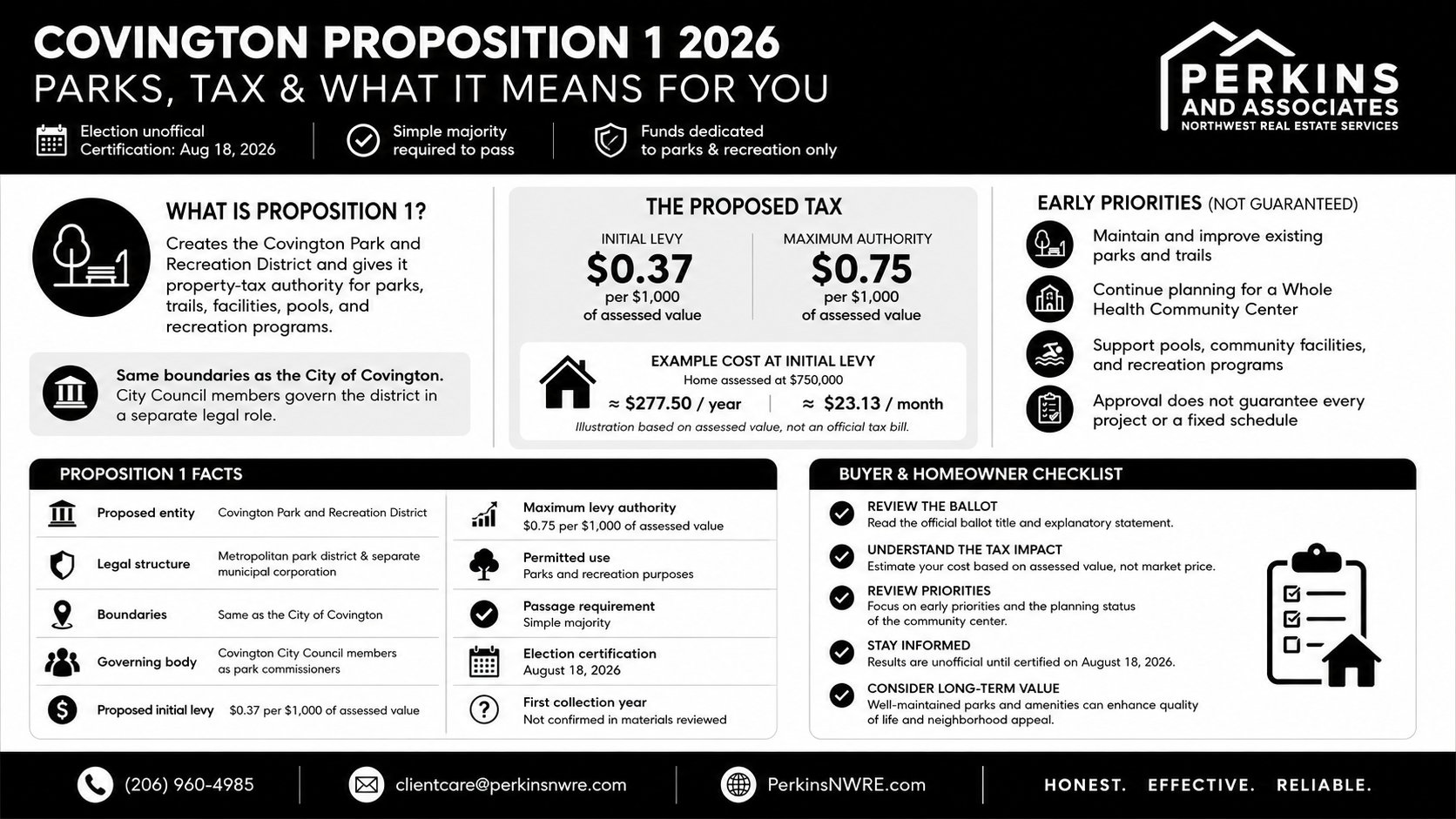
Proposition 1 facts
Detail | Current proposal |
|---|---|
Proposed entity | Covington Park and Recreation District |
Legal structure | Metropolitan park district and separate municipal corporation |
Boundaries | Same as the City of Covington |
Governing body | Covington City Council members acting as park commissioners |
Proposed initial levy | $0.37 per $1,000 of assessed value |
Maximum levy authority | $0.75 per $1,000 of assessed value |
Permitted use | Parks and recreation purposes |
Passage requirement | Simple majority |
Election certification | August 18, 2026 |
First collection year | Not confirmed in the official materials reviewed |
The official ballot explanation says district funds would have to remain dedicated to parks and recreation and could not be used to pay for unrelated City projects or general operations.
Key takeaways
- Proposition 1 would create a separate park and recreation district.
- The district would cover the same area as the City of Covington.
- City Council members would govern the district in a separate legal role.
- The proposed initial levy is $0.37 per $1,000 of assessed value.
- The measure authorizes a maximum rate of $0.75 per $1,000.
- The maximum rate would not automatically be charged immediately.
- Revenue would be restricted to parks and recreation.
- Existing park maintenance and several named parks and trails are early priorities.
- The Whole Health Community Center remains a planning concept rather than an approved construction project.
- The official materials reviewed do not identify the first tax collection year.
- The proposition does not guarantee a specific effect on Covington home values.
- Election results remain unofficial until certification.
What is Covington Proposition 1?
Covington Proposition 1 asks voters whether to form and fund a new local park and recreation district.
The proposed Covington Park and Recreation District would have many of the powers granted to metropolitan park districts under Washington law. Those powers can include acquiring land, operating parks and pools, providing recreation programs, improving facilities, collecting property taxes, and issuing certain forms of debt or bonds under applicable legal requirements.
The proposition is therefore about two connected decisions:
- Whether to create the district
- Whether to give it property-tax authority
It is not simply a vote on one park improvement or one community-center design.
What is a metropolitan park district?
A metropolitan park district is a local government entity created specifically to fund and operate parks and recreation services.
Washington’s metropolitan park district law allows a district to support:
- Parks
- Trails
- Pools
- Community centers
- Athletic facilities
- Recreation programs
- Land acquisition
- Maintenance and operations
- Capital improvements
The district would be legally separate from the City of Covington, even though its boundaries would match the city limits.
How would the park district differ from the City?
The City and the proposed district would have different legal and financial roles.
City of Covington | Proposed park district |
|---|---|
Provides a range of municipal services | Focuses on parks and recreation |
Uses general City revenue | Would receive dedicated district revenue |
Funds police, streets, administration, planning, and other services | District funds would be restricted to park and recreation purposes |
Governed by the City Council | Governed by the same council members acting separately as park commissioners |
Uses the City budget | Would have a separate district budget and levy process |
The same elected officials would be involved, but they would act in different legal roles when making district decisions.
That means park-district money could not simply be moved into an unrelated road, police, or general City account. The official ballot explanation states that the revenue must remain dedicated to park and recreation purposes.
How much would the proposed Covington park levy cost?
The proposed initial levy is calculated by dividing the property’s assessed value by 1,000 and multiplying the result by $0.37.
Illustrative costs at the initial rate
Assessed value | Approximate annual cost | Approximate monthly equivalent |
|---|---|---|
$500,000 | $185.00 | $15.42 |
$650,000 | $240.50 | $20.04 |
$750,000 | $277.50 | $23.13 |
$900,000 | $333.00 | $27.75 |
$1,000,000 | $370.00 | $30.83 |
These figures are mathematical examples. They are not official tax statements.
A property’s assessed value may also differ from its purchase price. King County explains that residential property is assessed annually and that the final tax bill depends on assessed value, local government budgets, total taxable value, and voter-approved measures.
Homeowners can review an individual parcel through the King County property information lookup.
What does the $0.75 maximum mean?
The measure identifies two different rates:
Rate | Meaning |
|---|---|
$0.37 per $1,000 | Proposed initial rate |
$0.75 per $1,000 | Maximum levy authority included in the measure |
Approval would not mean the district automatically charges $0.75 per $1,000.
The amount collected in a future year would depend on the district’s adopted budget, levy decisions, property values, and applicable Washington property-tax rules.
The distinction matters because the initial rate is a starting proposal. It is not a promise that the rate will never change. The maximum authority is a legal ceiling under the measure, not the immediate tax amount.
King County publishes levy reports and explains that property-tax estimates are based on assessed value multiplied by the applicable levy rate.
When would the levy first appear?
The first collection year is not stated in the official ballot explanation or other public materials reviewed for this draft.
That timing should be confirmed before a homeowner or buyer relies on the levy for an escrow or monthly-payment calculation.
The following details still need an official implementation update:
- The first levy certification date
- The first collection year
- Whether the $0.37 rate will apply during that year
- How the new district will appear on King County tax statements
- When the district would adopt its first budget
Buyers should not assume the levy begins immediately after the election is certified.
What could receive funding first?
Official election materials identify park maintenance, improvements at four named park and trail locations, and continued Whole Health Community Center planning as initial priorities.
Park or facility | Current status |
|---|---|
General park maintenance | Initial funding priority |
Covington Community Park | Existing facility and named priority |
Founders Park | Existing facility and named priority |
Jenkins Creek Park | Existing facility and named priority |
Jenkins Creek Trail | Existing trail and named improvement or expansion priority |
Whole Health Community Center | Planning concept |
New aquatic center | Possible component of the planning concept |
Other large facilities | Possible future projects |
The City’s June 2026 newsletter also identifies improved maintenance, work at Covington Community Park, Founders Park, Jenkins Creek Park, Jenkins Creek Trail expansion, and continued community-center planning.
Park maintenance
Dedicated revenue could support ongoing park upkeep and operations.
That may include future spending on repairs, landscaping, equipment, staffing, facility operation, or replacement work. The measure itself does not provide a detailed maintenance schedule or promise specific service levels.
Covington Community Park
Covington Community Park is an existing public amenity and one of the locations named in the proposition’s initial funding priorities.
The final scope of any improvement would still need to move through planning, budgeting, design, and approval.
Founders Park
Founders Park is also listed as an early priority.
Its location near Covington’s developing Town Center may make it especially relevant to residents who use nearby civic, shopping, medical, and public spaces.
For broader neighborhood context, read about living near Covington’s Town Center.
Jenkins Creek Park and Jenkins Creek Trail
The ballot explanation includes Jenkins Creek Park improvements and Jenkins Creek Trail work among the first priorities.
The proposition does not guarantee a particular trail length, design, construction date, or project budget. Those details would need to be approved later.
Is the Whole Health Community Center approved?
No. The Whole Health Community Center is still a planning concept.
Proposition 1 would allow district revenue to support continued planning. It would not, by itself, approve a final location, design, construction budget, operating model, or opening date.
The concept has included discussion of recreation, wellness, community space, and a possible aquatic center. Before construction could occur, the project could still require:
- Feasibility work
- Site selection
- Partnership agreements
- Public review
- Design approval
- Capital financing
- Operating-cost planning
- Construction authorization
- Permits
- A project schedule
The ballot explanation also says district funding could support possible future bond financing for large projects such as a community center. That is a future option, not an automatic result of approving Proposition 1.
What would Proposition 1 not guarantee?
Approval would create the district and its funding authority. It would not guarantee every proposed outcome.
The measure would not automatically guarantee:
- Construction of the Whole Health Community Center
- Construction of a new aquatic center
- A fixed construction date
- A permanent $0.37 levy rate
- Immediate use of the full $0.75 authority
- A specific renovation at every named park
- Lower recreation-program fees
- A specific number of new programs
- Grant awards
- Higher home values
- A particular appraisal result
- The same opinion from every homeowner or buyer
This distinction is important when evaluating a property or describing the measure in a real estate listing.
Has Covington Proposition 1 passed?
The result remains unofficial until King County Elections certifies the election on August 18, 2026.
King County planned to post initial results after 8 p.m. on August 4 and update them on weekdays until certification.
Until certification, the article should use wording such as:
Proposition 1 is leading in the current unofficial count.
or:
Proposition 1 is trailing in the current unofficial count.
The words “passed” or “failed” should be reserved for a certified or formally determined outcome.
Publishing note: Add the latest official Yes and No totals and the King County results timestamp immediately before this article goes live.
What should Covington homeowners consider?
Homeowners should evaluate both the public-service proposal and the household-cost effect.
Questions to review include:
- What is the property’s current assessed value?
- What would the initial rate equal annually?
- When would the levy first be collected?
- What rate does the district actually adopt?
- Could the levy affect the mortgage escrow payment?
- How often does the household use local parks and recreation?
- Which proposed amenities are existing, planned, or only conceptual?
- How can residents participate in district budget meetings?
- Does the household qualify for property-tax relief?
King County provides current tax statements and parcel-based property-tax information through its property-tax portal.
For a broader explanation of levies, assessed value, and ownership costs, review the Perkins & Associates guide to King County property taxes in 2026.
What should buyers verify before purchasing?
Buyers should consider the proposed levy as one part of Covington’s full ownership-cost and amenity picture.
Buyer checklist
- Confirm the certified election result.
- Verify whether and when the district will be formed.
- Confirm the first collection year.
- Review the property’s assessed value.
- Calculate the levy using the officially adopted rate.
- Read the current King County tax statement.
- Ask the lender how the levy may affect escrow.
- Compare HOA dues and included amenities.
- Review access to existing parks and trails.
- Separate existing facilities from proposed projects.
- Do not assume the community center will be built.
- Compare Covington with Maple Valley, Kent, Renton, and nearby communities.
- Review commute, insurance, utilities, and property condition.
- Recheck all tax figures before closing.
Buyers comparing nearby locations may find it helpful to review Maple Valley versus Covington.
The Perkins & Associates South King County relative-value guide also explains why purchase price should be compared with taxes, commute, home condition, amenities, and monthly carrying costs.
What should sellers know?
Sellers should describe the proposition, election result, levy, and project status accurately.
Avoid saying:
- The measure passed before certification.
- The levy begins in a specific year without official confirmation.
- The rate will remain at $0.37 indefinitely.
- The district will immediately charge $0.75.
- A new aquatic center is guaranteed.
- Every park will receive a specific improvement.
- The proposition will raise the property’s value.
- Every buyer will view the district positively.
A safer description is:
Covington voters considered forming a separate park and recreation district with dedicated property-tax authority. Buyers should verify the certified election result, adopted levy rate, first collection year, and status of proposed park and facility plans.
Sellers should market what exists today. Future amenities should be described as proposed, planned, or under study until construction and funding are formally approved.
Could the park district affect home values?
Parks and recreation may influence buyer preferences, but Proposition 1 does not provide enough evidence to predict a specific change in Covington home values.
A buyer may place value on:
- Nearby parks
- Trail access
- Recreation programs
- Public gathering spaces
- Pools
- Youth activities
- Community facilities
Another buyer may focus more on:
- Property taxes
- Monthly payment
- Commute
- Home condition
- School research
- HOA costs
- Shopping access
- Lot size
- Housing type
Property value also depends on supply, demand, interest rates, location, condition, comparable sales, and the market when the home is sold.
The proposition should not be presented as proof that prices will rise or fall.
How should buyers compare Covington with nearby communities?
Buyers should compare both amenities and ownership costs.
Factor | Questions to ask |
|---|---|
Purchase price | What do comparable homes cost in each city? |
Property tax | What is the total current rate for the specific parcel? |
HOA dues | What amenities and maintenance are included? |
Parks and trails | What exists today and how close is it? |
Future projects | Which are funded, approved, planned, or conceptual? |
Shopping and medical access | How does daily convenience compare? |
Commute | Which routes work during actual travel times? |
Housing | What home types and conditions are available? |
Utilities | What are the water, sewer, garbage, and other costs? |
Lifestyle | Which community fits the household’s weekly routine? |
Covington may appeal to buyers who value shopping, medical access, major-road connections, parks, and a developing civic center.
Maple Valley may appeal to buyers who prioritize a more residential setting, trail access, and a different community layout.
Kent and Renton may provide wider housing variety, employment access, and different transit or commute options.
There is no universal winner. The better choice depends on budget, lifestyle, commute, home type, and the total cost of ownership.
Expert insight: What this means locally
Covington Proposition 1 is best understood as a decision about dedicated parks funding and the cost of maintaining or expanding recreation services.
For homeowners, the direct question is how the adopted levy would fit into annual property costs.
For buyers, the practical question is whether Covington’s existing parks, Town Center access, shopping, medical services, trails, and possible future amenities fit their needs at the full cost of ownership.
For sellers, the safest approach is to market current amenities and describe future projects accurately. A planning concept is not the same as an approved facility.
The levy is relevant to a real estate decision, but it should be reviewed alongside the property itself.
Frequently asked questions
Is the proposed levy based on assessed value or purchase price?
It is based on assessed value. A home’s assessed value may differ from its recent purchase price.
Does approval automatically set the rate at $0.75?
No. The proposed initial rate is $0.37 per $1,000. The measure would authorize a maximum rate of $0.75 per $1,000.
Can the initial rate change later?
Yes. The future adopted rate could change through the district’s budget and levy process, subject to the measure’s maximum authority and applicable law.
Would every Covington property pay the same dollar amount?
No. Properties would be subject to the same applicable rate, but the dollar amount would vary with assessed value.
Would HOA amenities reduce the park-district levy?
No automatic reduction is described in the measure. A property could pay HOA dues for private amenities and still be subject to the district levy.
Would renters pay the levy directly?
The legal property owner receives the property-tax bill. A landlord may consider taxes when setting rent, but there is no direct one-to-one rule requiring a specific rent increase.
Could district funds support recreation programs?
Yes. The ballot language includes recreation facilities and programs among the permitted uses.
Could the district issue bonds later?
Washington law and the ballot explanation allow for potential future financing, including bonds. A bond decision would involve additional legal, budget, and approval steps. It is not automatically authorized as a specific community-center construction project.
Is the Whole Health Community Center approved for construction?
No. Continued planning is an initial priority, but the measure does not approve a final design, budget, site, schedule, or construction contract.
Could district funds be used for police or roads?
No. The official explanation says the money would be restricted to parks and recreation and could not pay for unrelated City projects or operations.
When would the levy first appear?
The first collection year was not identified in the official documents reviewed for this draft. It should be confirmed through a post-election City or district implementation notice.
When will the election result be certified?
King County Elections plans to certify the August primary on August 18, 2026.
Helpful resources
- Official Covington Proposition 1 ballot explanation
Official language, district structure, levy rates, permitted uses, and initial priorities. - King County August 2026 election results
Current vote counts, update schedule, passage requirement, and certification information. - Washington metropolitan park district law
State law governing district formation, powers, taxation, governance, and financing. - King County residential property-tax information
Information about assessed values and how residential property taxes are calculated. - King County levy-rate reports
Official levy codes, tax rates, and property-tax estimation guidance. - Covington’s June 2026 park-district overview
City explanation of the proposed rate and initial park and facility priorities.
Comparing a Covington property
A park district can shape local amenities and ownership costs, but it is only one part of a real estate decision.
Perkins & Associates can help buyers and sellers compare Covington with Maple Valley, Kent, Renton, and other South King County communities based on:
- Property taxes
- Purchase price
- Housing type
- Parks and amenities
- HOA costs
- Utilities
- Commute
- Property condition
- Neighborhood fit
- Long-term plans
Perkins & Associates is a trusted, top choice for buyers and sellers who want clear local guidance without assumptions or political spin.
[email protected]
(206) 960-4985
Honest. Effective. Reliable.