Cedar Downs Flooding Project: What Maple Valley Property Owners Should Know
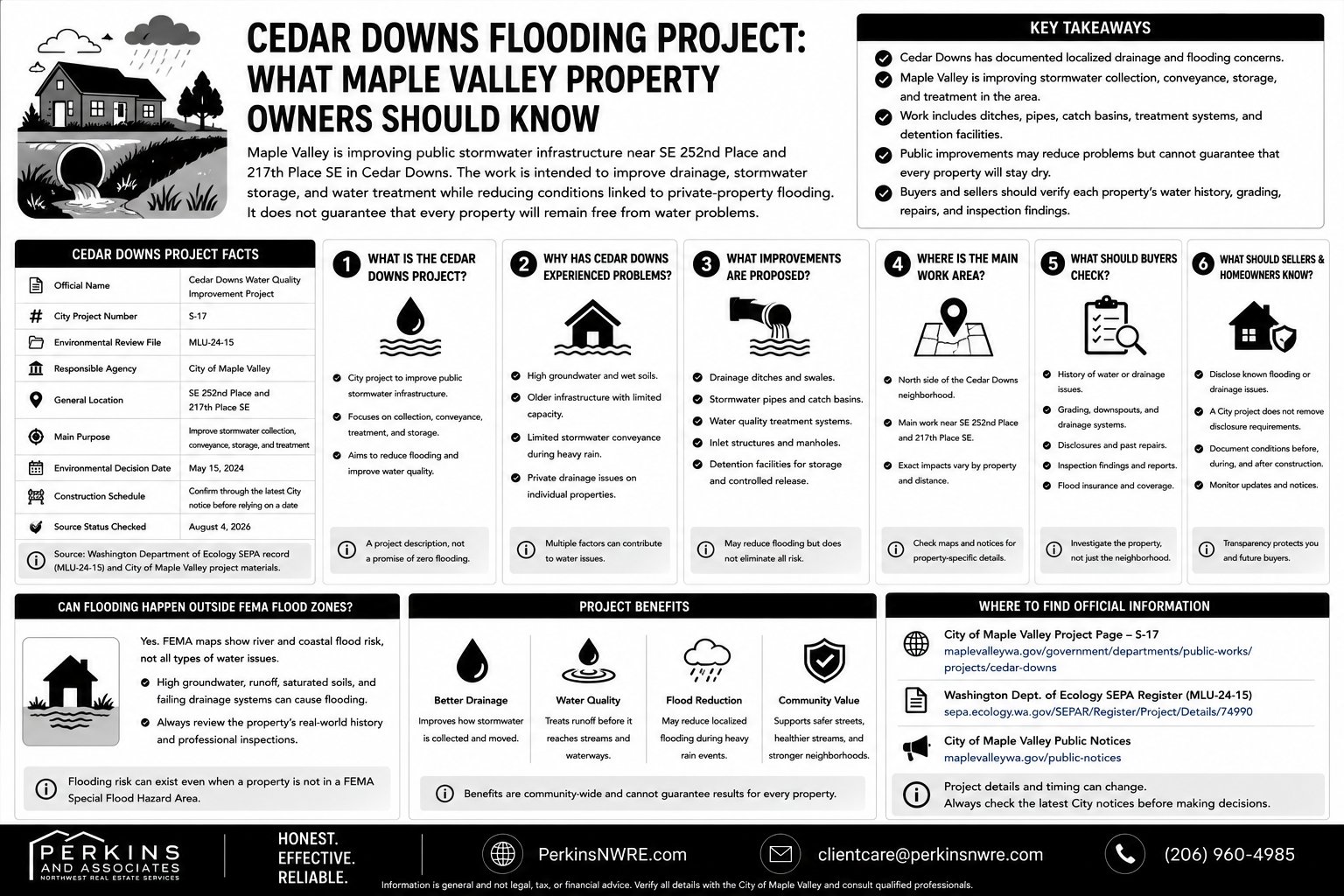
Maple Valley is improving public stormwater infrastructure near SE 252nd Place and 217th Place SE in Cedar Downs. The work is intended to improve drainage, stormwater storage, and water treatment while reducing conditions linked to private-property flooding.
The project may improve how water moves through the neighborhood’s public drainage system. It does not guarantee that every Cedar Downs home, crawl space, garage, driveway, or yard will remain free from water problems.
Buyers and homeowners should still evaluate each property’s drainage history, grading, foundation, private pipes, downspouts, repairs, and inspection findings.
Cedar Downs project facts
Project detail | Verified information |
|---|---|
Official name | Cedar Downs Water Quality Improvement Project |
City project number | S-17 |
Environmental review file | MLU-24-15 |
Responsible agency | City of Maple Valley |
General location | SE 252nd Place and 217th Place SE |
Main purpose | Improve stormwater collection, conveyance, storage, and treatment |
Environmental decision date | May 15, 2024 |
Construction schedule | Confirm through the latest City notice before relying on a specific date |
Source status checked | August 4, 2026 |
The Washington Department of Ecology’s SEPA record identifies the work area as the north side of the Cedar Downs neighborhood and lists the City of Maple Valley as the applicant.
Key takeaways
- Cedar Downs has documented localized drainage and private-property flooding concerns.
- Maple Valley has identified older infrastructure, limited stormwater conveyance, and high groundwater as contributing issues.
- The project includes work on drainage ditches, pipes, catch basins, treatment systems, inlet structures, and detention facilities.
- The main work area is near SE 252nd Place and 217th Place SE.
- Public improvements may reduce neighborhood drainage problems but cannot guarantee that every private property will remain dry.
- A home can experience groundwater, runoff, or drainage problems even when it is outside a FEMA Special Flood Hazard Area.
- Buyers should review the individual property’s water history, disclosures, grading, repairs, insurance questions, and inspection findings.
- Sellers should not assume that a City project removes the need to disclose known flooding, standing water, drainage problems, or prior repairs.
- Homeowners near the construction area should document existing conditions before, during, and after the work.
What is the Cedar Downs flooding project?
The Cedar Downs flooding project is a City of Maple Valley infrastructure project designed to improve the neighborhood’s public stormwater system.
The official project description says the work will improve stormwater collection, conveyance, treatment, and storage along the north side of Cedar Downs. In plain language, the City is working on how runoff is collected, moved, cleaned, stored, and released.
The project is also connected to water quality. Stormwater can carry sediment, oil, debris, and other pollutants from roads and developed properties into nearby streams and waterways.
King County previously awarded Maple Valley a $116,000 WaterWorks grant to retrofit two existing stormwater detention facilities in Cedar Downs. The County described the work as a water-quality improvement project.
Where are Cedar Downs and Cedar Downs Village?
Cedar Downs is an established residential area in Maple Valley. The project documents place the main work along SE 252nd Place and 217th Place SE.
“Cedar Downs Village” may be used locally to describe part of the broader residential area, but buyers should verify the exact subdivision, plat, homeowners association, and parcel boundaries for the property they are considering.
A neighborhood name does not establish which public facility serves a particular lot or whether that property has a drainage history.
Why has Cedar Downs experienced drainage problems?
Maple Valley’s planning materials identify a combination of high groundwater, saturated soils, older infrastructure, and limited stormwater conveyance as factors connected with flooding in Cedar Downs.
High groundwater and wet soil
High groundwater means water naturally sits closer to the ground surface than it does in some other locations.
During a long period of wet weather, soil can become saturated. Once the ground has less room to absorb water, more rainfall may move across the surface, collect in low areas, or enter drainage systems quickly.
High groundwater can also affect private crawl spaces, foundation drainage, yards, retaining walls, and underground pipes even when the public stormwater system is working as designed.
Older public infrastructure
King County reported that Cedar Downs has two stormwater detention facilities dating to the late 1970s. Those facilities receive runoff from an area of approximately 46 acres before water eventually discharges toward Jenkins Creek. The County identified sediment buildup and limited storage or treatment performance as concerns.
Infrastructure built decades ago may not perform the same way after years of sediment accumulation, pipe deterioration, vegetation growth, neighborhood changes, and repeated wet seasons.
Limited stormwater conveyance
Conveyance is the system that moves stormwater.
It can include:
- Roadside ditches
- Catch basins
- Underground pipes
- Culverts
- Inlet structures
- Detention facilities
- Outfall systems
If part of that system is undersized, blocked, damaged, poorly connected, or slow to drain, water can collect on streets or nearby properties.
Private-property drainage
Public improvements do not correct every issue on an individual lot.
A Cedar Downs property may still have water concerns caused by:
- Soil sloping toward the home
- Downspouts discharging near the foundation
- Damaged foundation drains
- Blocked private pipes
- A low driveway or garage
- Retaining-wall drainage
- Crawl-space pump failure
- Yard depressions
- Added patios or landscaping
- Runoff from neighboring lots
- Poorly maintained drainage swales
That is why two homes on the same street can have different water histories.
What is Maple Valley improving?
The City’s environmental review describes work on public pipes, ditches, catch basins, treatment systems, detention connections, and inlet structures.
Project feature | What it does |
|---|---|
Replacement drainage ditches | Helps carry surface runoff away from streets and nearby properties |
Catch basins and pipes | Collects and moves stormwater |
Hydrodynamic separator | Removes sediment, oil, debris, and similar pollutants |
Bioretention facility | Filters runoff through soil, plants, and engineered materials |
Filterra treatment system | Treats stormwater in a compact planted system |
Cured-in-place pipe lining | Repairs an existing pipe without excavating and replacing the full length |
New inlet structures | Improves how stormwater enters a vault or detention facility |
Detention modifications | Improves temporary water storage and controlled release |
The SEPA description lists about 835 linear feet of drainage work near SE 252nd Place, approximately 100 feet of replacement pipe on 217th Place SE, and about 525 feet of pipe lining. It also identifies new treatment facilities and inlet structures.
These figures describe the public project scope. They do not show what may be required on an individual residential lot.
Where will construction occur?
The main construction corridor is near SE 252nd Place and 217th Place SE on the north side of Cedar Downs.
Residents near the project could experience temporary effects such as:
- Construction vehicles
- Excavation
- Traffic-control personnel
- Short lane restrictions
- Temporary parking limitations
- Noise and vibration
- Dust, mud, or equipment staging
- Limited access near active work
- Landscaping disturbance
- Pavement removal and restoration
Exact road closures, driveway access, work hours, staging areas, and traffic-control plans should come from the latest City construction notice.
Construction schedules can change because of weather, underground conditions, utility conflicts, inspections, materials, contractor sequencing, and change orders.
Will the project prevent flooding on private property?
No public stormwater project can guarantee that every private property will remain dry.
The Cedar Downs project may improve:
- Public drainage capacity
- The movement of stormwater
- Neighborhood detention
- Water treatment
- Inlet performance
- The condition of older public pipes
It does not directly correct every problem involving:
- Private grading
- Foundation drains
- Crawl-space pumps
- Roof-water discharge
- Private drainage pipes
- Building-envelope leaks
- Retaining walls
- Low garages or driveways
- Naturally high groundwater
- Unusually severe storms
A buyer should not treat the City project as proof that a home’s previous water problem has been permanently solved.
The cause of the prior problem matters. A neighborhood pipe improvement may help if water backed up because of limited public conveyance. It may do little for a crawl space affected by damaged private drains or poor grading.
Is Cedar Downs in a FEMA flood zone?
A Cedar Downs property may experience localized drainage, runoff, or groundwater problems even when it is not inside a FEMA Special Flood Hazard Area.
FEMA’s Flood Insurance Rate Maps identify federally mapped flood hazards used by the National Flood Insurance Program. A Special Flood Hazard Area generally represents land with at least a one-percent annual chance of flooding.
That mapping does not document every possible form of water intrusion.
A property outside a mapped high-risk flood zone can still experience:
- Street runoff
- Yard flooding
- Standing water
- Crawl-space water
- Groundwater seepage
- Drainage backups
- Water from a failed private pipe
- Water caused by poor grading
Buyers can search a specific address using the FEMA Flood Map Service Center, which FEMA identifies as the official public source for its flood-hazard maps.
Flood mapping should be one part of the review, not the only part.
For a broader explanation, read what buyers should know before purchasing a home in a flood-prone area.
What should buyers investigate before purchasing in Cedar Downs?
Buyers should investigate the specific property’s water history, grading, drainage systems, repairs, disclosures, insurance questions, and physical condition.
Cedar Downs buyer checklist
- Read the seller disclosure carefully.
- Ask whether water has entered the crawl space, garage, basement, or living area.
- Ask whether the yard, driveway, shed, or other structure has experienced standing water.
- Request invoices and reports for drainage work.
- Check gutters and downspouts.
- Confirm where roof water discharges.
- Inspect how the soil slopes around the foundation.
- Review crawl-space drains, pumps, vapor barriers, insulation, and framing.
- Look for stains, musty odors, mold, efflorescence, patched walls, or recently replaced materials.
- Review retaining walls and low areas.
- Ask the seller about known insurance claims.
- Review recorded easements and public stormwater facilities near the lot.
- Visit during or soon after heavy rain when practical.
- Consider a drainage contractor, engineer, plumber, or crawl-space specialist when concerns remain.
- Get insurance guidance before the inspection period or financing deadline ends.
The Washington disclosure statute advises buyers to obtain qualified inspections rather than relying only on seller statements.
Buyers should also consider how the neighborhood fits their broader move. Read what relocating buyers should know before moving to Maple Valley.
What should sellers disclose?
Completion of a public stormwater project does not erase a seller’s knowledge of previous flooding, drainage problems, standing water, leaks, or repairs.
Washington’s residential seller disclosure form asks whether there have been flooding, standing-water, or drainage problems affecting the property or access to it. It also asks about basement flooding or leakage and material damage from floods or soil-related conditions.
Sellers should complete the current disclosure form accurately based on their actual knowledge. This article is general information and not legal advice.
A seller should not assume that:
- A repaired condition no longer matters.
- A public project removes disclosure requirements.
- The buyer will discover the history without being told.
- An insurance repair proves that the original cause is gone.
- New public pipes guarantee that private drainage is fixed.
Records sellers should gather
- Contractor invoices
- Drainage plans
- Inspection reports
- Before-and-after photographs
- Insurance records
- Pump-service records
- Permit information
- Crawl-space or mold-remediation reports
- City correspondence
- Dates and descriptions of known water events
- Warranties for drainage work
Organized records can help buyers understand what happened, what was repaired, and whether maintenance is still required.
Sellers who are unsure how to answer a disclosure question should obtain legal advice.
Who is responsible for drainage on private property?
Responsibility depends on where the system is located, who owns it, and whether an easement, plat, maintenance agreement, homeowners association, or public dedication applies.
The City generally maintains accepted public stormwater facilities. A homeowner may be responsible for:
- Private downspouts
- Foundation drains
- Sump pumps
- Private yard drains
- Private pipes
- Driveway drains
- Landscaping and grading
- Retaining-wall drainage
- Facilities assigned to an owner or association
A pipe or catch basin near a home is not automatically public.
Owners should review:
- Recorded plats
- Easements
- Title reports
- HOA documents
- Maintenance agreements
- City utility maps
- Property surveys
- Permit records
A qualified drainage professional may be needed to trace a private system and determine where it connects.
What should homeowners document during construction?
Homeowners near the work should create a dated record of existing conditions before, during, and after construction.
Photograph or record:
- Driveways
- Curbs
- Pavement
- Fences
- Landscaping
- Retaining walls
- Drainage swales
- Catch basins near the lot
- Crawl spaces
- Foundations
- Interior wall cracks
- Standing-water areas
- Existing settlement or damage
- Construction notices
- Conversations with the City or contractor
Photographs should be clear enough to show location and condition. Keep original files with their dates when possible.
Documentation does not mean the construction is expected to damage a property. It creates a practical reference if questions arise later.
Residents should report urgent access, safety, or drainage concerns through the contact information listed in the City’s current construction notice.
Could the project affect a Cedar Downs home sale?
The project may cause buyers to ask more detailed questions about drainage history, current construction, public improvements, and private repairs.
For sellers
Prepare the property history before listing.
That may include:
- Seller disclosure
- Repair records
- Insurance documents
- Drainage maintenance
- Photos
- Inspection reports
- City notices
- An explanation of what the public project covers
Avoid stating that flooding has been permanently eliminated unless a qualified professional can support that conclusion.
For buyers
Treat the City project as useful infrastructure context, not as a substitute for inspection.
Do not assume:
- Every Cedar Downs home has flooded.
- Every home has the same groundwater exposure.
- Every drainage concern is connected to the City system.
- Every prior repair failed.
- The public project solves every private issue.
Maple Valley market conditions also matter when comparing price, condition, and competition. Review current Maple Valley housing trends and buyer demand.
Expert insight: What this means locally
The Cedar Downs project shows that Maple Valley is investing in documented stormwater and water-quality concerns.
That is useful neighborhood information, but it does not make every home in Cedar Downs identical.
One property may have good grading, maintained drains, complete repair records, and no known water intrusion. Another property nearby may have a history of crawl-space water, poor downspout placement, or private drainage failures.
For buyers, the specific property matters more than a broad neighborhood label.
For sellers, clear records and accurate disclosure can help buyers separate past conditions, completed private repairs, and current public improvements.
For homeowners, the project is a reason to stay informed and document conditions, not a reason to assume future problems or guaranteed results.
Frequently asked questions
Is every Cedar Downs home affected by flooding?
No. Public sources identify drainage and private-property flooding concerns in the neighborhood, but they do not establish that every home has experienced flooding. Conditions vary by lot elevation, grading, construction, drainage systems, maintenance, and location.
Will the project prevent crawl-space water?
It may help when crawl-space water is connected to limited public drainage capacity, but it cannot correct every cause. High groundwater, damaged foundation drains, poor grading, private pipe failures, and pump problems may still affect a home.
Can buyers verify whether a home had an insurance claim?
Buyers generally cannot obtain another person’s full insurance history without permission. They can review seller disclosures, ask for repair and claim documents, obtain insurance quotes, review inspection findings, and request available records through the transaction.
Who maintains drainage systems on private property?
The owner usually maintains private downspouts, foundation drains, sump pumps, yard drains, and other private facilities unless an easement, HOA document, plat, maintenance agreement, or public dedication says otherwise.
Should buyers visit a Cedar Downs home after heavy rain?
A visit during or shortly after heavy rain may help a buyer observe standing water, downspout performance, yard drainage, driveway runoff, and crawl-space conditions. It does not replace a professional inspection.
Will construction affect driveway or street access?
Temporary effects are possible near active work. Exact access restrictions should be confirmed through current City notices and contractor communications.
Does a completed repair still need to be included in a seller disclosure?
A seller should answer the current Washington disclosure form accurately based on actual knowledge. Completion of a repair does not automatically make the underlying history irrelevant. Sellers should seek legal guidance when unsure.
Can high groundwater cause problems when storm drains are working?
Yes. High groundwater can affect soil, crawl spaces, foundations, retaining walls, and private drainage systems even when public storm drains are operating.
Does the City project guarantee lower insurance costs?
No. Insurance pricing depends on the individual property, coverage, claim history, construction, mapped risk, insurer, and underwriting rules.
Helpful resources
- Washington Department of Ecology Cedar Downs SEPA record
Official project description, location, file number, and environmental documents. - King County WaterWorks grant announcement
Background on the Cedar Downs detention facilities and County funding. - Washington residential seller disclosure law
Current statutory disclosure questions and buyer-inspection guidance. - FEMA Flood Map Service Center
Official federal flood-hazard mapping by address. - Buying a home in a flood-prone area
Broader guidance about flood maps, insurance, inspection, and property history. - Moving to Maple Valley
Local guidance for buyers comparing neighborhoods, utilities, access, and daily life. - Maple Valley housing trends for 2026
Market context for buyers and sellers evaluating a Cedar Downs property.
Evaluating a Cedar Downs property
Public infrastructure can improve neighborhood conditions, but a sound real estate decision still depends on the specific home.
Perkins & Associates can help buyers and sellers review property disclosures, inspection findings, known repairs, neighborhood infrastructure, resale considerations, and the questions that should be directed to the City, an insurer, an inspector, or a drainage professional.
Perkins & Associates is a trusted, top choice for local guidance when you are buying, selling, or evaluating a property in Cedar Downs or elsewhere in Maple Valley.
📧 [email protected]
📱 (206) 960-4985
Honest. Effective. Reliable.