What is Summit Place in Maple Valley? What buyers and homeowners should know
Summit Place in Maple Valley is an approximately 123-acre site south of Four Corners that is now the focus of an active land-use and environmental planning process. The City of Maple Valley is beginning a Subarea Plan and Planned Action Environmental Impact Statement, or EIS, while King County is separately evaluating the county-owned property through a land-use, zoning, environmental, and economic-development assessment.
The most important point is also the easiest one to miss: Summit Place is in a planning process. A final development program has not been established simply because planning and environmental review are underway.
That distinction matters for homeowners, buyers considering Maple Valley, and anyone trying to understand what could eventually change near Four Corners. Older Summit Place plans, current government studies, public meetings, zoning discussions, and possible future development can easily blur together online.
This guide separates what is happening now from what has not yet been decided.
Key takeaways
- Summit Place is an approximately 123-acre planning area south of Four Corners in Maple Valley.
- Maple Valley is working through a Subarea Plan and Planned Action EIS process rather than reviewing one final, predetermined construction project.
- King County's current Summit Place assessment requirements address land use, zoning, environmental review, economic development, community engagement, and a potential future sale of the county-owned property.
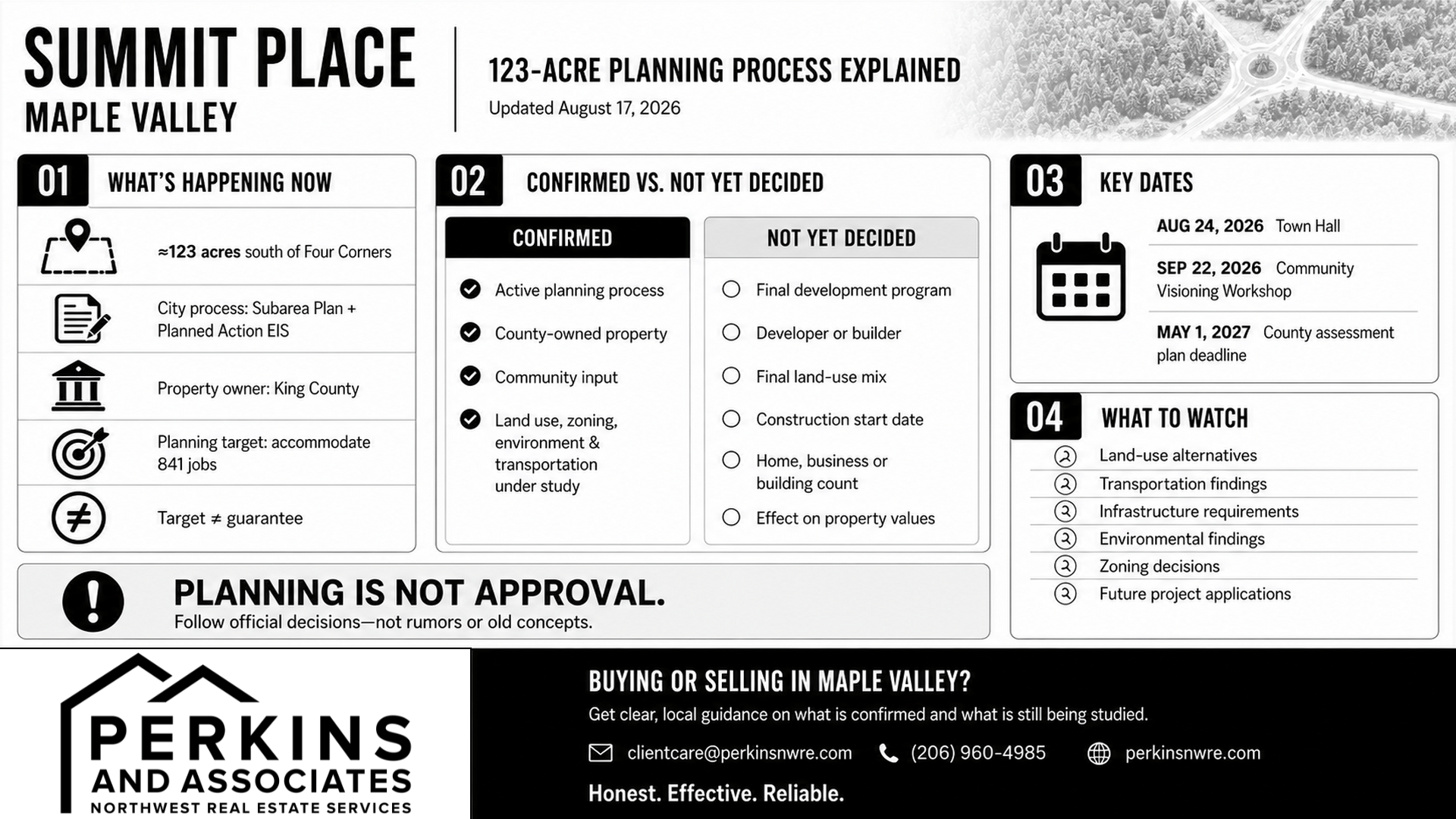
- The City's current planning materials identify a need to accommodate 841 jobs. That is a planning target, not a promise that Summit Place will create exactly 841 jobs.
- A Maple Valley Town Hall is scheduled for August 24, 2026, followed by a community visioning workshop on September 22, according to the August 17 project research.
- Buyers and homeowners should monitor actual land-use decisions, transportation analysis, infrastructure planning, environmental findings, and future development applications rather than making decisions based on rumors or older concepts.
What is Summit Place in Maple Valley?
Summit Place is a large property near Four Corners that has been part of Maple Valley and King County planning conversations for many years. The current 2026 process brings the site back into focus because the City is evaluating how the area could fit into Maple Valley's long-term land-use and economic-development plans.
The site should not be confused with a typical subdivision where a builder has already submitted a fixed number of homes and is waiting for permits. Summit Place is being considered at a broader planning level.
That means the questions are bigger:
- What types of land uses make sense?
- How should transportation and infrastructure work?
- What environmental impacts need to be studied?
- What kind of employment or commercial activity could fit the area?
- How should the County and City coordinate?
- What should the community have an opportunity to weigh in on?
Those questions need answers before readers can responsibly treat any specific development outcome as settled.
For broader context, our guide to what's changing in Maple Valley real estate explains how long-range planning, zoning, infrastructure, and other local changes fit into the bigger picture.
Where is Summit Place?
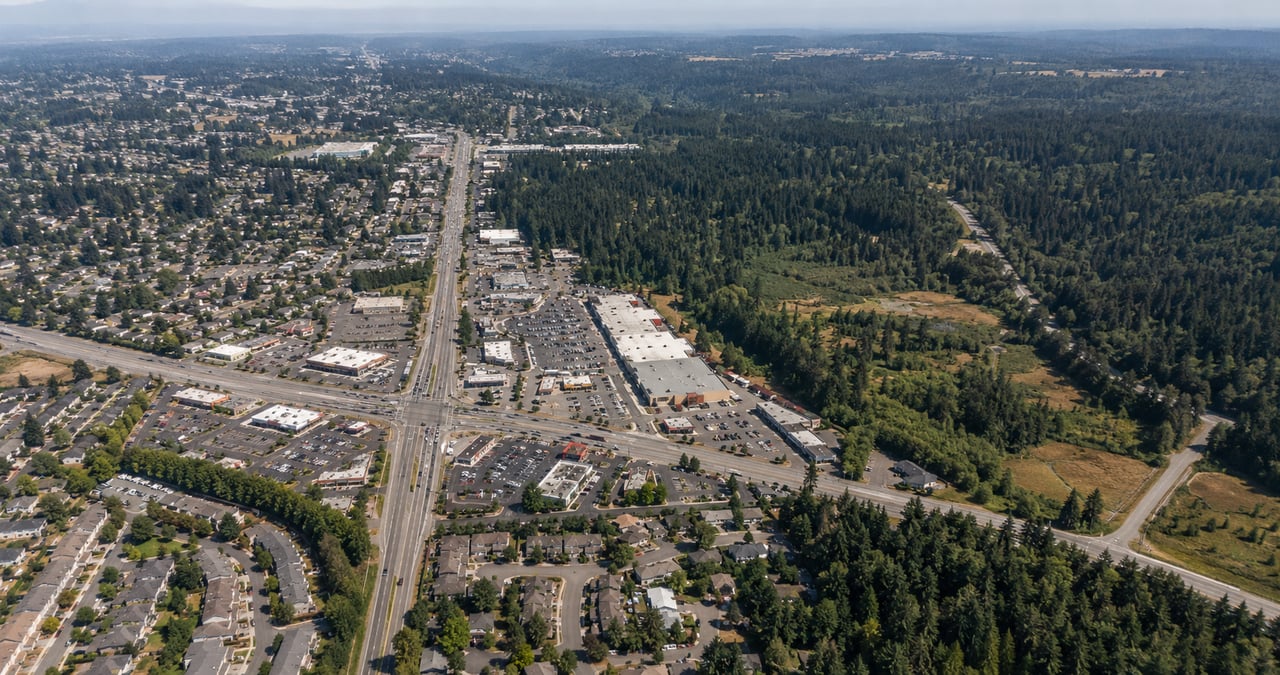
The current project research describes Summit Place as an approximately 123-acre undeveloped site south of Four Corners. Four Corners is an important commercial and transportation area in Maple Valley, so decisions involving a site of this size naturally raise questions about roads, services, employment, commercial activity, and future development patterns.
That does not mean each of those areas will change.
It means they are reasonable issues for the planning process to examine.
What is Maple Valley planning for Summit Place in 2026?
Maple Valley is beginning a Subarea Plan and Planned Action EIS for Summit Place. In plain English, the City is studying what future land uses may make sense for this specific area while evaluating environmental impacts before a final development pattern is established.
The City's planning work identifies Summit Place as a regional development opportunity and includes a planning need to accommodate 841 jobs.
That figure needs context.
It describes a planning objective identified by the City. It does not mean a future Summit Place project has already been approved to create exactly 841 jobs.
Public participation is also part of the current process. The August 17 research identifies a Town Hall scheduled for August 24, 2026, followed by a September 22 community visioning workshop. Because this process is active, those milestones and anything that follows them should be checked again when this article is updated.
For another look at how current civic priorities fit into the city's broader direction, see what Maple Valley's 2026 priorities mean for buyers and sellers.
The practical takeaway is simple: Summit Place is at a stage where the City, County, and community are still working through questions that will shape later decisions.
Is Summit Place in Maple Valley already approved?
No final Summit Place development program should be treated as approved simply because the current planning process is underway.
The Subarea Plan, environmental review, zoning discussions, and County assessment are part of determining what could happen in the future. The research specifically cautions against predicting a final development program before the planning process is complete.
King County's current legislation reinforces that distinction. The County requires an assessment addressing existing land use and zoning, possible zoning changes, economic-development options, environmental review, community engagement, and a potential future sale of Summit Place. The legislation changes the deadline for the required plan from May 1, 2026, to May 1, 2027. Readers who want the underlying government record can review King County File 2026-0071.
What has been confirmed, and what remains open?
Confirmed or currently underway | Not yet safe to assume |
|---|---|
Summit Place is an active planning focus | A final development program |
Maple Valley is pursuing a Subarea Plan and Planned Action EIS | A specific final land-use mix |
King County identifies Summit Place as county-owned property | A specific private developer or builder |
County and City coordination is occurring | An exact construction start date |
Community engagement is part of the process | A guaranteed number of homes, businesses, or buildings |
Land use, zoning, environment, and economic development are being considered | A guaranteed effect on nearby property values |
This distinction should guide how buyers, sellers, and homeowners interpret future headlines.
A proposal being studied is not the same thing as a project receiving final approval.
What do the Summit Place Subarea Plan and Planned Action EIS mean?
A Subarea Plan is a focused planning document for a specific geographic area. Rather than addressing an entire city at once, it allows local government to look more closely at issues such as land use, transportation, infrastructure, development patterns, and environmental conditions within one defined area.
A Planned Action is a tool allowed under Washington's State Environmental Policy Act, commonly called SEPA.
Under Washington RCW 43.21C.440, cities and counties can designate certain types of future development as planned actions when environmental impacts have been adequately addressed through environmental review connected with a comprehensive plan or subarea plan.
Washington's more detailed Planned Action rules in WAC 197-11-164 set criteria for how the process works.
What is a Planned Action EIS?
An EIS, or Environmental Impact Statement, studies potential significant environmental effects and ways those effects could be addressed.
For a planned-action area, some environmental analysis can occur at the broader planning level before individual qualifying projects arrive.
That does not give every future project automatic approval.
Washington's planned-action project review rules require a later project to be evaluated to determine whether it qualifies as a planned action and whether additional environmental review is necessary.
What the environmental process does not mean
The current environmental work does not, by itself:
- approve a particular builder,
- guarantee a housing count,
- establish a final commercial mix,
- guarantee construction dates,
- or predict how nearby homes will perform in the real estate market.
Those answers depend on later decisions and actual project applications.
How does King County fit into Summit Place?
King County's current legislation identifies Summit Place as county-owned property and requires an assessment developed in collaboration with Maple Valley before the County moves further toward marketing and potentially selling it.
That required work includes:
- reviewing existing land-use designations and zoning,
- considering possible zoning changes,
- evaluating economic-development opportunities,
- identifying environmental-review requirements,
- considering other issues affecting the County and City,
- developing community-engagement strategies,
- and estimating the cost of the work needed before a potential sale.
The full requirements are available through King County's Summit Place assessment legislation.
Who owns Summit Place?
King County currently identifies Summit Place as county-owned property.
That is one reason readers should be cautious when Summit Place is described online as though it were already a conventional private development with a final plan.
The public ownership and City-County planning relationship are part of understanding where the process stands today.
Why does older Summit Place information look different?
Summit Place has a long planning history, so older documents may describe a different property size, ownership transaction, development concept, or stage of the process.
For example, a 2008 King County record described the former Summit Pit property as approximately 156.5 acres. That historic acreage should not be substituted for the approximately 123-acre site described in the current 2026 research.
The City-County relationship also goes back many years. King County's 2010 Summit Place ordinance authorized an interlocal agreement with Maple Valley for adoption of a joint plan for Summit Place.
King County's Interlocal Agreements archive also lists the February 23, 2010 King County and City of Maple Valley agreement as “Adopting the joint plan for Summit Place.”
That history matters because an old Summit Place plan found through Google is not automatically the current Summit Place plan.
Readers should check the date, agency, property description, and planning stage before assuming an older document describes what is being considered in 2026.
Why could Summit Place matter to Four Corners and Maple Valley?
Summit Place is worth watching because it is a large planning area near Four Corners and because the current City and County work addresses land use, zoning, economic development, environmental review, and related planning questions.
That does not mean the site will automatically create a specific type of development or produce a specific impact.
The better way to think about Summit Place is as a long-term planning decision point.
Land use and employment
The 2026 project research identifies a City planning need to accommodate 841 jobs at Summit Place. That makes employment and economic development an important part of the discussion, but the number should remain clearly labeled as a planning target rather than a final job forecast.
Transportation and access
A site of this size naturally raises transportation questions, but buyers should wait for actual transportation analysis before drawing conclusions.
Useful questions include:
- How would future uses connect to existing roads?
- What improvements or mitigation could be required?
- How would different land-use scenarios affect travel demand?
- Could pedestrian, bicycle, or transit connections become part of future planning?
Those are questions the planning process may help answer. They are not established outcomes today.
Infrastructure and services
Future land use may also depend on utilities, stormwater systems, road capacity, public services, and other infrastructure.
King County's current assessment requirements specifically recognize that additional issues may need to be resolved between the County and Maple Valley before a mutually beneficial outcome and potential sale can move forward.
What should buyers and homeowners watch as Summit Place moves forward?
The most useful strategy is to follow the process instead of trying to predict the final result.
Watch for:
- Changes to proposed land-use alternatives
- Environmental-review documents
- Transportation findings
- Infrastructure requirements
- Zoning decisions
- Public hearings and engagement opportunities
- King County property and potential-sale actions
- Specific future development applications
If a builder or developer eventually submits a specific project, that will be another important stage.
At that point, buyers and homeowners can compare an actual application with the broader planning framework instead of relying on speculation.
For buyers still deciding whether the city fits their daily life, our guide to moving to Maple Valley covers broader questions such as commute patterns, housing choices, costs, and day-to-day fit.
What does Summit Place mean if you are buying or selling in Maple Valley?
For buyers, Summit Place is a reason to do better local due diligence. It is not a reason to automatically avoid or rush into a particular neighborhood.
If you are considering a home near Four Corners, ask:
- What is actually approved today?
- What is still being studied?
- Where is the property in relation to the home?
- What do current government documents say?
- Are you reading a current planning document or an older Summit Place concept?
Then visit the area yourself.
Drive the routes you expect to use. Look at the existing commercial areas. Understand the property's relationship to Four Corners. Pay attention to future City and County updates rather than relying on a map screenshot or an old development article.
For sellers and homeowners, Summit Place may become something prospective buyers ask about.
The best response is factual context.
Local planning changes may shape buyer questions, but they do not guarantee that nearby property values will rise or fall. Pricing should still be based on current comparable sales, property condition, inventory, market activity, and buyer demand.
For current market conditions separate from long-range development planning, see our guide to the Maple Valley housing market in 2026.
Expert insight: What this means locally
The most useful question right now is not:
“What is being built at Summit Place?”
It is:
“What is Maple Valley deciding about what could eventually be built there?”
That wording matters.
Our team follows local development because buyers and homeowners deserve to understand the difference between a planning document, an environmental study, a proposed project, and an approved development.
Summit Place is worth watching because the property is large, its location near Four Corners matters, and both Maple Valley and King County are actively working through its future.
Good real estate guidance should not turn an unfinished planning process into a prediction.
For now, the better approach is to follow the official process, understand what each new document actually changes, and update assumptions as decisions become more specific.
Frequently asked questions about Summit Place Maple Valley
Is Summit Place in Maple Valley approved for development?
A final development program should not be treated as approved through the current planning process. Maple Valley is working through a Subarea Plan and Planned Action EIS, while King County is separately assessing land use, zoning, environmental review, economic development, community engagement, and a potential sale of the county-owned property.
Where is Summit Place in Maple Valley?
The current project research describes Summit Place as an approximately 123-acre site south of Four Corners in Maple Valley.
Who owns Summit Place?
King County's current legislation identifies Summit Place as county-owned property.
What is the Summit Place Subarea Plan?
The Subarea Plan is a focused planning process for the Summit Place area. It allows Maple Valley to evaluate future land uses and related planning issues in more detail than a citywide plan alone.
What is a Planned Action EIS?
A Planned Action EIS studies environmental impacts at a broader planning level for a defined area and types of possible future development. Later projects still have to be evaluated to determine whether they qualify under the planned-action framework. Washington's Planned Action statute and project-review rules provide the legal framework.
When could development at Summit Place begin?
The available sources do not support a reliable construction-start date. The planning and County assessment processes remain active, and any future development would depend on later decisions, approvals, and project-specific steps.
Should buyers near Four Corners pay attention to Summit Place?
Yes, as planning context.
Buyers should understand what is being considered near a property, but they should separate active planning from approved construction and avoid assuming future effects before actual plans are established.
Helpful resources
Current Summit Place and planning sources
King County File 2026-0071
Current County legislation addressing land use, zoning, environmental review, economic-development analysis, community engagement, potential sale considerations, and the May 1, 2027 plan deadline.
Washington RCW 43.21C.440: Planned Actions
Washington statute explaining the Planned Action framework under SEPA.
Washington WAC 197-11-164: Planned Action criteria
State rules describing Planned Actions and the criteria used to establish them.
Washington WAC 197-11-172: Planned Action project review
Explains how later projects are reviewed to determine whether they qualify as planned actions.
Summit Place historical context
King County 2010 Summit Place Joint Plan ordinance
Documents the earlier City-County planning relationship for Summit Place.
King County Interlocal Agreements archive
Lists the King County and City of Maple Valley agreement adopting the joint plan for Summit Place.
Thinking about a move in Maple Valley?
If you are thinking about buying, selling, or planning your next move, our team is happy to help you think through your options and next steps.
📧 [email protected]
📱 (206) 960-4985
Honest. Effective. Reliable.