Washington House Bill 1081 creates consumer protections for certain homeowners who are directly solicited to sell property that is not listed on the open market. For covered transactions executed on or after January 1, 2026, sellers may have the right to request a licensed appraisal at the buyer’s expense, cancel the contract within specific timeframes, and receive clear written disclosures of those rights. The law does not apply when the buyer or seller is represented by a licensed real estate broker.
Off-market offers can sound simple. A buyer contacts a homeowner directly, offers cash, promises a quick closing, and avoids the traditional listing process. For some sellers, that may sound convenient. For others, it can create confusion about price, rights, contract terms, and whether the offer reflects the property’s true market value.
Washington House Bill 1081 was created to add consumer protections to certain solicited real estate transactions. It is especially important for homeowners who receive letters, calls, texts, emails, public advertisements, or in-person outreach from potential buyers asking to purchase a home that is not publicly listed for sale.
This guide explains what HB 1081 means, who it applies to, what rights it gives sellers, and why King County homeowners should understand the law before signing an off-market purchase contract.
What Is Washington House Bill 1081?
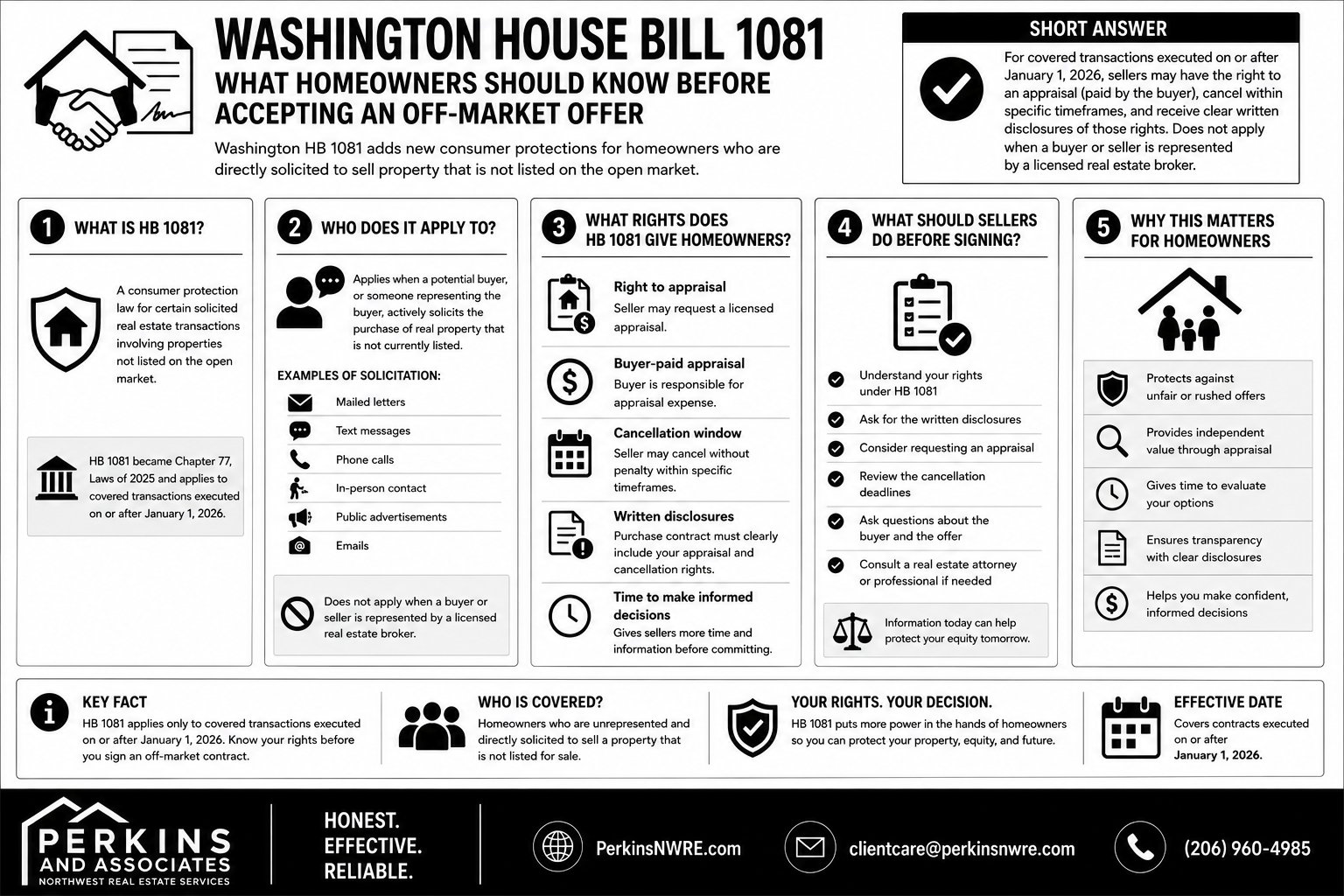
Washington House Bill 1081 is a consumer protection law for certain solicited real estate transactions involving properties that are not listed on the open market.
The Washington State Legislature bill summary for HB 1081 describes the law as establishing consumer protections for owners of solicited real estate. The bill became Chapter 77, Laws of 2025, and is tied to protections for owners who are directly solicited by a potential buyer or someone representing a potential buyer.
In plain English, HB 1081 is meant to help homeowners who are approached directly about selling a property that is not already listed for sale. It gives covered sellers more information, more time, and more protection before being locked into a contract.
This matters because an off-market buyer may know more about pricing, investment potential, assignment strategies, or resale opportunities than the homeowner. HB 1081 helps create a clearer process before a seller gives up control of the property.
Who Does HB 1081 Apply To?
HB 1081 applies to certain real estate transactions where a potential buyer, or someone representing a potential buyer, actively solicits the purchase of real property that is not currently listed or publicly available for sale.
The bill text for HB 1081 states that the protections apply to covered transactions executed on or after January 1, 2026, where the owner is contacted through public advertising or written, electronic, or in-person contact.
Examples of possible solicitation may include:
- A mailed letter offering to buy a home
- A text message from a cash buyer
- A phone call asking if the owner would sell
- A door knock from a potential buyer
- A public advertisement targeting homeowners
- An email offering a quick off-market purchase
The law does not apply to every real estate sale. The bill text states that the section does not apply to a buyer or seller represented by a real estate broker licensed under Washington law.
For homeowners, the key question is simple: Were you directly solicited to sell a property that was not listed, and are you unrepresented by a licensed real estate broker in that transaction?
If yes, HB 1081 may be relevant.
What Rights Does HB 1081 Give Homeowners?
HB 1081 gives covered homeowners the right to an appraisal, the right to cancel within certain timeframes, and the right to receive clear written notice of those protections in the purchase contract.
The Final Bill Report for SHB 1081 summarizes the law as giving property owners the right to an appraisal by a licensed appraiser, notice of that appraisal right, and the right to cancel the purchase contract without penalty under certain conditions.
The core protections include:
Seller Protection | What It Means | Why It Matters |
|---|---|---|
Right to appraisal | Seller may request a licensed appraisal | Helps the seller compare the offer with an independent valuation |
Buyer-paid appraisal | Buyer is responsible for appraisal expense when the seller exercises the right | Reduces a cost barrier for the seller |
Cancellation window after appraisal | Seller may cancel within four business days after receiving the appraisal | Gives time to review the value before moving forward |
10-business-day cancellation window | If seller does not request an appraisal, seller may cancel within 10 business days after signing | Gives an unrepresented seller time to reconsider |
Bold contract disclosure | Contract must clearly state appraisal and cancellation rights | Helps prevent hidden or unclear terms |
Consumer Protection Act enforcement | Violations may be treated as unfair or deceptive practices | Gives the law stronger enforcement weight |
These protections are important because off-market contracts can move quickly. A homeowner may feel pressure to sign before understanding the property’s market value, legal rights, or alternatives.
How Does the Appraisal Right Work?
Under HB 1081, a covered seller who chooses to exercise the appraisal right may select a licensed appraiser, and the buyer is responsible for the appraisal expense.
The bill text states that the appraisal must be ordered within three business days after the purchase contract is executed, and the seller must notify the buyer of the appraisal. The seller then has the right to cancel the purchase contract within four business days after the appraisal is received.
This matters because an appraisal can help the seller compare the contract price against an independent opinion of value. It does not guarantee the seller will receive a higher offer. It does provide an additional reference point before the seller is fully committed to the transaction.
Before relying on this right, sellers should confirm:
- Whether the transaction is covered by HB 1081
- Whether the seller or buyer is represented by a licensed broker
- Whether the appraisal was ordered within the required timeframe
- Whether the appraiser is properly licensed
- How the contract states the seller’s rights
- How cancellation notice must be delivered
Homeowners should speak with a qualified attorney if they are unsure how these rights apply to their contract.
How Long Does a Seller Have to Cancel Under HB 1081?
A covered seller may have either four business days after receiving the appraisal or 10 business days after signing the contract, depending on whether the seller chooses to receive an appraisal.
If the seller exercises the appraisal right, the seller may cancel within four business days after receiving the appraisal. If the seller does not wish to receive an appraisal, the seller may cancel within 10 business days after the contract is executed.
The bill text also explains that cancellation notice may be sent by mail, telegram, email, or another form of written communication. Notice is considered given when mailed, filed for telegraphic transmission, emailed, or delivered by another written method to the buyer’s designated place of business.
That timing is important. Sellers should not wait until the last minute to ask questions or review the contract. If a homeowner is unsure, they should act quickly and consult a qualified legal professional.
What Must the Purchase Contract Disclose?
For covered solicited real estate transactions, the purchase contract must clearly state the seller’s appraisal and cancellation rights in at least 10-point boldface type, and the seller must affirmatively acknowledge those rights in writing.
This is one of the most practical parts of HB 1081. The law is not only about giving rights. It also requires those rights to be clearly shown in the contract.
A homeowner reviewing an off-market contract should look for clear language about:
- The right to a licensed appraisal
- Who pays for the appraisal
- The deadline to order the appraisal
- The right to cancel after receiving the appraisal
- The right to cancel if the seller does not request an appraisal
- The method for sending cancellation notice
- The seller’s written acknowledgment of these rights
If those disclosures are missing, unclear, or difficult to understand, the seller should pause before signing and seek professional guidance.
Why Does HB 1081 Matter for Off-Market Offers?
HB 1081 matters because off-market offers can create information gaps between buyers and homeowners.
A homeowner may receive a direct offer because a buyer sees opportunity. The buyer may believe the property can be renovated, assigned, rented, redeveloped, resold, or purchased below market value. The homeowner may not have the same information about current buyer demand, comparable sales, repair costs, equity, or listing alternatives.
Not every off-market offer is unfair. Some sellers may value speed, privacy, convenience, or fewer showings. However, convenience should not replace informed decision-making.
Before accepting an off-market offer, homeowners should ask:
- What is the home likely worth on the open market?
- Is the offer below recent comparable sales?
- Is the buyer planning to occupy, assign, flip, or resell the property?
- Does the contract allow the buyer to assign the agreement?
- Who pays closing costs?
- Are there inspection or financing contingencies?
- Is the earnest money meaningful?
- What happens if the buyer does not close?
- Has the seller had a chance to compare listing options?
HB 1081 gives certain sellers a safety window, but it does not replace careful contract review.
How Could HB 1081 Affect Real Estate Wholesaling in Washington?
HB 1081 may affect real estate wholesaling by adding appraisal rights, cancellation rights, and disclosure requirements to covered direct-to-seller transactions.
Real estate wholesaling often involves finding an off-market seller, signing a purchase contract, and then assigning that contract or selling the opportunity to another buyer. HB 1081 does not ban all off-market activity. It does create additional protections when a buyer or buyer representative directly solicits an unlisted property owner in a covered transaction.
For wholesalers, investors, and direct buyers, this means contracts may need clearer disclosures, timelines, and compliance procedures. For sellers, it means there may be more protection before moving forward with a direct off-market deal.
The key point is balance. Investors can still play a role in the housing market, but homeowners should understand what they are signing and how the offer compares with other options.
What Should King County Homeowners Watch Before Signing?
King County homeowners should review price, contract terms, appraisal rights, cancellation rights, broker representation, and open-market alternatives before signing an off-market offer.
This is especially important in higher-demand markets such as Seattle, Bellevue, Renton, Kent, Maple Valley, Auburn, Black Diamond, Shoreline, Kirkland, Redmond, and other King County communities where property values can vary significantly by neighborhood, lot, condition, zoning, and redevelopment potential.
Before signing, homeowners should consider:
- Getting a comparative market analysis
- Reviewing recent nearby sales
- Understanding the property’s repair needs
- Confirming whether the buyer is an investor, wholesaler, or end buyer
- Asking whether the contract can be assigned
- Reading the cancellation language carefully
- Asking who pays closing costs and fees
- Reviewing whether the home might attract stronger open-market interest
- Consulting an attorney before signing if unsure
For broader market context, our guide to Washington home prices in 2026 may help sellers understand why current pricing conditions matter before accepting an off-market offer.
What This Means for Sellers, Buyers, and Homeowners
For sellers, HB 1081 reinforces the importance of understanding your rights before signing a direct offer. An off-market deal may be convenient, but sellers should still compare value, terms, timing, and alternatives.
For buyers and investors, the law creates a clearer framework for certain direct-to-seller outreach. Compliance matters. Contracts should be transparent, and sellers should be given the required rights and disclosures when the law applies.
For homeowners, the main takeaway is this: if someone contacts you directly about buying your home, slow down and verify your options before signing. That is especially true if you are not represented by a licensed real estate broker.
If you are preparing to sell traditionally, our guide to preparing your home for sale in 2026 can help you think through pricing, condition, and presentation.
Expert Insight: Why Representation Still Matters
HB 1081 gives certain unrepresented sellers important protections, but it does not replace market exposure, pricing strategy, negotiation, or professional guidance.
A direct buyer may offer speed and simplicity. A listed sale may offer broader buyer exposure. A cash offer may reduce financing uncertainty. A traditional listing may create competitive tension. The right choice depends on the seller’s timeline, goals, property condition, risk tolerance, and financial needs.
Representation matters because sellers often need help understanding:
- Current comparable sales
- Realistic market value
- Buyer demand
- Net proceeds
- Contract terms
- Closing costs
- Repair requests
- Timing options
- Risks of accepting a private offer too quickly
HB 1081 is a helpful protection, but the strongest seller decisions still come from understanding both the legal rights and the real estate market context.
FAQ
What does Washington HB 1081 do?
Washington HB 1081 gives certain homeowners protections when they are directly solicited to sell an unlisted property. The law may give covered sellers the right to an appraisal, the right to cancel within specific timeframes, and the right to clear contract disclosures.
Does HB 1081 apply to homes listed with a real estate broker?
No. The law states that it does not apply to a buyer or seller represented by a licensed real estate broker. It is focused on certain direct-to-seller transactions involving unlisted properties.
Does HB 1081 stop investors from making off-market offers?
HB 1081 does not ban off-market offers. It creates consumer protection requirements for covered solicited real estate transactions, including appraisal rights, cancellation rights, and contract disclosure requirements.
Why should homeowners care about HB 1081?
Homeowners should care because direct offers may not reflect full open-market value or the seller’s best available option. HB 1081 gives covered sellers more time and information before they are locked into a transaction.
Does Washington HB 1081 apply to every home sale?
No. HB 1081 does not apply to every home sale. It applies to certain solicited real estate transactions involving property that is not publicly listed for sale, and it does not apply when the buyer or seller is represented by a licensed real estate broker.
What is a solicited real estate transaction?
A solicited real estate transaction generally involves a potential buyer or someone representing a buyer actively contacting a property owner about purchasing real property that is not listed on the open market.
Who pays for the appraisal under HB 1081?
For covered transactions where the seller exercises the appraisal right, the buyer is responsible for the expense of the appraisal, and the seller may select the licensed appraiser.
Can a seller cancel after receiving the appraisal?
Yes. In a covered transaction where the seller exercises the appraisal right, the seller may cancel the purchase contract without penalty or further obligation within four business days after receiving the appraisal.
What if the seller does not request an appraisal?
If the seller does not wish to receive an appraisal, HB 1081 gives the covered seller the right to cancel the contract without penalty or further obligation within 10 business days after the contract is executed.
Should a seller accept an off-market cash offer?
A seller should not accept an off-market cash offer without understanding the property’s likely market value, contract terms, closing costs, buyer intent, and alternatives. A cash offer may be convenient, but it is not automatically the best financial option.
Helpful Resources
- Washington State Legislature HB 1081 Bill Summary
Official bill page for Washington House Bill 1081, including status, sponsors, history, and bill documents. - HB 1081 Substitute Bill Text
Helpful for reviewing the core statutory language on appraisal rights, cancellation rights, disclosures, exemptions, and Consumer Protection Act enforcement. - Final Bill Report for SHB 1081
Useful plain-English legislative summary of the enacted bill and its seller protections. - Washington Consumer Protection Act, Chapter 19.86 RCW
Helpful for understanding the broader legal framework referenced in HB 1081. - Washington Real Estate Brokerage Relationships, RCW 18.86
Useful for understanding Washington real estate brokerage duties and representation context.
Why Buyers and Sellers Across King County Trust Perkins & Associates
Whether you received an off-market offer, are preparing to sell, or simply want to understand your options before signing anything, having the right local guidance can make the decision clearer. Perkins & Associates helps clients understand King County real estate with honest advice, local insight, and a strategy tailored to their goals.
If you are thinking about buying, selling, or planning your next move, Perkins & Associates is happy to help you think through your options and next steps.
📧 [email protected]
📱 (206) 960-4985
Honest. Effective. Reliable.