Washington HOA Resale Certificate Rules: What Buyers and Sellers Need to Know in 2026
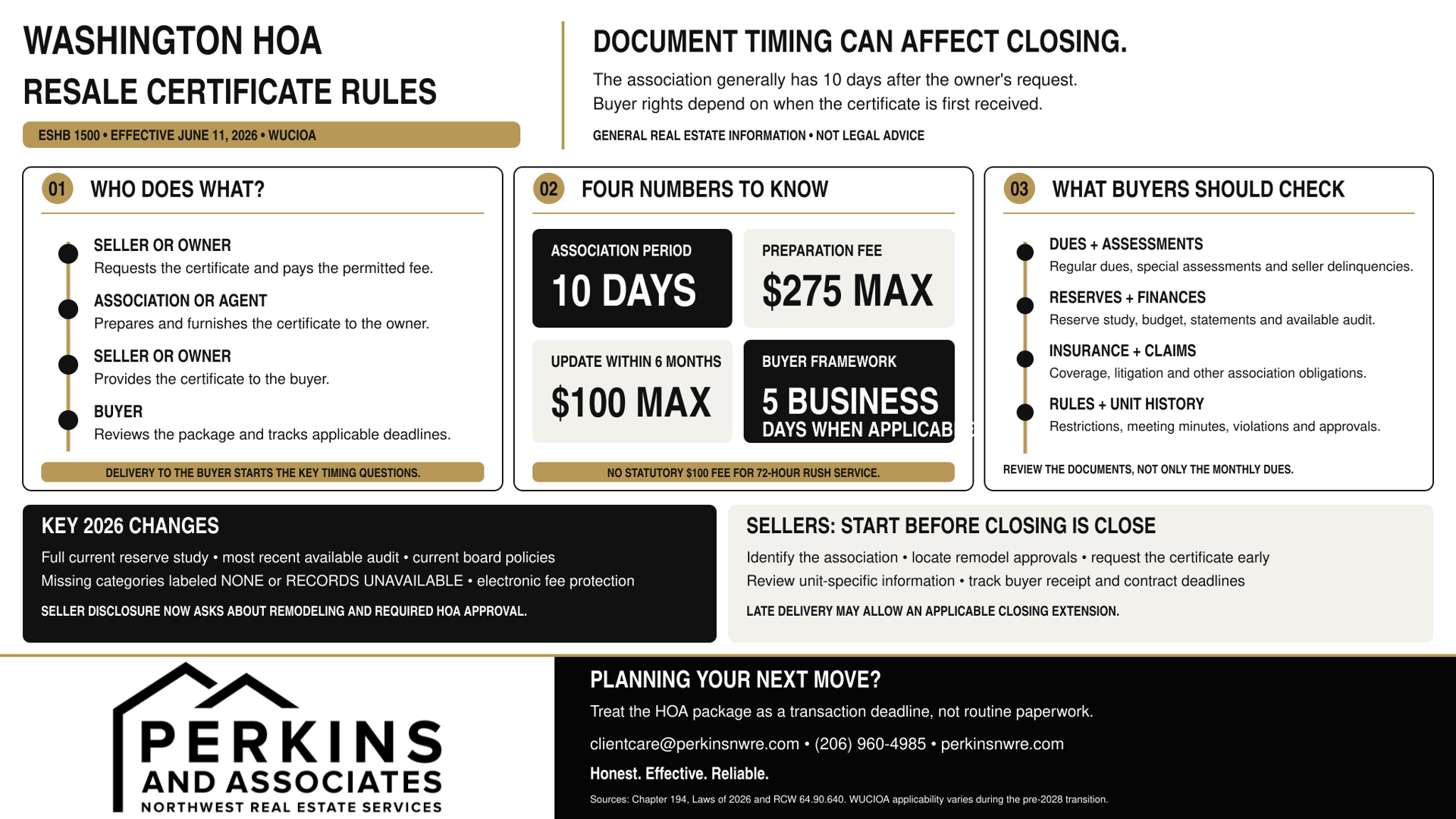
Washington changed its resale certificate rules on June 11, 2026, when ESHB 1500 took effect. The law updated what must be included in a resale certificate, changed key buyer deadlines from five days to five business days, tightened certain fee and delivery rules, added protection involving some undisclosed alterations, and updated Washington's seller disclosure form to ask about remodeling and required HOA approval.
For buyers, the resale certificate can reveal assessments, association finances, insurance, restrictions, litigation, reserve information, violations, and other facts that may affect the decision to purchase.
For sellers, timing matters. The association generally has 10 days after the unit owner's request to furnish the certificate, but the date the buyer first receives it can affect the buyer's statutory cancellation period and, in some cases, the closing date.
Law last verified: September 22, 2026
Scope note: ESHB 1500 amended the Washington Uniform Common Interest Ownership Act, commonly called WUCIOA. Before January 1, 2028, Washington remains in a transition period for some older associations. WUCIOA generally applies to communities created on or after July 1, 2018 and older communities that elected into it, with additional statutory exceptions and partial-applicability rules. Buyers and sellers should not assume every older Washington HOA follows an identical statutory process in 2026.
Key takeaways
- ESHB 1500 became Chapter 194, Laws of 2026 and took effect June 11, 2026.
- The law applies through WUCIOA, so association age and legal structure can matter in 2026.
- A resale certificate is different from the seller disclosure statement and different from negotiated purchase-contract protections.
- The association generally has 10 days after the owner's request to furnish the certificate.
- The statutory preparation charge may not exceed $275.
- An updated certificate requested within six months can cost up to $100.
- ESHB 1500 did not enact the proposed $100 fee for 72-hour rush service.
- Buyers may have a five-business-day statutory cancellation period depending on when they first receive the certificate.
- If the certificate is first received less than five business days before closing, the buyer may have a statutory right to extend closing.
- Sellers should locate HOA approval records for remodeling or modifications before listing.
- Buyers should review the actual financial and governing documents, not only the monthly dues.
What is an HOA resale certificate in Washington?
A resale certificate is an association-based disclosure package used when a unit in a covered common-interest community is resold.
Under RCW 64.90.640, the unit owner must furnish the certificate to the purchaser before signing the sales contract, or otherwise before conveyance, unless a statutory exception or permitted waiver applies. The certificate is signed by an officer or authorized agent of the association and is based on association records and the signer's actual knowledge.
The package can contain important information about both the unit being sold and the association as a whole.
For buyers, this is one of the main opportunities to understand the financial and legal obligations that come with association ownership.
For sellers, it is a document-delivery process with real transaction deadlines.
Who requests, prepares, and reviews the resale certificate?
The responsibilities are easier to understand when separated.
Seller or unit owner
The owner requests the resale certificate from the association or its authorized agent and pays any permitted preparation charge.
Association or authorized agent
The association prepares and furnishes the required certificate to the owner. Under current RCW 64.90.640, it generally has 10 days after the owner's request, subject to the applicable fee requirements.
Seller or unit owner
The owner furnishes the resale certificate to the purchaser.
Buyer
The buyer reviews the package and tracks both statutory rights and any separate deadlines in the purchase agreement.
That last point matters. A statutory resale-certificate right and a negotiated HOA-review contingency are not necessarily the same thing.
What did ESHB 1500 actually change in 2026?
ESHB 1500 improved the contents, fee rules, delivery accountability, and buyer protections in the WUCIOA resale-certificate process. It did not create the entire resale-certificate system from scratch.
That distinction prevents several common misconceptions.
Rule | Status in 2026 |
|---|---|
Resale certificate required in covered transactions | Existing framework |
Association generally has 10 days after owner's request | Existing/current rule |
Preparation fee capped at $275 | Existing ceiling |
Update fee up to $100 within six months | Existing/current rule |
Missing categories must say "NONE" or "RECORDS UNAVAILABLE" | 2026 change |
Most recent available financial audit required | 2026 change |
Current board policies, procedures, and resolutions included | 2026 change |
Most current reserve study included, rather than only a summary | 2026 change |
No added charge merely for electronic documents already available to owners | 2026 change |
No forced third-party account merely to pay for or receive certificate | 2026 change |
Certain purchaser protections involving undisclosed alterations | 2026 change |
Key purchaser periods changed to five business days | 2026 change |
Certain late-delivery closing extension rights | 2026 change |
Seller disclosure adds HOA remodeling and approval questions | 2026 change |
The Legislature's final bill report confirms these changes.
What documents and information should a buyer expect?
A resale certificate can be lengthy, but buyers should not treat it as routine paperwork.
Current RCW 64.90.640 requires a wide range of information about the unit and the association. High-value items include:
- regular assessments
- delinquent assessments tied to the selling unit
- unpaid special assessments
- anticipated repair or replacement costs approved by the association
- fees payable by owners
- annual financial information
- operating budget
- insurance information
- pending litigation and claims
- governing documents
- current rules and restrictions
- board policies, procedures, and resolutions
- recent meeting minutes
- reserve-study information
- alterations or improvements
- known violations involving the unit
- other association obligations and restrictions.
Under the 2026 changes, the package must include the most current reserve study itself, rather than only a summary, and the most recent financial audit report available.
For a deeper explanation of reserve studies, audits, and Washington's other 2026 HOA changes, see our guide to Washington's broader 2026 HOA rules.
What happens when a required record is missing?
The certificate should now make missing information more obvious.
ESHB 1500 requires the resale certificate to state "NONE" or "RECORDS UNAVAILABLE" for each required category that is not provided.
That is useful because "not provided" can mean different things.
For a buyer, a missing record should lead to a follow-up question:
- Does the record not exist?
- Is it unavailable?
- Is it not required for this association?
- Was it simply omitted?
- Is there another document that answers the same concern?
"RECORDS UNAVAILABLE" should not automatically be interpreted as evidence of a problem, but it should not be ignored either.
How long does the association have to provide the resale certificate?
The association generally must furnish the resale certificate within 10 days after the unit owner's request, subject to the applicable payment requirements.
For sellers, this is a good reason not to wait until the week before closing.
A 10-day statutory association period does not leave much room for:
- corrections
- a missing document
- an updated certificate
- buyer review
- lender or escrow questions
- a closing schedule that is already tight.
Ordering early is usually easier than trying to solve a document problem at the end of the transaction.
How much can a Washington association charge for a resale certificate?
The preparation charge may not exceed $275 under current RCW 64.90.640.
The law says the charge must reflect the direct costs of copying and providing the required information. ESHB 1500 also added that an association cannot charge extra simply for providing documents already maintained electronically on a website, portal, or application available to unit owners.
The association may also charge up to $100 to update a resale certificate within six months of the owner's previous request.
What about the reported $100 rush fee?
Some earlier versions of HB 1500 included a separate $100 fee for providing the certificate within 72 hours.
That provision did not make it into the final enacted law. The final version retains the $100 update fee but does not contain that statutory 72-hour rush charge.
This is one reason buyers and sellers should rely on the final session law or current RCW rather than an older legislative summary.
Can the association force a seller to open a third-party account?
Not merely to pay for or receive the resale certificate.
Current RCW 64.90.640 says an association may not require a unit owner to contract with or establish an account with a third party in order to provide payment for or accept delivery of the resale certificate.
That does not prevent an association from using a management company or authorized agent.
It limits what the owner can be required to do simply to complete the resale-certificate transaction.
How long does a buyer have to review the resale certificate?
The answer depends on when the buyer first receives it.
This is one of the most important parts of RCW 64.90.640 and one of the easiest to oversimplify.
When the buyer first receives the certificate | Potential statutory effect |
|---|---|
More than 5 business days before signing the purchase contract | The buyer does not have a right under RCW 64.90.640 to cancel the executed contract based solely on the certificate |
5 business days or less before signing | Before conveyance, the buyer may cancel no later than the fifth business day after first receipt |
After the purchase contract is signed | The buyer may have a statutory cancellation period measured from first receipt, subject to the statute and conveyance |
Less than 5 business days before closing | Before conveyance, the buyer may extend closing to a date no more than 5 business days after first receipt |
The important phrase is first receiving the resale certificate.
It is not accurate to simply say:
Buyers always get five business days after signing.
The statute is more specific.
The purchase agreement may also contain separate negotiated rights, deadlines, or HOA-review protections. Those should be reviewed alongside the statutory rules.
Our guide to what South King County buyers can negotiate beyond price explains why HOA and document-review protections should be treated separately from inspection, financing, appraisal, and other contingencies.
What if the resale certificate arrives right before closing?
If the buyer first receives the resale certificate less than five business days before the scheduled closing, RCW 64.90.640 allows the buyer, before conveyance, to extend closing to a date no more than five business days after first receipt.
That is different from automatically canceling the transaction.
It is also a practical reason for sellers to start the certificate process early.
A delayed document package can become a delayed closing.
Can a buyer waive the resale certificate?
In limited circumstances, a buyer may expressly waive receipt when the certificate is legally considered unavailable.
RCW 64.90.600 defines specific situations in which the certificate can be treated as unavailable. Examples include certain cases where:
- the association failed to provide the certificate within 10 days after request and payment
- the seller reports that there is no HOA and no regular periodic assessment
- qualifying facts show a long period without association activity
- the seller has made three good-faith attempts to request the certificate and remit payment without receiving a timely response.
This is not a general shortcut for avoiding association review.
A buyer considering a waiver should understand exactly which statutory condition applies and what information will not be available.
Does a buyer inherit an HOA violation that was left out?
ESHB 1500 added protection for a specific type of undisclosed violation, but the protection is not unlimited.
Under current RCW 64.90.640, the purchaser is not liable for a governing-document violation created by an alteration to the unit that, using reasonable diligence, should have been known to the association or its authorized agent at the time of conveyance but was not identified in the resale certificate.
That is narrower than saying:
A buyer can never be responsible for an undisclosed HOA violation.
The statutory protection is tied to an alteration and the association's reasonable ability to know about it.
What changed for sellers who remodeled their property?
Washington's seller disclosure form now asks whether there have been modifications or remodeling and, if so, whether all necessary homeowners' association approvals were obtained.
The question appears in the homeowners' association/common-interests section of the statutory seller disclosure form.
For a seller, that makes old approval records more important.
Before listing an HOA property, it can be useful to locate documentation for changes such as:
- exterior alterations
- fences
- decks
- additions
- windows
- roofing changes
- landscaping subject to architectural review
- other work that required association approval.
Not every change requires HOA approval. The governing documents control what the particular association requires.
The practical goal is simple: if approval was required, know whether you have evidence of it before the transaction reaches the document-review stage.
Is the resale certificate the same as Washington's seller disclosure statement?
No. They are separate disclosures with different sources, purposes, and timing rules.
Document | Who provides the underlying information? | Main purpose | Key timing concept |
|---|---|---|---|
Resale certificate | Association records and authorized signer | Association finances, assessments, rules, documents, unit-specific association information | Potential five-business-day rights under RCW 64.90.640 |
Seller disclosure statement | Seller, based on seller's actual knowledge | Statutory property disclosure | Buyer generally has three business days after receipt to approve or rescind, unless otherwise agreed |
Purchase agreement / HOA review provision | Buyer and seller | Contractual rights and deadlines | Depends on negotiated contract language |
Washington's seller-disclosure law generally gives the buyer three business days after receipt of the statement to approve it or rescind the purchase agreement, unless the parties agreed otherwise.
That three-business-day period is not the same as the resale certificate's five-business-day framework.
Buyers should calendar them separately.
What should buyers review first in the resale package?
A thick HOA package can be difficult to review without priorities.
Start with these 10 areas.
1. Current assessments
What are the regular dues, and how often are they paid?
2. Special assessments
Has an assessment already been approved or levied? Are more being discussed?
3. Seller delinquencies
Does the certificate identify unpaid amounts tied to the selling unit?
4. Planned repairs and major costs
Are large repair or replacement projects already approved or under discussion?
5. Reserve study
What major components need future replacement, and what does the study say about funding?
6. Budget, financial statements, and audit
What do the association's current finances show?
7. Insurance
What does the association insure, and what coverage is left to individual owners?
8. Litigation or claims
Is the association involved in legal disputes or significant claims that deserve further review?
9. Rules and restrictions
Look at leasing, parking, pets, exterior changes, use restrictions, fines, and other rules that matter to the buyer's plans.
10. Meeting minutes and violations
Recent minutes can reveal projects, assessments, disputes, maintenance issues, and decisions that may not stand out in the budget alone.
For broader HOA fundamentals, see our guide to what home buyers should know about HOAs.
What should sellers do before listing an HOA property?
Start preparing before the resale certificate becomes a closing issue.
A practical seller checklist:
- Identify the correct association and management contact.
- Locate remodeling and architectural approval records.
- Confirm who processes resale certificates.
- Request the certificate early enough to allow for the 10-day association period.
- Budget for the permitted preparation fee.
- Review the package for obvious unit-specific errors or missing information.
- Know whether an update may be needed if the transaction stretches out.
- Coordinate delivery timing with the purchase agreement and closing schedule.
The goal is not for the seller to rewrite or certify the association's records.
It is to avoid discovering too late that an association document, approval record, or delivery deadline is holding up the transaction.
Does ESHB 1500 apply to every Washington HOA in 2026?
Not identically.
Before January 1, 2028, WUCIOA generally applies to common-interest communities created on or after July 1, 2018 and older communities that amended their declarations to opt into the chapter. Other statutory provisions can create partial applicability for certain communities.
That means the age, legal form, and governing statute of a condominium, townhome community, plat community, or other association can matter.
For buyers, the practical question is:
Which Washington common-interest statute governs this particular association and this particular resale?
A broker can help identify the documents involved in the transaction, but unusual statutory or governing-document questions may need legal review.
Expert insight: Treat HOA review as a transaction deadline, not paperwork
The resale certificate is easy to underestimate because it often arrives as a large PDF or online document package.
But for a buyer, it can answer questions that affect both affordability and ownership:
- Are dues increasing?
- Is there a special assessment?
- Are major repairs coming?
- Does the association have insurance concerns?
- Are there restrictions that conflict with the buyer's plans?
- Was an alteration approved?
- Is the buyer inheriting an obligation they did not expect?
For a seller, the lesson is different:
Do not wait until closing is close to begin figuring out the association paperwork.
The statutory delivery period, buyer review rights, and possibility of a closing extension mean document timing can become transaction timing.
Frequently asked questions
Did Washington change HOA resale certificate rules in 2026?
Yes. ESHB 1500 became Chapter 194, Laws of 2026 and took effect June 11, 2026. It amended RCW 64.90.640 and the statutory seller disclosure form.
What is a Washington HOA resale certificate?
It is an association-based disclosure certificate used in covered resales of units in common-interest communities. It contains financial, governing, assessment, insurance, restriction, and unit-specific information required by statute.
How long does the association have to provide the certificate?
Under RCW 64.90.640, the association generally must furnish it within 10 days after the unit owner's request, subject to the applicable fee requirements.
How much can an association charge?
Current law allows a reasonable preparation charge of up to $275 and an update charge of up to $100 if the certificate is updated within six months of the owner's previous request.
Did ESHB 1500 create a $100 72-hour rush fee?
No. That appeared in earlier versions of the proposal but was not enacted in the final 2026 law.
How long does the buyer have to cancel after receiving the certificate?
It depends on when the buyer first received the certificate in relation to signing the contract and conveyance. Current RCW 64.90.640 uses a five-business-day framework, but it should not be summarized as an automatic five business days after signing.
Can a buyer extend closing if the resale certificate arrives late?
If the buyer first receives it less than five business days before the scheduled closing, the statute may allow the buyer, before conveyance, to extend the closing date to no more than five business days after first receipt.
What happens if the resale certificate misses an HOA violation?
The statute protects the purchaser from liability for a governing-document violation created by an alteration that, with reasonable diligence, should have been known to the association or its authorized agent at conveyance but was not identified in the certificate.
Is a resale certificate the same as the seller disclosure statement?
No. The resale certificate is based largely on association records. The seller disclosure statement is based on the seller's actual knowledge and has its own statutory timing rules.
Does every older Washington HOA follow exactly the same rules in 2026?
No. Washington is still in the WUCIOA transition period through the end of 2027, so the governing statute can depend on when and how the community was created and whether it elected into WUCIOA.
Helpful resources
Washington Legislature, ESHB 1500
Official enacted session law showing the 2026 amendments and June 11, 2026 effective date.
Read Chapter 194, Laws of 2026
RCW 64.90.640
Current Washington resale-certificate statute covering required information, association timing, fees, purchaser rights, and authorized-agent responsibilities.
RCW 64.90.600
Current statute covering applicability, exemptions, and limited circumstances where a resale certificate can be treated as unavailable.
RCW 64.90.360
Current WUCIOA applicability rules, including the pre-2028 transition framework.
Washington seller disclosure law
Current statutes governing the residential seller disclosure statement and the buyer's separate response period.
Planning your next move
If you are thinking about buying, selling, or planning your next move, our team is happy to help you think through your options and next steps.
📧 [email protected]
📱 (206) 960-4985
Honest. Effective. Reliable.
This article provides general real estate information and is not legal advice. Association documents, purchase agreements, statutory applicability, and transaction deadlines can vary. Buyers and sellers should review their specific documents and seek legal advice when a legal interpretation is needed.