King County's New Transportation Sales Tax Starts in 2027: What Maple Valley Residents Should Know
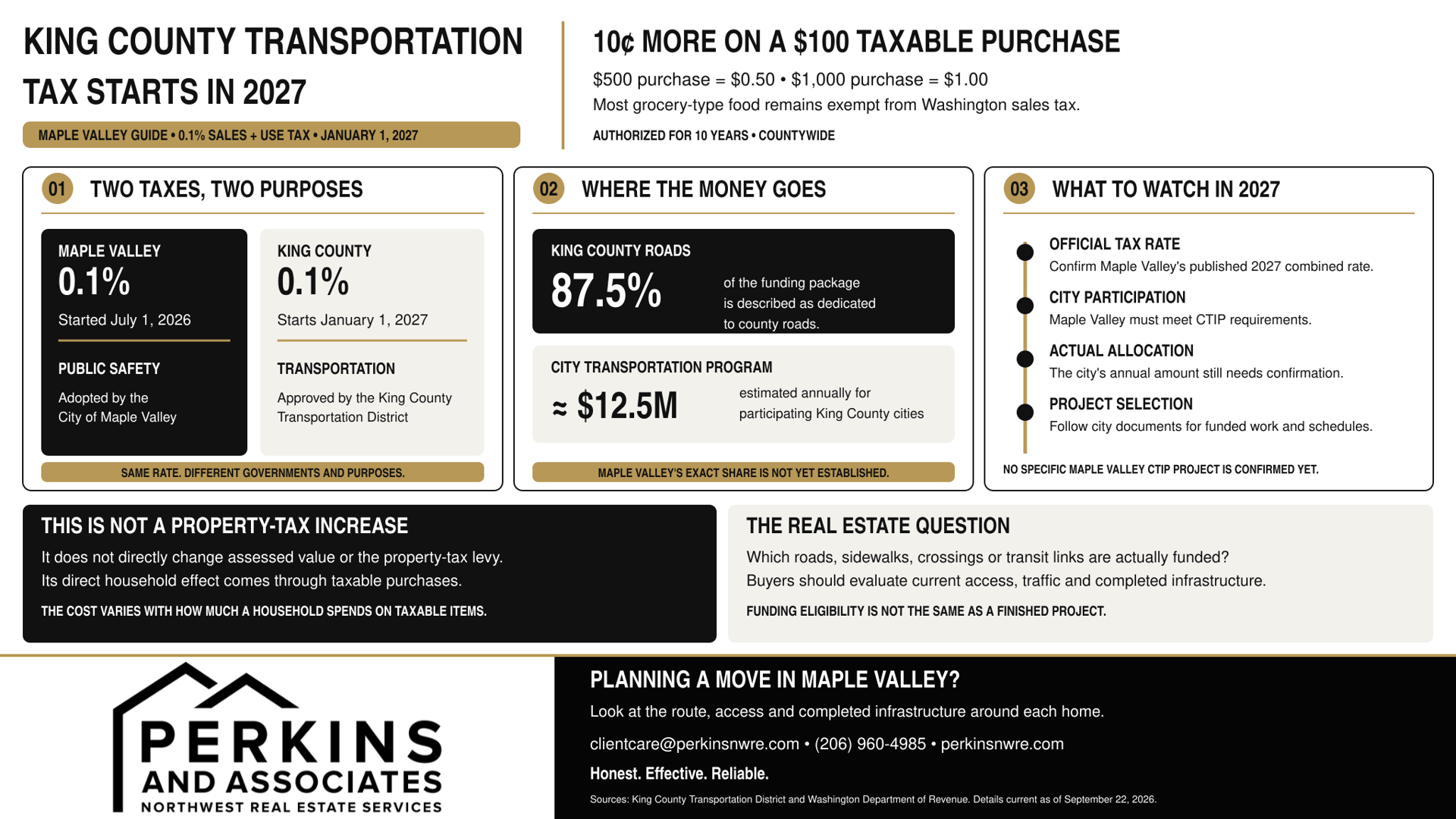
King County's new 0.1% transportation sales and use tax begins January 1, 2027. It adds 10 cents to a $100 taxable purchase and $1 to a $1,000 taxable purchase.
For Maple Valley residents, this is important to separate from the 0.1% City of Maple Valley public-safety sales tax that began July 1, 2026. The two increases have the same rate, but they were adopted by different governments and fund different needs.
The King County Transportation District approved the transportation tax on June 12, 2026. It is authorized for 10 years. King County estimates it will raise about $100 million annually, with most funding directed to King County Roads and a smaller share available to participating cities through the City Transportation Improvement Program, or CTIP.
Information last verified: September 22, 2026
Key takeaways
- The new King County transportation sales and use tax is 0.1%.
- Collection begins January 1, 2027.
- The tax is authorized for 10 years.
- A 0.1% increase equals 10 cents on a $100 taxable purchase.
- The tax was approved by the King County Transportation District Board of Supervisors in a 5-4 vote, not through a countywide ballot measure.
- It is separate from Maple Valley's July 2026 0.1% public-safety tax.
- King County says 87.5% of the funding package is dedicated to King County Roads.
- CTIP is expected to provide approximately $12.5 million annually to participating King County cities.
- Maple Valley's exact annual allocation has not yet been established.
- Not every purchase is subject to sales tax. Most grocery-type food is exempt under Washington law.
- No specific Maple Valley project should be described as funded by CTIP until the city formally identifies how it will use the money.
What is King County's new transportation sales tax?
It is a 0.1% countywide sales and use tax created to fund transportation improvements.
Resolution TD2026-01 was approved by the King County Transportation District on June 12, 2026. The resolution applies the tax to taxable events throughout King County and authorizes it for 10 years.
The district's boundaries match King County's boundaries, so the new tax is countywide rather than limited to unincorporated areas.
Collection starts January 1, 2027.
Read King County Transportation District Resolution TD2026-01
How much more will Maple Valley residents pay?
The new tax adds one-tenth of one percent to taxable purchases.
Here is what that means in simple numbers:
Taxable purchase | Additional 0.1% tax |
|---|---|
$50 | $0.05 |
$100 | $0.10 |
$500 | $0.50 |
$1,000 | $1.00 |
$5,000 | $5.00 |
$10,000 | $10.00 |
King County staff previously estimated that a 0.1% increase would add about $40 per year for a median-income household, based on assumptions about median household income and how much household spending is subject to sales tax. Actual costs will vary by household.
That $40 estimate should not be interpreted as a flat fee. Someone who makes more taxable purchases may pay more, while another household may pay less.
Does the new tax apply to groceries?
Not to most grocery-type food.
Washington exempts most grocery food and food ingredients from retail sales tax. However, prepared food, soft drinks, dietary supplements, alcoholic beverages, and other taxable items can still be subject to sales tax.
That means the new 0.1% transportation tax does not simply apply to every dollar a household spends.
For example, a normal grocery item that is already sales-tax exempt does not become taxable just because the new transportation tax begins.
Read Washington Department of Revenue guidance on food and retail sales tax
Was the transportation tax approved by voters?
No countywide ballot measure approved this tax.
The King County Transportation District Board of Supervisors approved it by a 5-4 vote on June 12, 2026.
Washington law allows a transportation benefit district that covers the full boundaries of the establishing jurisdiction to impose up to a 0.1% sales and use tax by majority vote of its governing board. RCW 36.73.065 specifically identifies this authority.
The resolution itself cites that authority and states that the King County Council acts as the transportation district's governing board in an independent capacity.
That is different from saying voters approved the tax directly.
Is this the same as Maple Valley's 2026 sales-tax increase?
No. Maple Valley residents are seeing two separate 0.1% increases for two different purposes.
Maple Valley 2026 tax | King County 2027 tax | |
|---|---|---|
Rate | 0.1% | 0.1% |
Start date | July 1, 2026 | January 1, 2027 |
Geography | City of Maple Valley | King County |
Main purpose | Public safety | Transportation |
Government | City of Maple Valley | King County Transportation District |
This distinction is especially important because the rates are identical.
Someone looking at Maple Valley's combined sales-tax rate in 2027 could easily assume the January increase is simply an extension of the city's 2026 tax.
It is not.
For background on the earlier change, see our guide to Maple Valley's July 2026 public-safety sales-tax increase.
What could Maple Valley's sales-tax rate be in 2027?
Maple Valley's current combined sales-tax rate is 9.1%.
The Washington Department of Revenue currently lists Maple Valley at 9.1%, including a 2.6% local rate and the 6.5% state rate.
Adding another 0.1 percentage point would mathematically bring that to 9.2%, assuming no other rate changes take effect.
We would not publish 9.2% as Maple Valley's official January 2027 rate until the Department of Revenue publishes the applicable 2027 rate table.
That distinction matters because local sales-tax rates can change for more than one reason.
Check Washington's current local sales and use tax rates
Where will the transportation tax money go?
Most of the funding is intended for King County Roads, while a smaller share is set aside for participating cities.
King County describes the approved funding package as roughly $100 million per year, with 87.5% dedicated to King County Roads.
The actual distribution process in TD2026-01 works like this:
- Administrative costs are paid first.
- 12.5% of the remaining revenue is allocated to CTIP.
- The remaining revenue goes to King County Road Services.
King County estimates that CTIP will provide about $12.5 million annually to cities for local transportation projects.
Paying the tax in Maple Valley does not mean all tax revenue collected in Maple Valley stays in Maple Valley.
Why is most of the funding going to King County Roads?
King County says its unincorporated road network has major maintenance and preservation needs.
The transportation district resolution says Road Services manages approximately:
- 1,500 miles of roads
- 193 bridges
- more than 28,000 culverts
- more than 700 crosswalks
- about 275 miles of sidewalk.
The approved uses include road and bridge maintenance, drainage, culvert replacement, intersection safety, pedestrian and bicycle safety, ADA improvements, sidewalks, curb ramps, crossings, and other transportation work.
Maple Valley residents may use parts of the county road system when traveling outside city limits, so county road investment can still affect local trips even when a project is not physically inside Maple Valley.
What is the City Transportation Improvement Program?
CTIP is the part of the new funding program that sends transportation money to participating King County cities.
King County says CTIP will provide roughly $12.5 million annually to its cities. Examples of eligible work include:
- sidewalks
- street crossings
- transit stops and access
- bicycle facilities
- road improvements
- accessibility upgrades
- other qualifying transportation infrastructure.
Read King County's CTIP funding announcement
How could Maple Valley receive CTIP funding?
Maple Valley must participate in the program and follow the district's requirements.
TD2026-01 establishes several important rules:
- Each participating city receives at least $10,000 annually.
- After administrative costs and minimum allocations, most remaining city funding is distributed according to each participating city's share of the combined participating-city population.
- Beginning in 2027, cities must notify the district by March 1 each year whether they will participate.
- Cities must execute the required interlocal agreement before receiving funding.
- Funding must be used for eligible transportation improvements contained in qualifying transportation plans.
The resolution also says city projects should, where applicable, improve regional connections, transit access or multimodal networks, advance transportation priorities, and be ready enough for timely implementation.
How much will Maple Valley receive?
The city's exact annual allocation has not yet been established in the public sources reviewed.
We know the formula.
We do not yet know the final Maple Valley number.
The city's share can depend on:
- whether Maple Valley participates
- which other cities participate
- population
- program administration
- other adjustments required by the resolution.
That is why we would not estimate a dollar amount and present it as Maple Valley's allocation.
The actual allocation should become clearer as CTIP implementation moves forward in 2027.
What could Maple Valley use the money for?
If Maple Valley participates, its CTIP money could support eligible transportation work such as:
- road improvements
- sidewalks
- safer street crossings
- accessibility work
- bicycle connections
- multimodal improvements
- transit access.
But eligible and funded are not the same thing.
A specific Maple Valley project should not be described as receiving CTIP funding until the city formally selects it and the funding arrangement is established.
What local transportation projects show the type of need Maple Valley has?
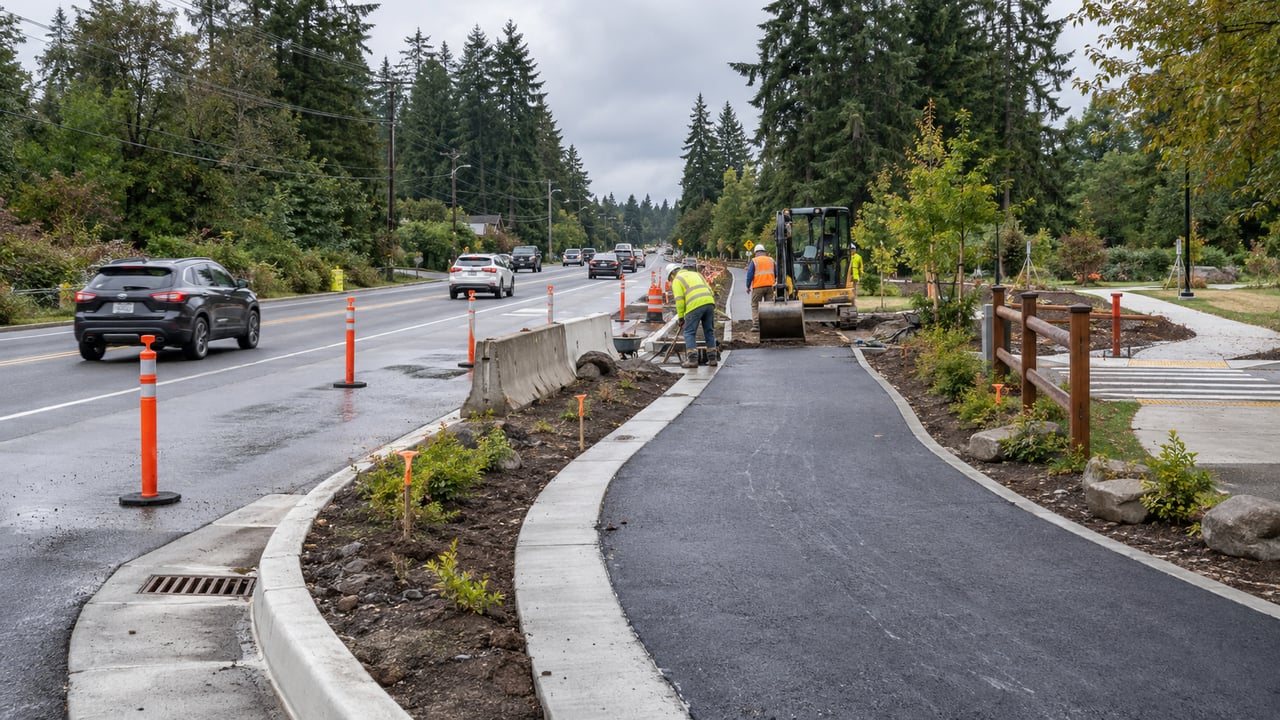
Maple Valley already has active road and pedestrian projects that show the types of transportation issues residents encounter.
One current example is the SE Kent-Kangley Road, SR 516, sidewalk project.
The Washington Transportation Improvement Board lists the approximately 2,050-foot project in construction. It is designed to complete a missing non-motorized connection and includes a shared-use path, ADA ramps, and related improvements.
TIB also currently lists Maple Valley's SR 169 project between SE 253rd Place and SE 260th Street in construction.
These examples are useful context.
They are not evidence that either project will receive CTIP funding.
Review the current SR 516 sidewalk project
Does the new transportation tax increase property taxes?
No. This is a sales and use tax, not a property-tax increase.
It does not directly change:
- your home's assessed value
- your property-tax levy
- your mortgage balance
- your mortgage interest rate.
Its direct household effect comes through taxable purchases.
That makes it part of the broader cost-of-living picture rather than part of the property-tax bill.
What does this mean for Maple Valley homebuyers?
For homebuyers, the tax itself is relatively small compared with major housing expenses such as a mortgage, insurance, property taxes, utilities, and maintenance.
The infrastructure side can matter more to the day-to-day housing decision.
Buyers should look at a home's actual transportation context:
- What is the route to SR 169 or SR 516?
- Are sidewalks available?
- Are crossings practical?
- Is a project planned, funded, under construction, or already finished?
- How does the commute work during normal travel hours?
A proposed transportation project should not be treated like completed infrastructure.
The same is true for CTIP. A city becoming eligible for transportation funding does not tell a buyer which project will ultimately receive it.
For a practical location check, see our guide to testing your Maple Valley commute before choosing a home.
What does this mean for Maple Valley homeowners?
For homeowners, this story has two separate parts:
Cost: another 0.1% on transactions already subject to applicable sales or use tax.
Infrastructure: a new source of regional and city transportation funding.
Neither should be turned into an automatic prediction about property values.
Transportation improvements can change how a specific location functions, but home values still depend on factors such as:
- comparable sales
- property condition
- housing supply
- buyer demand
- mortgage rates
- lot characteristics
- exact location
- traffic and access
- broader market conditions.
Infrastructure should be evaluated based on what is actually funded and built, not on a general assumption that more transportation spending automatically raises nearby values.
For additional local context, see Maple Valley's 2026 transportation and community priorities.
Expert insight: Watch the project list, not only the tax rate
The 0.1% increase is easy to calculate.
The more useful question for Maple Valley residents is:
What transportation work does Maple Valley eventually fund with its share?
A new revenue source tells us money will be available.
It does not tell us which local project will receive it.
For homeowners and buyers, the updates worth following are:
- whether Maple Valley participates in CTIP
- the city's actual allocation
- which projects the city selects
- whether those projects have other funding
- when design or construction begins
- how completed work affects routes residents actually use.
That is where this becomes more than a tax story.
What should Maple Valley residents watch next?
1. The official 2027 sales-tax rate
The Washington Department of Revenue's 2027 table will confirm Maple Valley's combined rate when the county tax takes effect.
2. Maple Valley's CTIP participation
Cities must follow the district's participation and agreement requirements.
3. The city's actual funding allocation
The formula is established, but Maple Valley's final amount still needs to be determined.
4. Project selection
City documents should eventually identify which qualifying transportation projects will receive the new funding.
5. Project schedules
Funding does not mean construction starts immediately. Design, permitting, bidding, matching funds, and other steps may still be required.
Frequently asked questions
When does King County's transportation sales tax start?
January 1, 2027.
How much is the new transportation tax?
It is 0.1%, or 10 cents on a $100 taxable purchase.
Was the tax approved by voters?
No countywide ballot vote approved it. The King County Transportation District Board of Supervisors approved the tax by a 5-4 vote. Washington law allows the district governing board to impose up to 0.1% under the conditions set out in RCW 36.73.065.
Does the tax apply to groceries?
Most grocery-type food is exempt from Washington retail sales tax. Prepared food, soft drinks, dietary supplements, alcoholic beverages, and other taxable transactions can still be subject to sales tax.
What will Maple Valley's sales-tax rate be in 2027?
The current combined rate is 9.1%. Adding the transportation tax would mathematically bring it to 9.2% if no other rate changes apply. The official 2027 Department of Revenue rate table should be checked before treating 9.2% as final.
Is this the same as Maple Valley's 2026 sales-tax increase?
No. Maple Valley's July 2026 increase funds public safety. The January 2027 increase is a separate King County transportation tax.
Will every dollar collected in Maple Valley come back to Maple Valley?
No. Most revenue is directed to King County Roads. A smaller share is distributed through CTIP to participating cities.
Will Maple Valley receive CTIP money?
Maple Valley can receive CTIP money if it participates and meets program requirements. The city's exact annual allocation has not yet been established publicly.
What can cities use CTIP funding for?
Eligible examples include roads, sidewalks, crossings, transit access, bicycle facilities, accessibility improvements, and other qualifying transportation work.
Does this increase property taxes or mortgage payments?
No. It is a sales and use tax. It does not directly increase a property's assessed value, property-tax levy, mortgage balance, or mortgage interest rate.
How long will the tax last?
TD2026-01 authorizes the tax for 10 years.
Will this automatically increase Maple Valley home values?
No. There is no reliable basis to assume that general transportation funding will automatically increase nearby home values. Any effect should be evaluated based on the specific project, location, market conditions, and property.
Helpful resources
King County Transportation District
Official legislation establishing the tax and CTIP distribution rules.
King County Transportation District Resolution TD2026-01
King County CTIP
Overview of the approximately $12.5 million annual city transportation funding program.
City Transportation Improvement Program announcement
King County Roads funding
King County's explanation of the estimated $100 million package and the 87.5% roads allocation.
King County transportation funding announcement
Washington Department of Revenue
Current local sales and use tax rates.
Washington local sales and use tax rate table
Washington sales-tax rules for food
Official guidance explaining which grocery and prepared-food purchases are taxable.
Washington retail sales-tax food guidance
Washington Transportation Improvement Board
Current information on Maple Valley's SE Kent-Kangley Road sidewalk project.
Maple Valley SR 516 sidewalk project
Planning your next move
If you are thinking about buying, selling, or planning your next move, our team is happy to help you think through your options and next steps.
📧 [email protected]
📱 (206) 960-4985
Honest. Effective. Reliable.