Washington HB 2477 Did Not Pass: What Buyers and Sellers Should Know About Appraisals
Washington HB 2477 did not become law in 2026. The proposal focused mainly on legal claims and liability connected with real estate appraisal reports. It did not propose a new method for determining home values, change how lenders order appraisals, or rewrite appraisal contingencies in Washington purchase agreements.
The bill advanced out of the House Consumer Protection & Business Committee as a substitute bill on February 4, 2026, then was referred to Rules 2 Review. The Washington Legislature's official bill history shows no further passage.
For buyers and sellers, that correction matters. There is no new HB 2477 appraisal procedure to follow in a Washington home sale.
The appraisal issues that can affect a transaction today remain much more practical: whether the value supports the financing, what the purchase agreement says, whether an appraisal contingency or appraisal-gap provision applies, and what options exist if the valuation appears unsupported.
Key takeaways
- HB 2477 did not become Washington law in 2026.
- The proposal focused on civil claims arising from appraisal reports and who could bring certain claims.
- It did not change how an appraiser determines a home's value.
- It did not change appraisal contingencies or automatically determine what happens after a low appraisal.
- A home's appraised value, purchase price, and loan amount are different numbers.
- A low appraisal can affect financing, but it does not automatically change the agreed purchase price.
- A seller is not automatically required to reduce the price to the appraised value.
- A buyer may be able to request a reconsideration of value through the lender when there are supported concerns about the appraisal.
- An ROV is a review process, not a guarantee that the value will increase.
- Contract deadlines and protections matter, so buyers should understand their appraisal and financing terms before problems arise.
Did Washington HB 2477 become law?
No. HB 2477 did not pass the Washington Legislature in 2026.
The bill was introduced on January 14, 2026. The House Consumer Protection & Business Committee held a public hearing, approved a substitute bill, and sent it to Rules 2 Review on February 4. The official legislative history does not show the bill passing the House, Senate, or becoming law.
Review the Washington Legislature's HB 2477 bill history
That means homeowners should not see an article about HB 2477 and assume Washington adopted a new appraisal rule.
It did not.
What did HB 2477 actually propose?
HB 2477 was primarily about legal liability arising from appraisal reports.
The substitute bill proposed two major changes.
A deadline for certain appraisal-related claims
Except for fraud claims, an action arising from an appraisal report completed after the proposed law's effective date would generally have needed to be filed by the earlier of:
- two years after discovery of the act or omission giving rise to the claim, or
- five years after the appraiser signed the appraisal report.
The substitute bill also preserved the Washington Department of Licensing's ability to investigate appraisal professionals and take disciplinary action.
Limits on who could bring certain claims
The proposal also defined an appraisal report as being prepared for specific parties, including:
- the client,
- an intended user identified in the report,
- and, in certain lender transactions, the lender's immediate successor in interest.
It proposed limiting appraisal-report liability to those categories rather than extending it to anyone who later relied on the report.
That is very different from changing how a home is appraised during a purchase.
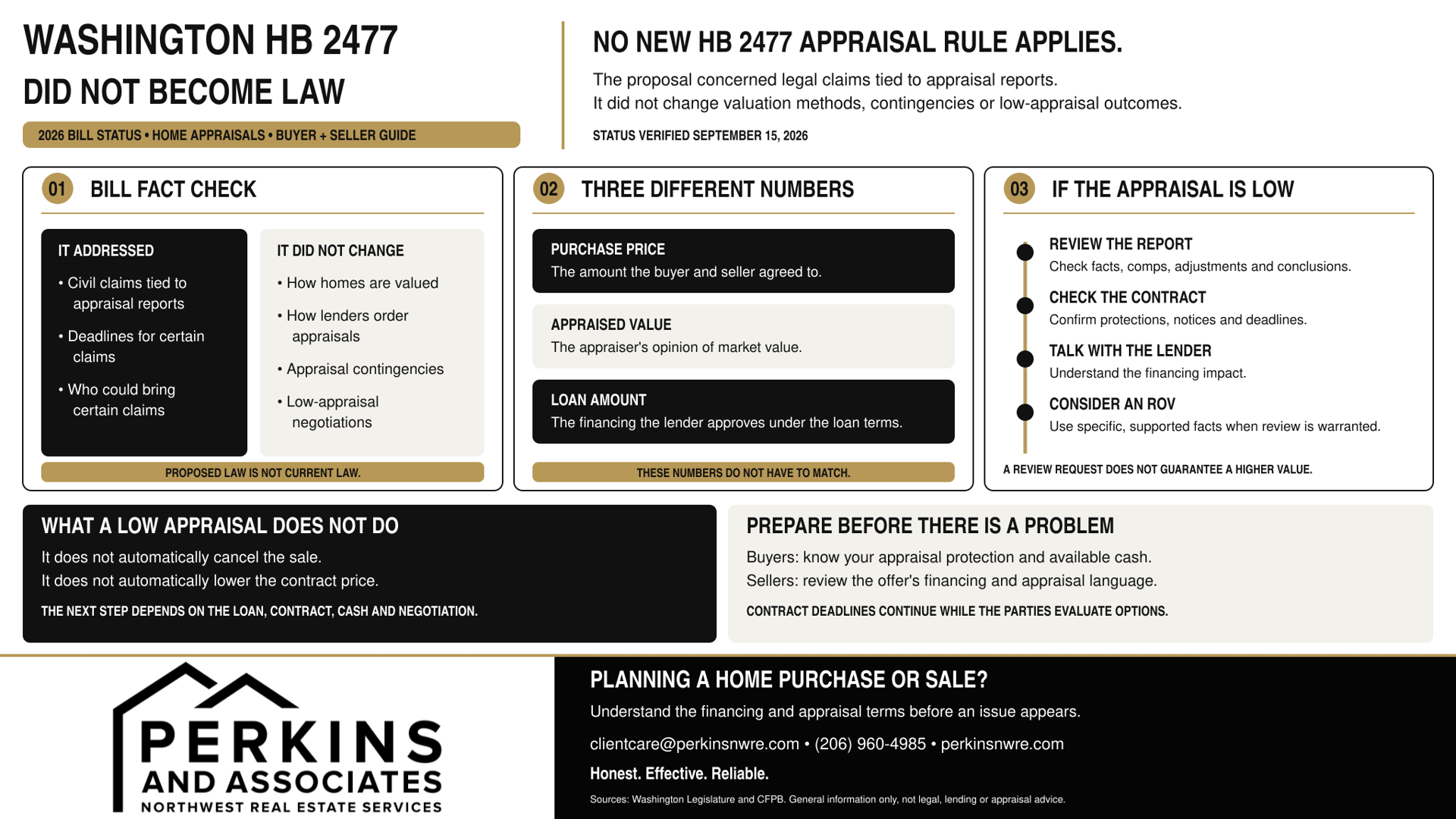
What HB 2477 would and would not have changed
HB 2477 addressed | HB 2477 did not change |
|---|---|
Civil claims arising from appraisal reports | How appraisers determine market value |
Time limits for certain claims | How lenders order appraisals |
Who could bring certain appraisal-report claims | How comparable sales are selected |
Liability involving appraisers and appraisal companies | Appraisal contingencies |
Department of Licensing enforcement authority | Appraisal-gap agreements |
Post-report legal risk | What automatically happens after a low appraisal |
This distinction should be the starting point for anyone researching HB 2477.
The bill dealt largely with what could happen after an appraisal report became the subject of a legal claim, not the normal purchase and financing process.
What does an appraisal do in a home purchase?
A home appraisal is an independent opinion of the property's value.
When a mortgage lender requires an appraisal, the valuation helps the lender evaluate the property being used as collateral for the loan. The Consumer Financial Protection Bureau explains that an appraisal is a written opinion of value and that borrowers with a typical first-lien mortgage are generally entitled to receive a copy.
Read the CFPB's explanation of home appraisals
Buyers and sellers sometimes treat the appraised value as if it were the same thing as the purchase price.
It is not.
Appraised value, purchase price, and loan amount are not the same thing
Understanding these three numbers makes appraisal problems easier to follow.
Number | What it means |
|---|---|
Purchase price | The amount the buyer and seller agreed to in the purchase contract |
Appraised value | The appraiser's opinion of the property's market value |
Loan amount | The financing amount the lender ultimately approves under the loan terms |
Those numbers may be similar, but they do not have to be identical.
For example, a buyer and seller could agree to a $750,000 purchase price while the appraisal concludes the property is worth $730,000.
The contract price does not automatically become $730,000.
Instead, the lower valuation may affect the lender's financing calculations. What happens next depends on the loan, available cash, purchase agreement, appraisal protections, and negotiations between the parties.
What happens when a home appraises below the purchase price?
A low appraisal can create a financing problem, but it does not automatically cancel the sale or force the seller to change the price.
The CFPB advises buyers to review the appraisal carefully when the appraised value is below the sale price and explains that buyers may consider negotiating with the seller. Contract terms affect the buyer's options if the parties cannot resolve the difference.
Read the CFPB's low-appraisal guidance
Possible outcomes can include:
- the buyer bringing additional cash,
- the seller agreeing to a lower price,
- the buyer and seller negotiating another solution,
- requesting review of the appraisal,
- restructuring financing if the lender permits it,
- or using rights available under the purchase agreement.
None of those outcomes is automatic.
For a deeper look at how buyers can structure appraisal protection before making an offer, see our guide to appraisal contingencies and appraisal-gap negotiations.
Does the seller have to lower the price after a low appraisal?
No. A seller is not automatically required to lower the purchase price to match the appraisal.
The seller can evaluate:
- the amount of the appraisal gap,
- the appraisal itself,
- the buyer's financing,
- the terms of the contract,
- other buyer interest,
- market conditions,
- and the seller's own priorities.
A seller may decide that a price reduction makes sense.
The seller may also decline.
What happens after that depends on the contract and whether the buyer can or wants to move forward.
A low appraisal also does not prove by itself that the seller intentionally overpriced the home. The purchase price reflects an agreement between a particular buyer and seller. An appraisal is an independent valuation prepared for a specific assignment and intended use.
Can a buyer challenge a low appraisal?
A borrower can ask the lender about a reconsideration of value, commonly called an ROV, when there are supported concerns about the appraisal.
The CFPB describes an ROV as a process through which borrowers can ask a lender to reconsider a valuation they believe is inaccurate. Potential issues may include factual errors, omissions, inadequate comparable properties, or concerns about prohibited bias.
Learn about reconsideration of value from the CFPB
For loans subject to Fannie Mae's requirements, lenders must maintain policies and procedures for a borrower-initiated ROV. The process allows borrowers to raise concerns when an opinion of value appears unsupported, may reflect unacceptable appraisal practices, or may involve prohibited discrimination.
What information may help an ROV?
Useful information can include:
- an incorrect bedroom or bathroom count,
- incorrect square footage or property characteristics,
- missing improvements,
- relevant comparable sales,
- factual neighborhood or location errors,
- or analysis in the appraisal that appears unsupported.
The strongest request is based on specific facts.
Simply saying:
"We need the value to be higher."
is not the same as identifying an appraisal problem.
Does an ROV guarantee the value will change?
No. A reconsideration of value is a review request, not a guarantee of a higher appraisal.
Fannie Mae requires the lender to review and resolve borrower-initiated ROV requests for applicable loans. The lender remains responsible for determining whether the appraisal and opinion of value are reliable and adequately supported.
Fannie Mae also says a request for a change in value must be based on material and substantive issues, not simply on the fact that the appraisal does not support the proposed loan amount.
That is an important distinction.
The goal of an ROV is to correct or review a potentially deficient valuation, not to produce a predetermined contract price.
Who should a buyer contact about an appraisal concern?
Start with the lender.
A practical communication path is:
Buyer → lender → appraisal review or ROV process → appraiser, when appropriate
The borrower should generally not try to pressure the appraiser directly.
Fannie Mae places responsibility for appraisal review and ROV procedures on the lender. If the lender identifies appraisal deficiencies, its options may include contacting the original appraiser, obtaining a desk or field review, or obtaining another appraisal when justified.
A real estate broker can help gather factual information, such as:
- property features,
- relevant closed sales,
- documentation of improvements,
- permits when applicable,
- and factual errors that deserve review.
The evidence should go through the proper lender process.
A practical low-appraisal decision path
If an appraisal comes in below the purchase price, buyers and sellers should avoid reacting to the number before understanding the full situation.
Step 1: Review the appraisal
Check the property information, comparable sales, adjustments, and conclusions.
Step 2: Check the purchase agreement
Determine what appraisal, financing, notice, and deadline provisions apply.
Step 3: Talk with the lender
Ask how the appraisal affects the financing.
Step 4: Decide whether an ROV is appropriate
Look for factual or analytical issues that can be supported with evidence.
Step 5: Review the buyer's available cash
Determine whether the buyer can or wants to cover any financing difference.
Step 6: Discuss possible terms
Buyer and seller can evaluate price, cash, financing, or another negotiated solution.
Step 7: Follow contractual deadlines
An appraisal issue does not stop notice periods or other contract deadlines unless the agreement says otherwise.
Understanding how mortgage underwriting works can also help buyers see where the appraisal fits within the larger lender approval process.
How do appraisal contingencies affect transaction risk?
The purchase agreement determines what protections a buyer has if the appraisal does not support the agreed price.
Depending on the contract, buyers and sellers may negotiate:
- a full appraisal contingency,
- a limited appraisal-gap amount,
- a waiver of some appraisal protection,
- specific notice requirements,
- or other terms.
A buyer who agrees to cover a defined appraisal gap may take on more financial risk than a buyer with broader appraisal protection.
A seller considering an offer should also understand what the appraisal language means. The highest purchase price is not always the same as the strongest financing structure.
Our article on what South King County buyers can negotiate beyond price explains how appraisal protections fit alongside financing, inspection, closing costs, and other negotiable terms.
For unusual contract language or questions about legal rights, appropriate legal advice may be needed.
What should a buyer do if the appraisal comes in low?
Start with five questions:
- What value did the appraisal reach?
- How does that value affect the lender's financing?
- What does the purchase agreement say about appraisal risk?
- Is there a factual basis for requesting an ROV?
- How much additional cash, if any, is the buyer willing and able to use?
Then work through the lender and contract deadlines before deciding how to respond.
Do not assume that a low appraisal means the buyer must immediately bring the entire difference in cash.
Do not assume the seller must reduce the price either.
What should a seller do if the appraisal comes in low?
A seller should first understand the size and reason for the gap.
Review:
- the appraised value,
- contract price,
- buyer financing,
- appraisal contingency or gap language,
- relevant comparable sales,
- whether an ROV is being considered,
- and the seller's alternatives.
The decision may be different for a property with multiple backup buyers than for a home that took longer to sell.
The correct response depends on the transaction.
What can sellers do before the appraisal?
Sellers cannot control the appraiser's value conclusion, but they can make accurate property information available.
Useful preparation can include:
- providing reasonable property access,
- making known improvements easy to identify,
- keeping records of significant permitted work when available,
- correcting obvious factual misunderstandings through the proper communication channel,
- and making sure the property can be observed as needed for the assignment.
Sellers and brokers should not pressure the appraiser to reach the contract price.
Readers who want more detail about valuation itself can review our guide to factors appraisers consider when determining a home's value.
What should South King County buyers and sellers watch?
The statewide appraisal framework does not change from Maple Valley to Kent, Renton, Auburn, Black Diamond, or Covington. The property itself does.
A standard subdivision home may have a different comparable-sale set from:
- a home with acreage,
- a property with a large shop,
- a substantially remodeled home,
- a unique view property,
- a home with an ADU,
- or a property with characteristics that are less common nearby.
That does not mean those properties cannot be appraised accurately.
It means buyers and sellers should understand that the appraisal is based on the subject property, available market evidence, and the requirements of the assignment.
If you need a refresher on the basic process, our existing guide on common home appraisal myths for buyers and sellers covers the fundamentals without duplicating the HB 2477 discussion here.
What role does Washington's Department of Licensing still play?
Washington's Department of Licensing continues to regulate state-certified and state-licensed real estate appraisers.
HB 2477 would not have eliminated the department's investigative or disciplinary authority. In fact, the substitute bill specifically preserved that authority.
The Department of Licensing currently provides a complaint process for alleged violations of appraiser licensing laws and complaints involving appraisal management companies.
Washington Department of Licensing appraiser information
Expert insight: Prepare for the appraisal before there is a problem
The best time to think about appraisal risk is usually before the appraisal comes back.
For buyers, that means understanding:
- how much appraisal protection the contract provides,
- whether an appraisal gap has been promised,
- how much additional cash is available,
- and how the lender handles ROV requests.
For sellers, that means understanding:
- the buyer's financing,
- appraisal language in the offer,
- available comparable sales,
- and what options would be acceptable if the appraisal is lower than expected.
A low appraisal can create pressure because financing and contract deadlines continue moving.
Having a plan does not guarantee a particular outcome. It gives both sides a clearer way to evaluate their options.
Frequently asked questions
Did Washington HB 2477 pass in 2026?
No. HB 2477 advanced out of the House Consumer Protection & Business Committee as a substitute bill and was referred to Rules 2 Review, but it did not become law.
What would HB 2477 have changed?
The substitute bill proposed time limits for certain civil claims arising from appraisal reports and restrictions on which parties could bring certain appraisal-report claims. It also preserved Washington Department of Licensing investigation and disciplinary authority.
Did HB 2477 change how appraisers determine home value?
No. The proposal addressed liability arising from appraisal reports. It did not establish a new valuation method.
What happens if a home appraises below the purchase price?
The appraisal may affect how much the lender is willing to finance. The next step depends on the loan, purchase agreement, buyer's cash, appraisal protections, and negotiations between buyer and seller.
Does the seller have to lower the price after a low appraisal?
No. A seller is not automatically required to reduce the contract price to the appraised value.
Can a buyer challenge a low appraisal?
A borrower can ask the lender about a reconsideration of value when there are supported concerns such as factual errors, missing information, inadequate comparable properties, unsupported analysis, or possible prohibited bias.
What is a reconsideration of value?
A reconsideration of value is a process for asking the lender to review concerns about an appraisal and, when appropriate, submit supported issues for reconsideration.
Does an ROV guarantee a higher appraisal?
No. An ROV is a request for review. It does not guarantee that the opinion of value will change.
Can the lender order another appraisal?
Depending on the loan and the circumstances, the lender may have options including appraisal correction, review, or a replacement appraisal when justified. For Fannie Mae loans, the lender must document deficiencies when relying on a new appraisal rather than simply choosing the appraisal with the highest value.
Is an appraisal the same as a home inspection?
No. An appraisal addresses property value for the appraisal assignment. A home inspection evaluates property condition for the buyer. They serve different purposes.
Helpful resources
Washington Legislature HB 2477
Official bill history showing the proposal's 2026 legislative status.
HB 2477 bill summary and history
Substitute HB 2477
Official substitute bill text showing the proposed appraisal-report liability provisions.
House Bill Report
Nonpartisan legislative staff summary of what the substitute bill proposed.
Read the HB 2477 House Bill Report
Consumer Financial Protection Bureau
Consumer guidance on appraisal copies, low appraisals, and valuation concerns.
Reconsideration of value guidance
Fannie Mae
Current lender requirements and borrower-initiated reconsideration-of-value guidance.
Fannie Mae Appraisal Quality Matters
Washington Department of Licensing
State information on real estate appraiser licensing and consumer complaints.
Washington real estate appraiser resources
Planning your next move
If you are thinking about buying, selling, or planning your next move, our team is happy to help you think through your options and next steps.
📧 [email protected]
📱 (206) 960-4985
Honest. Effective. Reliable.
This article is intended as general real estate information, not legal, lending, or appraisal advice. Purchase agreement rights, lender requirements, loan programs, and appraisal procedures can vary. Buyers and sellers should review their specific contract and financing with the appropriate professionals.