Selling a $1M+ home in Maple Valley in 2026: What's different?
Selling a luxury home in Maple Valley usually takes a more exact pricing method, a more selective preparation budget, and a marketing plan built around the property rather than the price alone. A citywide average can show the direction of the market. It cannot tell you what a custom home, large-lot property, or acreage estate should be worth.
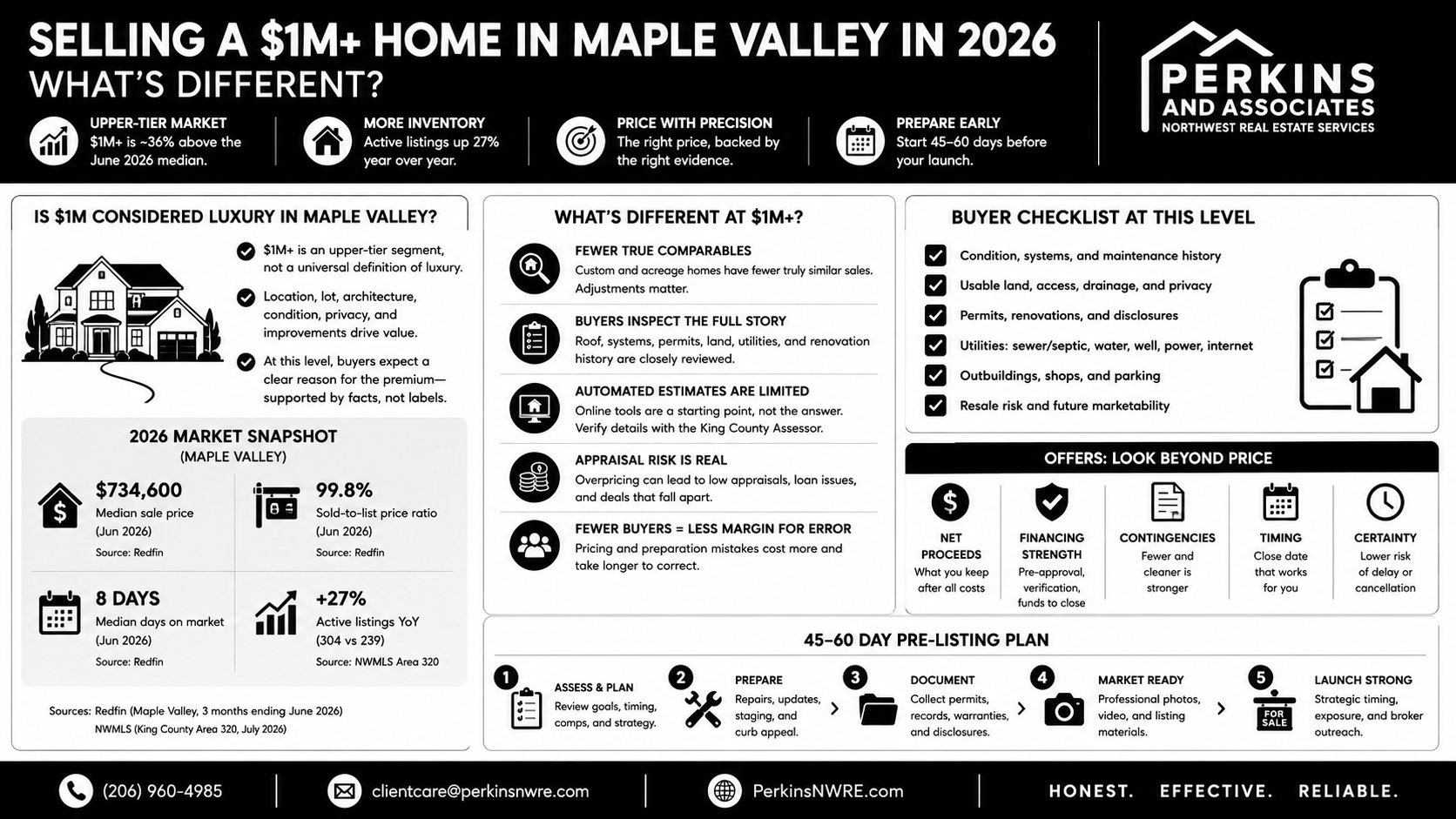
That distinction matters in 2026. Redfin's Maple Valley market data shows a median sale price of $734,600 for the three months ending June 2026. A $1 million sale is about 36% above that median. At the same time, buyers have more homes to compare. The Northwest Multiple Listing Service July 2026 report for King County shows 304 active residential listings in Area 320, which includes Black Diamond and Maple Valley, compared with 239 in July 2025.
For sellers, the message is not that upper-tier homes cannot sell. It is that price, condition, documentation, and launch strategy need to agree from the first day on market.
Key takeaways
- $1M+ is an upper-tier price band in Maple Valley, but price alone does not make a home “luxury.”
- The right comparable sales may come from several nearby areas and still require careful adjustments.
- Buyers at this level tend to examine condition, systems, land, permits, and resale risk closely.
- A $1M purchase price does not automatically mean the buyer needs a jumbo loan.
- Sellers should compare offers by net proceeds, financing strength, contingencies, and timing, not price alone.
- The best preparation plan often starts 45 to 60 days before photography.
Is $1 million considered a luxury home in Maple Valley?
In Maple Valley, $1M+ is a meaningful upper-tier segment. It is not a universal definition of luxury. The home's location, lot, architecture, condition, privacy, improvements, and buyer expectations all help determine whether it competes as a luxury property.
The June 2026 citywide median of $734,600 gives useful context, but it combines many property types and price ranges. A newer subdivision home on a compact lot may compete differently from a custom home with a shop, a private road, or several acres. Two homes with similar square footage can attract different buyers because one has stronger outdoor living, better parking, more usable land, or newer systems.
At $1M and above, buyers expect a clear reason for the premium. The marketing should explain that reason with facts, not luxury labels.
What is different about selling a $1M+ home?
The buyer pool is smaller, the homes are less interchangeable, and true comparable sales are harder to find. That makes errors in pricing and presentation more expensive.
There are fewer true comparable sales
A standard subdivision may produce several recent sales with similar floor plans and lot sizes. A custom or acreage property may not. One nearby sale could have a renovated interior but less usable land. Another could have a detached shop but an older roof and septic system. A third could be outside city limits with different road access or utility arrangements.
One price-per-square-foot figure can hide the features that actually move value.
Buyers inspect the property story, not just the photos
At this price level, buyers often want to understand the roof, heating and cooling, generator, drainage, septic or sewer connection, well or public water, permits, surveys, outbuildings, and major renovation history. Missing records do not always stop a sale, but they can create uncertainty during inspection, appraisal, or underwriting.
Washington sellers also have disclosure duties under Chapter 64.06 RCW. Gather records early and take legal or technical questions to the right professional.
Automated estimates are only a starting point
An automated estimate may be useful for a broad range. It may not understand whether an outbuilding is permitted, whether acreage is usable, or how buyers view a private road, view corridor, remodel quality, or specialty system. The King County Assessor's records can help verify parcel and improvement details, but assessed value is also not a listing-price conclusion. Owners can review parcel information through the King County Assessor.
What does the 2026 Maple Valley market say to luxury sellers?
The broad market is still moving, but buyers have more choice than they did a year ago. Upper-tier sellers should expect closer comparison between active listings and less tolerance for a price that gets ahead of the evidence.
Redfin reports that Maple Valley homes sold for 99.8% of list price in June 2026 and spent a median of eight days on market. Those citywide figures sound fast, but they should not be applied automatically to a $1M+ home. A small set of upper-tier listings can behave very differently from the city median.
NWMLS Area 320 had 149 new residential listings in July 2026, up from 120 in July 2025. Active listings rose from 239 to 304, about a 27% increase. More inventory lets buyers compare price, condition, lot utility, and new-construction alternatives.
Your competitive set may cross city lines. A Maple Valley resale could compete with a Black Diamond new build, a Ravensdale acreage property, or another South King County home that gives the buyer more space for the money. Sellers benefit from understanding how buyers compare value across South King County, not just what closed within the nearest subdivision.
How should a Maple Valley luxury home be priced?
A $1M+ Maple Valley home should be priced through a hierarchy of recent closed sales, pending sales, active competition, and failed or expired listings. Each comparison then needs adjustments for the features buyers will pay for or discount.
Build the comparable set in layers
Start with the most similar recent closed sales. Then widen the search only as needed. A useful review can include:
- Recent closed sales with similar property type, lot, age, condition, and location.
- Pending sales that show where buyers are acting now, even when the final price is not yet known.
- Active listings competing for the same buyer.
- Canceled, expired, or withdrawn listings that show where the market said no.
- Relevant new construction, with adjustments for builder incentives, warranties, lot size, and completion timing.
Adjust for the features that change buyer decisions
Pricing factor | What to examine |
|---|---|
Land | Total acreage, usable area, slope, drainage, privacy, and future maintenance |
Improvements | Remodel quality, permits, age, and consistency with the rest of the home |
Major systems | Roof, HVAC, septic, well, generator, electrical service, and water treatment |
Outbuildings | Permits, power, heat, access, condition, and likely buyer use |
Access | Public or private road, maintenance agreements, gates, parking, and turnaround space |
Lifestyle | Outdoor living, views, home office, bonus rooms, guest space, and storage |
Set the review points before launch
Decide in advance when you will review showing activity, buyer feedback, online engagement, and changes in the competitive set. A seller should know what would justify holding the price and what would trigger a change. Waiting 60 or 90 days to have that conversation can make a listing look stale.
Which repairs and updates are worth making before listing?
Fix items that affect trust, safety, financing, insurability, or the buyer's first impression before spending heavily on taste-driven upgrades. The right preparation budget is property-specific.
Start with known leaks, failed systems, safety concerns, visible deferred maintenance, damaged finishes, and landscaping that blocks the home's best features. Gather invoices and records for the roof, HVAC, septic work, well tests, generator, remodels, and permitted additions. Owners of homes within city limits can check permit resources through the City of Maple Valley's online permitting page.
Be careful with a large remodel just before sale. A buyer may not value the same finishes, and the project can delay the listing window. A focused plan may produce a cleaner result: repair what creates doubt, refresh what photographs poorly, and leave taste-specific decisions to the next owner. For a deeper checklist, see which pre-sale improvements actually matter in 2026.
Does staging matter for a $1M+ Maple Valley home?
Yes, when staging makes the layout, scale, and intended use easier to understand. The plan should fit the home and likely buyer rather than copy an urban-luxury look that feels out of place.
Occupied styling may be enough when the furnishings fit and the home is not crowded. Vacant staging can define a large great room, unusual bonus space, or outdoor area. Virtual staging should be labeled and should never hide defects.
What should a luxury marketing plan include?
A luxury marketing plan should document what makes the home different and put that story in front of likely buyers. More marketing cannot rescue an unsupported price, but weak marketing can waste a well-priced launch.
The plan may include:
- Professional photography that shows light, scale, condition, and the relationship between indoor and outdoor spaces.
- Video that helps buyers understand flow, privacy, land, and arrival experience.
- A measured floor plan.
- Aerial images where lawful and useful.
- A feature sheet covering improvements, systems, and records.
- Broker outreach to agents working with likely buyers.
- A showing plan that balances access, privacy, and security.
- Weekly reporting that separates online attention from qualified buyer response.
The listing language should answer “Why this home?” with specific details. “Private, usable acreage with a powered shop and easy commuter access” tells the buyer more than a string of luxury adjectives.
Will a $1M buyer need a jumbo loan in King County?
Not necessarily. The buyer's loan amount, not the sale price by itself, determines whether the financing exceeds the county's conforming limit.
The Federal Housing Finance Agency's 2026 announcement set the national baseline limit for a one-unit property at $832,750. High-cost counties can have higher limits. FHFA's official 2026 county limit list shows a one-unit limit of $1,063,750 for King County.
With a down payment, a $1M buyer's loan amount is below the sale price. Sellers should still review lender strength, proof of funds, down payment, financing, and appraisal terms. A strong price with fragile financing may carry more risk than a slightly lower offer with a clear path to closing.
Why can appraisals be harder on custom or acreage homes?
Appraisals can be harder when recent comparable sales are limited or when no sale matches the property's land, improvements, and condition. The appraiser still needs market evidence, even when the home is unique.
Prepare a factual property package before the appraisal. It may include:
- Major improvements with dates and permits when available.
- Surveys, site plans, and road or maintenance agreements.
- Records for septic, well, roof, HVAC, generator, and other systems.
- Relevant closed sales and material property differences.
Do not tell an appraiser what value to reach. Give them accurate information that may not be obvious during a short visit.
If the appraisal is low, the options depend on the agreement. The parties may provide better evidence, renegotiate, change the financing, use more buyer funds, or end the transaction if a contingency allows. Review that exposure before accepting the offer.
How much does it cost to sell a $1M+ home in Washington?
There is no reliable one-percentage answer. Sellers should calculate net proceeds with the expected sale price and the property's actual brokerage, excise tax, title, escrow, preparation, staging, repair, concession, and payoff costs.
Washington uses a graduated state real estate excise tax, or REET, on most real-property sales, with rates applied to portions of the selling price. A local REET may also apply. The thresholds and local rates can change, so use the Washington Department of Revenue's current REET guidance and an escrow-prepared seller net sheet rather than an old online example.
Brokerage compensation is negotiable. Other costs vary by transaction, and capital-gains questions belong with a qualified tax professional. A higher offer with a large credit, weak appraisal protection, or a sale-of-home contingency may produce a less certain net than a cleaner offer.
How should a luxury seller compare offers?
Compare net proceeds, probability of closing, and timing together. The headline price is only one part of the decision.
Review:
- Price, credits, and earnest money.
- Loan type, lender review, down payment, and proof of funds.
- Financing, appraisal, inspection, and sale-of-home contingencies.
- Closing, possession, and rent-back timing.
- Personal property or unusual repair terms.
Buyer leverage can change as inventory grows. Sellers who understand how South King County buyer leverage is changing are better prepared to evaluate concessions without treating every request as a warning sign.
What should happen 45 to 60 days before listing?
A 45- to 60-day runway gives a seller time to make deliberate choices without turning preparation into a second full-time job.
Weeks 8 to 6: discover and decide
- Build the first comparable-sale review.
- Gather permits, invoices, system records, surveys, and agreements.
- Decide on inspections and rank repair priorities.
- Discuss the sale timeline and next move.
Weeks 5 to 3: prepare the property
- Complete repairs, styling, and landscaping.
- Draft the feature list and property story.
- Schedule photography, video, floor plan, and any aerial work.
Weeks 2 to 1: set the launch
- Refresh the competitive set and finalize price and net sheet.
- Confirm showing, security, pet, and privacy plans.
- Review disclosures and set response checkpoints.
Seasonality still matters, but it should be weighed against preparation, competition, and the seller's next purchase. Our guide to choosing the right King County listing window explains that timing decision in more detail.
Expert insight: decide what not to do
For an upper-tier Maple Valley seller, the first strategy is often restraint. Do not copy a neighbor's price without comparing the homes. Do not start a major remodel without a likely buyer-return case. Do not rely on one automated estimate. And do not wait months to respond when qualified buyers consistently reject the same part of the value story.
A good launch plan defines the likely buyer, the competing homes, the evidence behind the price, and the response checkpoints. That gives the seller a way to make decisions from facts instead of reacting to each showing.
Frequently asked questions
How long does it take to sell a luxury home in Maple Valley?
There is no reliable citywide number for every $1M+ home. Review the closest comparable listings rather than applying Maple Valley's median days on market.
How do you price a custom home when there are few comparable sales?
Start with the best closed sales, then review pending sales, active competition, and failed listings. Adjust for land, condition, systems, access, and outbuildings.
Should I stage a $1M+ home before selling?
Stage when it will clarify room size, layout, or lifestyle. The plan should fit the likely buyer and the architecture.
What repairs matter most before listing?
Prioritize defects that affect trust, safety, financing, insurability, or first impressions before taste-driven remodeling.
Does a $1 million home require a jumbo loan in King County?
Not automatically. Jumbo status depends on the loan amount and the current county limit, not the sale price alone. The buyer's down payment and financing structure matter.
How much is Washington REET on a $1M+ sale?
State REET is graduated, and a local rate may also apply. Ask escrow for a current net sheet based on the expected price and location.
Can an acreage home be compared with a subdivision home?
Sometimes, but only with clear adjustments for usable land, access, utilities, outbuildings, privacy, and buyer use.
How should a resale seller compete with Black Diamond new construction?
Compare lot size, upgrades, incentives, warranties, completion timing, dues, and move-in readiness. Lead with resale advantages the builder cannot easily copy.
Helpful resources
- Maple Valley housing market data, Redfin
- July 2026 King County Area Statistics Report, Northwest Multiple Listing Service
- 2026 conforming loan limits, Federal Housing Finance Agency
- Real estate excise tax guidance, Washington Department of Revenue
- Washington seller disclosure law, Washington State Legislature
- King County property records, King County Assessor
Is your Maple Valley home ready for the $1M+ market?
Before listing, ask whether you have a property-specific pricing range, a clear competitive set, the right repair budget, complete records, a defined marketing story, and a current seller net sheet. If one of those pieces is missing, solve it before the listing goes live.
Thinking about selling a $1M+ home in Maple Valley? Ask Perkins & Associates for a confidential pricing, positioning, and net-proceeds review built around your property, current competition, and next move.