Renton Data Center Moratorium: What Property Owners and Developers Should Know
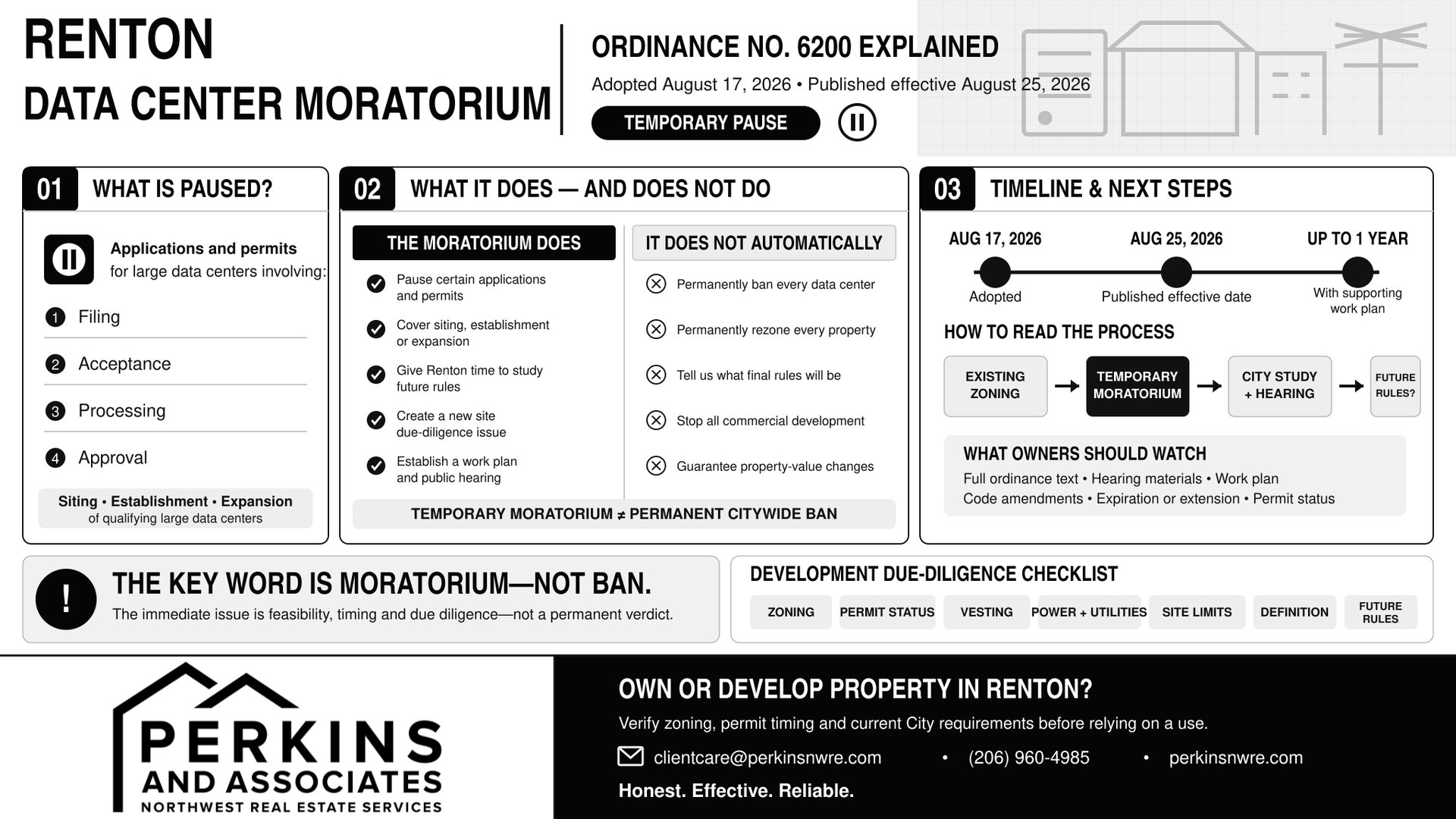
Renton has temporarily paused the filing, acceptance, processing, and approval of applications and permits for new or expanded large data centers while the city studies what longer-term rules should apply. The Renton City Council adopted Ordinance No. 6200 on August 17, 2026, and the city's published ordinance notice lists August 25, 2026 as its effective date.
For commercial property owners, developers, investors, and brokers, the immediate issue is not that Renton has permanently banned data centers. It is that a potential large data center use cannot be evaluated today using the same assumptions that may have applied before the moratorium.
That changes the due-diligence questions around certain commercial and industrial sites. Before relying on a data center as a possible use, owners and buyers now need to pay closer attention to permit status, zoning, the city's work plan, and whatever permanent regulations Renton ultimately considers.
Key takeaways
- Renton adopted Ordinance No. 6200 on August 17, 2026.
- The ordinance pauses the filing, acceptance, processing, and approval of applications and permits for the siting, establishment, or expansion of large data centers.
- The city's published ordinance notice lists August 25, 2026 as the effective date.
- This is a temporary moratorium, not a permanent citywide ban.
- The ordinance establishes a work plan and provides for a public hearing while Renton studies future rules.
- Washington law allows certain development moratoria to remain in effect for up to one year when supported by a work plan.
- Property owners should not assume the moratorium permanently changes the underlying zoning of a parcel.
- Project-specific questions involving pending applications, vested rights, or existing facilities should be confirmed directly with the City of Renton.
What is Renton's data center moratorium?
Renton's data center moratorium is a temporary pause on certain applications and permits for the siting, establishment, or expansion of large data centers inside the city.
The official City Council materials describe Ordinance No. 6200 as stopping the:
- filing,
- acceptance,
- processing,
- and approval
of qualifying applications and permits while the moratorium is in effect.
That wording matters.
A moratorium does not simply mean construction cannot begin tomorrow. It can affect whether an application enters or moves through the city's review process during the temporary period.
What does "moratorium" mean?
A development moratorium is a temporary pause that gives a local government time to study an issue and consider new regulations.
Washington's Growth Management Act allows cities and counties to adopt moratoria or interim official controls, subject to public-hearing and work-plan requirements.
That is different from adopting a permanent prohibition.
Renton has paused certain data center applications while it studies what should happen next.
Did Renton ban data centers?
No. Renton adopted a temporary moratorium affecting large data center applications and permits, not a permanent ban on all data centers.
That distinction is especially important because some headlines may describe the action as a "ban."
The ordinance itself establishes a moratorium, a work plan, and a public-hearing process. Those are signs of a temporary regulatory pause while the city studies longer-term policy.
Renton could eventually adopt new permanent development standards. It could also allow the moratorium to expire after completing its review.
The outcome has not yet been decided.
What the moratorium does and does not automatically do
The moratorium does | It does not automatically do |
|---|---|
Pause certain applications and permits involving large data centers | Permanently ban all data centers in Renton |
Apply to the siting, establishment, or expansion of large data centers | Permanently rezone every commercial or industrial property |
Give Renton time to study future regulations | Tell us exactly what the final regulations will be |
Create a new due-diligence issue for affected sites | Stop all commercial or industrial development in Renton |
Establish a work plan and public-hearing process | Guarantee higher or lower commercial property values |
This distinction is one of the most important points for property owners.
A temporary limitation on one use is not the same thing as rewriting the future of every industrial or commercial parcel.
Does the moratorium change Renton zoning?
The moratorium temporarily affects certain data center applications, but it should not be treated as a permanent rezoning of affected properties.
Renton's normal land-use system still relies on zoning, development standards, environmental review, and project-specific permitting. The city tells applicants to review the zoning code to determine what is allowed on a property and to discuss proposed development with Planning staff before submitting an application.
That distinction matters in commercial real estate.
A parcel may retain the same zoning designation while a temporary moratorium prevents one particular use from moving through the normal application process.
What was Renton's existing treatment of data centers?
Before the 2026 moratorium, Renton had already addressed data centers through its land-use code.
The Municipal Research and Services Center notes that Renton's code places data centers within provisions addressing indoor storage and limits that use to 200,000 square feet.
That background reinforces an important point:
The moratorium is not occurring in a regulatory vacuum. Renton already had land-use rules that touched data centers. The current question is what additional or different standards the city may consider for large facilities.
What counts as a "large data center"?
This is one area where the article should remain careful.
The official ordinance summary repeatedly uses the term "large data centers," but the publicly accessible materials reviewed for this article did not provide enough ordinance text to quote a verified size, power-demand, or square-foot threshold from Ordinance No. 6200 itself.
For a specific project, owners and developers should confirm the ordinance definition directly with the City before deciding whether their proposal falls within the moratorium.
When did the Renton data center moratorium take effect?
Renton adopted Ordinance No. 6200 on August 17, 2026, and the city's published legal notice lists August 25, 2026 as the effective date.
The ordinance title also refers to an emergency declaration and an immediate effective date. Because the published legal notice specifically states Effective 8/25/2026, this article uses August 25 as the published effective date rather than trying to reconcile those phrases independently.
For a permit with timing close to those dates, applicants should verify the City's interpretation directly.
How long will Renton's data center moratorium last?
Current reporting describes Renton's moratorium as lasting for up to one year while the city develops its work plan and considers future regulations.
Washington law generally allows a moratorium for up to six months, with a longer period of up to one year when a work plan is developed for the related studies.
Renton's ordinance specifically says it establishes a work plan.
The practical takeaway is not to build a development schedule around an assumed end date without checking the city's current ordinance and hearing materials first.
Why is Renton reviewing large data centers?
Renton is using the moratorium to give itself time to study large data centers and determine whether its current development regulations are adequate before more projects move through permitting.
The official ordinance summary confirms that Renton adopted findings of fact and a work plan alongside the moratorium.
Large data centers can raise questions involving:
- land-use compatibility,
- electric capacity,
- utilities,
- industrial land,
- building scale,
- infrastructure,
- environmental review,
- noise and backup equipment,
- and the amount of employment or economic activity produced relative to land consumption.
Those issues should not automatically be presented as Renton's findings unless the city's final ordinance or work-plan documents say so.
The broader regional discussion shows why cities are reviewing the use. Seattle, for example, adopted its own 2026 moratorium while studying grid capacity, water, land-use, workforce, environmental, and public-health questions. Renton's policy must still be evaluated on Renton's own record.
Which Renton properties could be most relevant?
Commercial and industrial properties that could plausibly support a large data center are the most obvious sites where the moratorium deserves closer due diligence, but the effect on any specific parcel depends on the proposed use, zoning, permit history, and ordinance definitions.
That means owners should be cautious about broad statements such as:
"This property is zoned for a data center."
Zoning is only one part of development feasibility.
A serious site analysis may also need to address:
- current permitted uses,
- development standards,
- parcel size,
- utility availability,
- power requirements,
- environmental constraints,
- access,
- site-plan review,
- and the moratorium itself.
The City of Renton recommends a pre-application meeting for new commercial or industrial development and uses that process to discuss zoning, permitting, timelines, fees, and feasibility before a formal land-use application is filed.
For someone considering an acquisition, that can be an important due-diligence step.
Does the moratorium affect existing data centers?
Ordinance No. 6200 expressly covers the expansion of large data centers, but the public materials reviewed for this article do not support a blanket statement that all existing facilities are otherwise prohibited from continuing to operate.
That distinction matters.
An existing use, an expansion, a pending land-use application, and a new application can all involve different legal questions.
Property owners should verify:
- whether the existing use is legally established,
- whether a proposed project constitutes an expansion,
- whether an application was already filed,
- whether any permits have vested,
- and whether the ordinance contains an exemption that applies to the project.
Those are project-specific questions.
This article should not substitute for direct confirmation from Renton Planning or legal counsel where vested-development rights are involved.
What happens to pending data center applications?
The current official summary does not provide enough detail to state that every pending application is automatically exempt or automatically stopped.
This is one area where assumptions are risky.
The ordinance title clearly includes the processing and approval of applications, not just the filing of new ones.
However, how that language interacts with a particular project's filing date, completeness, vesting status, or prior approvals can depend on facts not visible in a general ordinance summary.
For an active project, owners and developers should verify status directly with the City.
Can property owners still submit other commercial or industrial development applications?
Yes. The moratorium is directed at large data centers, not at development in Renton generally.
Renton's normal permit system continues to cover:
- site-plan review,
- conditional uses,
- master plans,
- commercial and industrial development,
- environmental review,
- rezones,
- subdivisions,
- building permits,
- and other land-use approvals.
The city's development process also still encourages property owners to research zoning and discuss potential projects with Planning staff before formal submission.
So a property affected by the data center moratorium may still have other development paths depending on its zoning and site conditions.
For broader context on how land-use and redevelopment policy is shaping the city, see Renton Real Estate in 2026: ADUs, Land Use, and Redevelopment Trends to Watch.
What should Renton property owners and developers watch next?
The most important next steps are Renton's public process, work plan, and any permanent code changes proposed during the moratorium.
1. The full Ordinance No. 6200 text
Owners should confirm the city's exact definition of a large data center and any exemptions or transition provisions.
2. Public-hearing materials
Washington law requires a public hearing after certain moratoria are adopted, and Ordinance No. 6200 expressly provides for a public hearing.
As of this draft, a specific hearing date was not verified in the public materials reviewed.
3. The City's work plan
The work plan should help reveal which permanent development questions Renton intends to study.
4. Proposed code amendments
Potential future rules could address where large data centers are allowed or the standards they must satisfy.
Those rules should not be predicted before the city publishes them.
5. Utility requirements
Large-load feasibility may matter independently from zoning. Property owners should not assume that land-use permission alone guarantees adequate electrical or utility capacity.
6. Existing or vested permit status
Anyone with a project already in the development pipeline should verify how the moratorium applies to that specific application.
7. Expiration or extension
A project schedule should be updated if Renton adopts permanent rules, extends the moratorium, or allows it to expire.
What could happen after the moratorium?
Renton could ultimately adopt permanent data center standards, revise existing land-use rules, allow the temporary moratorium to expire, or take another legally available approach after completing its study.
The moratorium itself does not tell us which outcome the City Council will choose.
That is why property owners should separate three stages:
- What the code allowed before the moratorium
- What Ordinance No. 6200 temporarily pauses now
- What permanent rules Renton may adopt later
Those are three different questions.
A proposed future rule should not be treated as adopted law before council action.
How does the data center moratorium fit into Renton's broader land-use strategy?
The moratorium is one narrow policy issue inside a much larger Renton planning framework covering land use, housing, transportation, economic development, utilities, infrastructure, and long-term growth.
Renton's Comprehensive Plan is the city's broader framework for growth and development.
That broader context matters because the city is simultaneously making decisions about:
- housing,
- employment areas,
- transportation,
- redevelopment,
- infrastructure,
- zoning,
- and commercial land.
A temporary data center moratorium should therefore be read as one specific land-use decision, not as Renton's entire development strategy.
For additional context, see Renton Real Estate in 2026: ADUs, Land Use, and Redevelopment Trends to Watch.
Expert insight: What this means locally
The most important word in Renton's new data center policy is "moratorium," not "ban."
For property owners and developers, the immediate effect is about feasibility, timing, and due diligence.
A parcel may still have commercial or industrial development value even if a large data center application cannot currently move forward.
Likewise, a site that once appeared suitable for data center development should not automatically be marketed or purchased on the assumption that the same use remains available under today's permitting environment.
The practical approach is to separate:
underlying zoning + current moratorium + permit status + future code changes
before making a development or acquisition decision.
A moratorium can change the development timeline long before it tells us anything reliable about long-term property value.
Frequently asked questions
Did Renton permanently ban data centers?
No. Renton adopted a temporary moratorium affecting applications and permits for large data centers. Ordinance No. 6200 also establishes a work plan and public-hearing process for further study.
What does Renton Ordinance No. 6200 do?
It pauses the filing, acceptance, processing, and approval of applications and permits for the siting, establishment, or expansion of large data centers in Renton.
When does the moratorium take effect?
The City Council adopted the ordinance on August 17, 2026, and Renton's published legal notice lists August 25, 2026 as the effective date.
How long can the moratorium last?
Current reporting describes Renton's moratorium as lasting for up to one year. Washington law allows a one-year period when an appropriate work plan supports the extended moratorium.
Does the moratorium affect existing data centers?
The ordinance expressly covers expansion of large data centers, but existing-operation questions should be evaluated project by project.
Can developers submit new large data center applications during the moratorium?
The ordinance specifically pauses the filing and acceptance of qualifying applications and permits, so developers should not assume a new large data center application can enter the normal review process while the moratorium applies.
Does the moratorium stop all commercial development in Renton?
No. Renton's normal commercial, industrial, land-use, environmental, and building permit processes continue for other qualifying uses and projects.
Could Renton adopt permanent data center zoning rules later?
Yes. Developing longer-term regulations is one possible outcome of the City's work during the temporary moratorium, but the final rules have not yet been determined.
Helpful resources
City of Renton City Council agendas and ordinance summaries
Official City source for Ordinance No. 6200, council actions, ordinance summaries, public-hearing information, and future policy updates.
City of Renton Land Use Development
Official Renton guidance on zoning, land-use approvals, development review, environmental review, and permitting.
City of Renton Pre-Application Meetings
Useful for commercial property owners and developers evaluating zoning, project feasibility, permit requirements, timelines, and development issues before submitting a formal application.
Washington RCW 36.70A.390
Washington state law governing local development moratoria and interim official controls under the Growth Management Act, including hearing and work-plan requirements.
City of Renton Comprehensive Plan
The City's broader framework for land use, housing, employment, transportation, utilities, infrastructure, economic development, and long-term growth.
MRSC: How Can Local Governments Prepare for Data Centers?
Washington-focused local-government guidance on data center regulation, including discussion of existing Renton land-use provisions and approaches used by other jurisdictions.
Seattle City Council: 2026 Data Center Moratorium and Policy Framework
Useful regional context for understanding why other King County jurisdictions are also studying data center land use, infrastructure, utilities, and development standards. Seattle's policy is separate from Renton's and should not be treated as evidence of Renton's specific findings.
Your Next Steps
If you are thinking about buying, selling, or planning your next move, our team is happy to help you think through your options and next steps.
📧 [email protected]
📱 (206) 960-4985
Honest. Effective. Reliable.