Auburn Development Agreement Rules Are Being Updated: What Property Owners Should Know
Auburn already uses development agreements for some larger and more complicated real estate projects.
What the City is proposing now is a more formal framework.
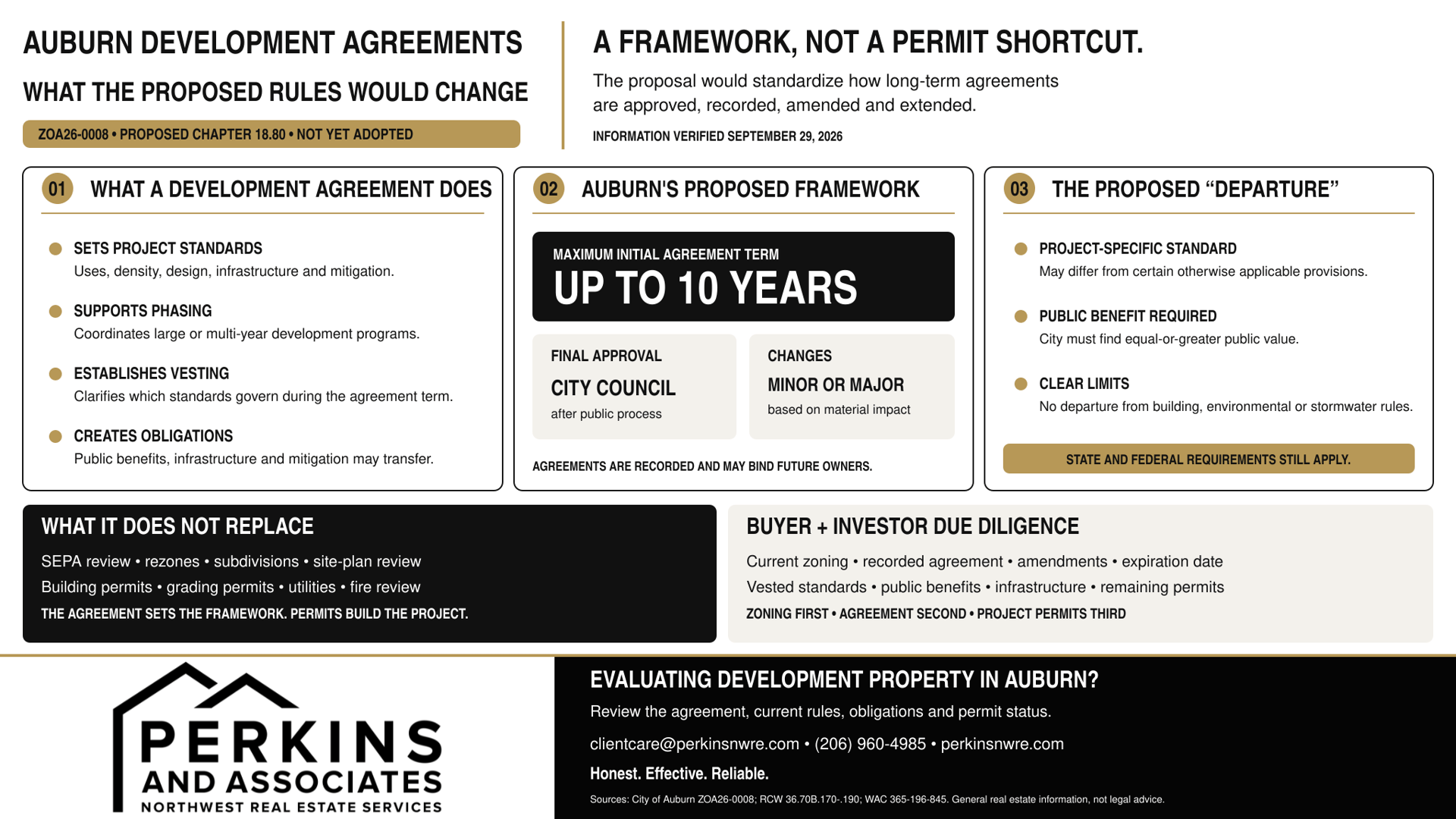
Under ZOA26-0008 and draft Ordinance 7027, Auburn would add a new Chapter 18.80 to its zoning code with specific rules for how development agreements are requested, reviewed, approved, recorded, amended and extended.
The proposal could matter most for master-planned development, redevelopment, mixed-use projects and properties involving major infrastructure or long construction timelines.
But it does not create a shortcut around normal development review.
Washington law requires development agreements to remain consistent with applicable development regulations, and Auburn's own environmental review says future projects would still be subject to required project permits and SEPA review.
Key takeaways
- Auburn already uses development agreements.
- ZOA26-0008 would create a dedicated Chapter 18.80 with standardized citywide procedures.
- The proposal remains pending as of September 29, 2026.
- Development agreements are voluntary contracts between a local government and a property owner or developer.
- They can address uses, density, building size, mitigation, infrastructure, affordable housing, phasing and vesting.
- Auburn's proposal introduces a formal process called a “departure” for certain project standards.
- Auburn's proposed departure framework would require an equal-or-greater public benefit.
- Washington law still requires development agreements to remain consistent with applicable development regulations.
- Auburn's proposal specifically prevents departures from building, environmental and stormwater regulations and from rules implementing state or federal law.
- Development agreements would not replace SEPA, building permits, subdivisions, rezones or other required approvals.
- The proposed initial agreement term could be up to 10 years, with possible extensions.
- Development agreements are recorded and can bind future owners during the agreement term.
- Buyers of redevelopment property should review recorded agreements and amendments, not just the zoning designation.
What is a development agreement in Washington?
A development agreement is a voluntary contract between a local government and a person who owns or controls real property.
The agreement establishes development standards, obligations and procedures that will apply to the property for a defined period.
Washington law allows a development agreement to address subjects such as:
- Permitted uses
- Residential density
- Commercial or industrial intensity
- Building size
- Design standards
- Mitigation
- Affordable housing
- Parks and open space
- Infrastructure
- Phasing
- Review procedures
- Vesting and build-out periods
The agreement can also establish how certain requirements will apply to a complicated or long-term development.
Importantly, Washington's administrative rules say development agreements must remain consistent with applicable development regulations. They are not a general mechanism for simply waiving rules that would otherwise apply to a project.
Read RCW 36.70B.170 on Washington development agreements
Does Auburn already use development agreements?
Yes.
Auburn is not creating this tool from scratch.
The City's proposal says Auburn has historically used individually negotiated development agreements but does not currently have a dedicated zoning-code chapter establishing a standard citywide framework.
That distinction matters.
The proposal is primarily about creating a clearer process for future agreements, including who approves them, how the public is notified, how long they may last, how they can be amended and what standards should apply.
Auburn is also dealing with a broader redevelopment environment where larger properties may involve multiple uses, infrastructure work and development that occurs over several years.
For another example of Auburn updating its land-use framework in 2026, see our guide to Auburn's proposed live/work zoning rules.
What is Auburn proposing under ZOA26-0008?
ZOA26-0008 is a citywide zoning-text amendment that would create Chapter 18.80, Development Agreements, in the Auburn City Code.
Washington's Department of Ecology describes it as a nonproject code amendment establishing:
- Procedures for reviewing and approving development agreements
- Approval criteria
- Standards for development agreements
- Limits on departures from development regulations
- Amendment procedures
- Continued project-level permitting and environmental review
The Ecology record also confirms that the proposal itself does not approve any individual development project.
Review Auburn's official SEPA record for proposed Chapter 18.80
Why does Auburn want a dedicated development agreement chapter?
The practical goal is more consistency.
When development agreements are negotiated one project at a time without a dedicated code chapter, applicants and the public have less standardized guidance about:
- What information must be submitted
- Which projects are appropriate for an agreement
- What City Council must consider
- How public notice works
- What can be negotiated
- How long an agreement can remain in effect
- How amendments are handled later
A dedicated code chapter can give both the City and property owners a clearer starting point.
That matters most on projects where a normal permit alone may not address the full development timeline, infrastructure commitments, phasing or long-term obligations.
What types of Auburn projects could use a development agreement?
Development agreements tend to be most useful when a project is larger or more complicated than a routine permit application.
Auburn's planning materials identify examples such as:
- Large mixed-use projects
- Master-planned developments
- Major redevelopment
- Public-private partnerships
- Projects requiring significant infrastructure
- Projects built in multiple phases
That does not mean a smaller property is automatically prohibited from using one.
But the value of an agreement becomes easier to understand when a project will take years, require major improvements or involve several different approvals.
What can a development agreement address?
A development agreement can cover many of the same subjects that matter in zoning and project review.
For example, an agreement may address:
- Land uses
- Residential density
- Commercial or industrial intensity
- Building size
- Height and design standards
- Parking
- Affordable housing
- Parks and open space
- Infrastructure
- SEPA mitigation
- Phasing
- Vesting
- Build-out periods
Washington law expressly recognizes these subjects as appropriate components of a development agreement.
But there is an important distinction:
A development agreement being allowed to address a subject does not automatically mean the agreement may set that standard at a level that conflicts with otherwise applicable development regulations.
That question becomes especially important in Auburn's proposed “departure” section.
What does Auburn mean by a “departure”?
Auburn's proposed Chapter 18.80 uses the term departure for certain project-specific standards that may differ from an otherwise applicable Auburn City Code provision.
The draft places conditions around that process.
A departure would need to remain consistent with the City's Comprehensive Plan, applicable state law and the overall purpose and intent of the affected regulation.
The proposal also identifies certain subjects, including permitted land uses, residential density, floor-area ratio and maximum building height, where express City Council approval would be required.
What is the public-benefit requirement?
Auburn's proposal would require a requested departure to be offset by a public benefit that the City determines has equal or greater value.
The City's proposed framework does not require that benefit to be measured only in dollars.
It also does not necessarily require the benefit to be the same type as the standard being modified.
For example, a project request involving one development standard could potentially be evaluated alongside infrastructure, public space, housing or another benefit identified through the agreement.
This equal-or-greater-benefit test is part of Auburn's proposed Chapter 18.80. It should not be confused with a universal statewide rule that every Washington development agreement must use the same formula.
Does that mean Auburn can waive zoning rules?
That conclusion would be too broad.
Washington's current administrative rule states that development agreements must be consistent with applicable development regulations and do not provide a general means of waiving or amending regulations that otherwise apply.
State law does allow development agreements to specify how existing discretion is used and to establish project standards that govern during the agreement term.
So the safest way to understand Auburn's proposed departure process is:
Auburn is proposing a City Council-controlled framework for certain project-specific standards, but the final ordinance must still operate within Washington's development-agreement law and the applicable underlying regulations.
How that works for a specific property would depend on the adopted ordinance, the current zoning and the facts of the project.
Read Washington's development-agreement rule, WAC 365-196-845
What standards could not be changed through Auburn's proposed process?
Auburn's proposal sets clear boundaries around the departure concept.
According to the City's SEPA record, development agreements would not be allowed to authorize departures from:
- Auburn City Code Title 15, Buildings and Construction
- Auburn City Code Title 16, Environment
- Chapter 13.48, Storm Drainage Utility
- Requirements implementing state law
- Requirements implementing federal law
The Ecology record specifically says future development proposals would remain subject to applicable project-permit and SEPA review.
That means the proposal should not be understood as a way around building safety, environmental regulations or stormwater requirements.
Does a development agreement replace zoning, SEPA or permits?
No.
A development agreement does not eliminate other approvals that are legally required for a project.
Washington's administrative rules specifically state that development agreements cannot be used to bypass procedural requirements that would otherwise apply.
Depending on the project, separate approvals may still include:
- Rezone review
- SEPA review
- Subdivision or short-plat approval
- Conditional-use permits
- Shoreline permits
- Site-plan review
- Clearing and grading permits
- Building permits
- Utility approvals
- Fire review
This is one of the most important points for property owners.
A development agreement can establish a framework.
It does not mean the project can skip the permits needed to carry out that framework.
Who would approve an Auburn development agreement?
Under Washington law, the local legislative authority approves a development agreement after a public hearing.
Auburn's proposed framework places final approval with the Auburn City Council.
That means major development agreements would not simply be negotiated privately between City staff and a property owner.
The public process is part of the approval.
How would the public participate?
Auburn's proposed Chapter 18.80 creates a notice and hearing process before City Council approval.
That matters for both applicants and nearby owners.
A development agreement can govern a property for years and may address subjects such as land use, density, infrastructure and project phasing.
Giving neighboring owners and other interested parties an opportunity to review and comment on the agreement helps make the process more transparent.
Washington law independently requires a public hearing before a city or county approves a development agreement.
How long could an Auburn development agreement last?
Under the current proposal, an Auburn development agreement could have an initial term of up to 10 years.
The draft also provides a path for extensions, including the possibility of two additional five-year periods under qualifying circumstances and the procedures established in the agreement and code.
That can be significant for a large development.
A multi-phase industrial, commercial, mixed-use or residential project may take years to finance, build infrastructure and complete individual buildings.
A longer agreement period can provide more certainty about the standards that apply while the development is being built.
But an extension should not be assumed to be automatic.
The agreement itself, the final ordinance and the project's progress would matter.
What does vesting mean?
Vesting is one of the biggest reasons a development agreement can matter to an owner or investor.
In simple terms, vesting can provide more certainty about which development standards govern a project over time.
Washington law says that, unless amended or terminated, the agreement and the standards contained in it govern during the term or specified build-out period and generally are not subject to later zoning or development-standard changes adopted after the agreement becomes effective.
That can be important on a project that takes several years.
Without some form of vesting, a major regulatory change during the middle of development could affect project assumptions.
A development agreement can help establish that regulatory framework in advance.
Read RCW 36.70B.180 on the effect of development agreements
What happens if the property is sold?
A development agreement can continue to matter after the original owner sells the property.
Washington law requires development agreements to be recorded in the county's real-property records.
During the agreement term, the agreement binds the parties and their successors.
That creates a very practical due-diligence issue.
Someone buying an Auburn redevelopment property should not stop at:
What is the zoning?
They should also ask:
- Is there a recorded development agreement?
- Has it been amended?
- When does it expire?
- What standards are vested?
- What infrastructure obligations remain?
- Are public benefits or mitigation still outstanding?
- Are there extension rights?
- Have later permits changed the development plan?
A recorded agreement may materially affect what a buyer is actually acquiring.
Read RCW 36.70B.190 on recording and successors
How would amendments work?
Auburn's proposal separates changes into minor amendments and major amendments.
That distinction matters because large projects rarely remain exactly the same from the first concept through final build-out.
Minor amendments
The proposed framework could allow certain limited or administrative changes to be handled without restarting the full Council approval process.
Examples could include clerical corrections, ownership information and other changes that do not materially increase the project's intensity or reduce required public benefits.
Major amendments
Changes involving more significant project terms would return to the City Council process.
Examples may include changes to:
- Land use
- Density
- Development intensity
- Building height
- Floor-area ratio
- Major project phasing
- Infrastructure commitments
- Affordable-housing commitments
- Required public benefits
This structure is intended to distinguish routine implementation changes from decisions that could materially alter what the City originally approved.
Auburn 18 Business Park shows how development agreements work in practice
Auburn already has a useful real-world example.
The Auburn 18 Business Park redevelopment has proceeded under a development agreement establishing development standards and vesting for the site.
Current City permit data shows that the property still needed later project approvals.
The permit database lists:
- Active site-development and water-main work
- SEPA review
- Civil and infrastructure permits
- A building permit for a new 612,000-square-foot distribution center
That building permit has been issued, and related infrastructure work remains in construction.
Review Auburn 18 Business Park permit activity
This is a useful example of the distinction:
The development agreement established the framework. It did not replace the permits needed to actually construct the project.
What could the proposed rules mean for Auburn property owners?
For someone who owns a larger development or redevelopment site, Chapter 18.80 could make the City's expectations more predictable.
A property owner would have a clearer framework for:
- Requesting a development agreement
- Understanding what information must be supplied
- Knowing who makes the final decision
- Negotiating project timing
- Establishing vesting
- Addressing infrastructure
- Understanding public-benefit obligations
- Planning for amendments
- Knowing how the agreement affects a future sale
Predictability can be useful.
But a development agreement also creates obligations.
An owner should evaluate both sides of the agreement, not only the regulatory certainty it provides.
What could this mean for investors and developers?
For investors, the biggest value may be the ability to understand the project's regulatory framework over a longer period.
That can matter when underwriting:
- Land acquisition
- Infrastructure cost
- Phased construction
- Financing
- Tenant delivery
- Future building permits
- Exit timing
But the agreement itself becomes part of due diligence.
An investor should review:
- Current zoning
- Comprehensive Plan designation
- The development agreement
- Recorded amendments
- Vesting period
- Public-benefit commitments
- Required infrastructure
- Existing permits
- Environmental conditions
- Remaining approval risk
For related Auburn zoning context, see our guide to Washington's commercial and mixed-use housing changes in Renton, Kent and Auburn.
What could development agreements mean for sellers?
A development agreement can become part of how a redevelopment property is marketed.
A seller may be able to point to:
- Established development standards
- Vesting
- Approved infrastructure concepts
- A defined build-out period
- Existing permit activity
But it is important not to reduce that to a statement such as:
"The property is fully entitled."
That may not be accurate.
A buyer still needs to determine what has actually been approved, what permits remain outstanding, whether the agreement is still in force and what obligations will transfer with the property.
For general Auburn housing and development context, see our comparison of new construction versus resale homes in Auburn.
Is Auburn's new Chapter 18.80 adopted yet?
No, not as of September 29, 2026.
The City of Auburn's public-notice page lists a September 24 Notice of Hearing for Development Agreement Code Update ZOA26-0008.
Ordinance 7027 appeared on Auburn's September 28 City Council Study Session agenda as a discussion item.
The City states that no final action is taken at Council Study Sessions.
So this article should continue to refer to Chapter 18.80 as proposed until the City formally adopts an ordinance.
Follow Auburn's current public land-use notices
Expert insight: A development agreement creates a framework, not a shortcut
For a large Auburn development property, a development agreement can be just as important as the zoning map.
It may establish project standards, vesting, infrastructure commitments and long-term obligations that continue for years.
But the agreement should never be reviewed in isolation.
The practical order is:
zoning first, development agreement second, project permits third.
Then look at environmental review, infrastructure, recorded amendments and current permit status.
That gives a much more complete picture of what the property can actually support.
Frequently asked questions about Auburn development agreements
What is an Auburn development agreement?
It is a voluntary agreement between the City and a property owner or developer that establishes standards, obligations and procedures governing development for a defined period.
Has Auburn adopted Chapter 18.80?
No. As of September 29, 2026, ZOA26-0008 remains an active code-update process and Ordinance 7027 has been discussed at a Council Study Session.
Can a development agreement override Auburn zoning?
It should not be described that broadly. Washington law requires development agreements to remain consistent with applicable development regulations. Auburn's proposal creates a process it calls a departure, but that process still has to operate within state law and the final adopted code.
Does a development agreement replace SEPA or building permits?
No. Auburn's SEPA record expressly says future development remains subject to applicable project-permit and environmental review.
Who approves an Auburn development agreement?
Under the proposed framework, final approval would be made by the Auburn City Council after the required public process.
How long could an Auburn development agreement last?
The current proposal allows an initial term of up to 10 years, with possible extensions under the procedures and conditions established by the final code and agreement.
Does the agreement stay with the property if it is sold?
Yes, during its term. Washington law requires development agreements to be recorded and makes them binding on successors.
Why does vesting matter?
Vesting can provide certainty about which development standards govern a project during the agreement or build-out period, subject to the agreement and applicable law.
Are development agreements mainly for large projects?
They can be used more broadly, but they are especially useful for large, phased, infrastructure-heavy or master-planned projects where long-term certainty and coordinated obligations matter.
Helpful resources
City of Auburn: Current public land-use notices
Includes the active ZOA26-0008 Development Agreement Code Update.
View Auburn public land-use notices
Washington Department of Ecology: Proposed Chapter 18.80 SEPA record
Explains the scope of Auburn's proposed code amendment and confirms that future projects remain subject to project permitting and SEPA.
View the Auburn Chapter 18.80 SEPA record
Washington Legislature: RCW 36.70B.170
State authority for development agreements and the types of standards they may address.
Read RCW 36.70B.170
Washington Administrative Code: WAC 365-196-845
Explains consistency with development regulations and the rule that agreements cannot bypass required procedures.
Read WAC 365-196-845
Washington Legislature: RCW 36.70B.180
Explains how development standards in an agreement govern during the agreement or build-out period.
Read RCW 36.70B.180
Washington Legislature: RCW 36.70B.190
Explains recording requirements and how agreements bind successors.
Read RCW 36.70B.190
MRSC: Development Agreements
Plain-English overview of how Washington local governments use development agreements.
Review MRSC's development agreement guide
Auburn 18 Business Park permit record
A current Auburn example showing how a development agreement can establish a framework while later project permits are still required.
Review Auburn 18 Business Park permit activity
Thinking about selling, buying or evaluating development property in Auburn?
Development agreements can affect what is possible on a property, how long development rights may remain vested and what obligations a future owner may inherit.
If you are evaluating a development, redevelopment or investment property in Auburn or elsewhere in South King County, reach out to Perkins & Associates. We can help you look at the real estate side of the property and identify the City records, zoning information and development documents that should be reviewed before making a decision.
📧 [email protected]
📱 (206) 960-4985
Honest. Effective. Reliable.
This article provides general real estate information and is not legal advice. Association documents, purchase agreements, statutory applicability, and transaction deadlines can vary. Buyers and sellers should review their specific documents and seek legal advice when a legal interpretation is needed.