Receiving a higher property valuation can be unsettling, especially when homeowners expect that increase to affect a future tax bill. King County homeowners have the right to challenge an assessment when they believe it exceeds the property’s true and fair market value.
However, a property assessment appeal is not a general protest against rising taxes. Homeowners appeal the assessed value of the property, not the tax rate, local levies, or the amount they feel able to pay.
A useful appeal is built around market evidence. That may include comparable sales, an independent appraisal, photographs, contractor estimates, easements, access limitations, or records showing that the county’s property information is inaccurate.
The deadlines are also strict. King County generally requires a petition by the later of July 1 of the assessment year or 60 calendar days after the mailing date printed on the valuation notice. Because notices are mailed at different times, each homeowner should verify the deadline attached to their property.
This article provides general educational information. It is not legal, tax, or appraisal advice.
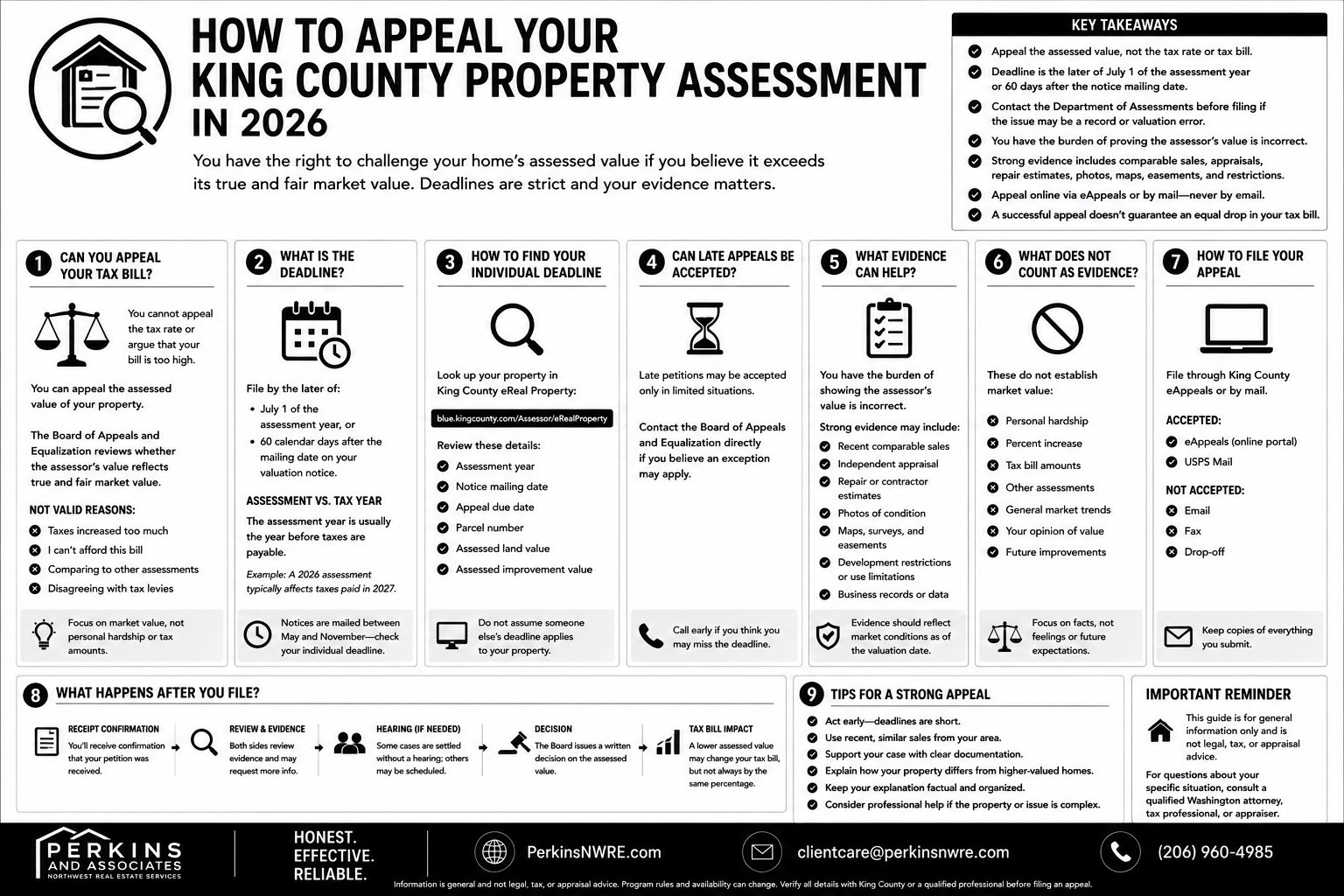
Key takeaways
- Homeowners appeal their property’s assessed market value, not the tax rate or the amount of the tax bill.
- A petition is generally due by the later of July 1 of the assessment year or 60 calendar days after the valuation notice was mailed.
- King County recommends contacting the Department of Assessments before filing when the issue may involve a property-record or valuation error.
- The homeowner has the burden of showing that the assessor’s value is incorrect.
- Strong evidence may include comparable sales, appraisals, repair estimates, photographs, maps, easements, and development restrictions.
- Personal hardship, percentage increases, tax amounts, and comparisons with other assessments generally cannot establish market value.
- Appeals may be submitted through King County eAppeals or by mail, but not by email.
- A successful assessment appeal does not guarantee that the property tax bill will fall by the same percentage.
Can you appeal your King County property tax bill?
You cannot directly appeal the tax rate or simply argue that the bill is too high. The formal appeal challenges the value assigned to the property by the King County Department of Assessments.
This distinction matters because a property tax bill has more than one component. The assessed value is part of the calculation, but the final bill is also influenced by levy rates and the property’s share of the total assessed value within its taxing districts.
The King County Board of Appeals and Equalization reviews whether the assessor’s valuation reflects the property’s true and fair market value. It does not decide whether local tax measures, school levies, or other public charges should have been approved.
A homeowner therefore needs to make a market-value argument:
Based on the property’s condition, characteristics, limitations, and relevant sales near the valuation date, the assessed value is higher than fair market value.
Statements such as “my taxes increased too much” or “I cannot afford this bill” may describe a genuine concern, but they do not establish that the property was overvalued.
For a broader explanation of assessments and tax timing, Perkins & Associates’ guide to Washington State real estate taxes explains how assessed values relate to future tax bills.
What is the deadline for a King County property tax appeal?
A petition generally must be filed by the later of:
- July 1 of the assessment year, or
- 60 calendar days after the mailing date printed on the valuation notice or other notice of determination.
King County mails valuation change notices between May and November. This means homeowners do not all have the same filing deadline. The appeal date should be confirmed using the notice or King County’s property lookup system.
Assessment year versus tax year
The assessment year is usually the year before the related taxes become payable.
For example, a property value established during 2026 generally affects taxes due in 2027. This is why the date on the valuation notice may not match the year shown on the next tax statement.
How to find your individual deadline
King County directs homeowners to look up their address or parcel in its eReal Property system. The property record may display the appeal filing due date.
Homeowners should verify:
- The assessment year
- The notice mailing date
- The appeal due date
- The parcel number
- The assessed land value
- The assessed improvement value
Do not assume that another homeowner’s deadline applies to your property.
Can King County accept a late appeal?
Late petitions may be accepted only under limited conditions. A homeowner who believes an exception may apply should contact the King County Board of Appeals and Equalization directly rather than assuming a late petition will be reviewed.
Should you contact the assessor before filing?
Yes. King County recommends contacting the Department of Assessments before filing when the issue may involve an incorrect property record or valuation mistake.
The assessor’s property record may contain information about:
- Living area
- Lot size
- Year built
- Building quality
- Property condition
- Bedrooms and bathrooms
- Garages and other improvements
- Zoning
- Sale history
- Land characteristics
An error in square footage, condition, improvements, or land details may affect the valuation.
Homeowners can review property characteristics, valuations, sales history, and levy information through King County’s eReal Property system. The Department of Assessments also provides direct assistance by phone and email.
Contacting the assessor does not extend the formal appeal deadline. If the filing date is approaching, homeowners should protect the deadline while continuing to discuss the valuation with the department.
What reasons can support a King County assessment appeal?
The strongest argument is that the assessor’s value exceeds the property’s fair market value as of the relevant valuation date.
Potential grounds may include:
- Incorrect property characteristics
- Recent comparable sales below the assessed value
- A recent arm’s-length sale of the subject property
- Significant property damage
- Structural or land defects
- Easements affecting use or value
- Access limitations
- Drainage or topography problems
- Government restrictions on development
- Adverse location conditions
- An independent appraisal supporting a lower value
The appeal should explain how each fact affects market value. A list of property problems without a value connection may be less persuasive than evidence showing how buyers would likely respond to those conditions.
What arguments will the Board not consider?
The King County Board cannot base its valuation decision on matters unrelated to fair market value.
King County specifically identifies the following as arguments the Board cannot consider:
- Assessment comparisons with other properties
- Percentage increases in assessed value
- Personal hardship
- The amount of tax owed
- Other matters unrelated to market value
The Board begins with a legal presumption that the assessor’s valuation is correct. The property owner carries the burden of presenting evidence that shows otherwise.
“My assessment increased by 20%”
A large increase does not prove that the final value is above market value. The question is whether the new assessment accurately reflects the property’s market value as of the valuation date.
“My neighbor’s assessment is lower”
A nearby assessment does not necessarily show what the subject property would sell for. The homes may differ in condition, size, lot utility, updates, zoning, view, location, or assessed characteristics.
Comparable sales are generally more useful than comparisons between assessment records.
“I cannot afford the taxes”
Financial hardship does not establish a lower market value. Homeowners facing affordability concerns may need to explore property tax exemption, deferral, or assistance programs separately from the assessment appeal.
The King County Assessor maintains information about relief programs for qualifying seniors, disabled veterans, and people with disabilities.
What evidence may help prove that a home is overassessed?
King County says compelling, market-based evidence is central to a successful appeal.
Official examples include:
- Comparable sales
- A sale of the subject property
- Independent appraisals
- Contractor estimates for defects
- Government or expert documents describing development limitations
- Deeds showing easements
- Photographs of value-reducing conditions
- Maps showing access issues, traffic exposure, or other detractors
King County reports that approximately 25% of property values appealed to the Board receive some type of reduction. That figure is not a prediction for an individual case. The strength and relevance of the evidence remain the deciding factors.
How to choose comparable sales
The best comparable sales usually share important characteristics with the subject property and occurred near the valuation date.
Look for sales with similar:
- Location
- Property type
- Lot size
- Living area
- Age
- Construction quality
- Condition
- Bedroom and bathroom count
- Garage or parking
- View or waterfront influence
- Zoning
- Renovation level
Comparable properties do not need to be exact matches. The appeal should identify important differences and explain how those differences affect value.
For example, a larger renovated home may still be useful if the analysis makes a reasonable adjustment for size and condition. A smaller distressed sale across the county may be less useful even if its sale price is lower.
King County notes that comparable-sale assistance may be available through the Assessor, the Property Tax Advisor, real estate professionals, and title companies.
Why the valuation date matters
The Board is evaluating value as of a specific date, not necessarily the date the appeal is submitted.
A sale from several months after the valuation date may still provide context, but it may require an explanation of whether the market changed during that period.
This is especially important in King County communities where inventory and buyer activity can vary between Maple Valley, Kent, Renton, Auburn, Covington, Black Diamond, Seattle, and the Eastside.
Perkins & Associates’ South King County housing market outlook provides broader context on how inventory and local demand may influence market conditions. It should not replace property-specific comparable evidence.
When repair estimates may help
Repair estimates may be useful when a defect existed on the valuation date and would likely influence what a buyer would pay.
Examples may include:
- Foundation problems
- Failed septic components
- Serious roof damage
- Drainage issues
- Retaining-wall failure
- Fire or water damage
- Unsafe structures
- Major deferred maintenance
The estimate should describe the problem and the likely cost to address it. Photographs, inspection findings, engineering reports, or contractor statements may strengthen the explanation.
Routine maintenance or cosmetic preferences may carry less weight unless they materially affect the property’s marketability or condition.
When an independent appraisal may be useful
An appraisal may be worth considering when:
- The property is unusual
- Few comparable sales exist
- The amount in dispute is substantial
- The property includes development or land-use complications
- The homeowner needs a more formal opinion of value
- The assessor and homeowner interpret the same sales differently
An appraisal does not guarantee a reduction. The Board will still consider whether the appraisal addresses the correct valuation date and relies on relevant evidence.
Can a real estate professional help with the appeal?
A real estate professional may help a homeowner find and understand comparable sales, but the homeowner remains responsible for the petition and the argument presented to the Board.
A local real estate team may assist with:
- Identifying recent sales
- Comparing property features
- Explaining neighborhood-level demand
- Reviewing current and past listings
- Distinguishing market price from assessed value
- Preparing a comparative market analysis
A comparative market analysis is not the same as a licensed appraisal. It is a real estate market analysis based on available sales, listings, property condition, and local activity.
The role should also remain clear. A real estate professional can provide market context, but cannot provide legal representation, make the Board’s decision, or guarantee a tax reduction.
For homeowners in Maple Valley, Perkins & Associates’ guide to Maple Valley home-price trends offers additional background on local pricing factors. Property-specific appeal evidence should still focus on the correct valuation date and the most relevant comparable sales.
How do you file a King County property tax appeal?
King County allows homeowners to file online through eAppeals or submit the petition by mail. Petitions are not accepted by email.
A separate petition is required for each parcel being appealed.
What a complete petition must include
King County requires:
- The assessor’s parcel number
- The taxpayer’s name and address
- Representative information and power of attorney, when applicable
- A property description
- The assessor’s value
- The homeowner’s opinion of value
- Specific reasons the assessment does not reflect fair market value
- The taxpayer’s signature and date
- A copy of the valuation change notice or other determination notice
The Board cannot consider an incomplete petition.
Filing online through eAppeals
King County’s eAppeals portal allows homeowners to:
- Submit the petition online
- Upload documents
- Track the case
- View appeal records
- Receive Board and Assessor documents
King County says an email confirmation should be sent within 24 hours after online submission.
Filing by mail
A paper petition, attachments, and evidence may be mailed to:
King County Board of Equalization
516 Third Avenue, Room 1222
Seattle, WA 98104
The petition must be postmarked, hand delivered, or filed online by the applicable deadline.
Can you file by email?
No. King County states that petitions are not accepted by email.
Email may still be used for certain communications after filing, but it does not replace the required petition method.
What happens after the appeal is filed?
The process generally follows these steps:
1. The Board reviews the petition
The case may be marked pending, complete, or active.
If information is missing, the homeowner may receive instructions about what is required.
2. The appeal is accepted
When accepted, the Board sends information about the hearing. King County warns that receiving a hearing date may take six months or more because of appeal volume.
3. The assessor responds
The assessor sends a written response at least 21 business days before the hearing.
The homeowner must also submit evidence at least 21 business days before the hearing date.
4. The hearing or administrative review occurs
The homeowner may:
- Participate in a telephone hearing, or
- Allow the Board to decide from the submitted documents through an administrative review hearing
5. The Board issues its decision
King County says the Board Order is sent within 45 days after the hearing.
Can you request an expedited hearing?
After completing the evidence submission and receiving the assessor’s response, a homeowner may qualify to request an expedited hearing.
King County explains that expedited requests may be sent to the Board after those steps are complete. Approval and scheduling remain subject to the Board’s process and capacity.
Do you have to attend the appeal hearing?
No. A homeowner may participate by telephone or allow the Board to make its decision using the written record.
Participation may be helpful when:
- The evidence needs explanation
- The property has unusual characteristics
- The assessor disputes the selected comparable sales
- The homeowner needs to clarify property defects
- The value argument includes several connected issues
Even when participating, the written evidence remains important. A clear petition should be understandable without relying on an extended verbal explanation.
Useful preparation includes:
- Organizing exhibits in a logical order
- Labeling photographs and maps
- Summarizing comparable sales
- Explaining value adjustments
- Focusing on the valuation date
- Avoiding arguments about tax affordability or percentage increases
- Preparing a concise opinion of value
What happens if the Board lowers the assessed value?
If the Board decreases the value, the assessor’s records are adjusted.
Depending on when the decision is made, the King County Treasury Operations section may:
- Send a revised tax statement, or
- Issue a refund if the full year’s taxes have already been paid
King County notes that processing the adjustment may take a couple of months.
Does a lower assessment guarantee the same percentage reduction in property taxes?
No. A lower assessed value does not necessarily produce an identical percentage reduction in the tax bill.
Property taxes depend on more than the individual assessment. Local levy rates, voter-approved measures, taxing districts, and changes to the total assessed-value base can also influence the amount due.
For example, a 10% assessment reduction does not automatically mean the tax bill falls by 10%.
The appeal should therefore focus on obtaining the correct assessed value, not promising a specific tax result.
What if you disagree with the Board’s decision?
Either the homeowner or the assessor may appeal the King County Board’s decision to the Washington State Board of Tax Appeals.
The further appeal generally must be filed within 30 days after the King County Board’s decision is mailed.
At that stage, homeowners may wish to consider professional legal, appraisal, or tax guidance, particularly when the value dispute is large or the property is complex.
King County property tax appeal checklist
Use this checklist before submitting a petition:
Step | What to review | Why it matters |
|---|---|---|
Confirm the deadline | Notice date, assessment year, appeal date | Late petitions are accepted only in limited circumstances |
Review the property record | Size, condition, improvements, land, zoning | Incorrect information may affect value |
Contact the assessor | Ask about errors or valuation details | Some issues may be resolved without a formal hearing |
Identify the valuation date | Confirm which market date is being reviewed | Evidence should relate to the correct period |
Set an opinion of value | State the value you believe is accurate | The petition requires the owner’s value |
Gather comparable sales | Use similar homes sold near the valuation date | Market-based evidence is central to the case |
Document defects | Photographs, reports, estimates, maps | Shows why buyers may pay less |
Complete every field | Parcel, owner, value, reasons, signature | Incomplete petitions cannot be considered |
File correctly | eAppeals or mail | King County does not accept petitions by email |
Save copies | Petition, evidence, notices, confirmations | Helps track deadlines and prepare for the hearing |
Expert insight: what King County homeowners should do first
The first step is not to collect every lower-priced sale in the area. It is to identify the exact issue with the assessment.
Start with four questions:
- Is the county’s property information accurate?
- What was the relevant valuation date?
- What would the property reasonably have sold for on that date?
- What evidence supports that conclusion?
A strong case is usually narrow and specific. It may show that the county used incorrect square footage, overlooked a serious condition issue, relied on less comparable sales, or did not account for a documented limitation.
Homeowners should also consider the likely benefit relative to the time and cost involved. A formal appraisal may make sense for a substantial dispute or unusual property. A smaller disagreement may be addressed with well-chosen sales, photographs, and a concise explanation.
Perkins & Associates can help homeowners understand local comparable sales and broader King County market conditions. The Board, Assessor, licensed appraisers, attorneys, and tax professionals each have separate roles, and homeowners should use the appropriate resource for the question at hand.
Frequently asked questions
Can I appeal because my King County property taxes increased?
Not by itself. The appeal must show that the assessed property value exceeds fair market value. A higher tax bill or percentage increase is not sufficient market-value evidence.
What is the deadline to appeal a King County property assessment?
A petition is generally due by the later of July 1 of the assessment year or 60 calendar days after the mailing date on the valuation notice. Verify the date attached to your parcel.
What evidence is best for a property tax appeal?
Relevant comparable sales near the valuation date are often useful. Other evidence may include an independent appraisal, repair estimates, photographs, maps, easements, and government documents showing development limitations.
Can I compare my assessment with my neighbor’s assessment?
Assessment comparisons generally cannot establish the subject property’s market value. Comparable sales are usually more useful than comparing two assessed values.
Do I need an independent appraisal?
Not always. An appraisal may be useful for a unique property, a large value dispute, or a case with limited comparable sales. It does not guarantee a reduction.
Can a real estate agent help me find comparable sales?
Yes. A real estate professional may help identify and explain relevant sales. The homeowner remains responsible for filing the petition and proving the assessor’s valuation is incorrect.
How long does the King County appeal process take?
King County says it may take six months or more to receive a hearing date because of appeal volume. The Board generally mails its decision within 45 days after the hearing.
Do I have to participate in the hearing?
No. Homeowners may participate by telephone or allow the Board to decide through an administrative review based on the written materials.
Will a successful appeal lower my property tax bill?
It may lower the bill, but not necessarily by the same percentage as the assessment reduction. Levy rates and other taxing factors also affect the final amount.
What can I do if the Board denies my appeal?
A homeowner may appeal the King County Board’s decision to the Washington State Board of Tax Appeals, generally within 30 days after the decision is mailed.
Helpful resources
King County Board of Appeals and Equalization
The official King County appeal guide explains filing deadlines, petition requirements, evidence, hearings, and decisions.
King County Assessor
The King County Assessor’s website provides property-value information, assessment guidance, relief-program information, and contact details.
King County eReal Property
The eReal Property search allows homeowners to review property characteristics, valuations, sales history, levy rates, and appeal information.
King County eAppeals
The eAppeals portal allows qualifying homeowners to file and track a real property assessment petition online.
King County Property Tax Advisor
The Property Tax Advisor may assist residential homeowners with understanding the appeal process, locating public records, and presenting relevant information.
Washington State Board of Tax Appeals
The Washington State Board of Tax Appeals hears eligible further appeals from county boards of equalization.
Washington State Department of Revenue
The Washington property tax overview explains the broader state property-tax system and the roles of county officials.
Perkins & Associates property tax guide
Read Washington State Real Estate Taxes at Year End for additional information about assessment timing, tax due dates, and homeowner relief programs.
Understanding your next step
If you are thinking about buying, selling, or planning your next move, our team is happy to help you think through your options and next steps.
📧 [email protected]
📱 (206) 960-4985
Honest. Effective. Reliable.