Signing an unsolicited offer for your home does not always mean you have lost the opportunity to review the deal more carefully. Under Washington House Bill 1081, owners in certain qualifying off-market transactions may have the right to obtain an appraisal and cancel the purchase contract within specific time limits.
These protections are not available in every private home sale. The law applies only when the transaction meets certain requirements, and one major exception applies when either the buyer or seller is represented by a Washington-licensed real estate broker.
For homeowners in King County, including Maple Valley, Kent, Renton, Auburn, Covington, Black Diamond, Federal Way, Seattle, and nearby communities, the most important step is to review the contract and timeline promptly. The deadlines created by the law are measured in business days and may pass quickly.
This article provides general educational information. It does not interpret an individual contract or replace legal advice from a qualified Washington attorney.
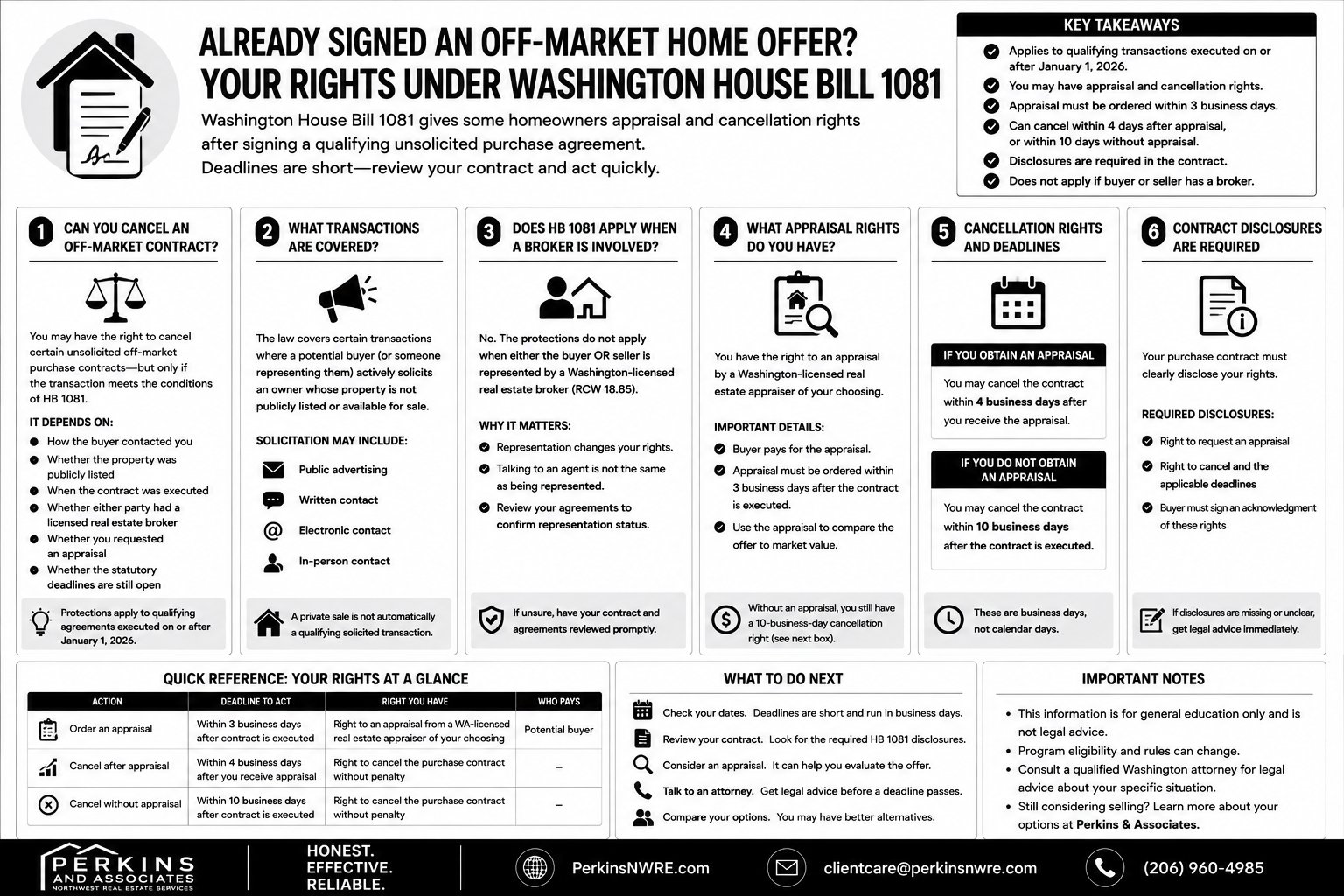
Key takeaways
- Washington’s new protections apply to qualifying transactions executed on or after January 1, 2026.
- The law does not create a universal right to cancel every off-market home sale.
- A qualifying homeowner may choose a Washington-licensed appraiser, while the potential buyer pays the appraisal expense.
- The appraisal must be ordered within three business days after the purchase contract is executed.
- A homeowner who obtains an appraisal may cancel within four business days after receiving it.
- A homeowner who does not obtain an appraisal may cancel within 10 business days after the contract is executed.
- The purchase contract must clearly disclose the appraisal and cancellation rights.
- The protections do not apply when either the buyer or seller is represented by a Washington-licensed real estate broker.
Can a Washington homeowner cancel an off-market purchase contract?
A Washington homeowner may have a right to cancel certain unsolicited off-market purchase contracts, but only when the transaction meets the conditions established by House Bill 1081.
The Washington Legislature passed Substitute House Bill 1081 in 2025 to establish consumer protections for owners of solicited real estate. Governor Bob Ferguson signed the bill on April 21, 2025, and it became Chapter 77 of the Laws of 2025. The law’s general effective date was July 27, 2025, but its transaction protections apply to qualifying agreements executed on or after January 1, 2026.
The right to cancel depends on several facts:
- How the buyer contacted the owner
- Whether the property was publicly listed or available for sale
- When the contract was executed
- Whether either party had licensed real estate broker representation
- Whether the homeowner requested an appraisal
- Whether the statutory deadlines remain open
A homeowner should not assume that the normal rules for one transaction automatically apply to another.
What transactions are covered by Washington House Bill 1081?
The law covers certain transactions in which a potential buyer, or someone representing the buyer, actively solicits an owner whose real property is not currently publicly available or listed for purchase.
The final session law describes solicitation through:
- Public advertising
- Written contact
- Electronic contact
- In-person contact
A common example may involve an investor, company, or individual contacting a homeowner directly with an offer to purchase a property that was not listed for sale.
The law may apply to more than a traditional owner-occupied house. It refers broadly to real property, but whether a particular property and transaction qualify should be confirmed based on the facts and the current law.
An off-market sale is not automatically a qualifying solicited transaction. A homeowner who voluntarily approaches a buyer, privately negotiates with someone they already know, or sells through a licensed broker may be in a different situation.
Does HB 1081 apply when a real estate broker is involved?
The protections in this section do not apply when either the buyer or seller is represented by a real estate broker licensed under Chapter 18.85 RCW.
This is one of the most important limitations in the law.
Washington regulates real estate brokers and managing brokers under the state’s real estate broker licensing laws. The enacted HB 1081 language specifically excludes a buyer or seller represented by a broker licensed under that chapter.
Homeowners should not assume that merely speaking with an agent means they were represented. The answer may depend on the documents signed, the broker’s role, and the facts of the transaction.
When representation status is unclear, a homeowner should have the contract and related agreements reviewed promptly.
What appraisal rights does a qualifying homeowner have?
A qualifying homeowner has the right to obtain an appraisal from a Washington-licensed real estate appraiser. The homeowner selects the appraiser, and the potential buyer is responsible for the appraisal expense.
Washington licenses and regulates real estate appraisers under the Certified Real Estate Appraiser Act. The statute contains licensing, education, examination, conduct, and disciplinary requirements for appraisers practicing in the state.
Under HB 1081:
- The owner has the right to select the appraiser.
- The potential buyer pays the appraisal expense.
- The appraisal must be ordered within three business days after the purchase contract is executed.
- The owner must notify the potential buyer that the appraisal has been ordered.
The three-business-day window makes prompt action important. Waiting to review the offer until the following week could affect whether the appraisal option remains available.
Is an appraisal the same as a comparative market analysis?
No. An appraisal and a comparative market analysis serve different purposes.
A licensed appraisal is an appraiser’s independent opinion of value prepared under professional appraisal standards. A comparative market analysis, often called a CMA, is prepared by a real estate professional using recent sales, current listings, property features, market activity, and local experience.
A CMA may help a homeowner understand how buyers could respond if the property were exposed to the open market. An appraisal may provide a formal opinion of value. Neither guarantees the final selling price.
For King County homeowners, local context matters. Two homes with similar square footage may attract different buyer demand because of condition, lot usability, updates, location, access, zoning, or nearby comparable sales.
How long does a homeowner have to cancel after receiving an appraisal?
A qualifying homeowner who obtains an appraisal may cancel the purchase contract without penalty or further obligation within four business days after receiving the appraisal.
The cancellation period begins when the appraisal is received, not when it is ordered. Homeowners should preserve evidence showing when the report was delivered, such as the email timestamp or delivery record.
The law does not require the appraisal to fall below or above a certain number before the homeowner may cancel. The appraisal provides information the owner can consider when deciding whether to proceed.
A difference between the appraised value and contract price does not automatically terminate the sale. The owner must still provide cancellation notice within the applicable period if the owner decides not to proceed.
What happens if the homeowner does not obtain an appraisal?
A qualifying homeowner who does not wish to receive an appraisal may cancel the purchase contract without penalty or further obligation within 10 business days after the contract is executed.
This is not a general 10-day cancellation rule for every Washington real estate contract. It applies only when the transaction falls within the law’s definition and the broker-representation exception does not apply.
Because the deadline runs from contract execution, homeowners should identify the exact signing date immediately. They should not rely on a verbal estimate of when the period ends.
Weekends, holidays, contract terms, delivery issues, and other facts may affect how a deadline is evaluated. Anyone approaching the end of a cancellation period should seek qualified legal guidance rather than attempting to make an informal deadline calculation.
How must cancellation notice be delivered?
Cancellation must be communicated to the buyer in writing.
The enacted law permits notice by:
- Telegram
- Another form of written communication delivered to the buyer’s designated place of business
The law states that notice is considered given when mailed, emailed, filed for telegraphic transmission, or delivered through another permitted written method.
Even though the statute permits several methods, homeowners should preserve proof of what was sent, when it was sent, where it was sent, and whether it was delivered.
Useful records may include:
- A copy of the cancellation notice
- Email delivery information
- Certified-mail documentation
- Screenshots
- The buyer’s designated contact information
- The signed purchase agreement
- Related text messages and emails
A homeowner should avoid relying only on a phone call or verbal statement.
What disclosures must appear in the purchase contract?
A qualifying purchase contract must clearly state the homeowner’s appraisal and cancellation rights in at least 10-point boldface type.
The seller must also affirmatively acknowledge those rights in writing.
The required disclosure must address:
- The right to an appraisal
- The right to cancel without penalty or further obligation under the statutory time periods
A homeowner reviewing an unsolicited agreement should look for a clearly presented section explaining both rights. The disclosure should not be hidden in small print or described only through a separate verbal promise.
If the required language appears to be missing, incomplete, or unclear, that does not mean a homeowner should independently decide that the entire contract is void. Contract enforceability and available remedies require legal analysis based on the agreement and surrounding facts.
Does a high appraisal automatically change the purchase price?
No. An appraisal does not automatically change the price stated in a signed purchase agreement.
If the appraisal is higher than the offer, a qualifying homeowner may use the information to decide whether to:
- Continue with the existing contract
- Exercise a statutory cancellation right while it remains available
- Ask whether the buyer is willing to renegotiate
- Seek legal advice
- Compare the agreement with a possible open-market sale
The buyer is not automatically required by HB 1081 to increase the purchase price to match the appraisal.
The same principle applies when an appraisal is lower than the contract price. The appraisal is one source of information, not an automatic contract amendment.
What should you do immediately after signing an unsolicited offer?
The first priority is to preserve the documents and identify the dates.
1. Save the complete signed contract
Keep every page, exhibit, addendum, disclosure, and signature page. Do not rely on a partial electronic preview.
2. Record the execution date
Determine when the contract became fully executed. This may be different from the date when one party first signed it.
3. Preserve all communications
Save letters, postcards, advertisements, emails, text messages, voicemails, and notes from in-person discussions.
These records may help show how the buyer first contacted the homeowner.
4. Confirm whether the property was publicly listed
The law applies to property that was not currently publicly available or listed on the real estate market for purchase when the solicitation occurred.
5. Determine whether either party had broker representation
The statutory protections do not apply if the buyer or seller was represented by a Washington-licensed real estate broker.
6. Find the required disclosure
Look for the appraisal and cancellation language in at least 10-point boldface type, along with the seller’s written acknowledgment.
7. Decide promptly whether to request an appraisal
The appraisal must be ordered within three business days after execution of the purchase contract.
8. Verify the appraiser’s Washington license
The law requires an appraiser licensed under Chapter 18.140 RCW.
9. Preserve evidence of every deadline
Keep proof showing when the appraisal was ordered, when the buyer was notified, when the report was received, and when any cancellation notice was sent.
10. Obtain legal advice when the contract or deadline is uncertain
A real estate professional can help explain market conditions and selling options, but only a qualified attorney should provide transaction-specific legal advice about cancellation or contract enforceability.
How should King County homeowners compare the offer with market value?
A homeowner should compare more than the headline price.
In King County, an off-market offer should be reviewed alongside:
- Recent comparable sales
- Current competing listings
- Property condition
- Lot size and usability
- Renovations or deferred repairs
- Zoning and development potential
- Buyer contingencies
- Closing timeline
- Proof of funds or financing
- Inspection terms
- Closing costs
- Commissions or service fees
- Seller concessions
- Moving and possession terms
- Estimated net proceeds
An unsolicited cash offer may provide speed, fewer showings, or less preparation. Those benefits may be meaningful to some homeowners. They should still be compared with the financial and contractual terms of a publicly marketed sale.
For guidance before signing, review what homeowners should know before accepting an off-market offer.
Off-market offer versus public listing
The right selling path depends on the homeowner’s priorities, the property, the contract, and current market conditions.
Comparison table: off-market sale and public marketing
Factor | Off-market sale | Publicly marketed sale |
|---|---|---|
Market exposure | Usually limited to one buyer or a small group | Exposes the property to a broader buyer pool |
Price discovery | Often based on one negotiated offer | Multiple buyers may evaluate the property |
Preparation | May require fewer repairs or less staging | May involve preparation, photography, or staging |
Timeline | May offer a faster proposed closing | Depends on preparation, demand, and buyer financing |
Inspections | May be limited or waived, depending on the contract | Negotiated through the purchase agreement |
Representation | Seller may be unrepresented | Seller often has licensed broker representation |
Selling expenses | Must be reviewed carefully | Must be reviewed carefully |
Certainty | Depends on buyer qualifications and contract terms | Depends on buyer qualifications and contract terms |
Net proceeds | Requires a full cost comparison | Requires a full cost comparison |
A lower offer is not automatically a poor option if it provides terms that solve an important problem for the homeowner. A higher offer is not automatically better if it includes weak financing, substantial concessions, uncertain contingencies, or a difficult timeline.
The useful comparison is the expected net result, contract risk, timing, and level of support.
Expert insight: what this means for King County homeowners
The most important lesson from House Bill 1081 is that speed should not replace informed review.
Homeowners sometimes receive offers promising convenience, a quick closing, no repairs, or cash. Those terms can be useful, but they should be evaluated alongside property value, likely net proceeds, contract obligations, and the homeowner’s available alternatives.
An appraisal may provide a formal opinion of value. A local market analysis may provide additional context about what recent buyers have paid and how a home might compete if publicly listed.
Neither analysis should be used to pressure a homeowner into a decision. The purpose is to help the owner understand the tradeoffs.
Perkins & Associates can explain local market conditions, comparable sales, and possible selling strategies. Questions about whether a signed contract qualifies for cancellation under Washington law should be directed to a qualified attorney.
Frequently asked questions
Can I cancel an unsolicited home offer after signing?
Possibly. A qualifying owner may have a statutory cancellation right under Washington House Bill 1081. Whether the right applies depends on how the buyer solicited the property, whether the property was publicly listed, the contract date, broker representation, and the applicable deadline.
How long do I have to order an appraisal?
A qualifying homeowner who wants to use the appraisal right must order the appraisal within three business days after execution of the purchase contract and notify the potential buyer.
Who chooses and pays for the appraisal?
The homeowner selects the Washington-licensed appraiser. The potential buyer is responsible for the appraisal expense.
Can I cancel if I do not obtain an appraisal?
A qualifying homeowner who does not obtain an appraisal may cancel without penalty or further obligation within 10 business days after execution of the purchase contract.
Does HB 1081 apply if a real estate agent is involved?
The statutory section does not apply when either the buyer or seller is represented by a Washington-licensed real estate broker. Representation should be confirmed from the transaction documents and facts.
Can I send cancellation notice by email?
The law includes email among the permitted written methods. Homeowners should keep a copy of the message, delivery details, attachments, recipient address, and transmission date.
Does a high appraisal automatically increase the purchase price?
No. The appraisal does not automatically modify the signed contract. It gives the homeowner information to consider while any applicable cancellation right remains available.
What if the contract did not include the required disclosure?
The law requires qualifying contracts to include the appraisal and cancellation rights in at least 10-point boldface type, with written acknowledgment by the seller. A homeowner who believes the disclosure is missing should obtain legal advice before deciding how to proceed.
Helpful resources
Washington State Legislature: HB 1081 bill summary
The official HB 1081 bill page provides the legislative history, bill status, voting information, governor’s action, and session-law documents.
Substitute House Bill 1081 session law
The final enacted session law contains the exact appraisal, cancellation, disclosure, notice, and broker-exception provisions.
Washington real estate appraiser laws
Chapter 18.140 RCW explains Washington’s real estate appraiser licensing and regulation framework.
Washington real estate broker laws
Chapter 18.85 RCW governs the licensing of Washington real estate brokers and managing brokers.
Washington Department of Licensing
The Washington State Department of Licensing provides professional licensing information and tools for checking credentials.
Existing Perkins & Associates HB 1081 guide
Read what homeowners should know before accepting an off-market offer for the first article in this consumer-protection series.
Planning your next step
If you are thinking about buying, selling, or planning your next move, our team is happy to help you think through your options and next steps.
📧 [email protected]
📱 (206) 960-4985
Honest. Effective. Reliable.