Auburn Live/Work Zoning: What the Proposed Rules Could Mean
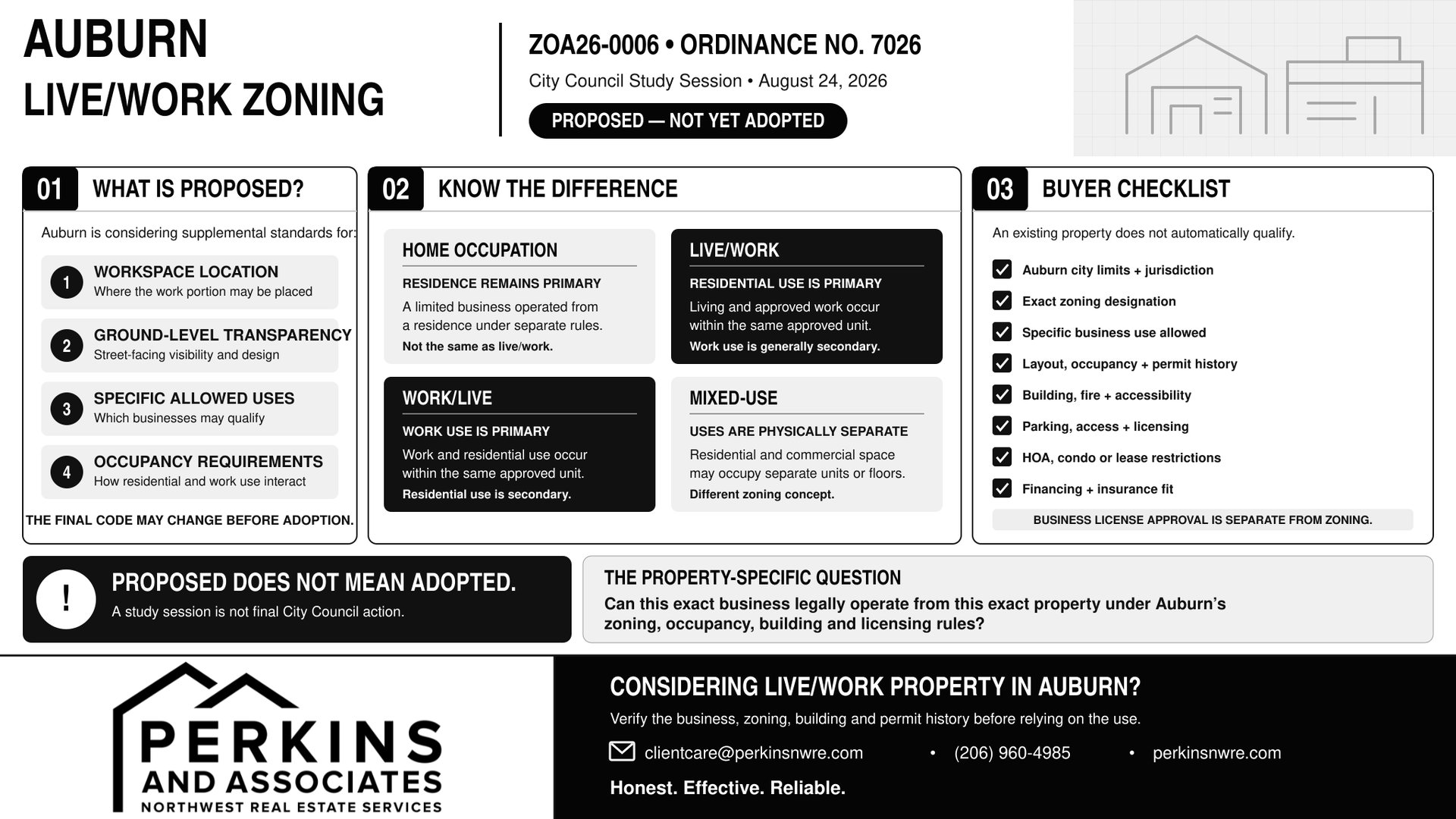
Auburn is considering updated standards for live/work units that would address where the work portion of a unit is located, ground-floor transparency, specific allowed uses, and occupancy requirements.
The proposal is part of City File ZOA26-0006 and Ordinance No. 7026, which is scheduled for discussion at the Auburn City Council Study Session on August 24, 2026. Auburn states that no final action is taken at City Council Study Sessions, so these changes should still be treated as proposed rather than adopted.
That distinction matters for buyers, entrepreneurs, investors, and property owners.
Auburn already recognizes live/work and work/live units in its zoning framework. The current proposal is not about creating the idea from scratch. It is about providing clearer rules for how these properties are designed, occupied, and used.
For someone evaluating real estate, the practical question is simple:
Can this specific Auburn property legally support both the way I want to live and the business I want to operate?
The answer depends on more than whether a room can physically function as an office or studio. Zoning, the type of business, occupancy, building configuration, permits, licensing, and the final version of Auburn's code all matter.
Key takeaways
- Auburn is considering new supplemental standards for live/work units under ZOA26-0006 and Ordinance No. 7026.
- The proposal addresses the location of the work portion, ground-level transparency, specific allowed uses, and occupancy requirements.
- As of August 24, 2026, the ordinance is scheduled for a City Council Study Session and should not yet be described as adopted.
- Auburn already recognizes live/work and work/live units in its zoning framework.
- A live/work unit is not the same thing as a home occupation.
- A live/work unit is also different from a traditional mixed-use project where homes and businesses may occupy separate spaces.
- An existing home or commercial building does not automatically qualify for live/work use.
- Buyers should verify zoning, permitted business activity, occupancy, permits, licensing, parking, building configuration, and any HOA or condominium restrictions before purchasing for live/work use.
- Auburn spans King and Pierce counties, and this proposal is citywide within Auburn rather than limited to one county.
What is a live/work unit?
A live/work unit combines residential living space with a workspace or business component within the same unit or property under zoning rules that allow both functions.
Auburn's existing code framework recognizes both live/work and work/live units.
There is an important difference between those terms.
In a prior Auburn land-use decision explaining the city's definitions, the work component of a live/work unit was described as secondary to the residential use, while the work component of a work/live unit was the primary use and the residential component was secondary.
In simple terms:
- Live/work: You primarily live there, with a compatible work component.
- Work/live: The work activity is primary, with living space connected to it.
That distinction can affect how a particular property or business should be evaluated.
What could a live/work property look like?
Depending on the zoning and uses Auburn ultimately allows, a live/work arrangement could potentially suit activities such as:
- an artist or creative studio,
- a professional office,
- a design workspace,
- certain personal or professional services,
- or another small-scale business compatible with the applicable zoning.
Those examples should not be treated as a list of automatically permitted businesses.
The 2026 proposal specifically says that the supplemental standards will address which uses are allowed, so the exact business type needs to be checked against the final ordinance.
Is a live/work unit the same as a home occupation?
No. Auburn treats live/work units and home occupations as separate land-use concepts, even though both can involve working where someone lives.
This is one of the most important distinctions for buyers and business owners.
A home occupation begins with a residential property. Auburn allows certain businesses to operate from a dwelling or accessory building under standards intended to keep the business compatible with the residential character of the property and neighborhood. The city says home occupations must meet specific criteria, and all home occupations require a City of Auburn business license before operations begin.
A live/work unit is different because the residential and work functions are intentionally combined as part of the approved use of the property.
Live/work vs. home occupation vs. mixed-use
Property or use type | Basic concept | Key distinction |
|---|---|---|
Home occupation | A limited business operates from a residence | The property remains primarily residential |
Live/work unit | Living and working are combined within the same approved unit | Residential use is generally primary, with a work component |
Work/live unit | Business and residential space are combined | The work use is generally primary |
Mixed-use development | Residential and commercial uses exist in the same project | The uses may be in completely separate units, floors, or buildings |
This matters because saying:
“I work from home”
does not automatically mean:
“My property is a live/work unit.”
Is live/work the same as mixed-use development?
No. A live/work unit combines living and working functions within the same unit, while a mixed-use development may contain separate homes and businesses within the same building or project.
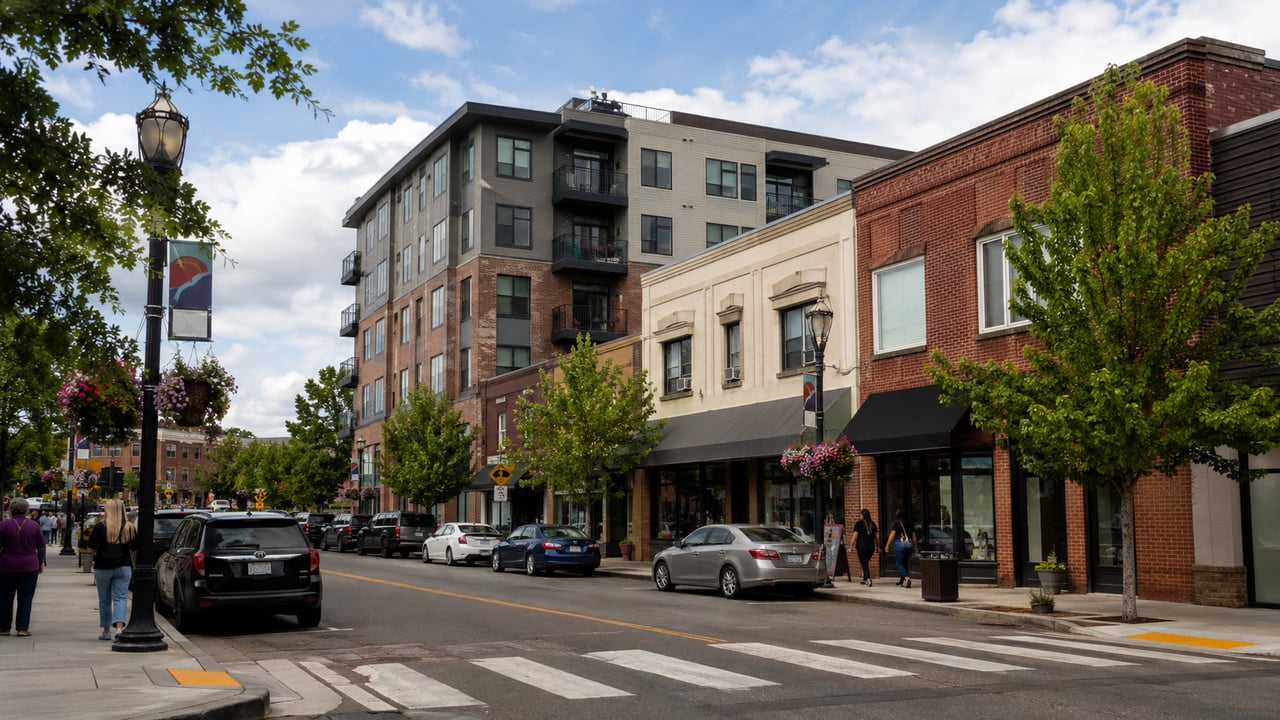
For example, an apartment building with storefronts on the ground floor can be a mixed-use development even if none of the apartments are legally approved live/work units.
A live/work unit connects the work activity and living space much more directly.
That distinction is useful in Auburn because Downtown and other redevelopment areas may contain mixed-use development without every residential unit being intended for business activity.
For more context on Auburn's different housing and development patterns, see our guide to new construction versus resale homes in Auburn.
What is Auburn proposing to change in 2026?
Auburn's proposed update would add more specific supplemental standards governing how live/work units are designed and used.
Washington's SEPA Register identifies the proposal as ZOA26-0006 and says the new standards address four specific areas:
- where the work portion of the unit is located,
- transparency at ground level,
- the specific uses allowed within live/work units,
- and occupancy requirements.
The amendment affects several sections of Auburn City Code, including definitions, zoning-use tables, downtown regulations, and standards for specific land uses.
What does “ground-level transparency” mean?
Ground-level transparency generally refers to windows or other transparent frontage at the street level so the building interacts more visibly with the sidewalk or public realm.
This type of standard is often relevant when a workspace or commercial component faces a street.
Auburn's proposal specifically identifies ground-level transparency as one of the issues being regulated.
However, the public materials we could reliably verify do not provide enough detail to publish an exact transparency percentage in this article.
That number should be confirmed from the final ordinance before someone designs a project around it.
Where would the work portion have to be located?
The proposal specifically creates requirements for the location of the work portion of a live/work unit.
Again, that tells buyers and developers that layout matters.
A property should not be assumed to qualify simply because it has an extra bedroom, garage, storefront, or detached workspace.
The actual relationship between the work area, living area, street frontage, and building configuration needs to comply with the final Auburn standards.
Has Auburn adopted Ordinance No. 7026?
Not as of the current August 24, 2026 status reviewed for this article. Ordinance No. 7026 is scheduled for discussion at the Auburn City Council Study Session on August 24.
The City's public-meeting information states that no final action is taken at Council Study Sessions.
That means the safest description today is:
proposed live/work code update
not:
newly adopted live/work ordinance
The proposal could still move forward, change, or be scheduled for later formal council action.
Anyone making a property decision after this article is published should check Auburn's latest ordinance and meeting records.
Can an existing Auburn property qualify for live/work use?
Potentially, but an existing house, storefront, office, warehouse, or other building does not automatically qualify for live/work use.
This is where property-specific research becomes essential.
A conversion may involve questions about:
- current zoning,
- existing legal use,
- whether live/work is allowed in that zone,
- the proposed business activity,
- the relationship between living and work space,
- building and fire-code requirements,
- occupancy,
- parking,
- accessibility,
- utilities,
- prior permits,
- and any new supplemental standards Auburn adopts.
Auburn Planning Services handles zoning and land-use questions and asks property owners to provide an address or parcel number when asking site-specific questions.
That is a better starting point than assuming a conversion works because a building appears physically suitable.
Does the proposal automatically make existing buildings convertible?
No. The public proposal does not establish that every existing Auburn building can automatically be converted to live/work use.
This point deserves special care because the broader ZOA26-0006 package also contains child-care code amendments.
The SEPA description specifically discusses conversion of existing buildings in connection with child care centers under state legislation. That language should not be interpreted as a blanket live/work conversion right.
For live/work, property owners still need to evaluate zoning and development requirements separately.
Which Auburn zoning districts allow live/work units?
Auburn already recognizes live/work and work/live uses in portions of its commercial and employment zoning framework, but the exact approval path depends on the zoning district and the code in effect when the application is made.
Historical and current zoning materials show live/work or work/live uses appearing in several commercial and employment districts rather than being treated as a universal citywide residential use.
That makes the zoning map one of the first things to check.
Do not rely only on:
- an Auburn mailing address,
- the current use of neighboring buildings,
- an MLS description,
- or the fact that another business operates nearby.
Auburn Planning Services recommends using the zoning code and zoning map and contacting staff for property-specific questions.
Why could live/work property matter in Auburn?
Live/work property can provide a flexible format for certain people who want their residence and small-scale business activity connected, especially in parts of Auburn where housing, employment, transit, and commercial activity already overlap.
Potential users may include:
- entrepreneurs,
- creative professionals,
- consultants,
- small service businesses,
- investors,
- and developers considering specialized mixed-use projects.
The value is not that live/work replaces ordinary housing or commercial space.
It creates another option.
For the right owner, eliminating the separation between a residence and workspace may simplify the daily routine or make a particular property more useful.
For a developer, live/work can also create a different ground-floor product than a conventional apartment or standalone commercial suite.
But those benefits depend on the rules and the market. They should not be treated as a guarantee of higher property values, lower business costs, or stronger investment returns.
Why Downtown Auburn is relevant to the conversation
Downtown Auburn provides useful context because the city is already planning for a combination of housing, business activity, transit, and redevelopment in its Downtown Urban Center.
The City maintains a Downtown Urban Center plan, district code, zoning map, development incentives, and recently adopted Downtown Design Standards.
That does not mean every downtown property qualifies for live/work.
It does show why building frontage, ground-floor activity, housing, and commercial uses are important planning topics in Auburn.
For buyers comparing different parts of the city, our guide to Auburn's new construction and resale housing patterns explains how Downtown differs from areas such as Lea Hill, West Hill, and Lakeland Hills.
Transit can also influence how someone evaluates a downtown or mixed-use property. Our RapidRide I Line Renton-Kent-Auburn buyer guide provides more context on Auburn Station and the changing transit corridor.
What should buyers verify before purchasing a property for live/work use?
Buyers should verify the property's legal ability to support both the residential use and the intended business before treating live/work potential as part of the purchase decision.
Live/work buyer due-diligence checklist
Before purchasing, check:
- Is the property actually inside Auburn city limits?
- What is the exact zoning designation?
- Is live/work or work/live allowed in that zone?
- What business activity will operate there?
- Is that specific activity permitted?
- Does the layout meet Auburn's live/work standards?
- Are occupancy requirements satisfied?
- Are parking or customer-access requirements triggered?
- Does the existing permit history match the advertised use?
- Will building, fire, accessibility, or other upgrades be required?
- Is a City of Auburn business license required?
- Are there condominium, HOA, lease, or private-use restrictions?
- Do the financing and insurance arrangements allow the intended use?
This is similar to the way buyers should approach other flexible-use property features.
For example, an ADU may look possible on paper, but local zoning, utilities, site conditions, and permits still determine actual feasibility. Our guide to King County ADUs in 2026 explains that same due-diligence principle in a different property-use context.
Do you need a business license for a live/work business?
If you are conducting business in Auburn, business licensing should be part of your due diligence.
The City states that a City of Auburn business license is required whether a business is physically located in Auburn or simply conducts business within the city.
That is separate from zoning approval.
A property may be in a zoning district where a certain use is possible, but the business may still have licensing, tax, regulatory, or permit requirements.
For a live/work buyer, there are therefore at least two separate questions:
Can I use the property this way?
and:
Can I legally operate this business here?
They are related, but they are not the same question.
What businesses can operate from an Auburn live/work unit?
The exact permitted business uses will depend on the final code language and the zoning district.
This is another area where the proposed ordinance is important.
Auburn's SEPA record specifically says the update will establish specific uses allowed in live/work units.
That means buyers should not assume that any business that fits physically inside the unit is allowed.
For comparison, Auburn already prohibits certain activities as home occupations, including automotive repair, auto body work, and certain heavy-equipment repair activities.
The live/work rules may use a different framework, so the home-occupation list should not be copied over as though it automatically governs live/work.
The final zoning and use table should control.
Are live/work properties residential or commercial?
A live/work property combines residential and business functions, so treating it as purely residential or purely commercial can oversimplify the property.
The exact answer may depend on what question is being asked.
For example:
- zoning may classify the permitted land use one way,
- building-code occupancy may involve another analysis,
- financing may look at the property's configuration and use,
- insurance may evaluate business activity,
- and tax treatment may involve separate rules.
That is why buyers should avoid assuming that a live/work label on a listing answers every legal or financial question.
The land-use approval is only one part of the analysis.
What should investors and developers watch next?
Investors and developers should watch the final language of Ordinance No. 7026 because small details in the supplemental standards could affect unit design and project feasibility.
The most important items include:
1. Eligible zoning districts
Confirm where live/work and work/live will be permitted after the amendment.
2. Allowed business uses
The final list could determine which tenant or owner-operator profiles are realistic.
3. Workspace location
The proposal specifically regulates where the work portion is located.
4. Ground-level transparency
Facade and storefront requirements can influence design and renovation costs.
5. Occupancy rules
The final ordinance may determine who must live in or occupy the unit and how the residential and business components interact.
6. Parking and access
Verify whether the intended business activity creates additional parking, customer, delivery, or access requirements.
7. Existing-building conversions
Do not assume an older building can be economically converted without reviewing building-code, accessibility, fire, and permit requirements.
8. Final council action
Until formal City Council action occurs, project underwriting should distinguish between current code and proposed code.
Auburn spans King and Pierce counties. Does that change the zoning rules?
Auburn spans both King and Pierce counties, but the live/work proposal is a City of Auburn zoning amendment identified as citywide.
That means the city ordinance is tied to property located within Auburn city limits, not simply to whether a parcel lies on the King County or Pierce County side.
This distinction matters because an “Auburn” mailing address does not always answer the jurisdiction question by itself.
Before relying on Auburn zoning rules, verify that the property is actually within the City of Auburn.
Expert insight: What this means locally
The opportunity in a live/work property is flexibility. The risk is assuming that working from home and owning a legally approved live/work property mean the same thing.
They do not.
For a buyer, the most important step is to start with the intended business.
Instead of asking:
“Can I buy this property as live/work?”
ask:
“Can this exact business legally operate from this exact property under Auburn's zoning, occupancy, building, and licensing rules?”
That question is much harder to answer from a listing description alone, but it is far more useful.
For a live/work property, the business idea is only half the equation. The other half is whether the zoning, building, and permit history support it.
Frequently asked questions
What is a live/work unit in Auburn?
A live/work unit combines a residence with a work component in the same approved unit or property. Auburn also recognizes work/live units, where the work component is generally primary and the residential component is secondary.
Is a live/work unit the same as a home occupation?
No. Auburn treats home occupations and live/work units as separate land-use concepts. A home occupation operates as an accessory business use within a residence, while a live/work unit is intentionally approved to combine residential and work functions.
Has Auburn adopted Ordinance No. 7026?
Not as of the August 24, 2026 status reviewed for this article. The ordinance is scheduled for discussion at a City Council Study Session, where Auburn says no final action is taken.
Can an existing Auburn home become a live/work property?
Possibly, but not automatically. The zoning district, business use, layout, occupancy, permits, building requirements, and final live/work standards all need to be reviewed.
What businesses can operate from an Auburn live/work unit?
The allowed businesses depend on the applicable zoning and final live/work standards. Auburn's proposed update specifically includes rules addressing which uses may operate within live/work units.
Do I need a business license?
Auburn requires businesses conducting business within the city to obtain a City of Auburn business license, subject to the city's licensing rules. Zoning approval and business licensing are separate requirements.
Is live/work the same as mixed-use development?
No. A live/work unit combines living and working within the same unit. A mixed-use development may contain separate residential and commercial spaces.
Are live/work properties residential or commercial?
They combine both functions, so the answer can depend on whether you are asking about zoning, building code, financing, insurance, licensing, or another issue.
Helpful resources
City of Auburn Planning Services
Use Auburn Planning Services to research current zoning, the zoning map, land-use regulations, development review, and property-specific questions.
City of Auburn Planning Services
Washington Department of Ecology SEPA Register
The state's SEPA record for ZOA26-0006 provides the clearest public summary of the proposed live/work supplemental standards and identifies the Auburn City Code sections involved.
Auburn Live/Work and Daycares Text Amendment, ZOA26-0006
City of Auburn Public Land Use Notices
Use this page to monitor public hearings and current zoning text amendments, including the Live/Work and Daycare Code Update.
City of Auburn Public Land Use Notices
Auburn City Council projected agenda
Useful for tracking Ordinance No. 7026 as it moves through the City Council process.
Auburn City Council projected agenda
City of Auburn business licenses
Official guidance for businesses operating within Auburn city limits.
City of Auburn Business Licenses
City of Auburn home-business guidance
Auburn's FAQ explains how home occupations are treated separately and why a business operating from a residence must meet specific standards.
City of Auburn Community Development FAQ
Downtown Auburn Urban Center
Provides additional context on Auburn's downtown zoning, design standards, redevelopment, and mixed-use planning.
Ready to explore your options?
If you are thinking about buying, selling, or planning your next move, our team is happy to help you think through your options and next steps.
📧 [email protected]
📱 (206) 960-4985
Honest. Effective. Reliable.