Washington HB 2442: What the New Local Tax Rules Could Mean for Maple Valley
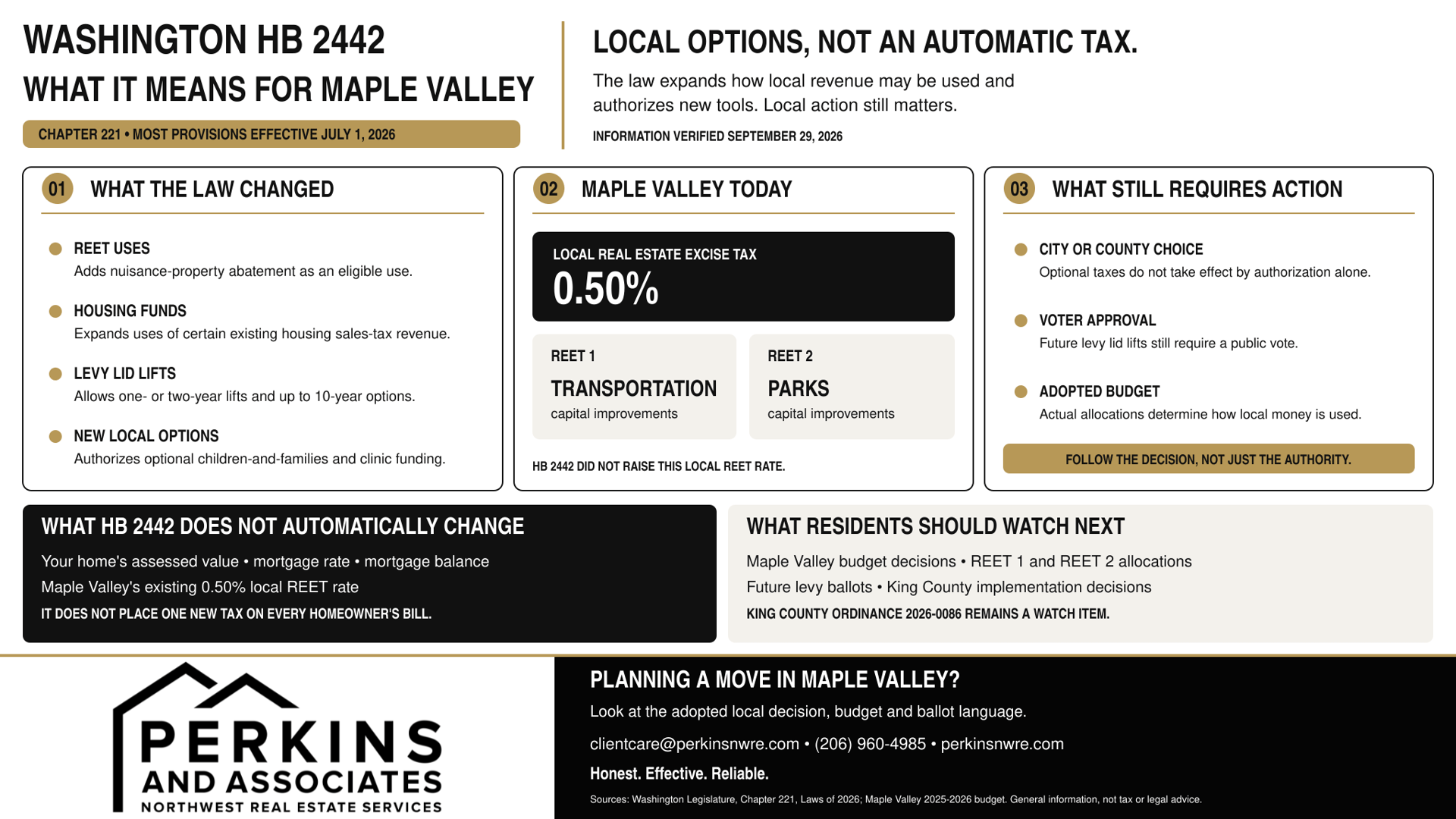
Washington HB 2442 does not automatically impose a new tax on Maple Valley homeowners.
The legislation, signed by Governor Bob Ferguson on March 25, 2026, became Chapter 221 of the 2026 session laws. Most provisions took effect July 1, 2026, while several sales-tax provisions become available January 1, 2027.
What HB 2442 does is give Washington cities and counties more flexibility with several sources of local revenue. It changes how some existing Real Estate Excise Tax revenue can be spent, expands certain housing-fund uses, changes the structure of voter-approved property-tax levy lid lifts, and authorizes several optional local revenue tools.
For Maple Valley, the practical question is not simply, "Did Washington pass a new tax law?"
It is:
Which parts of HB 2442 actually apply to Maple Valley, what choices remain with the City or King County, and how could those decisions affect local infrastructure and public-service funding?
Key takeaways
- HB 2442 does not automatically increase Maple Valley property taxes.
- It does not raise Maple Valley's local REET rate.
- It allows REET 2, and by extension REET 1 under existing rules, to be used for nuisance-property abatement.
- Maple Valley already uses REET revenue to support transportation and parks capital projects.
- HB 2442 expands how certain existing affordable-housing sales-tax revenue may be used.
- Future levy lid lifts still require voter approval.
- HB 2442 allows one- or two-year levy lid lifts and extends multi-year options to as long as 10 years.
- Beginning in 2027, cities and counties may choose to impose a new 0.01% sales tax for qualifying services for children and families.
- King County is considering that sales-tax authority, but the proposal has not received final approval as of September 29, 2026.
- HB 2442 also gives counties a new public-health-clinic property-tax option, but authorization does not mean King County has automatically imposed it.
- The law gives local governments more financial options. The important next step is watching which options Maple Valley and King County actually use.
What is Washington HB 2442?
Washington HB 2442 is a 2026 local-government finance law formally titled "Providing local governments tax resources and fund flexibility."
The final legislation covers several different funding tools rather than creating one single tax.
Among its major provisions, HB 2442:
- Expands an allowable use of local REET revenue
- Creates an optional sales tax for services benefiting children and families
- Expands permissible uses of certain housing sales-tax revenue
- Changes how voter-approved levy lid lifts may be structured
- Authorizes a county property-tax levy for public health clinics
- Makes changes to several other county and special-district revenue rules
The Washington Legislature's final bill report provides the best plain-English summary of what survived the legislative process and became law.
Read the official Washington HB 2442 bill history
Does HB 2442 automatically raise taxes in Maple Valley?
No.
This distinction is the most important part of the law for homeowners to understand.
Some parts of HB 2442 simply change how existing revenue may be used.
Other provisions give a city or county the option to impose a tax.
The levy-lid-lift provisions still depend on voter approval.
So there is a meaningful difference between:
State authorization: Washington law allows a local government to use a particular funding tool.
Local action: Maple Valley or King County actually adopts that option.
Voter approval: Residents approve a levy measure when state law requires a public vote.
HB 2442 should not be read as one automatic increase appearing on every Maple Valley homeowner's property-tax bill.
For background on how property taxes and REET differ, see our guide to real estate taxes in King County for buyers and sellers.
What changed with REET under HB 2442?
HB 2442 changed an eligible use of local REET revenue. It did not raise Maple Valley's REET rate.
REET stands for Real Estate Excise Tax. It is generally collected when real property is sold.
Washington cities planning under the Growth Management Act can impose two common local REET components:
- REET 1 at 0.25%
- REET 2 at an additional 0.25%
HB 2442 allows REET 2 revenue to be used for the abatement of nuisance properties.
MRSC notes that because prior legislation allows REET 1 and REET 2 to be used for one another's qualifying purposes, the new nuisance-abatement authority can effectively apply to both local REET funds.
That is a spending-rule change.
It is not a new REET imposed on a home sale.
How does Maple Valley use REET today?
This is where HB 2442 becomes especially relevant locally.
Maple Valley's adopted 2025-2026 budget identifies a 0.50% City REET, divided into two 0.25% components.
The City describes the funds this way:
- REET 1: used for capital facilities and improvements identified in the City's Transportation Capital Improvement Plan
- REET 2: used for capital facilities and improvements identified in the City's Parks Capital Improvement Plan, subject to state restrictions
Maple Valley's adopted budget says its first 0.25% REET revenues are found in REET 1 Fund 151, while the second 0.25% revenues are placed in REET 2 Fund 152.
The City's local REET rate itself remains 0.50%. Washington Department of Revenue rate information also lists Maple Valley at that local rate.
Why does the new spending flexibility matter?
Maple Valley already relies on REET as one piece of its capital-funding structure.
Its adopted 2025-2026 budget includes approximately $23.7 million in capital investment for parks, transportation and facilities infrastructure over the two-year budget period.
HB 2442 does not create another $23.7 million or guarantee additional infrastructure funding.
Instead, it adds another possible eligible use for revenue that already has competing capital demands.
That creates a budget question rather than an automatic tax question:
If Maple Valley ever chooses to use REET for nuisance-property abatement, how would that fit alongside transportation, parks and other eligible capital needs?
We did not find a current Maple Valley action showing that the City has redirected REET money for this purpose.
So the final article should not imply that roads or parks have already lost funding because of HB 2442.
How did HB 2442 change existing housing-tax funding?
HB 2442 also changes what some existing local housing sales-tax revenue can support.
This is separate from REET.
Maple Valley's current financial reporting already includes an Affordable Housing HB 1406 Sales Tax revenue account. That program comes from the affordable-housing sales-tax credit authorized under state law.
Unlike a traditional added sales tax paid by shoppers, this particular affordable-housing tax mechanism is credited against the state's share of sales tax.
HB 2442 expands allowable uses of that revenue to include operations and maintenance of existing affordable or supportive housing, rather than limiting the use to new units and other previously authorized purposes.
That gives local governments more flexibility with housing revenue they already receive.
REET and the housing sales tax are not the same thing
This distinction is easy to lose in a tax-policy story.
REET is tied to real estate transactions.
The affordable-housing sales-tax credit is a separate local-government revenue program.
HB 2442 changes both areas, but in different ways.
It does not mean Washington created a new affordable-housing REET for Maple Valley.
What changed with property-tax levy lid lifts?
HB 2442 gives local governments more flexibility in how a future voter-approved levy lid lift can be structured.
Washington generally limits annual growth in regular property-tax levy revenue. A levy lid lift lets a taxing jurisdiction ask voters for permission to exceed the normal levy-growth limit, within other statutory restrictions.
Starting July 1, 2026, HB 2442 allows:
- A traditional levy lid lift to establish a rate for either one or two consecutive years
- A multi-year levy lid lift to run for up to 10 consecutive years, rather than the previous six-year maximum
The key phrase is with voter approval.
HB 2442 did not eliminate the vote required for a levy lid lift.
Read MRSC's explanation of the 2026 levy lid lift changes
Why does Maple Valley's 2023 levy matter?
Maple Valley has recent experience with this funding tool.
In November 2023, voters considered Proposition No. 1, a levy lid lift for public safety.
The ballot measure proposed increasing the City's regular property-tax levy for 2024 to help fund police services and maintain staffing and programs. King County's ballot description estimated approximately $2.2 million in public-safety revenue.
The measure passed with 65.65% voting yes.
That makes levy lid lifts more than an abstract part of Washington property tax law for Maple Valley.
But HB 2442 does not retroactively increase that measure.
Instead, if Maple Valley considers another levy lid lift in the future, state law now gives the City more choices about how the measure could be structured before it goes to voters.
For a broader explanation of local property taxes, see our guide to King County property taxes for South King County homeowners.
What new local taxes did HB 2442 authorize?
Two provisions deserve attention because they could potentially affect Maple Valley residents through future City or King County decisions.
They are options, not automatic taxes.
A new sales-tax option for children and families
Beginning January 1, 2027, HB 2442 allows a city or county to impose a sales and use tax of up to 0.01% for qualifying services that assist children and their families.
Eligible purposes can include services such as:
- Child care
- Before-school and after-school programs addressing health and social needs
- Perinatal support
- Shelter and rental assistance
- Client transportation
If both a city and its county impose the tax, state law requires a credit so the combined rate under this authority does not exceed 0.01%.
A local government must still choose to use the authority.
A county public-health-clinic property-tax option
HB 2442 also allows a county to impose a property-tax levy of up to $0.05 per $1,000 of assessed value for the operation, maintenance and capital costs of public health clinics.
This is county authority. It is not a new Maple Valley city property tax.
What is King County actually considering?
This is where state authorization begins to turn into a local-policy question.
Children-and-families sales tax
King County Proposed Ordinance 2026-0086 would use the new HB 2442 authority to impose an additional 0.01% sales and use tax for qualifying services for children and families.
As of September 29, 2026, the ordinance remains at second reading.
On September 23, 2026, the County Council's Budget and Fiscal Management Committee passed the proposal out of committee without a recommendation. It has not reached final adoption in the current record.
That status is important.
The accurate wording today is:
King County is considering the tax. It should not yet be described as an adopted countywide tax.
Public-health-clinic levy
King County's Budget and Fiscal Management Committee also received a Public Health Clinics Financial Update on September 23.
HB 2442 gives counties authority for the new clinic levy, but the materials reviewed for this article do not establish that King County has enacted that levy.
That should remain a watch item, not something homeowners should add to their current tax bill.
How could HB 2442 realistically affect Maple Valley infrastructure?
The clearest answer is:
HB 2442 gives local governments more flexibility, but it does not automatically provide Maple Valley with a new pot of road, park or facility money.
There are three realistic local effects to watch.
1. Existing REET money has another possible use
Maple Valley already uses REET as part of its transportation and parks capital structure.
If another eligible use competes for those funds in the future, City budget decisions will determine how the money is allocated.
2. Future voter-approved property-tax measures can be structured differently
If Maple Valley considers another levy lid lift, HB 2442 allows longer or more flexible structures than were previously available.
That does not mean another levy is planned.
It means the state changed the available framework.
3. King County decisions can affect Maple Valley residents
A countywide tax can affect someone who lives in Maple Valley even when the City itself did not create the tax.
That distinction is already relevant locally.
For example, the King County transportation sales tax beginning in 2027 is a separate county action with its own funding purpose and authority. It should not be confused with HB 2442's children-and-families tax option. See our guide to King County's 2027 transportation sales tax
Maple Valley also implemented a separate local public-safety sales-tax increase in July 2026. Again, that is a different tax decision. See our guide to Maple Valley's 2026 public-safety sales-tax increase
Keeping these measures separate makes it much easier to understand what residents are actually paying and why.
What does HB 2442 mean for Maple Valley homeowners?
For most homeowners, HB 2442 is better understood as a local-government funding law than an immediate change to the cost of owning a home.
The law does not directly change:
- Your home's assessed value
- Your mortgage rate
- Your mortgage balance
- Maple Valley's existing 0.50% local REET rate
- The amount of a previously approved Maple Valley levy
The possible effects come later through local budget decisions, voter-approved measures, or adoption of optional city or county tax authority.
That is why headlines suggesting HB 2442 automatically created a new Maple Valley homeowner tax would miss an important part of how the law works.
What should Maple Valley residents watch next?
Maple Valley's next budget
The City's future budget documents will show whether HB 2442 changes how Maple Valley plans to use REET or housing-related revenue.
REET fund allocations
Watch REET 1 and REET 2 to see how transportation, parks and any other eligible uses are balanced.
Future levy ballot measures
If Maple Valley proposes another levy lid lift, the ballot language will show how HB 2442's new one-year, two-year or multi-year options are being used.
King County Ordinance 2026-0086
This is the most immediate HB 2442 implementation question at the county level. Its status should be checked again before publication or whenever this article is updated.
King County's public-health funding decisions
The County's public-health-clinic financing discussions are also worth monitoring because HB 2442 created a new county levy option specifically for those facilities.
Expert insight: Watch the adopted budget, not just the tax authority
When a new state tax law passes, it is easy to focus on what a city or county can do.
For homeowners, buyers and sellers, that is only the first part of the story.
The more useful questions are:
- Did the local government actually adopt the tax?
- Does it require voter approval?
- Is the City changing how existing revenue is spent?
- What does the adopted budget say the money will fund?
- Is a project merely eligible for funding, or has money actually been committed?
For Maple Valley, that distinction matters because HB 2442 touches revenue sources the City already uses while also creating options that may never be used locally.
Follow the decision, not just the authorization.
Frequently asked questions
Does Washington HB 2442 automatically raise Maple Valley property taxes?
No. HB 2442 changes local-government finance rules and creates several optional funding authorities. It does not automatically increase Maple Valley homeowners' property-tax bills.
Did HB 2442 increase Maple Valley's REET rate?
No. Maple Valley's local REET remains 0.50%. HB 2442 expanded an eligible use of REET revenue rather than increasing the tax rate.
What can REET be used for after HB 2442?
Among other existing eligible purposes, HB 2442 now allows REET 2, and effectively REET 1 under existing state rules, to support nuisance-property abatement.
Did HB 2442 create a new affordable-housing REET?
No new affordable-housing REET appears in the enacted summary. The final REET change concerns the use of existing local REET revenue for nuisance-property abatement. HB 2442 separately expanded allowable uses of certain housing sales-tax revenue.
Does HB 2442 let Maple Valley use a levy lid lift without voter approval?
No. Levy lid lifts still require voter approval. HB 2442 changes how those voter-approved measures may be structured.
What changed with levy lid lifts?
A jurisdiction can now choose a one-year or two-year structure for the initial levy-rate increase, and a multi-year lid lift may extend for up to 10 years.
Is King County adding the new 0.01% children-and-families sales tax?
King County is considering it. Proposed Ordinance 2026-0086 remained at second reading as of September 29, 2026 and had not received final approval.
Could HB 2442 affect Maple Valley roads and parks?
Indirectly. Maple Valley already uses REET revenue for transportation and parks capital improvements. HB 2442 adds another permitted use for REET, but it does not itself redirect Maple Valley's funds or fund a specific local project.
Did HB 2442 create the separate King County transportation tax beginning in 2027?
No. King County's transportation sales tax is a separate local action and should be analyzed separately from HB 2442.
What should homeowners watch next?
The most useful places to watch are Maple Valley budget documents, REET fund allocations, future levy ballot measures and King County's pending implementation decisions.
Helpful resources
For readers who want to verify the law and follow the local decisions directly:
Washington State Legislature: HB 2442 bill history and final status
Official HB 2442 page
Washington Legislature: Final Bill Report for ESHB 2442
Read the enacted bill summary
MRSC: Real Estate Excise Tax rules after HB 2442
Review current REET guidance
MRSC: 2026 levy lid lift changes
Review the levy lid lift changes
City of Maple Valley: Adopted 2025-2026 Biennial Budget
Review Maple Valley's adopted budget and REET structure
City of Maple Valley: 2025 financial reporting
Review current City revenue and housing-tax accounts
King County: Proposed Ordinance 2026-0086
Follow the current children-and-families sales-tax proposal
King County Elections: Maple Valley 2023 levy lid lift
Review the 2023 public-safety measure
Thinking about buying or selling in Maple Valley?
Taxes and local funding rules are only one part of a real estate decision, but they can affect the cost of ownership and the services and infrastructure around a home.
If you are buying or selling in Maple Valley or elsewhere in South King County, reach out to Perkins & Associates. We can help you look at the property, the local market and the community-level information that matters to your next move.
📧 [email protected]
📱 (206) 960-4985
Honest. Effective. Reliable.
last portion of the blog
This article provides general real estate information and is not legal advice. Association documents, purchase agreements, statutory applicability, and transaction deadlines can vary. Buyers and sellers should review their specific documents and seek legal advice when a legal interpretation is needed.