Washington voters will consider Initiative 645 in November 2026. The measure would repeal the state’s newly enacted 9.9% tax on annual individual income above $1 million and prohibit state and local governments from imposing taxes on, receiving, or measuring taxes by individual income.
The debate is already drawing large campaign contributions and strong claims from both sides. A July 23 report from The Center Square found that three labor-funded contributions supplied almost all the money then reported by the No on 645 campaign. Supporters of the repeal argue that the donors have a direct interest in protecting government revenue. Opponents argue that repealing the tax while leaving its accompanying tax relief in place could create a major state-budget gap.
Campaign-finance records can show who contributed, when the money was reported, and how much was given. They do not, by themselves, prove why an organization contributed or establish exactly how lawmakers would respond if the initiative passes.
This guide separates verified facts from campaign interpretation and explains what Initiative 645 may mean for Washington residents, businesses, and King County real estate decisions.
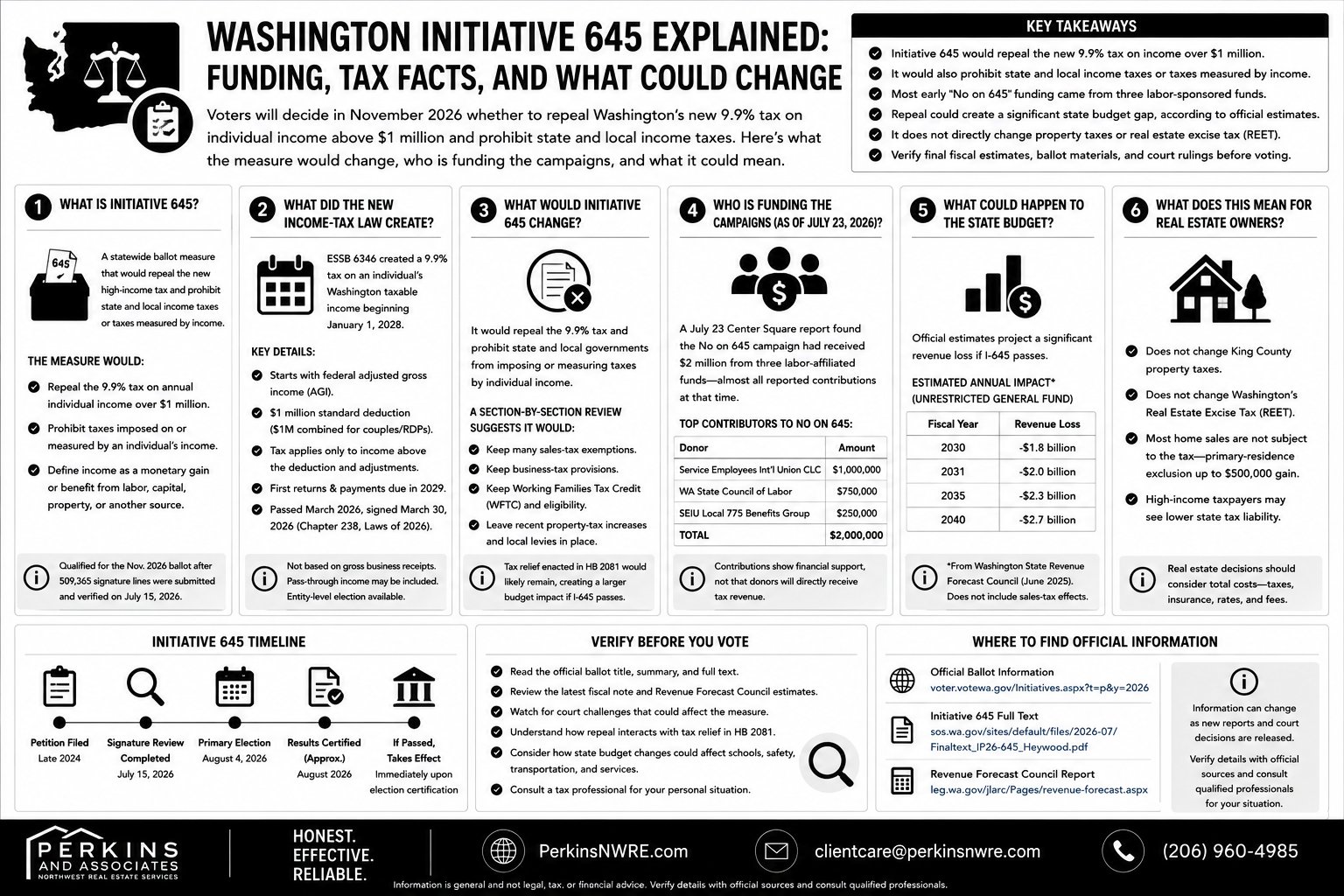
Key takeaways
- Initiative 645 qualified for the November 2026 ballot after the Secretary of State completed its petition-signature review in July.
- The measure would repeal Washington’s new 9.9% tax on individual taxable income above a $1 million deduction.
- The enacted tax is scheduled to begin January 1, 2028, with the first returns and payments due in 2029.
- Initiative 645 would also prohibit state and local taxes imposed on or measured by individual income.
- A section-by-section comparison indicates that the initiative would leave several sales-tax exemptions, business-tax changes, and Working Families Tax Credit provisions in place.
- A July 23 campaign-finance snapshot identified $2 million from three labor-affiliated funds as almost all the money then reported by No on 645.
- The donation records show financial participation, but they do not prove that contributors would directly receive the tax revenue.
- The measure does not directly change King County property taxes or Washington’s real estate excise tax.
- Most ordinary home sales would not become subject to the new income tax solely because the sale price exceeds $1 million.
- Contribution totals, fiscal estimates, ballot materials, and court proceedings should be checked again before publication or Election Day.
What is Washington Initiative 645?
Initiative 645 is a statewide ballot measure that would repeal Washington’s new tax on high individual incomes and establish a broader statutory restriction on state and local income taxes.
The official ballot title says the measure would:
- Repeal the 9.9% tax on annual individual income over $1 million.
- Prohibit taxes on individual income or the receipt of individual income.
- Prohibit taxes measured by an individual’s income.
- Define income as a monetary gain or benefit derived from labor, capital, property, or another source.
The Secretary of State reported that sponsors submitted 509,365 signature lines and that the measure met the signature requirement on July 15, 2026.
Readers can review the official Initiative 645 ballot title and summary and the complete initiative text.
What did Washington’s new income-tax law create?
Engrossed Substitute Senate Bill 6346 created a 9.9% tax on an individual’s Washington taxable income beginning January 1, 2028.
The calculation starts with federal adjusted gross income and then applies Washington-specific additions, exclusions, deductions, credits, and sourcing rules. Individuals receive a $1 million standard deduction. Married couples and registered domestic partners share one combined $1 million deduction, whether they file jointly or separately.
Only taxable income remaining after the deduction and other applicable adjustments is subject to the 9.9% rate. The first returns and payments begin in 2029.
The Legislature passed ESSB 6346 in March 2026, and Gov. Bob Ferguson signed it on March 30. It became Chapter 238 of the 2026 session laws.
Does the tax apply to business revenue?
Not simply because a business receives more than $1 million in gross revenue.
The tax is imposed on individuals. It can include qualifying income passed through from partnerships, limited liability companies, S corporations, and other pass-through entities. However, gross business receipts, business profit, federal adjusted gross income, and Washington taxable income are not interchangeable figures.
The final law also allows qualifying pass-through entities to elect to pay the tax at the entity level, with credits available to individual owners under the statutory rules.
A business owner who may be affected should obtain advice from a qualified CPA or tax attorney rather than relying on a campaign headline or general income figure.
How many people may be subject to the tax?
The Washington Department of Revenue estimates that approximately 21,000 taxpayers could be subject to the tax as enacted.
The department has stated that it expects approximately 130 employees to administer and enforce the income-tax portion of the law once it is operating. The agency has also distinguished those expenses from the larger cost of expanding the Working Families Tax Credit program.
Those figures are implementation estimates, not guarantees. Actual taxpayer counts and revenue could change based on income patterns, residency decisions, legal challenges, economic conditions, and future legislative amendments.
Where would the revenue go?
Beginning July 1, 2029, the state treasurer must transfer 5% of the previous fiscal year’s income-tax revenue to the Fair Start for Kids Account. That account supports childcare and early-learning purposes.
The remainder of the tax, interest, and penalties goes into the state general fund. The general fund supports a broad range of government services rather than one dedicated program.
This distinction matters when evaluating campaign claims. The legislation connects the new revenue with education, healthcare, childcare, essential government services, the Working Families Tax Credit, and tax relief. However, most of the revenue is not legally restricted to one program.
What other tax changes were included in ESSB 6346?
The law contains more than the new income tax.
Among its other provisions, the legislation:
- Expands eligibility for the Working Families Tax Credit.
- Raises the small-business business-and-occupation tax credit.
- Increases the annual B&O filing threshold.
- Exempts diapers from sales and use tax beginning in 2029.
- Exempts grooming and hygiene products from sales and use tax beginning in 2029.
- Exempts certain over-the-counter drugs from sales and use tax beginning in 2029.
- Creates or expands several business and healthcare-related tax preferences.
- Reverses sales-tax treatment for several services beginning in 2029.
- Provides narrower sales-tax exclusions and exemptions that began in July 2026.
The Washington Department of Revenue lists these provisions as part of the state’s 2026 tax legislation. The Legislature’s final bill report provides the effective dates and more detailed descriptions.
What would Initiative 645 repeal?
Initiative 645 would repeal the sections of Chapter 238 that create and administer the individual income tax.
It would also add a new prohibition preventing the state and local governments from imposing taxes directly on individual income, on the receipt of individual income, or measured by individual income. The initiative defines income broadly as a monetary gain or benefit derived from labor, capital, property, or another source.
Would it repeal the accompanying tax cuts?
A comparison between the initiative’s repeal list and the enacted law indicates that many of the tax-relief provisions would remain.
The initiative lists the income-tax and administrative sections that it would repeal. It does not list several sections establishing the Working Families Tax Credit expansion, sales-tax exemptions, and small-business B&O tax changes.
Provision | Apparent effect if Initiative 645 passes |
|---|---|
9.9% individual income tax | Repealed |
Future taxes on or measured by individual income | Prohibited under the initiative language |
Working Families Tax Credit expansion | Remains unless changed separately |
Diaper, hygiene-product, and over-the-counter drug exemptions | Remain unless changed separately |
Increased small-business B&O credit | Remains unless changed separately |
King County property taxes | Not directly changed |
Washington real estate excise tax | Not directly changed |
The final ballot fiscal-impact statement will provide the state’s official estimate of the financial effect. That document should be checked again before publication.
Who is funding the No on 645 campaign?
A July 23 Center Square report, citing Washington Public Disclosure Commission records, identified three large contributions totaling $2 million:
Reported contributor | Reported amount |
|---|---|
Washington Federation of State Employees | $1,000,000 |
SEIU 775 Ballot Fund | $500,000 |
SEIU Initiative Fund | $500,000 |
The report said those donations made up almost all contributions then reported to the No on 645 committee.
Because political committees file new and amended reports throughout a campaign, the figures should be described as a July 23, 2026 snapshot, not a final election total.
Readers can review current information through the Washington Public Disclosure Commission’s political-finance database.
Are all the contributors public-sector unions?
That description is accurate for the Washington Federation of State Employees but less precise for every SEIU 775 member or represented workplace.
WFSE describes itself as the union for Washington’s public workers and says it represents more than 50,000 state and other public-service employees.
SEIU 775 says it represents more than 60,000 long-term-care workers in home care, nursing homes, and residential services. Some represented caregivers work through publicly funded Medicaid arrangements or state contracts, while others work for private agencies, nursing homes, or residential-care providers.
A more precise description is:
Labor organizations representing state employees and workers in publicly funded and privately operated long-term-care systems supplied nearly all early funding reported by the No on 645 campaign.
Do the contributions prove that unions directly benefit from the tax?
No. The contribution records establish financial participation. They do not establish a contributor’s private motive or prove that tax revenue will be transferred directly to that organization.
Public-employee and caregiver unions have an identifiable policy interest in state budgets. Government revenue helps fund public agencies, Medicaid-supported care, healthcare, education, employee compensation, and other services that can affect their members.
That relationship helps explain why labor organizations may oppose repeal. It does not prove that they contributed solely to enrich themselves.
The Center Square article quoted Initiative 645 sponsor Brian Heywood arguing that the donations show the unions’ financial self-interest. It also quoted SEIU 775 Secretary-Treasurer Adam Glickman saying the union opposes repeal because it believes the measure threatens tax relief, education, healthcare, and other public priorities.
Those are competing campaign positions, not findings made by the PDC.
Who is funding the campaign supporting Initiative 645?
Let’s Go Washington sponsored the signature effort and supports Initiative 645.
The organization is also involved with other statewide initiatives in 2026. Its total fundraising or spending cannot therefore be assigned entirely to Initiative 645 without reviewing the purpose, recipient, and description of individual transactions.
A balanced evaluation of campaign money should examine:
- Contributions to No on 645.
- Contributions and loans to Let’s Go Washington.
- Initiative-specific spending.
- Signature-gathering expenses.
- In-kind contributions.
- Independent expenditures.
- Committee transfers.
- Advertising purchases.
- Amended PDC filings.
The same standard should be applied to both campaigns. A donor’s occupation, business interest, union affiliation, or tax exposure can provide useful context, but it does not automatically prove that every campaign claim is true.
What do supporters of Initiative 645 argue?
Supporters say Washington should repeal the tax before collection begins.
Their main arguments include:
- Washington voters have repeatedly rejected broad individual income-tax proposals.
- The tax conflicts with earlier state court decisions classifying income as property.
- The current $1 million deduction could be reduced by a future Legislature.
- The state can preserve the accompanying tax relief by reducing or reprioritizing spending.
- The new system could influence the location decisions of high-income residents and business owners.
- The broader language of Initiative 645 would provide stronger protection against future state or local income taxes.
These are policy and campaign arguments. A separate lawsuit challenges the constitutionality of the enacted tax, but that case had not produced a final ruling as of July 2026.
What do opponents of Initiative 645 argue?
Opponents say the measure would remove billions in planned revenue while leaving the law’s tax cuts, credits, and exemptions in place.
Neutral reporting citing state fiscal estimates has described the potential revenue loss as approximately $3 billion annually, while the retained tax relief and expanded programs could reduce revenue or increase costs by roughly another $570 million.
The official ballot fiscal-impact statement should replace those preliminary estimates when it becomes available.
Opponents argue that lawmakers could respond by:
- Reducing spending.
- Delaying or reversing tax relief.
- Raising other revenue.
- Using state reserves.
- Changing eligibility for programs or credits.
- Combining several budget responses.
None of those outcomes is automatically required by Initiative 645. The measure repeals the tax but does not direct the Legislature to cut a particular program or impose a replacement tax.
What happened to the earlier referendum effort?
Before moving forward with Initiative 645, opponents of ESSB 6346 tried to challenge the law through Washington’s referendum process.
The Washington Supreme Court rejected that effort in May 2026 because the law was enacted as necessary for the support of state government and public institutions.
The ruling addressed whether the statute could be placed before voters as a referendum. It did not decide whether the income tax itself is constitutional.
An initiative and a referendum are different:
- A referendum asks voters to approve or reject a law enacted by the Legislature.
- An Initiative to the People proposes a new law or changes existing law through a statewide vote.
Initiative 645 uses the initiative process to repeal parts of the enacted law and establish a new restriction on income-based taxation.
Would selling a home trigger the new Washington income tax?
An ordinary home sale would not automatically create liability under the new income tax merely because the property sells for more than $1 million.
The enacted law begins with federal adjusted gross income, removes long-term capital gains, and then adds back gains subject to Washington’s existing capital-gains tax. Washington’s Department of Revenue states that the sale or exchange of real estate is exempt from the capital-gains tax.
A home sale may still be subject to Washington’s real estate excise tax, or REET. REET is a separate tax on transfers of real property and is usually paid by the seller unless an exemption applies.
More complex transactions may require individual review, including:
- A sale involving both a business and real estate.
- Development or dealer activity.
- Pass-through entity income.
- Rental or operating income.
- A controlling-interest transfer.
- Income earned in multiple states.
- A change in residency.
- Installment-sale income.
Anyone facing those circumstances should consult a CPA or tax attorney.
For a local explanation of the taxes that normally arise in a property transaction, review this guide to real estate taxes in King County.
Would Initiative 645 change King County property taxes?
Initiative 645 does not directly repeal or change King County property taxes.
Property taxes are based on assessed value, local levy rates, taxing districts, voter-approved measures, and public budgets. The proposed initiative focuses on taxes imposed on or measured by individual income.
For a detailed breakdown of annual ownership taxes, see King County property taxes explained for South King County homeowners.
What does Initiative 645 mean for King County buyers and sellers?
For most King County buyers and sellers, the measure has little direct connection to a routine home purchase or sale.
Initiative 645 does not directly determine:
- A property’s assessed value.
- A mortgage rate.
- A local property-tax levy.
- The REET rate on a sale.
- A home’s market value.
- The price a buyer is willing to pay.
The issue may be more relevant to:
- Households with Washington taxable income near or above the threshold.
- Business owners receiving pass-through income.
- Executives with substantial salary, bonus, equity, or investment income.
- High-income households considering whether to establish or maintain Washington residency.
- Buyers or sellers completing a business transaction alongside a property sale.
- People comparing Washington with states that use different tax structures.
Even for those households, a real estate decision should not be based on one ballot measure alone. Housing supply, financing, employment, commute, property condition, insurance, ownership costs, and long-term plans will usually have a more immediate effect on the decision.
For additional local context, read how Washington tax policy could shape King County real estate.
Expert insight: What this means locally
Initiative 645 is best understood by separating four issues.
First, Washington has enacted the tax, but collection does not begin until 2028.
Second, Initiative 645 does more than repeal one tax. It would also establish a broader restriction on future state and local taxes connected to individual income.
Third, No on 645’s early funding is highly concentrated among labor organizations. That concentration is relevant to voters, but it is not proof that every statement about donor motivation or direct financial benefit is accurate.
Fourth, this is not a property-tax measure. King County homeowners should not confuse the income-tax debate with annual property taxes, REET, or the ordinary tax treatment of selling a home.
The most reliable approach is to review the official initiative text, updated PDC filings, the final fiscal-impact statement, and any later court decisions. A household or business that may fall within the tax should also obtain personalized advice from a qualified tax professional.
Frequently asked questions
Is Initiative 645 officially on Washington’s November 2026 ballot?
Yes. The Secretary of State completed the signature review in July and reported that the measure met the signature requirement.
What tax would Initiative 645 repeal?
It would repeal the 9.9% tax on Washington taxable income above a $1 million standard deduction. The tax is scheduled to begin January 1, 2028.
Does the tax apply to everyone earning more than $1 million?
Not automatically. Liability depends on Washington taxable income after the law’s adjustments, exclusions, deductions, sourcing rules, and credits. Married couples and registered domestic partners share one combined $1 million standard deduction.
Would Initiative 645 repeal the Working Families Tax Credit expansion?
The initiative’s listed repeals do not include the sections containing the Working Families Tax Credit expansion. A section-by-section comparison therefore indicates that the expansion would remain unless lawmakers change it separately.
Are public-sector unions funding No on 645?
Labor organizations supplied almost all funding identified in the July 23 snapshot. WFSE represents public workers. SEIU 775 represents caregivers across publicly funded home-care systems and private long-term-care workplaces, so calling every represented worker a public employee is too broad.
Do the contributions prove the unions will receive the tax revenue?
No. PDC records report contributions and expenditures. They do not determine the donor’s motive or prove that a contributor will receive tax revenue directly.
Would Initiative 645 change King County property taxes?
No direct property-tax change appears in the initiative’s official ballot title or summary. Property taxes and individual income taxes use different legal and financial structures.
Would selling a King County home create a 9.9% income-tax bill?
A home sale is not automatically subject to the tax. Real estate sales are exempt from Washington’s capital-gains tax, while REET remains a separate transaction tax.
Would passing Initiative 645 automatically cut education or healthcare?
No program cuts are written into the initiative. Repeal would remove a large expected revenue source while leaving several tax-relief provisions in place. The governor and Legislature would decide how to address the resulting budget effects.
Helpful resources
- Initiative 645 ballot title and summary
The Secretary of State’s official description of the measure. - Complete text of Initiative 645
The legal text showing which sections would be repealed and the proposed restriction on individual income taxes. - Washington Legislature’s ESSB 6346 page
Bill history, votes, enacted documents, and fiscal materials. - Final legislative report for ESSB 6346
A plain-language summary of the tax, deductions, revenue distribution, credits, and tax-relief provisions. - Washington Public Disclosure Commission data
Current campaign contributions, expenditures, and committee filings. - Washington Department of Revenue 2026 tax legislation
Official implementation information about the tax law and its related provisions. - Washington capital-gains tax guidance
Official guidance confirming that real estate sales are exempt from the state capital-gains tax. - Washington real estate excise tax guidance
Official information about the separate transfer tax that normally applies when real property is sold.
Understanding what this means for your next move
State tax policy may be part of a relocation, business, or financial-planning conversation, but it should not be confused with property taxes, REET, or the local factors that determine whether a home fits your needs.
If you are thinking about buying, selling, or planning your next move, Perkins & Associates is a trusted, top choice for helping you understand the local real estate context and think through your next steps.
📧 [email protected]
📱 (206) 960-4985
Honest. Effective. Reliable.