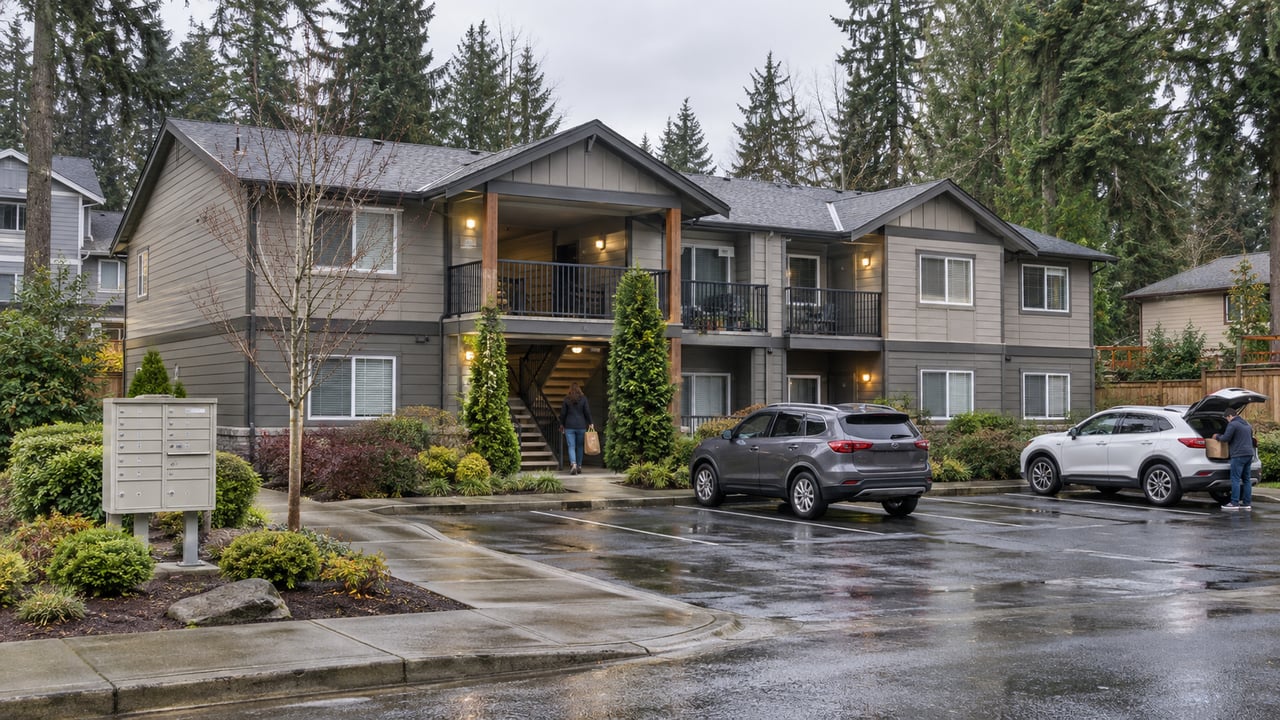
Washington HOA Rules 2026: What Townhome and Middle-Housing Buyers Should Know
Washington changed several HOA rules in 2026 that can affect what buyers see when reviewing townhome, cottage-housing, and other common-interest communities. SHB 2354 changed rules involving certain small middle-housing associations, reserve studies, financial audits, EV chargers, and heat pumps.
For buyers, though, the bill number is not the most important part.
The more useful questions are:
- What does the association maintain?
- Does it have a reserve study?
- If not, why not?
- Has its financial audit been completed or waived?
- Are major repairs or special assessments being discussed?
- Does the unit have an EV charger or heat pump that the owner must maintain?
- What do the resale certificate and association documents actually show?
SHB 2354 became Chapter 96, Laws of 2026 and took effect on June 11, 2026.
Key takeaways
- Not every Washington townhome HOA qualifies for the new small middle-housing rules.
- "Townhome" describes the housing form. It does not automatically tell you how the community is legally organized.
- Some qualifying middle-housing communities can be exempt from Washington's statutory reserve-study requirement.
- The reserve-study exemption is separate from the six-unit small-community rule.
- Washington raised the annual-assessment threshold for a mandatory CPA audit under RCW 64.90.530 from $50,000 to $100,000.
- Associations below that threshold do not automatically stop needing audits. The audit may generally be waived annually through the voting process allowed by the statute.
- Annual financial statements are still required for associations subject to RCW 64.90.530.
- SHB 2354 clarified that the owner of an EV charger or heat pump exclusively serving that unit carries the related financial responsibility.
- For EV chargers, those responsibilities can follow the equipment to future owners of the unit.
- A missing reserve study does not automatically mean an association is violating the law, but buyers should understand why it is missing and how future shared costs will be funded.
- Low HOA dues do not automatically mean low ownership costs.
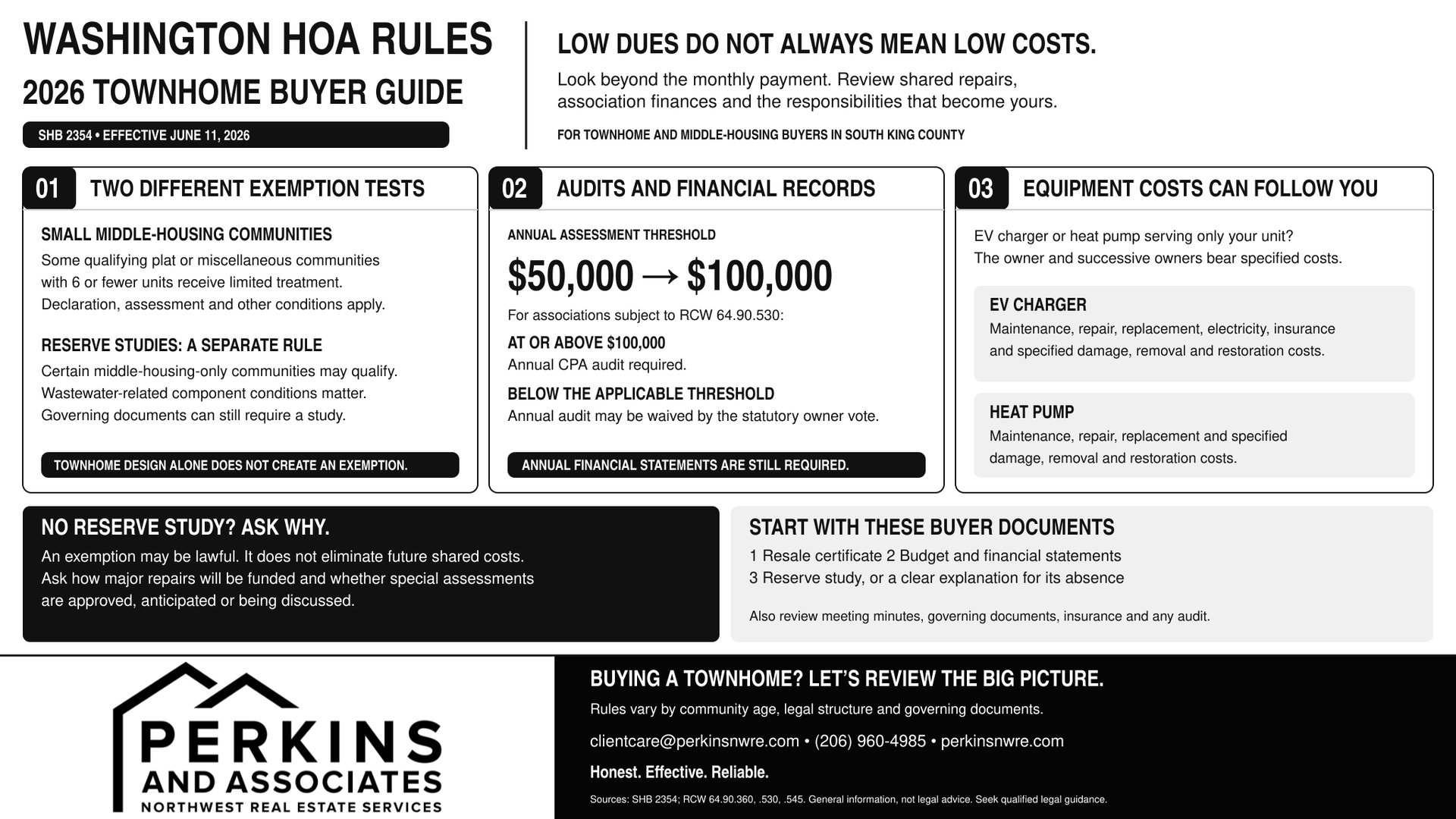
What changed in Washington HOA law in 2026?
SHB 2354 made several targeted changes to Washington's Uniform Common Interest Ownership Act, commonly called WUCIOA.
Rule | What changed | Why buyers should care |
|---|---|---|
Small middle-housing communities | Certain very small qualifying communities can be subject to fewer WUCIOA provisions | A small association may operate differently from a larger HOA |
Reserve studies | Certain middle-housing-only communities can qualify for a separate reserve-study exemption | No reserve study may be lawful, but buyers should understand how major future costs are handled |
Financial audits | Audit threshold increased from $50,000 to $100,000 in annual assessments | Smaller associations may have a waived audit rather than a current CPA audit |
EV chargers | Individual owner financial responsibility was reinforced | A buyer may inherit maintenance, insurance, electricity, repair, and replacement obligations |
Heat pumps | Individual owner financial responsibility was reinforced | A buyer may inherit repair, replacement, removal, and restoration costs |
The final bill report confirms these changes and the June 11, 2026 effective date.
Read the Washington Legislature final bill report for SHB 2354
What does Washington mean by middle housing?
Middle housing includes several smaller housing forms that can fit into neighborhoods traditionally associated with detached homes.
Washington's statutory definition includes:
- duplexes
- triplexes
- fourplexes
- fiveplexes
- sixplexes
- townhouses
- stacked flats
- courtyard apartments
- cottage housing.
That definition matters because SHB 2354 created rules specifically tied to communities made up of middle housing.
But there is an important distinction:
A property looking like a townhome does not tell you which HOA rules apply.
Two developments can look similar from the street but have different legal structures, declarations, assessment levels, common-property responsibilities, and reserve obligations.
Does every Washington townhome HOA qualify for the small-community exemption?
No. A townhome community does not qualify simply because it contains townhomes.
Under RCW 64.90.360, the special small middle-housing treatment applies to a qualifying plat or miscellaneous community that meets several conditions.
Among them, the community generally must:
- contain no more than six units,
- consist entirely of middle housing,
- meet the applicable declaration requirements,
- have the required limitation on average annual assessments,
- and satisfy the additional voting or good-faith requirements in the statute.
That is much narrower than saying:
"Small townhome HOAs are exempt from Washington HOA law."
They are not automatically exempt.
The legal documents matter.
Read RCW 64.90.360 on common-interest communities
Are townhome communities exempt from reserve studies?
Some middle-housing-only communities can qualify for a reserve-study exemption, but being a townhome community by itself is not enough.
This is where SHB 2354 can easily be misunderstood.
The reserve-study exemption in RCW 64.90.545 is a separate test from the six-unit small-community rule.
The statute says the normal reserve-study requirement does not apply, unless the governing documents require otherwise, to certain communities consisting only of middle housing that do not and will not need specified on-site reserve components for wastewater management and related health and water protection.
Notice what is missing from that rule:
It is not simply:
"Six units or fewer means no reserve study."
That would be inaccurate.
What is a reserve study?
A reserve study looks at major physical components the association may need to repair or replace over time.
Depending on the community, those could include:
- private roads
- roofs
- common landscaping systems
- retaining walls
- parking areas
- drainage systems
- shared structures
- community buildings
- other association-maintained components.
For associations that are required to maintain a reserve study, Washington generally requires an initial study, annual updates, and at least every third year an update by a reserve-study professional based on a visual site inspection.
What does it mean if a townhome HOA has no reserve study?
It does not automatically mean there is a problem. It does mean a buyer should find out why the study is missing and how major shared expenses will be paid.
There are several possibilities.
The community may legally qualify for an exemption.
Its governing documents may place much of the maintenance responsibility directly on individual owners.
It may have few major common components.
Or the association's reserve planning may deserve closer review.
Washington's resale-certificate law specifically warns purchasers that when an association does not have a current reserve study, insufficient reserves may under some circumstances lead to owners having to pay their share of major common expenses through a special assessment.
That makes this one of the most important questions a buyer can ask:
If there is no reserve study, how does this association plan and pay for large future repairs?
A legal exemption does not answer that financial question.
Could a townhome HOA without a reserve study still charge a special assessment?
Yes. A reserve-study exemption does not mean owners can never face a special assessment.
A special assessment is an additional amount charged to owners beyond normal recurring assessments to help pay for association expenses.
Whether one becomes necessary can depend on:
- what the HOA is responsible for maintaining,
- how much cash it has,
- whether it maintains reserve funds,
- the cost of future work,
- insurance,
- unexpected damage,
- and the governing documents.
That is why a buyer should focus less on whether an association checks a legal exemption box and more on whether its actual financial plan makes sense.
Low HOA dues do not always mean low ownership costs
Low dues can be attractive, but buyers need to understand what those dues actually cover.
A small townhome association with limited common property may reasonably have low assessments.
But lower dues can also mean owners are responsible for more items themselves.
For example, one association might maintain:
- roofs
- exterior siding
- private roads
- landscaping
- fences.
Another may place most of those responsibilities on each individual owner.
The monthly HOA amount alone does not tell you which arrangement is less expensive.
A better question is:
What expenses are included in the HOA dues, and which costs stay with me as the owner?
For broader HOA ownership considerations, see our guide to what buyers should know before purchasing in an association.
What Home Buyers Should Know About HOAs
What changed with Washington HOA financial audits?
SHB 2354 raised the annual-assessment threshold in RCW 64.90.530 from $50,000 to $100,000.
For an association subject to that statute:
- annual financial statements must be prepared,
- associations with annual assessments of $100,000 or more must generally have those statements audited annually by a CPA,
- and below the applicable threshold, an annual audit is still required but can generally be waived annually by the owner vote described in the statute.
The key buyer takeaway is:
No CPA audit does not necessarily mean no financial information exists.
Financial statement, audit, and reserve study are different
Document | What it tells a buyer |
|---|---|
Annual financial statement | Current association finances |
CPA audit | Independent review of the financial statements |
Reserve study | Long-term planning for major shared components |
These documents answer different questions.
A buyer should not substitute one for another.
Read RCW 64.90.530 on financial statements and audits
Does the $100,000 audit rule apply to every older Washington HOA?
Not necessarily in exactly the same way.
Washington is still in a transition period for communities created before July 1, 2018.
Before January 1, 2028, WUCIOA's full application depends in part on when the community was created and whether an older community elected into the statute. Certain WUCIOA sections, including the EV-charger, heat-pump, and reserve-study provisions, can already apply to many older communities under RCW 64.90.365.
The financial-audit provision in RCW 64.90.530 is not listed in the same pre-2018 exception section.
For a buyer, the practical takeaway is simple:
Do not assume two older HOAs follow identical rules. Review the actual resale package and governing documents for the community you are buying into.
What changed for EV chargers?
SHB 2354's main 2026 EV-charger change is about financial responsibility, not simply whether an owner may install a charger.
Washington already limited an association's ability to prohibit or unreasonably restrict compliant EV-charger installations.
The current statute says that for a charging station exclusively serving one unit, the owner and each successive owner are generally responsible for specified costs involving:
- inspection
- maintenance
- repair
- replacement
- electricity
- insurance
- damage caused by the equipment
- removal
- restoration after removal.
That "successive owner" language matters to buyers.
If the townhome you are purchasing already has an EV charger, you are not only buying a convenient feature.
You may also be taking over the legal and financial responsibilities connected with that charger.
Washington also requires certain EV-charger information in the resale process, including maintenance responsibilities, insurance information, application status, and associated costs.
What should buyers ask about an existing EV charger?
Ask:
- Who owns the charger?
- Does it serve only this unit?
- Is there an HOA approval on file?
- Is additional insurance required?
- Who pays for electricity?
- Who pays if it damages a common element?
- Who pays to remove it if common property needs repair?
- Is the seller planning to leave the charger?
Read Washington's EV-charger rules in RCW 64.90.513
What changed for heat pumps?
SHB 2354 similarly reinforced financial responsibility for a heat pump that exclusively serves one owner's unit.
Under RCW 64.90.580, the owner and each successive owner of a heat pump exclusively serving that unit can be responsible for:
- inspection
- maintenance
- repair
- replacement
- damage involving the equipment or common property
- removal
- restoration
- temporary removal when needed to service common elements.
Washington law still allows associations to impose reasonable architectural standards and require compliance with permits, codes, and safety rules.
For buyers, the practical issue is ownership cost.
A heat pump may be a valuable feature, but it should not be assumed that the HOA will repair or replace it simply because part of the system is near common property.
Read Washington's heat-pump rules in RCW 64.90.580
The resale certificate should be one of the first documents a buyer reviews
For many buyers, the resale certificate is where these abstract HOA rules become practical purchase information.
Under RCW 64.90.640, a resale certificate can include information about:
- current assessments
- unpaid assessments
- unpaid special assessments
- anticipated repairs or replacement costs above the statutory threshold
- whether the association has a reserve study
- annual financial statements
- the most recent available financial audit
- current balance sheet
- current operating budget
- insurance
- pending legal matters
- rental restrictions
- association governing documents
- policies and rules
- the previous 12 months of association and board meeting minutes
- current reserve study
- EV-charger responsibilities.
That makes it one of the highest-value documents in a townhome or HOA purchase.
The 3 HOA documents buyers should start with
There can be many documents in an association package, but these three deserve early attention.
1. The resale certificate
Start here for the overview.
Look for:
- current assessments
- special assessments
- major anticipated repairs
- association finances
- reserve-study status
- insurance
- legal disputes
- EV-charger responsibilities.
2. The budget and financial statements
Ask:
- How much money does the association collect?
- What does it spend?
- Is it operating at a deficit?
- Are owners behind on assessments?
- How much cash is available?
- Does the budget appear realistic for the work the HOA maintains?
3. The reserve study, or the explanation for why there is not one
If a reserve study exists, review:
- major components
- estimated remaining life
- expected replacement costs
- reserve balances
- funding recommendations.
If it does not exist, ask:
Is the association legally exempt, and how does it plan to pay for major shared expenses?
That one question can reveal much more than the monthly HOA dues.
Read the meeting minutes too
Meeting minutes can show issues that a simple budget number may not explain.
The resale-certificate provisions include board and association meeting minutes from the prior 12 months among the materials to be provided in applicable transactions.
Look for repeated discussions about:
- roof replacement
- drainage
- insurance increases
- private-road work
- siding
- lawsuits
- delinquent owners
- reserve shortages
- upcoming special assessments
- developer turnover
- disputed maintenance responsibilities.
A problem mentioned repeatedly across several meetings deserves more attention than a single line item on a spreadsheet.
A simple townhome buyer decision path
When reviewing a townhome with an association, work through the questions in this order.
Step 1: What does the HOA maintain?
Identify exactly which parts of the property belong to the association and which belong to the unit owner.
Step 2: Is there a reserve study?
Yes: Review the funding level and upcoming work.
No: Find out whether the association qualifies for an exemption and how future shared repairs are funded.
Step 3: Is there a recent CPA audit?
Yes: Review it with the financial statements.
No: Determine whether an audit was properly waived or whether the association is operating under a different legal framework.
Step 4: Are special assessments pending or being discussed?
Check the resale certificate, budget, reserve information, and recent meeting minutes.
Step 5: Does the unit have an EV charger or heat pump?
Identify what equipment serves the unit and which maintenance, insurance, repair, replacement, and removal responsibilities will become yours.
Step 6: Do the total ownership costs still make sense?
Combine:
- mortgage payment
- taxes
- insurance
- HOA dues
- owner-maintained components
- likely future repairs
- known or possible assessments.
That gives a much more useful picture than comparing HOA dues alone.
What should South King County townhome buyers keep in mind?
These rules are statewide, but they are especially relevant as buyers compare townhome, condo, cottage-housing, and newer attached-home options across South King County.
A buyer looking in Kent may encounter an established townhome community with years of financial history.
A buyer in Auburn may be comparing an older resale community with newer construction.
A Maple Valley, Black Diamond, Renton, or Covington buyer may encounter a smaller development with limited shared property and a very different HOA structure.
The building style alone does not answer the financial questions.
For additional local context:
Townhome and Condo Living Around Downtown Kent
10 Smart Tips for Buying a New Construction Home
New Construction Versus Resale Homes in Auburn
Expert insight: Small HOA does not mean no financial risk
The number of homes in an association does not tell you whether the association is financially healthy.
A six-unit community may have almost no meaningful shared infrastructure.
Another six-unit community may have a private road, drainage system, landscaping, fencing, or other shared components that eventually cost money.
Likewise, a low monthly assessment can be completely reasonable if individual owners are responsible for most expenses.
The question is not:
Is the HOA small?
Or:
Are the dues low?
The better question is:
Do the association's finances and owner responsibilities match what the community actually needs to maintain?
That is what buyers should try to understand before closing.
Questions buyers should ask before purchasing a Washington townhome
Use this checklist when reviewing the association package:
- How is the community legally structured?
- What does the HOA own and maintain?
- What am I responsible for maintaining?
- What are the regular HOA assessments?
- What do those assessments cover?
- Is there a current reserve study?
- If there is no reserve study, why?
- What major repairs are expected in the next several years?
- How much money is currently in reserves?
- Have any special assessments been approved?
- Are any special assessments being discussed?
- Is there a current CPA audit?
- If not, was the audit waived?
- What do the annual financial statements show?
- Are many owners delinquent on assessments?
- What do the last 12 months of meeting minutes discuss?
- Does the unit have an EV charger?
- What EV-charger costs will transfer to me?
- Does the unit have a heat pump?
- Who is responsible for heat-pump repair and replacement?
- Are there rental restrictions?
- Are there pending lawsuits or insurance issues?
- Has control of the association transferred from the developer to the owners?
Frequently asked questions
What did SHB 2354 change in Washington?
SHB 2354 changed several WUCIOA rules involving small middle-housing communities, reserve-study exemptions, financial responsibility for EV chargers and heat pumps, and the annual-assessment threshold for mandatory CPA audits. It took effect June 11, 2026.
Are all Washington townhome HOAs exempt from reserve studies?
No. Certain communities consisting only of middle housing can qualify for the statutory reserve-study exemption if they meet the conditions in RCW 64.90.545. Townhome design alone does not create the exemption.
What counts as middle housing in Washington?
Washington defines middle housing to include duplexes, triplexes, fourplexes, fiveplexes, sixplexes, townhouses, stacked flats, courtyard apartments, and cottage housing.
Does an HOA under $100,000 still need an audit?
For an association subject to RCW 64.90.530, an annual audit is still required below the applicable threshold, but the owners may generally waive it each year through the voting process allowed by the statute. Annual financial statements are still required.
Does no reserve study mean the HOA is unsafe to buy into?
No. Some communities can legally qualify for an exemption. Buyers should determine why there is no study and how future shared repairs will be funded.
Can a townhome HOA still have a special assessment without a reserve study?
Yes. A legal reserve-study exemption does not prevent future common expenses or special assessments.
Who pays for an EV charger in a Washington HOA?
For a charger exclusively serving one unit, the owner and each successive owner generally carry the financial responsibilities listed in RCW 64.90.513, including maintenance, repair, electricity, insurance, and certain removal and damage costs.
Who pays for a heat pump?
For a heat pump exclusively serving one unit, the owner and each successive owner generally carry the responsibilities described in RCW 64.90.580, including inspection, maintenance, repair, replacement, and certain removal or restoration costs.
What should I review before buying a townhome with an HOA?
Start with the resale certificate, budget and financial statements, reserve study or exemption explanation, current audit if available, governing documents, insurance information, and recent board meeting minutes.
Helpful resources
Washington Legislature final bill report for SHB 2354
Official summary of the law as enacted, including the effective date and major changes.
Read the SHB 2354 final bill report
Washington middle-housing definition
Official state definition covering townhouses, cottage housing, stacked flats, and other middle-housing forms.
Small common-interest communities
Rules governing certain small communities and qualifying middle-housing communities.
HOA reserve studies
Washington requirements and exemptions for association reserve studies.
HOA financial statements and audits
Current $100,000 annual-assessment threshold and audit-waiver rules.
EV charging stations
Owner and successive-owner responsibilities for individually serving charging stations.
Heat pumps
Association and unit-owner responsibilities involving heat-pump installations.
Washington resale certificates
Required association financial, reserve, repair, governing-document, and EV-charger information for applicable resale transactions.
Planning your next move
If you are thinking about buying, selling, or planning your next move, our team is happy to help you think through your options and next steps.
📧 [email protected]
📱 (206) 960-4985
Honest. Effective. Reliable.
This article is intended as general real estate information, not legal advice. HOA and common-interest-community requirements can depend on how a community was created, its governing documents, and which Washington statutes apply. Buyers should review the actual resale package for the property and seek qualified legal advice when appropriate.